Crypto Custodian BitGo Reports $90 Billion In US IPO Filing – Details

bitcoinistPublicado a 2025-09-21Actualizado a 2025-09-21

Resumen

According to the latest report, crypto custody company BitGo has filed an initial public offering (IPO) in the United States....

Trusted Editorial content, reviewed by leading industry experts and seasoned editors. Ad Disclosure

According to the latest report, crypto custody company BitGo has filed an initial public offering (IPO) in the United States. This strategic move comes as several digital asset firms look to take advantage of the improving climate under United States President Donald Trump’s administration.

BitGo Records $4.2 Billion Revenue In First Half Of 2025

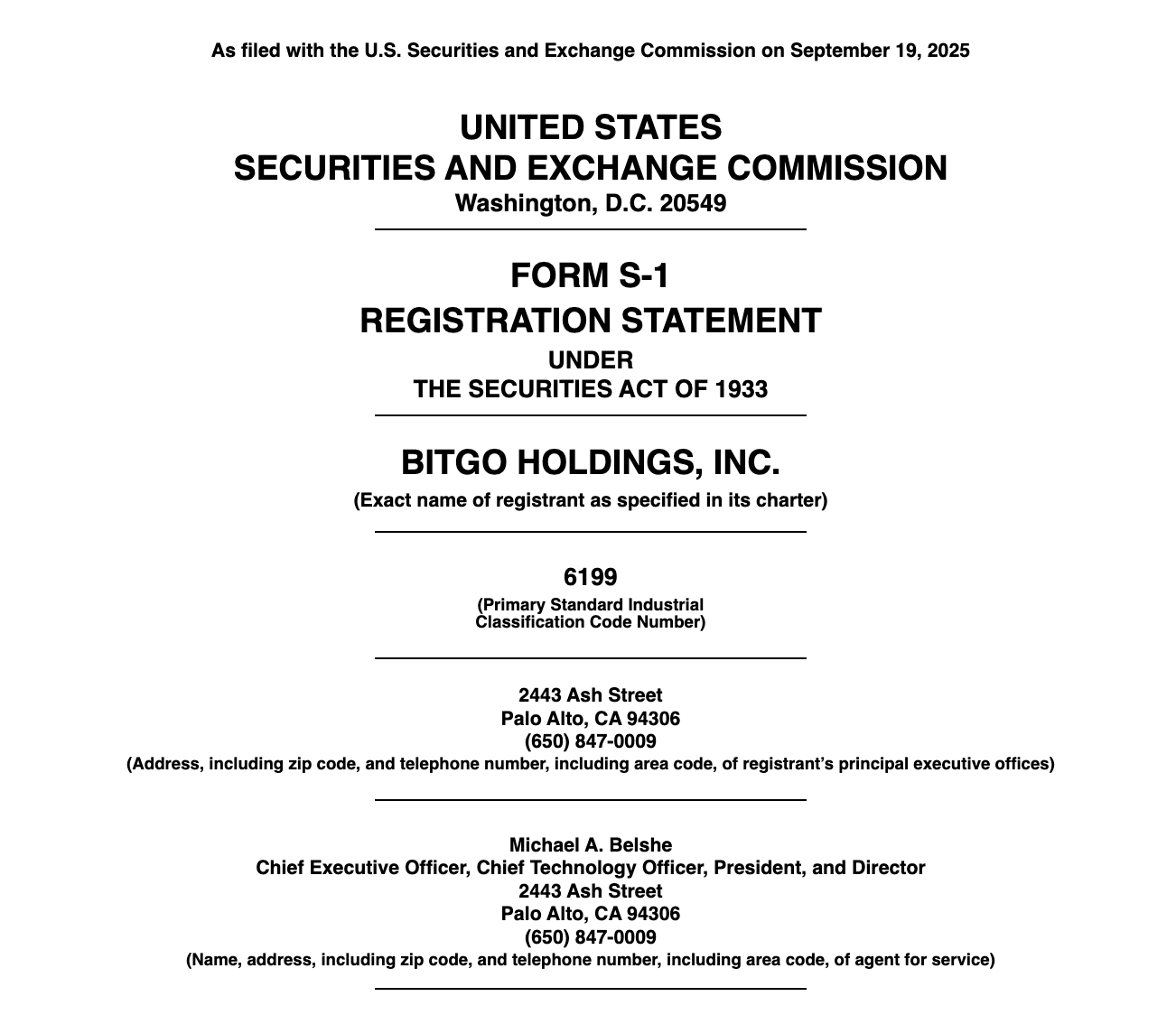
On Friday, September 19, BitGo submitted an S-1 filing with the US Securities and Exchange Commission (SEC) for an initial public offering. The crypto custodian aims to list its Class A common stock on the New York Stock Exchange (NYSE) under the ticker symbol “BTGO,” the document revealed.

This latest filing comes after BitGo initially submitted a confidential draft version of S-1 IPO document in July. The firm is looking to join a strong list of recent public debuts in the United States by crypto companies, including Circle, Bullish, and Figure.

In the S-1 filing, BitGo disclosed that it held around $90.3 billion worth of assets on its platform as of June 2025. Meanwhile, the crypto custody firm also claimed to have witnessed a revenue growth in the first half of the year, with $4.2 billion compared to $1.1 billion in the first six months of 2024.
crypto

Source: SEC

Based on the terms of the S-1, BitGo co-founder and CEO Mike Belshe will retain majority voting power under a dual-class share structure, holding Class B shares with 15 votes each. This detail will ensure that BitGo remains a “controlled company” under NYSE rules. 

The filing read:

Although we do not currently intend to rely on any such exemptions, we may do so in the future and if we utilize any of the exemptions, you will not have the same protections as those afforded to stockholders of companies that are subject to such governance requirements” and “Management - Controlled Company Status” for more information.

As already mentioned, several crypto firms have seen notable public market debuts over the past few months. Meanwhile, other major companies, including Gemini and Grayscale, are also looking to go public in the United States.

Crypto Firms Continue To Flourish Under Trump

Following the election of Donald Trump as US president, the US crypto landscape has witnessed a positive shift. This change has arrived on the back of a clearer regulatory regime, as seen with the introduction of crypto-focused bills such as the GENIUS Stablecoin Act.

Moreover, the “crypto treasury” frenzy is also another example to point at, as more publicly traded firms are actively acquiring digital assets on their balance sheet. This rise in the institutional adoption of cryptocurrencies can be seen in the continuous growth of the market, with various assets reaching multiple all-time highs in the past few months.

Crypto

The total crypto market capitalization on the daily timeframe | Source: TOTAL chart on TradingView

Featured image from Shutterstock, chart from TradingView
Editorial Process for bitcoinist is centered on delivering thoroughly researched, accurate, and unbiased content. We uphold strict sourcing standards, and each page undergoes diligent review by our team of top technology experts and seasoned editors. This process ensures the integrity, relevance, and value of our content for our readers.

Opeyemi Sule is a passionate crypto enthusiast, a proficient content writer, and a journalist at Bitcoinist. Opeyemi creates unique pieces unraveling the complexities of blockchain technology and sharing insights on the latest trends in the world of cryptocurrencies. Opeyemi enjoys reading poetry, chatting about politics, and listening to music, in addition to his strong interest in cryptocurrency.

Lecturas Relacionadas

Grupos católicos y de seguridad advierten que la Ley CLARITY podría debilitar las salvaguardias contra el delito con criptomonedas

Una coalición de líderes católicos, grupos vinculados a la aplicación de la ley y defensores contra la trata de personas advierte que la Ley CLARITY podría debilitar las salvaguardias utilizadas para combatir los delitos habilitados por las criptomonedas. Las críticas se centran en disposiciones que protegerían a los desarrolladores de software no custodio de ser tratados como transmisores de dinero. Este debate aborda una de las cuestiones más difíciles en la regulación de las criptomonedas: cómo distinguir el software neutral de la intermediación financiera. Los defensores de las criptomonedas argumentan que los desarrolladores que publican código no custodio no deben ser regulados como exchanges o procesadores de pagos. Los críticos temen que exenciones amplias puedan dificultar el rastreo de las finanzas ilícitas. El software no custodio es central para las finanzas descentralizadas (DeFi). La Ley CLARITY busca crear reglas más claras de estructura de mercado, pero la oposición muestra que no todas las batallas políticas tratan sobre la protección del inversor. Algunos legisladores también considerarán el impacto en la trata de personas, la evasión de sanciones y la visibilidad para la aplicación de la ley. La resistencia no significa que el proyecto de ley esté muerto, pero podría llevar a enmiendas, salvaguardias más estrictas o requisitos de información adicionales. Para las empresas de criptomonedas, las consecuencias son altas: reglas más claras podrían desbloquear inversiones, pero si el proyecto se enmarca como un debilitamiento de las salvaguardias contra el crimen, su camino político será más difícil.

bitcoinistHace 3 hora(s)

Grupos católicos y de seguridad advierten que la Ley CLARITY podría debilitar las salvaguardias contra el delito con criptomonedas

bitcoinistHace 3 hora(s)

La crónica del fraude grave que envuelve al unicornio cripto Blockstream

A lo largo de 2024, Blockstream, la empresa de cripto del pionero de Bitcoin Adam Back, se ha visto envuelta en varias controversias. Una investigación de NatInfoSec lanzó graves acusaciones sobre su producto de notas mineras, Blockstream Mining Note (BMN). Los principales señalamientos incluyen: una discrepancia entre el poder de cómputo mostrado (15 EH/s) y el necesario para cumplir con las obligaciones de los BMN (20-45 EH/s); una falta de evidencia verificable pública sobre las operaciones mineras a esa escala; rendimientos anuales fijos inusualmente altos, cercanos al 20%; y el descubrimiento de que Christopher William Cook, figura clave de la operación minera de Blockstream a través de Exacore, tiene antecedentes penales por fraude postal, información no revelada a los inversores. Aunque BitMEX Research y otros como Samson Mow han cuestionado algunos puntos por falta de pruebas o por implicar incorrectamente a BSTR, la compañía de tesorería de Bitcoin asociada a Back, las preguntas centrales sobre los BMN persisten. La comunidad y los analistas exigen mayor transparencia y capacidad de verificación sobre: el tamaño real y los límites de responsabilidad de los BMN; la fuente de los altos rendimientos prometidos; la procedencia verificable de los BTC pagados a los inversores; y el papel exacto de Cook. Hasta ahora, Blockstream no ha emitido una respuesta oficial integral a estas acusaciones.

marsbitHace 7 hora(s)

La crónica del fraude grave que envuelve al unicornio cripto Blockstream

marsbitHace 7 hora(s)

Trading

Spot
Futuros
活动图片