Altcoin Season Index Points To Possible Bottom Despite Bitcoin Dominance

bitcoinistPublicado a 2025-07-08Actualizado a 2025-07-08

Resumen

Altcoin season has remained elusive despite expectations that it would have begun early in 2025. This has led to calls...

Trusted Editorial content, reviewed by leading industry experts and seasoned editors. Ad Disclosure

Altcoin season has remained elusive despite expectations that it would have begun early in 2025. This has led to calls that there has been a change in the cycle and perhaps the concept of an altcoin season no longer applies. The Bitcoin dominance has also remained quite high during this time, with altcoins falling rapidly with each decline. However, the Altcoin Season Index is currently pointing to a possible bottom for altcoins.

Altcoin Season Index Bounces From Low Score Of 11

The Altcoin Season Index is an index which ranks the performance of the top 50 altcoins against the performance of Bitcoin on a scale of 1-100. In the case where the top 50 coins are performing better than Bitcoin on a 90-day period, it is considered altcoin season. Whereas in the case where the Bitcoin price is still outperforming the top 50 altcoins, excluding stablecoins and asset-backed tokens, then it is considered a Bitcoin season.

Presently, the Bitcoin price is still well ahead of the top 50 altcoins, as shown by its dominance still ranging above 65%. This has significantly reduced the chances of an alt season as the focus is still heavily on Bitcoin during this time. Even more concerning is the fact that the Bitcoin price has continued to outperform Ethereum, which is often the leader of the altcoin season.

According to data from Blockchain Center, the Altcoin Season Index is currently sitting at a low score of 27 at the time of this writing. This remains quite low but has been a major step-up from the low score of 11 that was recorded back in June following the market crash.
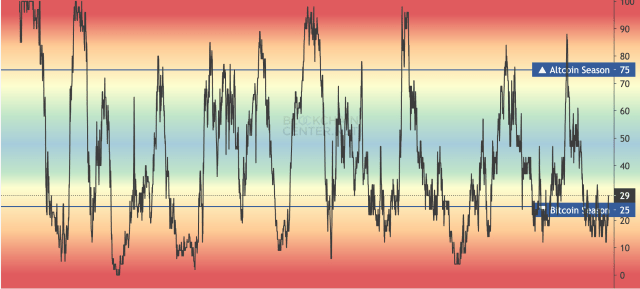
Altcoin Season Index
Source: Blockchain Center

Usually, when the index is this low, it often signals that the end of the downtrend is close and the bottom could be in. However, there could still be some ways to go, given that historically, the index has bottomed below 10 before the alt season begins.

This is seen throughout the history of the market, where the altcoin index had fallen below 8 back in 2020 before the legendary altcoin season of 2021. Then again, bottoming at a score of 4 back in 2023 before the 2024 rally.

Nevertheless, the index being this low does suggest that the bottom is either in or will be in soon. The next step would be a decline in the Bitcoin dominance, likely toward the 40% territory, and Ethereum outperforming the Bitcoin price to fully signal the entrance of the altcoin season.

Altcoins market chart from TradingView.com
Altcoins view for another recovery | Source: Crypto Total Market Cap Excluding BTC on TradingView.com
Featured image from Dall.E, chart from TradingView.com
Editorial Process for bitcoinist is centered on delivering thoroughly researched, accurate, and unbiased content. We uphold strict sourcing standards, and each page undergoes diligent review by our team of top technology experts and seasoned editors. This process ensures the integrity, relevance, and value of our content for our readers.

Scott Matherson is a leading crypto writer at Bitcoinist, who possesses a sharp analytical mind and a deep understanding of the digital currency landscape. Scott has earned a reputation for delivering thought-provoking and well-researched articles that resonate with both newcomers and seasoned crypto enthusiasts. Outside of his writing, Scott is passionate about promoting crypto literacy and often works to educate the public on the potential of blockchain.

Lecturas Relacionadas

Cuenta atrás para el Día-Q: ¿La computación cuántica acabará con las criptomonedas?

**Resumen: Cuenta atrás para el Q-Day: ¿Pondrá fin la computación cuántica a las criptomonedas?** La computación cuántica supone una amenaza existencial para la criptografía de clave pública (como RSA y ECC) que sustenta Internet y las cadenas de bloques. El algoritmo de Shor podría romper estos sistemas de forma eficiente. El "Q-Day", el momento en que esto sea factible, se estima entre 2030-2045. La criptografía post-cuántica (PQC), con algoritmos basados en retículos (lattice, como ML-KEM/DSA) o hashes (como SLH-DSA), es la solución. Estándares como FIPS 203-205 ya están definidos. La migración es urgente según la "desigualdad de Mosca": el tiempo de vida de los datos más el tiempo de migración debe ser mayor que el tiempo hasta el Q-Day. Para el ecosistema blockchain, el riesgo no es uniforme. Los activos en riesgo son aquellos cuyas claves públicas ya están expuestas en la cadena (por ejemplo, antiguas direcciones BTC no gastadas). La amenaza es una prueba de presión para sus pilares: libro de contabilidad público, transferencias irreversibles y autogestión de claves. **Bitcoin** se enfrenta principalmente a un desafío de gobernanza y consenso social. Migrar requiere un soft fork y lidiar con UTXO heredados de alto valor. Las firmas PQC son mucho más grandes, lo que impacta en el tamaño de los bloques y las tarifas. **Ethereum** aborda el problema con una hoja de ruta "Lean" y agilidad criptográfica. Utiliza la abstracción de cuentas (AA) para migrar firmas de usuario de forma gradual, y explora reemplazos para las firmas BLS de consenso (como leanXMSS con compresión SNARK) y para los compromisos de datos (KZG). La ventana para una migración coordinada de todo el ecosistema (protocolos, carteras, exchanges) es de 5 a 8 años. La computación cuántica no es un "arma del juicio final", sino un catalizador para una reconstrucción criptográfica. El mayor cuello de botella no es técnico, sino la compleja coordinación y gobernanza necesarias para una transición a tiempo.

marsbitHace 6 hora(s)

Cuenta atrás para el Día-Q: ¿La computación cuántica acabará con las criptomonedas?

marsbitHace 6 hora(s)

Cuenta regresiva hacia el Q-Day: ¿Pondrá fin la computación cuántica a las criptomonedas?

**Q-Day Cuenta Atrás: ¿Pondrá la Computación Cuántica Fin a las Criptomonedas?** La computación cuántica representa una amenaza existencial para las criptomonedas, ya que el algoritmo de Shor podría romper los criptosistemas de curva elíptica (ECC/ECDSA) que protegen las claves privadas. El "Q-Day", el momento en que un ordenador cuántico a gran escala logre esto, se estima entre 2035-2045. El riesgo es particularmente grave para activos en cadena cuyas claves públicas están expuestas (como antiguos UTXO de Bitcoin), que podrían ser drenados. La migración a criptografía post-cuántica (PQC), como los algoritmos basados en retículos (ML-KEM/DSA) o hashes (SLH-DSA) estandarizados por NIST, es urgente pero compleja. **Bitcoin** enfrenta un enorme desafío de gobernanza: migrar mediante un *soft fork* a direcciones PQC, lidiar con la expansión de las firmas (de ~70 bytes a varios KB) y decidir el destino de los UTXO heredados inactivos, un dilema entre la inmutabilidad y la supervivencia. **Ethereum** sigue una hoja de ruta "Lean" más ágil, utilizando la abstracción de cuentas para la migración de usuarios y explorando firmas basadas en hash (leanXMSS) comprimidas con zkVMs para los validores, junto con la renovación de sus capas de datos y compromisos. La conclusión es clara: la computación cuántica no es un apocalipsis instantáneo, pero inicia una cuenta atrás crítica. La ventana de acción cómoda es de 5-8 años. El mayor obstáculo no es técnico, sino de coordinación de todo el ecosistema y de consenso social sobre la gobernanza de los activos heredados, poniendo a prueba los principios fundamentales de Web3.

链捕手Hace 6 hora(s)

Cuenta regresiva hacia el Q-Day: ¿Pondrá fin la computación cuántica a las criptomonedas?

链捕手Hace 6 hora(s)

Trading

Spot
活动图片