$500M of on-chain collateral will face liquidation if ETH falls to…

AmbcryptoPublicado a 2022-06-12Actualizado a 2022-06-12

Resumen

$500M of on-chain collateral will face liquidation if ETH falls to…

Ethereum [ETH], the world’s largest altcoin, might be losing its plot despite anticipation around the Merge. Rather, one can say that the token is seeing a delayed plot. Ethereum core developer Tim Beiko recently opined that the merge to proof-of-stake (PoS) would happen between August and November. This announcement follows more bad news for Ethereum enthusiasts hoping for the completion of the Ethereum 2.0 Merge in August.

Here comes another bomb…

Data on Coinbase revealed that Ethereum was priced at $1,519.03 to the U.S dollar at press time, having fallen by 11.53% over the past 24 hours. In fact, ETH remains well below its all-time high of $4,891.70. In the last week alone, the crypto fell by 14.04%.

According to blockchain data explorer Blockchair, exactly 1,228,131 Ethereum transactions failed between 1 May and 31 May. Furthermore, the trend seemed to continue at the time of writing. Ergo, Ethereum’s transaction volumes have also dropped substantially given the current situation.

Towards the beginning of the week on 5 June, it went as low as 1.22 million ETH — A level not seen since mid-2020. At press time as well, the number stood in the one million to two million bracket. Indeed, a downtrend since May 2021.
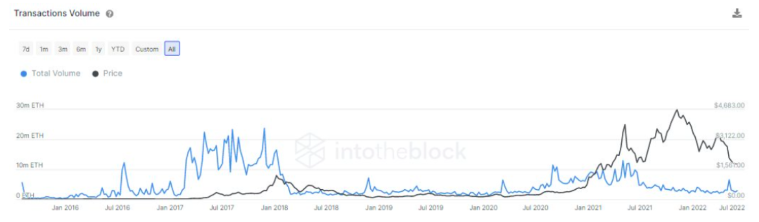
While most cryptocurrency market participants continue to struggle with bearish days, HODLers of the second-largest asset by market capitalization are also facing record lows in profit. Indeed, the percentage of Ethereum addresses in profits is at its monthly low.

Also, as revealed by Glassnode’s on-chain alerts account on 12 June, HODLers in losses have significantly inclined.
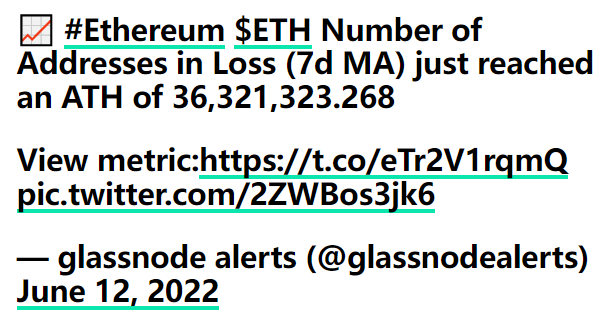
This is the after-effect of increasing Ethereum selling pressure as the price continues to trade down south.

Saving the best for the last?

Another MAJOR concern for Ethereum is unprecedented liquidation at the moment. Around $230 million worth of ETH tokens were liquidated in a day as the price declined. This is now, but the sheer decline could have some serious implications soon. Consider this, for instance –

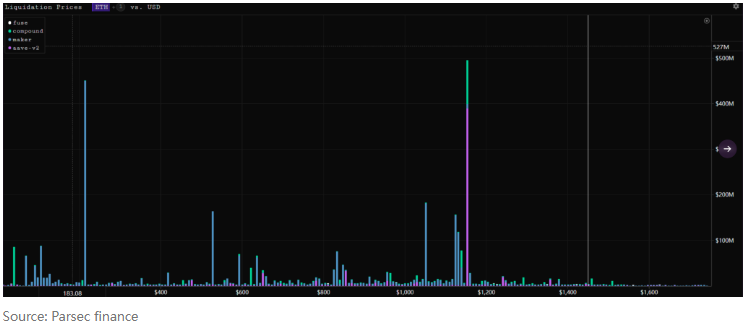
According to parsec finance, when ETH falls to around $1,150, nearly $500 million of on-chain collateral will face liquidation. wBTC will have more than $300 million of on-chain collateral near $21,600 or face liquidations.
Additionally, as per Curve, the stETH/ETH pool asset ratio is skewed, with ETH accounting for 24.11% and stETH accounting for 75.89%. stETH de-pegged slightly and the unbalanced pool signified that one of the assets, stETH in this case, is becoming more illiquid i.e. It would become difficult to sell as there isn’t enough ETH liquidity to incorporate sell orders of stETH at current prices.

Looks like we just have to wait and look for what’s in store next?
Lecturas Relacionadas

94.000 millones de yuanes, la mayor financiación de este año para robots humanoides ha aparecido

La empresa de robótica humana Neura, con sede en Múnich, ha completado una ronda de financiación Serie C de 14.000 millones de dólares (unos 94.900 millones de RMB), lo que supone la mayor inversión del año en este sector. Tras la operación, su valoración alcanza los 70.000 millones de dólares. La relevancia de esta ronda radica en la participación de inversores industriales como Schaeffler y Bosch, lo que señala un cambio estratégico: el foco pasa de la demostración tecnológica a la implementación práctica en fábricas. Neura, fundada por el experto en robótica industrial Armin Zeher, ha priorizado desde el inicio la aplicabilidad en entornos de producción real, contando ya con BMW como cliente. Otros inversores como NVIDIA, Amazon y Qualcomm aportan perspectivas complementarias en infraestructura de computación, logística y tecnología. El sector de la robótica humana está experimentando una afluencia masiva de capital, impulsada por dos factores clave: los avances en modelos de IA de gran escala, que mejoran la percepción y la toma de decisiones de los robots, y la creciente presión por la escasez y el encarecimiento de la mano de obra en la manufactura global. Actualmente, las empresas siguen dos caminos principales: los robots humanoides de propósito general (como Figure AI), con un horizonte comercial a más largo plazo, y los enfocados en escenarios industriales verticales y específicos (como Neura), que ofrecen una ruta de comercialización más rápida y definida. El campo de batalla real para estos robots ya no es el laboratorio, sino el suelo de la fábrica. Los escenarios de manufactura industrial, por su entorno estructurado y tareas repetitivas, se consideran los primeros en permitir una adopción a escala. Los entornos de trabajo peligrosos también tienen un gran potencial. Sin embargo, los principales retos para la adopción masiva ya no son puramente técnicos, sino de ingeniería y modelo comercial. Destacan los elevados costes de adaptación a cada línea de producción específica y la necesidad de desarrollar sistemas de mantenimiento y servicio locales robustos para garantizar la operación continua. La entrada de gigantes industriales históricos como inversores y la presencia inicial de robots en fábricas como las de BMW marcan un punto de inflexión: la confianza del sector se consolida y la pregunta central evoluciona de "si es posible" a "cómo hacerlo mejor, más rápido y de forma más estable".

marsbitHace 2 hora(s)

94.000 millones de yuanes, la mayor financiación de este año para robots humanoides ha aparecido

marsbitHace 2 hora(s)

Trading

Spot
Futuros
活动图片