Will The Ethereum Merge Skyrocket ETH?

newsbtcPublicado a 2022-04-27Actualizado a 2022-04-27

Resumen

The Ethereum Merge is the most critical aspect of the ETH 2.0 upgrade, since it will convert from a proof-of-work to a proof-of-stake system. The move from proof-of-work to proof-of-stake...

The Ethereum Merge is the most critical aspect of the ETH 2.0 upgrade, since it will convert from a proof-of-work to a proof-of-stake system.
The move from proof-of-work to proof-of-stake consensus is the focus of the upgrade. The improvement, as previously reported, has been postponed until the end of 2022, with no specific deadline in sight.
The world’s second-largest cryptocurrency was meant to be weeks away from the “merge” a June upgrade of its blockchain Ethereum that would make it faster, cheaper, and less power demanding, promising a meaner and cleaner crypto future.
Ethereum Merge Will Help ETH
Messari’s senior research analyst Tom Dunleavy believes in a report titled “The Decoupling Thesis” that the Ethereum merger will likely be a major turning point in investors’ economic outlook.
He points out that in the past, the crypto market leaders, Bitcoin and Ethereum, had a high positive association with the broader US stock market. For longer durations, the correlation between the two cryptos and the Nasdaq and S&P 500 index was 40-50 percent, while for shorter periods, it was about 90 percent.
Gold and US government bonds, on the other hand, have historically had a negative correlation with stocks. However, this negative link is weakening at the moment. During the 2020 market slump, both gold and bonds, as well as equities, fell.
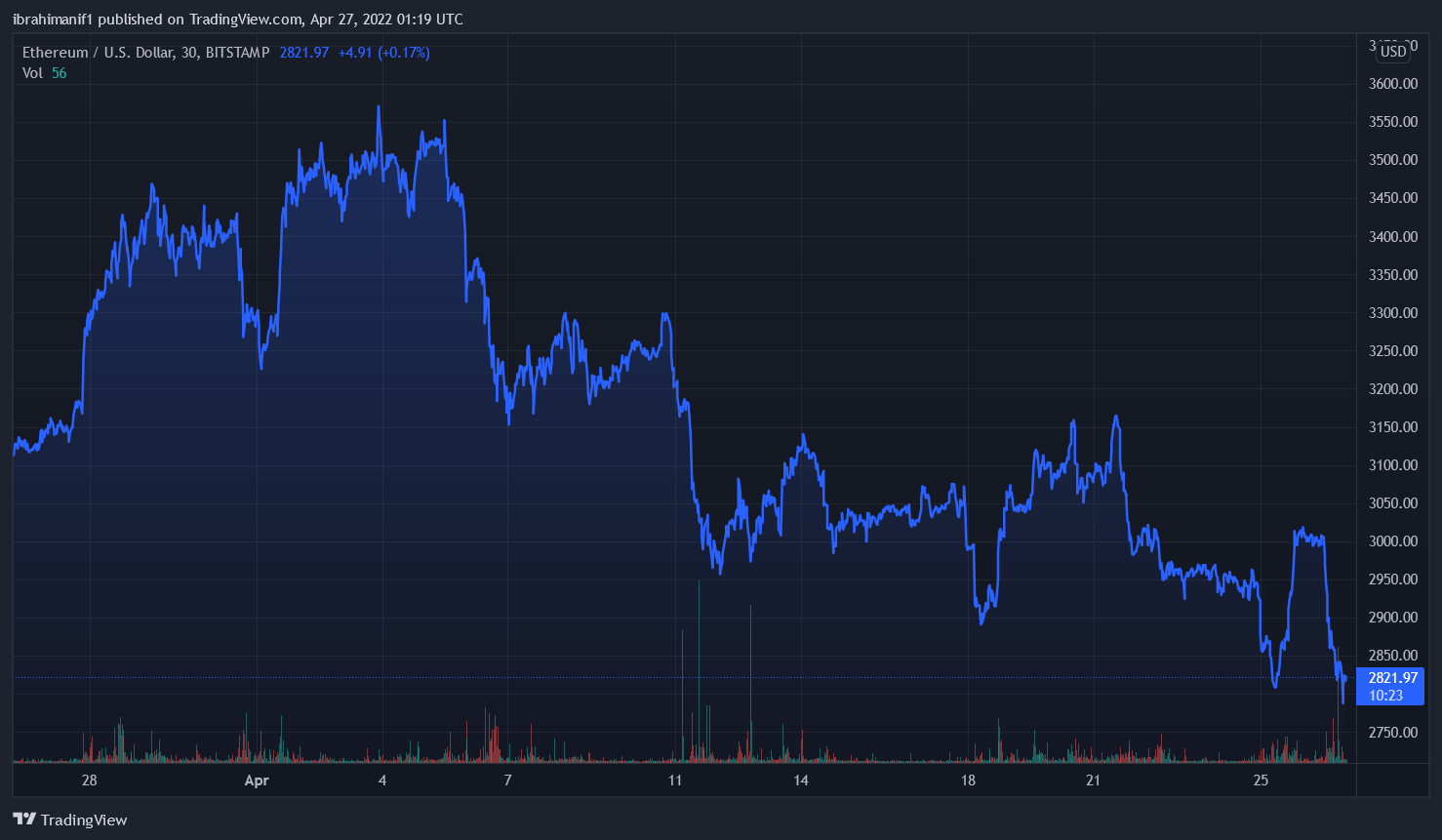
ETH/USD trades at $2,821. Source: TradingView
“The timeline for seeing this launch continues to extend,” said Brendan Playford, founder and CEO of decentralized financial data platform Masa Finance. She added, “It’s certainly plausible that Ethereum’s highly anticipated upgrade to a proof-of-stake system could be delayed again given that this transition is highly complicated and still uncertain as to whether it can actually deliver on its promise of lowering costs and increasing transaction speeds.”
On April 11, Ethereum declined 8% from $3,215 to $2,947, the day Ethereum principal developer Tim Beiko announced on Twitter that the June deployment had been postponed as testing proceeded. This month, it has dropped 13% to $2,844.
Following the merger, ETH will function as a quasi-government bond. Stakers will put up money in exchange for a fixed rate of return, similar to a bond principle. This will also cement Bitcoin’s status as a form of digital gold.
The Merge May Push The Flippening Forward
Messari has projected that the broader crypto industry would divorce from global markets by 2022. Various segments of the crypto business will continue to gain traction, according to the market research firm.
Meanwhile, predictions that the merger will propel Ethereum over Bitcoin are still circulating. Noelle Acheson, head of market analytics at Genesis Trading, told Reuters that after the merger, more funds will flock to Ethereum.
ETH is currently trading at around $2,850, with a market value of $343.98 billion, while Bitcoin is currently trading at around $38,200, with a market capitalization of $726.69 billion.

Lecturas Relacionadas

Anthropic lanza su OPI: ¿Milagro comercial o burbuja de valoración?

**Resumen:** Anthropic, la empresa de IA creadora de Claude, ha presentado en secreto su solicitud para una OPV (IPO), con el objetivo de cotizar en bolsa en octubre. Con una valoración actual cercana a los 965.000 millones de dólares tras una ronda de financiación de 650.000 millones, se espera que su valor supere el billón de dólares al debutar, pudiendo llegar incluso a 1,5 o 2 billones. Aunque algunos ven similitudes con la burbuja puntocom del año 2000, el artículo argumenta que existen diferencias fundamentales. A diferencia de las empresas de aquella época, que dependían de promesas sin ingresos, Anthropic presenta un crecimiento de ingresos sin precedentes (de 10.000 millones de dólares en ingresos anuales recurrentes a principios de 2025 a una proyección de 1 billón a finales de 2026), ya es rentable a nivel operativo y tiene una sólida cartera de clientes empresariales. Su alto valor se basa en métricas tangibles, como su ingreso por empleado (más de 10 millones de dólares), y un modelo de negocio SaaS predecible. El artículo concluye que este hito refleja una transición económica más profunda: el paso de una economía impulsada principalmente por el "carbono" (trabajo humano) a una economía dual "carbono-silicio", donde la inversión en capacidad de IA y potencia de cálculo se convierte en un motor clave de productividad y competitividad empresarial.

链捕手Hace 4 hora(s)

Anthropic lanza su OPI: ¿Milagro comercial o burbuja de valoración?

链捕手Hace 4 hora(s)

Senadores de EE.UU. presionan a los reguladores bancarios para obtener reglas de capital "justas" para las criptomonedas

Un grupo de senadores republicanos estadounidenses está presionando a los reguladores bancarios para que establezcan un marco de capital más claro y justo para las actividades con criptoactivos. En una carta dirigida a la Fed, la FDIC y la OCC, los legisladores, encabezados por la senadora Cynthia Lummis, criticaron los estrictos estándares de capital del Comité de Basilea, que asignan una ponderación de riesgo del 1250% a los criptoactivos, calificándola de "penalización general" que actúa como una prohibición efectiva. Los senadores elogiaron la guía interagencial reciente sobre valores tokenizados, que aclara que deben recibir el mismo tratamiento de capital que sus equivalentes no tokenizados, basándose en el riesgo del activo subyacente y no en la tecnología. Instaron a que este principio se aplique de manera consistente a otros activos digitales y a que se desarrolle un nuevo marco regulatorio, aprovechando también el progreso del proyecto de ley sobre estructura del mercado cripto. La solicitud coincide con el testimonio de los principales reguladores ante el Congreso, donde destacaron un cambio hacia una supervisión más "basada en el riesgo" y eficiente. El presidente de la FDIC, Travis Hill, y el interventor de la OCC, Jonathan Gould, subrayaron el papel del capital para la resiliencia del sistema y se comprometieron a facilitar la innovación responsable, revisando prácticas supervisoras pasadas e investigando denuncias de exclusión bancaria ("debanking").

bitcoinistHace 4 hora(s)

Senadores de EE.UU. presionan a los reguladores bancarios para obtener reglas de capital "justas" para las criptomonedas

bitcoinistHace 4 hora(s)

Trading

Spot
Futuros
活动图片