Everything You Need to Know About Play-to-Earn on Algorand in 2022

newsbtcPublicado a 2022-04-19Actualizado a 2022-04-19

Resumen

The gaming industry is diverse and ever-increasing, and recent developments prove that this also applies to blockchain-powered gaming. As the...

The gaming industry is diverse and ever-increasing, and recent developments prove that this also applies to blockchain-powered gaming. As the latest estimates suggest, the number of crypto wallets related to gaming witnessed an astounding increase from 29,563 at the start of 2021 to a whopping 754,000 in the third quarter of 2021. With this impressive growth rate, it is no surprise that savvy crypto investors have started to focus on the next big thing in the crypto market: play to earn gaming.
Axie Infinity, for example, touched an astonishing market cap of $7.8 billion, which some experts believe led to a frenzy for P2E games. Other P2E games, such as The Sandbox, saw an upsurge in activity, reaching millions of users globally. So far, most of these popular P2E titles are based on the gold standard of smart contracts, Ethereum.
However, similarly to the DeFi space, users and investors alike have started to voice their concerns about Ethereum’s limitations, namely scalability and high transaction fees. To tackle these issues, P2E game developers turned their attention to Ethereum alternatives that can truly support the growth of this nascent industry.
Boasting a multi-billion dollar market capitalization, Algorand ($ALGO) is undoubtedly among the most prominent Ethereum challengers in 2022. Since its launch in 2019, the ecosystem has seen plenty of migrations from both existing and new projects – including various P2E developers. Thus, without further ado, let’s take a look at everything Algorand has to offer to the P2E industry right now.
Why choose Algorand over Ethereum?
Algorand fans often describe the blockchain as one of the world’s most decentralized, scalable, and secure DLT infrastructures. It has a vast ecosystem of projects, including cutting-edge NFT marketplaces, some of the leading crypto tools and resources available in the market, and projects that are trending in the DeFi economy.
Technologically, Algorand comes with all the Layer-1 features and capabilities that crypto enthusiasts know since Ethereum – including its smart contracts, Algorand Virtual Machine (AVM), atomic transfers, and rekeying features. Among its most stand-out features is the AVM.
What AVM brings to smart contracts is that it interprets TEAL (Transaction Execution Approval Language) programs, consisting of a set of opcodes, to implement the logic of Smart Contracts and Smart Signatures. In a nutshell, it makes the process more scalable, fast and secure, less risky, low-cost, and fast. And with a block time of fewer than five seconds and a transaction fee of less than $0.0013, Algorand is currently among the most efficient Layer 1 solutions on the market.
The atomic transfer features of Algorand help make complex transfers smooth and high-speed. Complemented by a nominal transaction fee, these transfers are significantly low-cost for execution. These atomic transfers are compatible with all Algorand assets and multi-party transfers, which is a substantial advantage for P2E developers and players
Finally, the rekeying feature of Algorand helps solve operational bottlenecks by entrusting users with the option to change their private spending key without changing their public address. Apart from efficiency, rekeying also brings flexibility without losing continuity in the process.
Algorand and P2E
The Algorand ecosystem is growing, and it’s growing fast. According to official numbers, there are now more than 500 organizations worldwide leveraging the blockchain. When it comes to play-to-earn, the Algo Gaming Guild could verify north of 40 projects that are currently building on Algorand. This includes trading card games like Algo Clash, racing games including Drone Racing League, and real-time strategy games such as zCircuit and Cosmic Champs.

While speaking of the utility benefits of Algorand as a platform for P2E Games, Sayan Mukherjee, the Head of Business Development of Zone, an Algorand-based P2E game, says his development team chose Algorand because of two primary reasons.
First, there are speed, scalability, and low transaction costs. “The Algorand blockchain is really fast with immediate transaction finality. It enables us to give a near web2 experience to gamers globally with respect to speed,” Mukherjee says.
Secondly, Mukherjee says, Algorand is carbon negative. “Zone has a massive NFT ecosystem with the AFK Elephants (afkelephants.com), which also act as P2E rewards. Building the GameFi ecosystem on Algorand solves global ESG concerns while the users have a top-notch user experience. It gives the popular gaming term “gg” a new meaning altogether – green gaming!”
Earn vs. Play
Even though the P2E industry is growing every single day, experts have already spotted a bottleneck that could curb the popularity of the space. While gamers usually appreciate economic rewards for their playing time, many have pointed out that contemporary P2E titles are more “earn” than “play.” In other words, they just aren’t fun to play.
Unsurprisingly, the Algorand community has developed high hopes for one of its most promising upcoming P2E titles, Cosmic Champs. The project, which was already named as one of this year’s top NFT games by CoinMarketCap, and praised by the media as Algorand’s “most technically advanced game design,” is on a mission to become a contender for the top P2E release across all blockchains in 2022.
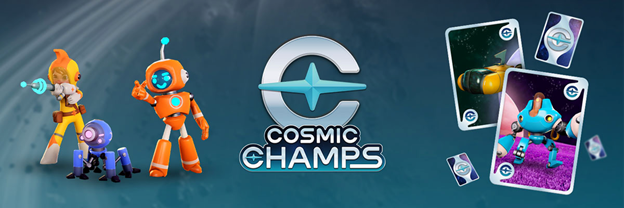
Developed by the gaming studio Mad Shapes, Cosmic Champs, a universe of real-time battle arenas, is the first three-dimensional real-time P2E game to land on Algorand. The studio has significant experience developing 3D mobile games and has been involved in the creation of various successful titles prior to its venture into P2E.
Additionally, unlike most P2E projects, Cosmic Champs is frictionless and immensely user-friendly – players aren’t even required to have a wallet or prior crypto-knowledge. As Matt Blanchard, a co-founder of Cosmic Champs says, “our game will be free to download and free to play. It’s important that the P2E economy has a level playing field that welcomes everybody, anywhere in the world. That’s the key to mass adoption.”
Of course, despite its focus on gameplay, Cosmic Champs still offers considerable economic incentives to its player base. In fact, as a result of better gameplay mechanics, the team expects player loyalty and thus user rewards to be quite competitive, potentially surpassing the earning potential of most of its peers. To reinforce this notion, the developers have added a native token to the game’s NFT rewards, which is scheduled to launch on April 21, 2022.
According to Blanchard, the utility of the $COSG token and a future DAO will not only make users feel actively involved in the governance of the game, but it will also help to further grow the Cosmic Champs game into an entire gaming metaverse. Among $COSG’s use cases are staking rewards, purchases on an NFT marketplace, minting new NFTs, and benefits for the gameplay.
Additionally, Cosmic Champs also allows for fractional NFTs that help maintain high-quality character aesthetics, necessary for the game to succeed in the long run, while helping to mint a significant number of NFTs that set the ground for a thriving user base.
Cosmic Champs is about to take #GameFi on Algorand to a whole new level
💥 High quality, 3D graphics
💥 P2E with their $COSG token
💥NFT Marketplace
💥Modelling for multi-games in Multiverse
💥Built to transition into a community DAO
Read more in their Medium article👇 https://t.co/EC5i8sZI7K
— DA̷REN.Algo (@Bmorecmore) April 4, 2022

Overall, the game is inclusive, engaging, and exciting for casual and novice participants and hardcore gamers. It is a highly democratic arena that allows anyone to play without having the Cosmic Champs NFTs. In the future, by utilizing and expanding on successful DeFi concepts like staking and earning, the project could grow exponentially – and this, of course, also foreshadows a bright future for the whole Algorand ecosystem.

Lecturas Relacionadas

Near vuelve al escenario de la IA: la transformación en cadena pública por problemas para pagar salarios, y los agentes y la privacidad como nueva narrativa de crecimiento

**Resumen: Near regresa a la IA: De una cadena de bloques por problemas de pago a Agentes y privacidad como nueva narrativa** Near, fundada por Illia Polosukhin, coautor del influyente artículo "Transformer" de IA, nació de manera inesperada en 2017. La razón original fue pragmática: una startup de IA que Polosukhin cofundó tuvo que pausar su trabajo en "síntesis de programas" (enseñar a máquinas a escribir código) debido a la dificultad de pagar a desarrolladores remotos en todo el mundo. Ante sistemas de pago transfronterizos ineficientes, él y su cofundador decidieron construir su propia cadena de bloques escalable y de bajo costo: Near. Aunque Near ganó tracción como cadena de alto rendimiento, su momento crucial llegó con el auge actual de la IA. La participación de Polosukhin en eventos como el GTC de Nvidia volvió a poner el foco en su legado en IA. Near ha reposicionado su tecnología hacia dos áreas clave: 1. **Near Intents (Intenciones):** Este sistema abstrae la complejidad de las transacciones entre cadenas. Los usuarios (o futuros Agentes de IA) solo declaran su objetivo (ej. "intercambiar BTC por ETH"), y una red de "solvers" (solucionadores) encuentra y ejecuta la mejor ruta, manejando los costos de gas de fondo. Esta capa ha procesado más de **200.000 millones de dólares** en volumen y generado **más de 34 millones** en tarifas, integrada en 25 cadenas. 2. **Transacciones Privadas:** Near ha lanzado funciones de "Intenciones Confidenciales" e "Intercambios Confidenciales" que ocultan los detalles de las operaciones (monto, dirección) hasta su liquidación. Esto protege a los grandes traders del "MEV" y del deslizamiento. Sorprendentemente, este tipo de transacciones ya representa **más del 40%** del volumen reciente en Near, mostrando una fuerte demanda, pero también planteando posibles desafíos regulatorios en el futuro. En resumen, Near ha vuelto a sus raíces en IA, aprovechando su tecnología de cadena abstracta para facilitar la economía de los Agentes de IA y abordando la creciente demanda de privacidad en DeFi, mientras navega por las oportunidades y riesgos de este nuevo capítulo.

marsbitHace 2 hora(s)

Near vuelve al escenario de la IA: la transformación en cadena pública por problemas para pagar salarios, y los agentes y la privacidad como nueva narrativa de crecimiento

marsbitHace 2 hora(s)

De Ethereum a la IA, 'CROPS': ¿Qué son estas 'variables lentas' que Vitalik enfatiza repetidamente?

En las últimas semanas, Vitalik Buterin ha destacado repetidamente el concepto CROPS, definido en el mandato de la Fundación Ethereum (EF Mandate) como los principios rectores fundamentales para Ethereum: Resistencia a la Censura, Resistencia a la Captura, Código Abierto, Privacidad y Seguridad. Más que un lema, CROPS constituye un marco estratégico que orienta el desarrollo de Ethereum hacia la soberanía del usuario, la descentralización robusta y la sostenibilidad a largo plazo, priorizando estos valores sobre mejoras puramente transaccionales como velocidad y costes. La relevancia de CROPS se amplifica con el auge de la IA. A medida que los agentes de IA se integran en billeteras y automatizan operaciones financieras, surge un riesgo crítico: los usuarios podrían ceder el control sobre sus activos, datos e identidad a plataformas centralizadas de IA. Vitalik vincula así "CROPS Ethereum" con "CROPS AI", planteando la necesidad de un ecosistema donde el acceso a la cadena de bloques y la ejecución de modelos de IA sean privados, verificables y resistentes a la censura. Propone soluciones como llamadas remotas a LLM pagadas con pruebas de conocimiento cero (ZK) y lecturas confidenciales de RPC para proteger la privacidad del usuario. En esencia, CROPS trasciende a Ethereum para abordar una cuestión central de la era digital: cómo preservar la autonomía y seguridad del usuario frente a sistemas cada vez más poderosos y potencialmente opacos. Este enfoque podría redefinir el diseño de billeteras y la experiencia de interacción en Web3, posicionando la privacidad, la apertura y el control verificable como pilares esenciales para el futuro.

marsbitHace 2 hora(s)

De Ethereum a la IA, 'CROPS': ¿Qué son estas 'variables lentas' que Vitalik enfatiza repetidamente?

marsbitHace 2 hora(s)

Token no es económico, economía no es Token

La industria de la IA se encuentra en un punto de inflexión, transitando desde una narrativa centrada en la innovación tecnológica hacia un enfoque dominado por la eficiencia del capital. Dos tendencias clave definen este cambio: la escasez de financiación y la escisión de activos por parte de los grandes conglomerados. La competencia actual se ha transformado en una carrera de activos pesados por la potencia de cálculo (compute), con costos operativos que escalan junto con el uso, un modelo "anti-internet" donde más usuarios significan mayores pérdidas. Este problema se ve agravado por prácticas de "contabilidad circular", como los acuerdos de créditos en la nube entre empresas, que inflan los ingresos sin generar flujo de caja real. La desconexión entre las valoraciones y los flujos de efectivo plantea un desafío estructural para el modelo de negocio. Paralelamente, grandes empresas como Baidu, Alibaba, ByteDance y Kuaishou están escindiendo sus unidades de IA (por ejemplo, Kling/Kunlunxin). Estos activos, valorados mucho más alto una vez independientes, pasan de ser vistos como "centros de coste" dentro del grupo a "centros de valor" en el mercado. La lógica cambia: mientras que en los estados financieros consolidados se miden por su impacto en los beneficios, como empresas independientes se valoran por su potencial de crecimiento futuro, su escasez en el mercado y su capacidad para atraer inversión. La industria evoluciona desde la "adoración del modelo" hacia la "realización de valor". Aunque la inversión en infraestructura (con un gasto de capital previsto de 805.000 millones de dólares para 2026 en EE.UU.) es enorme, la comercialización a gran escala aún está en sus inicios. El foco se desplaza de la potencia bruta de la GPU a la eficiencia integral del sistema, donde la CPU y la orquestación determinan la rentabilidad. En 2026, la pregunta central que la industria debe responder es: ¿cuánto vale realmente esta tecnología? La respuesta definirá el panorama del poder en la IA para la próxima década.

marsbitHace 3 hora(s)

Token no es económico, economía no es Token

marsbitHace 3 hora(s)

Trading

Spot
Futuros

Artículos destacados

Cómo comprar ALGO

¡Bienvenido a HTX.com! Hemos hecho que comprar Algorand (ALGO) sea simple y conveniente. Sigue nuestra guía paso a paso para iniciar tu viaje de criptos.Paso 1: crea tu cuenta HTXUtiliza tu correo electrónico o número de teléfono para registrarte y obtener una cuenta gratuita en HTX. Experimenta un proceso de registro sin complicaciones y desbloquea todas las funciones.Obtener mi cuentaPaso 2: ve a Comprar cripto y elige tu método de pagoTarjeta de crédito/débito: usa tu Visa o Mastercard para comprar Algorand (ALGO) al instante.Saldo: utiliza fondos del saldo de tu cuenta HTX para tradear sin problemas.Terceros: hemos agregado métodos de pago populares como Google Pay y Apple Pay para mejorar la comodidad.P2P: tradear directamente con otros usuarios en HTX.Over-the-Counter (OTC): ofrecemos servicios personalizados y tipos de cambio competitivos para los traders.Paso 3: guarda tu Algorand (ALGO)Después de comprar tu Algorand (ALGO), guárdalo en tu cuenta HTX. Alternativamente, puedes enviarlo a otro lugar mediante transferencia blockchain o utilizarlo para tradear otras criptomonedas.Paso 4: tradear Algorand (ALGO)Tradear fácilmente con Algorand (ALGO) en HTX's mercado spot. Simplemente accede a tu cuenta, selecciona tu par de trading, ejecuta tus trades y monitorea en tiempo real. Ofrecemos una experiencia fácil de usar tanto para principiantes como para traders experimentados.

380 Vistas totalesPublicado en 2024.12.11Actualizado en 2026.06.02

Cómo comprar ALGO

Discusiones

Bienvenido a la comunidad de HTX. Aquí puedes mantenerte informado sobre los últimos desarrollos de la plataforma y acceder a análisis profesionales del mercado. A continuación se presentan las opiniones de los usuarios sobre el precio de ALGO (ALGO).

活动图片