[dragon and tiger list] the risk of BTC's high leverage ratio falling sharply increased

Huobi ResearchPublicado a 2022-04-18Actualizado a 2022-04-19

Resumen

With the BTC price moving downward, the possibility of further falling below the support line in the near future is very high.

1. Market trend: the leverage ratio of BTC increases, and the risk of price decline increases

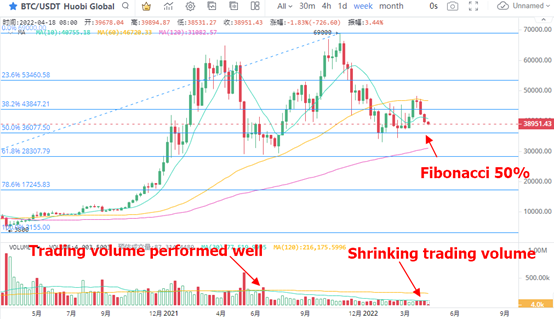
With the BTC price moving downward, the possibility of further falling below the support line in the near future is very high. Judging only from the trading volume and price performance, BTC does not support a new round of rebound. Compared with the trading volume in June 2021, the current weekly trading volume of BTC is sluggish, which may be the reason why it is difficult for BTC to rebound in the short term after breaking the position. At the beginning of July 2021, the weekly trading volume of BTC was relatively mild, especially more than twice the trading volume of BTC at the same point. Of course, not only the trading volume is shrinking, but also the number of active addresses on the BTC chain is running at a low level. Therefore, we can pay more attention to the long-term low absorption opportunities after withdrawal rather than short-term profit opportunities.
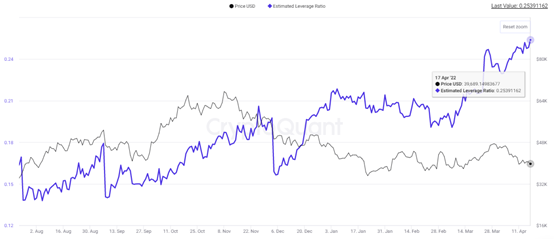
Among the important data changes of estimated leverage ratio, it can be seen that the index has reached the position of 0.254 on April 17, the highest value in two years. If BTC bulls fail to raise the price in the near future, under the premise of such a high leverage ratio, the downward movement of the price is bound to fall below the contract cost price of more investors and expand the scale of position explosion. Accordingly, the increase in the scale of position explosion will also quickly push the price down.
2. Interpretation of panic index:

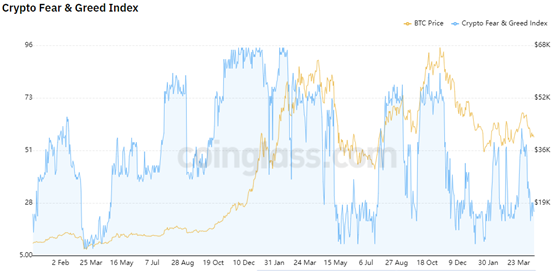
The recent performance of the panic index is weak. It has been lower than 50 since April 5, which indicates that investors' trading enthusiasm is not high. Compared with the performance of the panic index in the second half of 2021, the current panic index is more panic, so it can not be radical in the trading direction.

In the calculation of the panic index, the trading volume, volatility and bitcoin market value have 25%, 25% and 10% weights respectively. The current trading volume maintains a long-term contraction trend, limiting the rebound of the panic index. And the short-term BTC decline continues to expand, and the volatility is not high. In the position where the panic index is lower than 30, any change in price is worth the vigilance of bulls.
3. Dragon and tiger list:

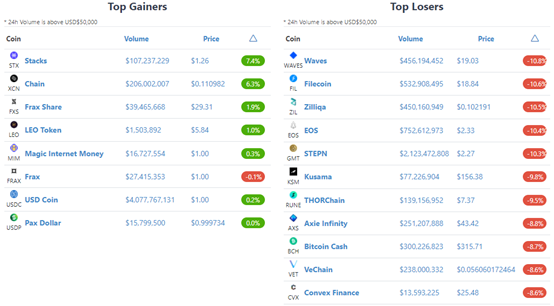
BTC led the continuation of the correction trend of mainstream currencies, and most sectors showed downward performance. In the increase list, the top currencies are STX, xcn and FXS. Among the falling rankings, waves, fil and ZIL have a large 24-hour decline of more than 10%.

Considering the continuation of the adjustment trend of mainstream currencies such as BTC and eth, the overall market is still dominated by callback. Most of the top gainers are the concept of stable currency. It is difficult to rebound in the near future. Pay more attention to the confirmation of the bottom, and then the low suction market.
STX

Stacks is a new Internet with decentralized applications, equipped with a complete set of open source development tools to build and guide the decentralized application and protocol ecosystem. Users have their own data, and the browser is everything they need to start. Stacks is the "Google" of the blockchain, in which the architecture is divided into three layers: the bottom layer of the blockchain - peer-to-peer network - data layer. The business model of stacks is very clear. Its goal is to become a blockchain browser. On this browser, users can create basic todo applications and build single page JavaScript applications.

In terms of price, STX rebounded during the period of high-volume short-term pulse, with a short-term 24-hour increase of 7.4%, and the trading volume increased by more than 7 times. While the short-term main force pulls the market, there is great uncertainty in the price performance. To catch up, you can choose to trade at a low suction point.

XCN

Chain is a cloud blockchain infrastructure that enables organizations to build better financial services from scratch. Chain launched chain core, a licensed and open source blockchain and sequence, whose ledger is a service product.

As a new currency listed on the fire currency exchange, xcn's short-term performance is still strong, and the price fluctuation intensity within the day has reached 4%. Xcn trading volume will remain relatively stable due to the shock.

FXS

FraX aims to become "the world's first decentralized stable coin, with some of its supply tokens supported by collateral and some stabilized by algorithms."

FraX protocol implements a dual token system: stable token FraX and protocol governance token FXS.

In the fourth quarter of 2021, with the release of FraX V2, FraX was adopted on a large scale and linked with the whole defi system. As of January 25, the FraX project fund pool earned an average of $500000 per day (annualized about $180 million) through the amo (algorithmic market making program) launched by the team in the early fourth quarter of 2021. During the same period, the supply of FraX climbed from less than $500 million to a staggering $2.6 billion.

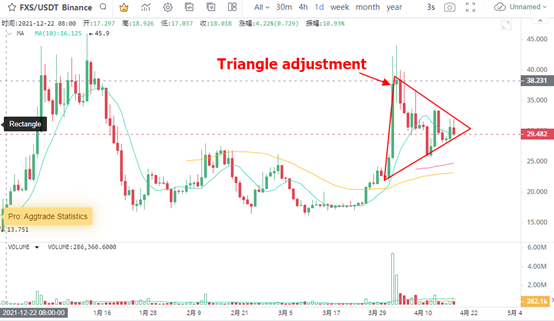
In terms of price, FXS retreated after the platform token Luna, which followed Terra algorithm to stabilize the currency, rebounded in the early stage, and the price is in the adjustment stage recently. Despite the 24-hour rise of 1.9%, FXS has not effectively left the adjustment area. In terms of lock up, FXS locked up $2.3 billion, with little change. Next, we can focus on the supporting effect of BTC stabilization on FXS. FXS is expected to have a strong price again after the overall market stabilizes.
Decline list

Among the decline list, waves and ZIL led the decline, with a 24-hour decline of 10.8% and 10.5%.

Wave has a large decline and expanded the decline space under the condition of large volume, indicating that the main force has typical shipping signs.

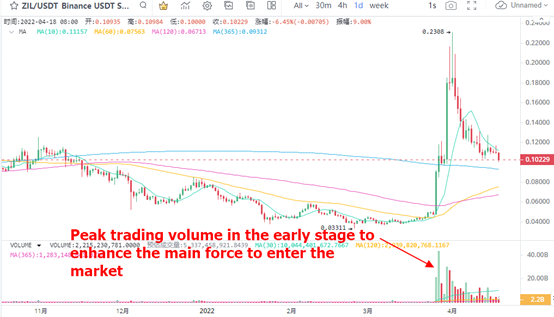
After ZIL released meta universe platform Metapolis, the price continued to rise strongly. It is reported that on April 2, ZIL will hold an event in Miami for the purpose of the Metapolis platform. Perhaps, the development of ZIL market is related to the good expectations of investors for its participation in metauniverse.

In terms of price performance, ZIL also rose and fell, but the decline in volume is more typical. In other words, ZIL may usher in a technical rebound after adjustment and expansion. Especially with the positive blessing, ZIL's massive rise since March 26 can not be ignored. This was the strongest bull rally ever.

Lecturas Relacionadas

Near vuelve al escenario de la IA: la transformación en cadena pública por problemas para pagar salarios, y los agentes y la privacidad como nueva narrativa de crecimiento

**Resumen: Near regresa a la IA: De una cadena de bloques por problemas de pago a Agentes y privacidad como nueva narrativa** Near, fundada por Illia Polosukhin, coautor del influyente artículo "Transformer" de IA, nació de manera inesperada en 2017. La razón original fue pragmática: una startup de IA que Polosukhin cofundó tuvo que pausar su trabajo en "síntesis de programas" (enseñar a máquinas a escribir código) debido a la dificultad de pagar a desarrolladores remotos en todo el mundo. Ante sistemas de pago transfronterizos ineficientes, él y su cofundador decidieron construir su propia cadena de bloques escalable y de bajo costo: Near. Aunque Near ganó tracción como cadena de alto rendimiento, su momento crucial llegó con el auge actual de la IA. La participación de Polosukhin en eventos como el GTC de Nvidia volvió a poner el foco en su legado en IA. Near ha reposicionado su tecnología hacia dos áreas clave: 1. **Near Intents (Intenciones):** Este sistema abstrae la complejidad de las transacciones entre cadenas. Los usuarios (o futuros Agentes de IA) solo declaran su objetivo (ej. "intercambiar BTC por ETH"), y una red de "solvers" (solucionadores) encuentra y ejecuta la mejor ruta, manejando los costos de gas de fondo. Esta capa ha procesado más de **200.000 millones de dólares** en volumen y generado **más de 34 millones** en tarifas, integrada en 25 cadenas. 2. **Transacciones Privadas:** Near ha lanzado funciones de "Intenciones Confidenciales" e "Intercambios Confidenciales" que ocultan los detalles de las operaciones (monto, dirección) hasta su liquidación. Esto protege a los grandes traders del "MEV" y del deslizamiento. Sorprendentemente, este tipo de transacciones ya representa **más del 40%** del volumen reciente en Near, mostrando una fuerte demanda, pero también planteando posibles desafíos regulatorios en el futuro. En resumen, Near ha vuelto a sus raíces en IA, aprovechando su tecnología de cadena abstracta para facilitar la economía de los Agentes de IA y abordando la creciente demanda de privacidad en DeFi, mientras navega por las oportunidades y riesgos de este nuevo capítulo.

marsbitHace 2 hora(s)

Near vuelve al escenario de la IA: la transformación en cadena pública por problemas para pagar salarios, y los agentes y la privacidad como nueva narrativa de crecimiento

marsbitHace 2 hora(s)

De Ethereum a la IA, 'CROPS': ¿Qué son estas 'variables lentas' que Vitalik enfatiza repetidamente?

En las últimas semanas, Vitalik Buterin ha destacado repetidamente el concepto CROPS, definido en el mandato de la Fundación Ethereum (EF Mandate) como los principios rectores fundamentales para Ethereum: Resistencia a la Censura, Resistencia a la Captura, Código Abierto, Privacidad y Seguridad. Más que un lema, CROPS constituye un marco estratégico que orienta el desarrollo de Ethereum hacia la soberanía del usuario, la descentralización robusta y la sostenibilidad a largo plazo, priorizando estos valores sobre mejoras puramente transaccionales como velocidad y costes. La relevancia de CROPS se amplifica con el auge de la IA. A medida que los agentes de IA se integran en billeteras y automatizan operaciones financieras, surge un riesgo crítico: los usuarios podrían ceder el control sobre sus activos, datos e identidad a plataformas centralizadas de IA. Vitalik vincula así "CROPS Ethereum" con "CROPS AI", planteando la necesidad de un ecosistema donde el acceso a la cadena de bloques y la ejecución de modelos de IA sean privados, verificables y resistentes a la censura. Propone soluciones como llamadas remotas a LLM pagadas con pruebas de conocimiento cero (ZK) y lecturas confidenciales de RPC para proteger la privacidad del usuario. En esencia, CROPS trasciende a Ethereum para abordar una cuestión central de la era digital: cómo preservar la autonomía y seguridad del usuario frente a sistemas cada vez más poderosos y potencialmente opacos. Este enfoque podría redefinir el diseño de billeteras y la experiencia de interacción en Web3, posicionando la privacidad, la apertura y el control verificable como pilares esenciales para el futuro.

marsbitHace 2 hora(s)

De Ethereum a la IA, 'CROPS': ¿Qué son estas 'variables lentas' que Vitalik enfatiza repetidamente?

marsbitHace 2 hora(s)

Token no es económico, economía no es Token

La industria de la IA se encuentra en un punto de inflexión, transitando desde una narrativa centrada en la innovación tecnológica hacia un enfoque dominado por la eficiencia del capital. Dos tendencias clave definen este cambio: la escasez de financiación y la escisión de activos por parte de los grandes conglomerados. La competencia actual se ha transformado en una carrera de activos pesados por la potencia de cálculo (compute), con costos operativos que escalan junto con el uso, un modelo "anti-internet" donde más usuarios significan mayores pérdidas. Este problema se ve agravado por prácticas de "contabilidad circular", como los acuerdos de créditos en la nube entre empresas, que inflan los ingresos sin generar flujo de caja real. La desconexión entre las valoraciones y los flujos de efectivo plantea un desafío estructural para el modelo de negocio. Paralelamente, grandes empresas como Baidu, Alibaba, ByteDance y Kuaishou están escindiendo sus unidades de IA (por ejemplo, Kling/Kunlunxin). Estos activos, valorados mucho más alto una vez independientes, pasan de ser vistos como "centros de coste" dentro del grupo a "centros de valor" en el mercado. La lógica cambia: mientras que en los estados financieros consolidados se miden por su impacto en los beneficios, como empresas independientes se valoran por su potencial de crecimiento futuro, su escasez en el mercado y su capacidad para atraer inversión. La industria evoluciona desde la "adoración del modelo" hacia la "realización de valor". Aunque la inversión en infraestructura (con un gasto de capital previsto de 805.000 millones de dólares para 2026 en EE.UU.) es enorme, la comercialización a gran escala aún está en sus inicios. El foco se desplaza de la potencia bruta de la GPU a la eficiencia integral del sistema, donde la CPU y la orquestación determinan la rentabilidad. En 2026, la pregunta central que la industria debe responder es: ¿cuánto vale realmente esta tecnología? La respuesta definirá el panorama del poder en la IA para la próxima década.

marsbitHace 3 hora(s)

Token no es económico, economía no es Token

marsbitHace 3 hora(s)

Trading

Spot
Futuros
活动图片