While Markets Consolidate, Crypto Fear and Greed Index Points to 'Extreme Fear'

newsbtcPublicado a 2022-04-16Actualizado a 2022-04-16

Resumen

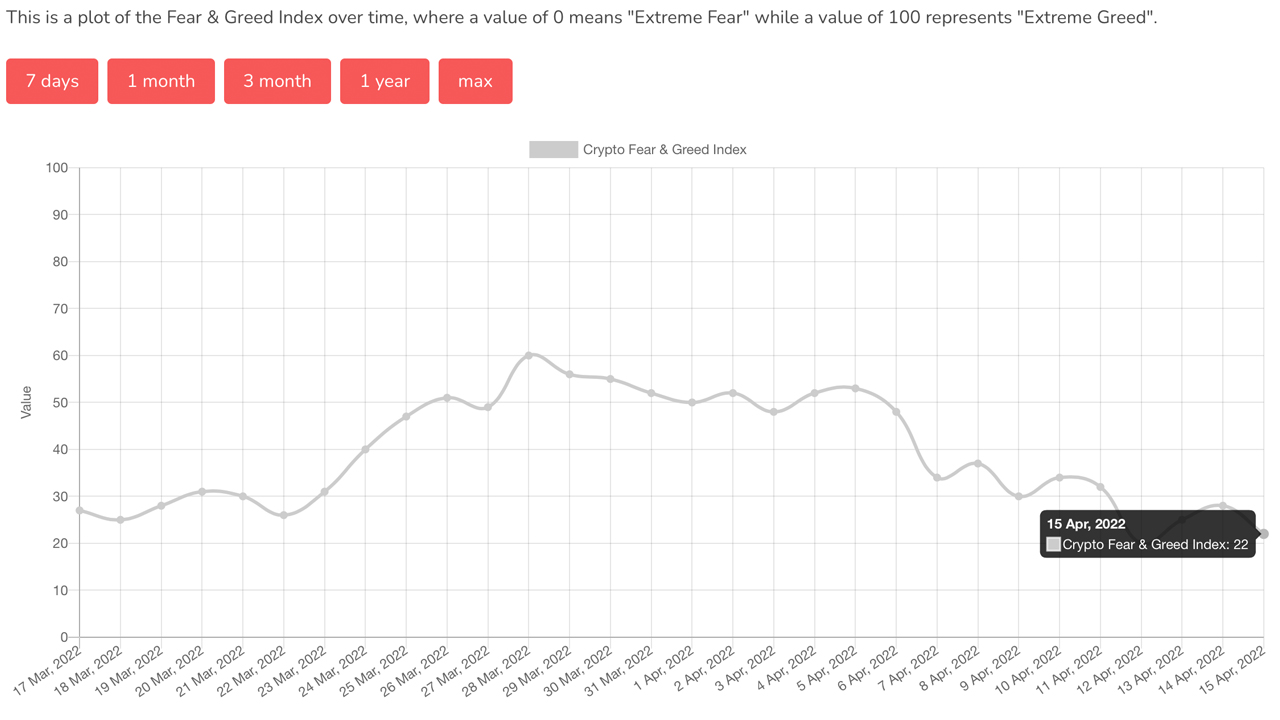
18 days ago on March 28, the Crypto Fear and Greed Index tapped the “greed” position, scoring a 60 for the first time in four months.

While Markets Consolidate, Crypto Fear and Greed Index Points to 'Extreme Fear'

18 days ago on March 28, the Crypto Fear and Greed Index tapped the “greed” position, scoring a 60 for the first time in four months. Since that day, bitcoin has lost more than $7,500 in USD value, and hit a low of $39,200 per unit on April 11. The downturn has pushed the Crypto Fear and Greed Index back down to the “extreme fear” position with a score of 22.

Crypto Sentiment Index Slides to ‘Extreme Fear,’ Bitcoin’s USD Value Is Down 35.7% Year-to-Date

On Friday, April 15, 2022, the price of bitcoin (BTC) has consolidated for now, after reaching a low four days ago. BTC’s 24-hour range on Friday has been between $39,823.77 to $40,709.11 per unit, with roughly $22 billion worth of global trading volume.

Bitcoin is down 7.2% this past week and two-week statistics show the leading crypto asset has lost roughly 11.3%. Year-to-date, bitcoin’s price against the U.S. dollar is 35.7% lower than a year ago today.
While Markets Consolidate, Crypto Fear and Greed Index Points to 'Extreme Fear'

While bitcoin’s market capitalization on Friday is around $767 billion it represents 38.91% of the current $1.97 trillion crypto economy. Today’s top trading pair with BTC is tether (USDT) with 60.88% of all trades worldwide. Tether is followed by USD (12.27%), BUSD (7.88%), JPY (4.09%), and KRW (3.28%).

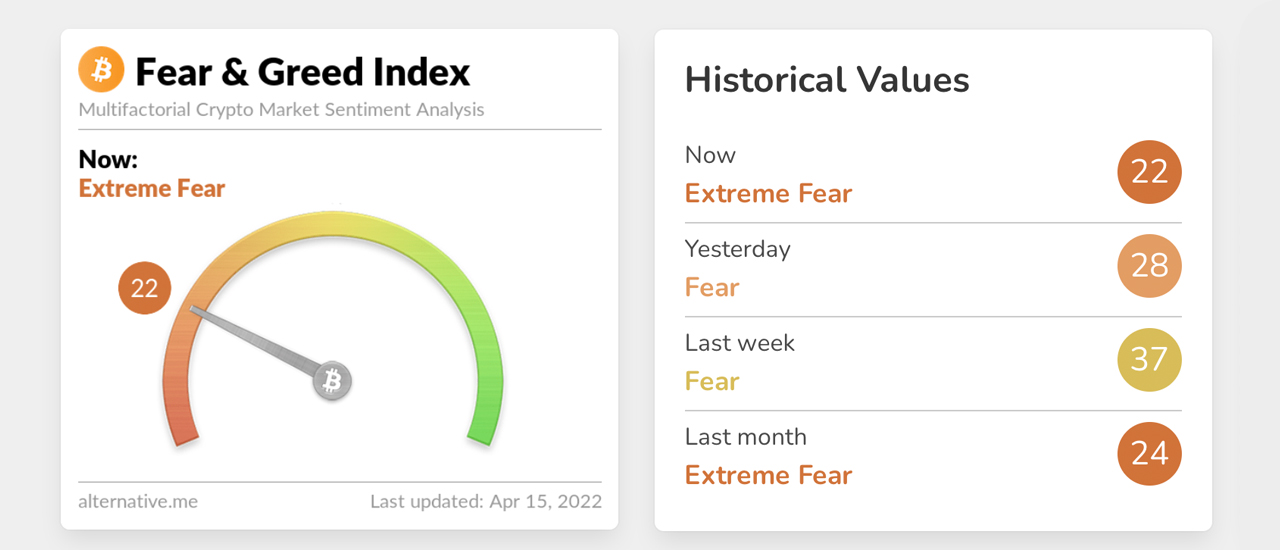
On April 15, the Crypto Fear and Greed Index tapped the “extreme fear” position and has a current score of 22. Yesterday, it was 28 which represents “fear” and the week prior, the score was 37, which also means “fear.”
While Markets Consolidate, Crypto Fear and Greed Index Points to 'Extreme Fear'

The Crypto Fear and Greed Index leverages market sentiment and crunches it down into a simple number and description. Sentiment indexes are used in traditional financial markets as well. Financial businesses, universities, and media organizations like CNN, the University of Michigan, Nasdaq’s ISEE Index, and more use these sentiment indexes to gauge how the market feels.

Bitcoin is the ninth-largest global asset today, in terms of market capitalization, above Berkshire Hathaway’s market valuation ($760.36B), and below Tesla’s capitalization ($1.018T).

The last time the Crypto Fear and Greed Index tapped a 22 was March 22, or 24 days ago. The Crypto Fear and Greed Index hosted on alternative.me explains extreme fear and greed can have two meanings.

“’Extreme fear’ can be a sign that investors are too worried. That could be a buying opportunity,” the website explains. “When Investors are getting too ‘greedy,’ that means the market is due for a correction.”
Lecturas Relacionadas

Valor de la asignación del oro como "seguro financiero" en el contexto de la crisis de la deuda estadounidense y los altos rendimientos

En un contexto de crisis de deuda estadounidense y altos rendimientos de los bonos, el oro se posiciona como un "seguro financiero" de valor para la diversificación de carteras. El precio del oro alcanzó un máximo histórico de $5,589/oz en enero de 2026, con un aumento del 35% interanual y más del 230% desde 2020. Este crecimiento responde a fuerzas macroeconómicas clave: la trayectoria fiscal insostenible de EE. UU. (deuda de $39 billones), la erosión de la confianza en el dólar impulsada por la desdolarización y las compras récord de bancos centrales (863 toneladas en 2025), el riesgo geopolítico (conflictos en Medio Oriente) y un entorno de tasas de interés reales bajas o negativas que reduce el costo de oportunidad de mantener el metal. Para los inversores, las principales vías de exposición son los ETFs respaldados por oro físico (como GLD, IAU), la tenencia física a través de dealers, o los ETFs de mineras de oro (como GDX) que ofrecen un apalancamiento al precio. Se recomienda una asignación moderada del 5-10% en una cartera, entendiendo al oro como un activo de cobertura y preservación de valor, no como una inversión de crecimiento. Los riesgos incluyen un repunte fuerte del dólar, un aumento sostenido de las tasas reales o una desescalada geopolítica. Factores clave a seguir son la evolución de las tasas reales en EE. UU., las negociaciones sobre el Estrecho de Ormuz, el ritmo de compras de los bancos centrales y las señales de política monetaria de la nueva Fed. La lógica estructural para mantener una exposición al oro sigue siendo sólida.

marsbitHace 1 hora(s)

Valor de la asignación del oro como "seguro financiero" en el contexto de la crisis de la deuda estadounidense y los altos rendimientos

marsbitHace 1 hora(s)

Trading

Spot
Futuros
活动图片