AI agents could become a new source of activity for the digital asset sector—from payments to trading and lending. The benefits from this will be distributed unevenly among market participants, believes Max Waddington, Senior Analyst at Fidelity Digital Assets.
Developers Are Using AI More Frequently
Fidelity studied data from over 100,000 GitHub developers. The use of digital programming assistants increased the number of commits by up to 180% and the number of releases by 30%.
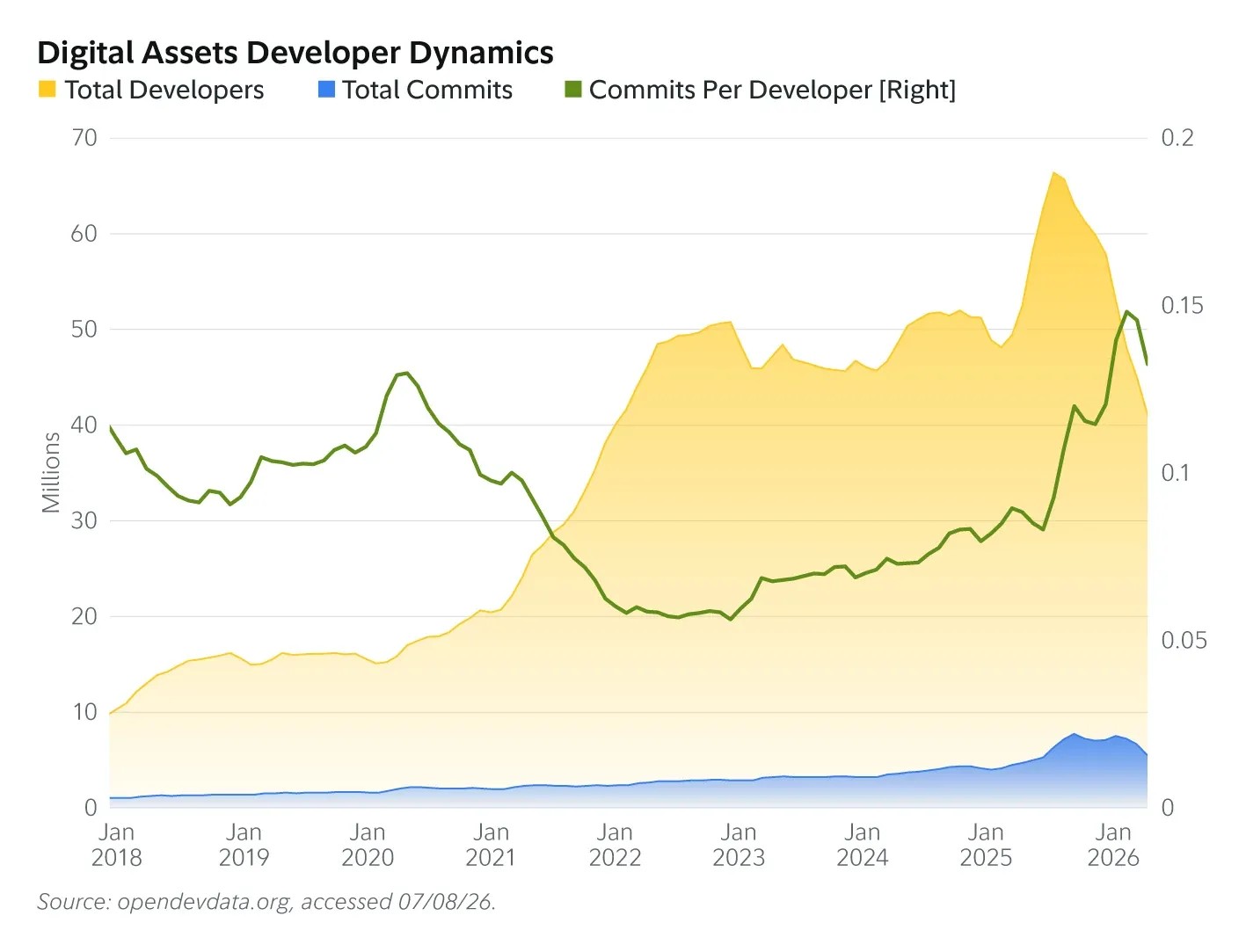
Waddington noted that such tools will allow small teams to build and launch blockchain applications faster. However, in financial and other critical software, code still requires manual review.
A similar trend was observed within the crypto industry itself. In 2026, against the backdrop of declining digital asset prices, both the number of developers and the volume of commits decreased, with the latter indicator falling more slowly. As a result, the average number of changes per developer continued to grow.
At the same time, an increase in the number of applications alone does not guarantee their success. Projects still need users, liquidity, regulatory compliance, and trust. According to Waddington, as development becomes cheaper, these factors will come to the forefront.
AI Agents Will Go On-Chain
Autonomous AI agents could become an additional driver of activity in the sector. They are capable of independently making payments, trading assets, providing liquidity, as well as issuing and taking loans.
Blockchains are suitable for such operations due to 24/7 operation, programmable settlements, and the ability to conduct microtransactions without human involvement.
This market is already taking shape. According to Keyrock, by May, AI agents had conducted over 176 million transactions worth more than $73 million. About 98.6% of the operations involved the USDC stablecoin.
Infrastructure for such scenarios is also developing. One of the most active players here is the exchange Coinbase, which previously launched the x402 protocol for automatic internet payments and later introduced Coinbase for Agents—a set of tools for trading and settlements using AI.
Nevertheless, Fidelity does not expect all agent operations to migrate to public blockchains. Banks, fintech companies, and traditional players are developing their own solutions, possessing an established customer base, infrastructure, and access to credit products.
In the view of analysts, AI agents will most likely work with multiple platforms simultaneously, choosing between them based on cost and convenience.
What are AI agent payments (agentic payments)?
Transaction Growth Does Not Guarantee Revenue Growth
Even if AI attracts millions of new operations to blockchains, this will not necessarily lead to a proportional increase in revenue for the networks themselves.
As an example, experts cited payments: their number can grow rapidly, but the fee per transaction remains low. Such transactions can also be batched, conducted off the main network, or moved to cheaper L2 solutions.
Operations with capital generate much more significant revenue. According to Fidelity's calculations, over the last 180 days, trading brought the base layer of Ethereum 49 times more revenue per dollar of volume than payments. Additional revenue is also created through MEV.
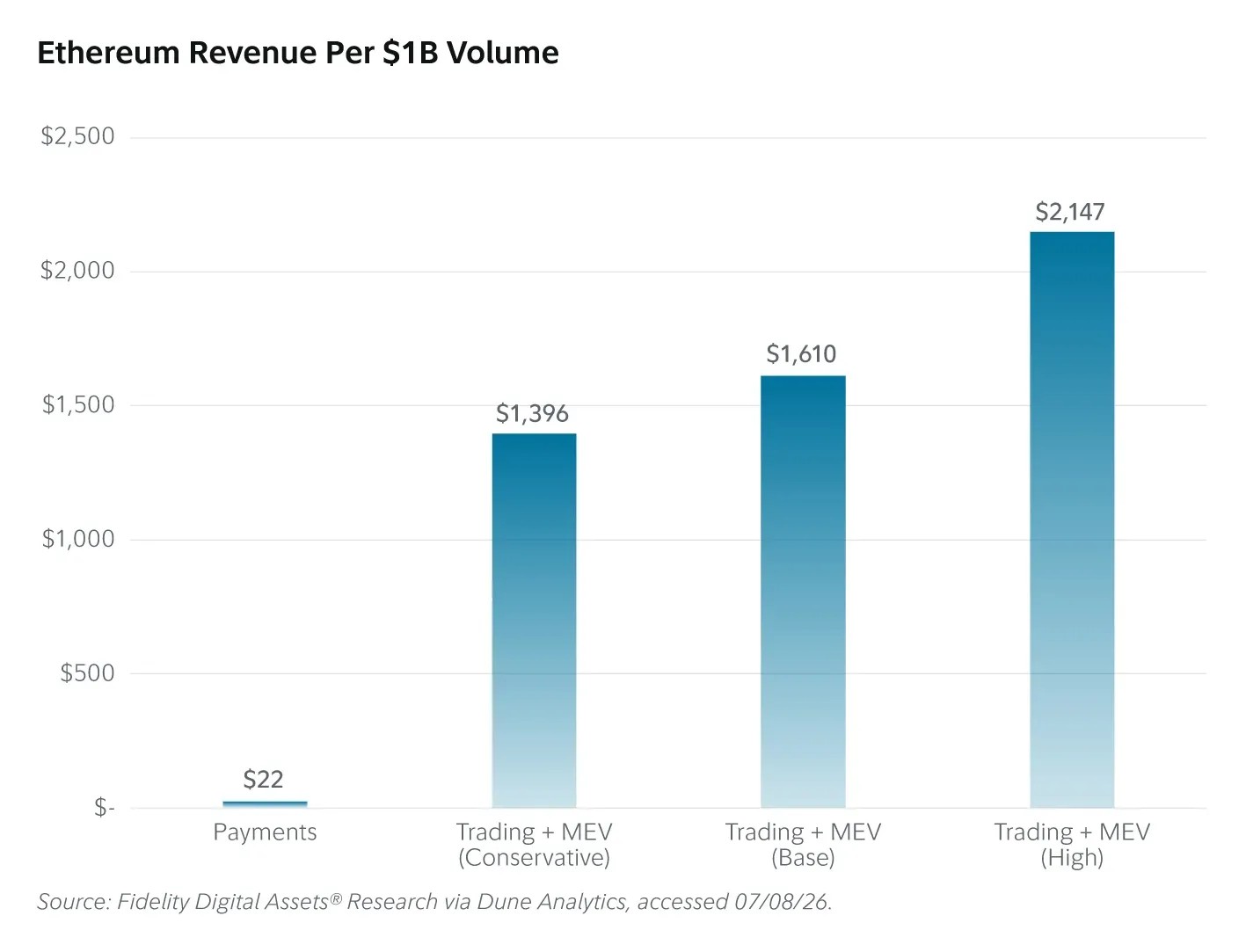
This is why analysts see greater potential in AI agents that will trade, lend, borrow, and provide liquidity. In the case of mass adoption of automatic payments, the main beneficiaries may be stablecoin issuers and infrastructure providers, rather than the native tokens of blockchains.
Recall that in March, specialists at Bernstein named digital assistants as the future of stablecoins. Later, Franklin Templeton noted that AI agents could become a driver of crypto payments.
end-content