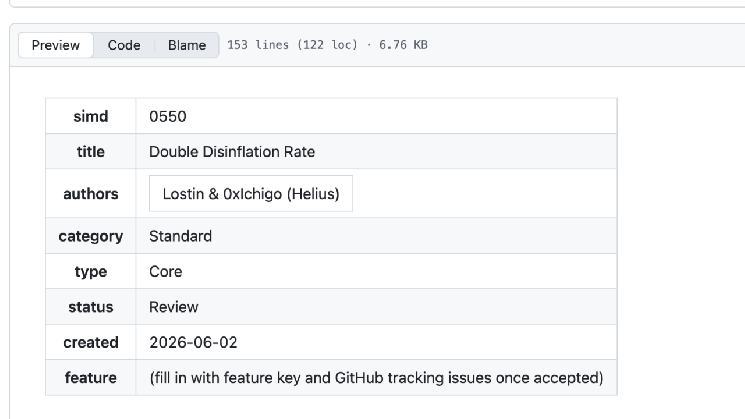
Too many AI-generated proofs isn't necessarily a good thing... the mathematics community can hardly keep up with reading them.
But there's good news—
In the face of this crisis, two generations of Fields Medalists, Terence Tao and Wang Hong, have offered nearly identical judgments:
Digest.
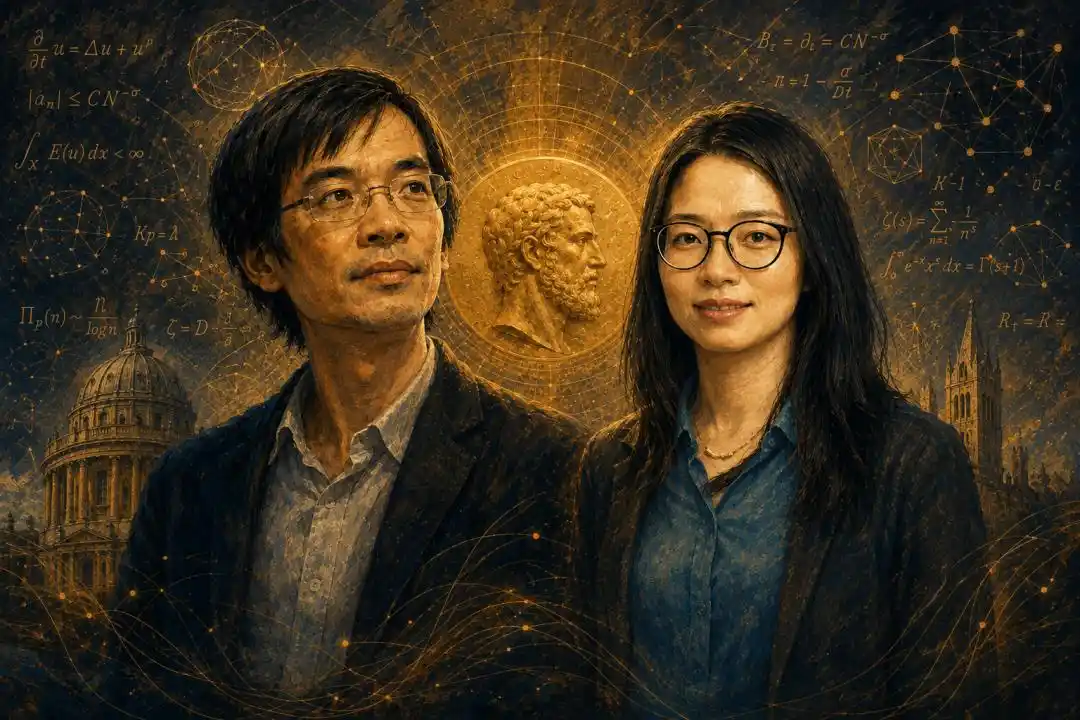
The School of Mathematical Sciences at Peking University recently released a lengthy 10,000-word interview with Wang Hong, where she offered quite pertinent advice:
The mathematics community cannot ignore the counterexamples or proofs generated by AI; we need to learn to use them, but also understand and digest them.
Terence Tao, on the other hand, spent several days thoroughly digesting a proof that involved AI from start to finish.
This proof solves the Sęndov conjecture, which had been pending for 67 years.
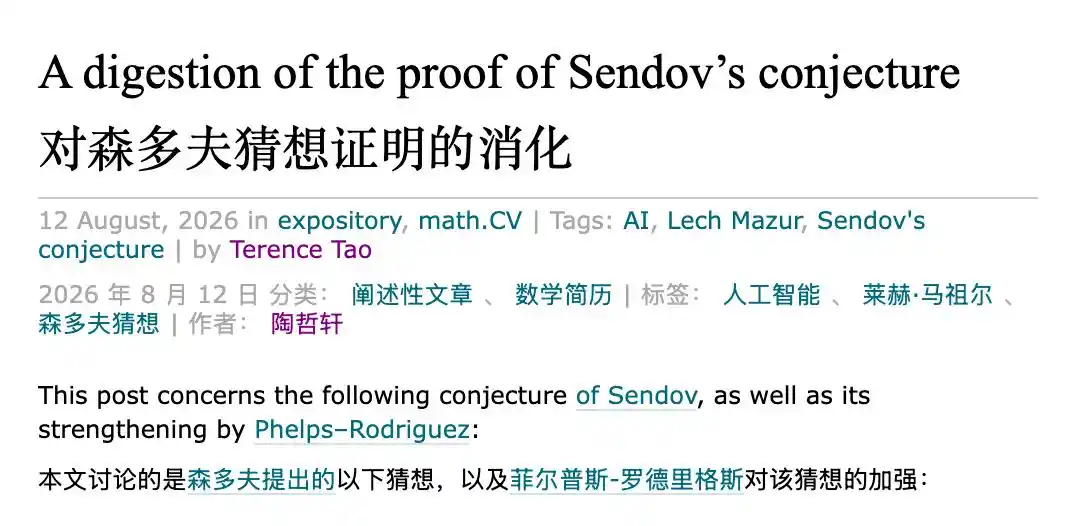
This sounds somewhat counterintuitive. If AI is here to help mathematicians solve problems and the answer is already out, why digest it again?
The answer from 'whistleblower' Terence Tao is:
A correct proof is only the first hurdle for a mathematical result; it must be understood and absorbed by professional mathematicians to be fully usable.
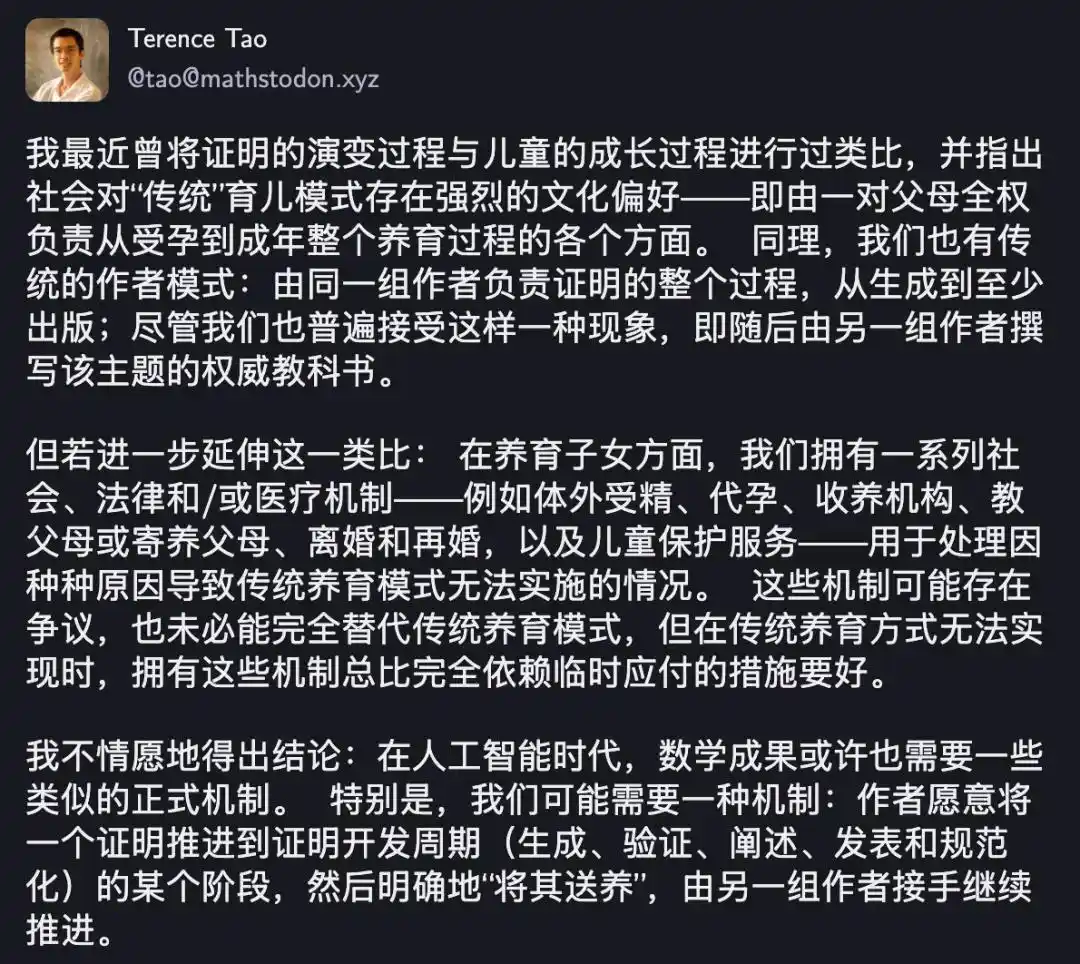
To use an analogy, traditional authors are like responsible parents, fully accompanying a proof from birth to publication. But moving forward, working with AI, this relationship may be more like 'adoption':
Someone uses AI to advance a proof to the generation or verification stage, then formally hands it off to another group for professional interpretation, organization, and publication.
Mathematicians still have much to do.
Digestion is the Next Step in Solving Mathematics' Century-Old Crisis
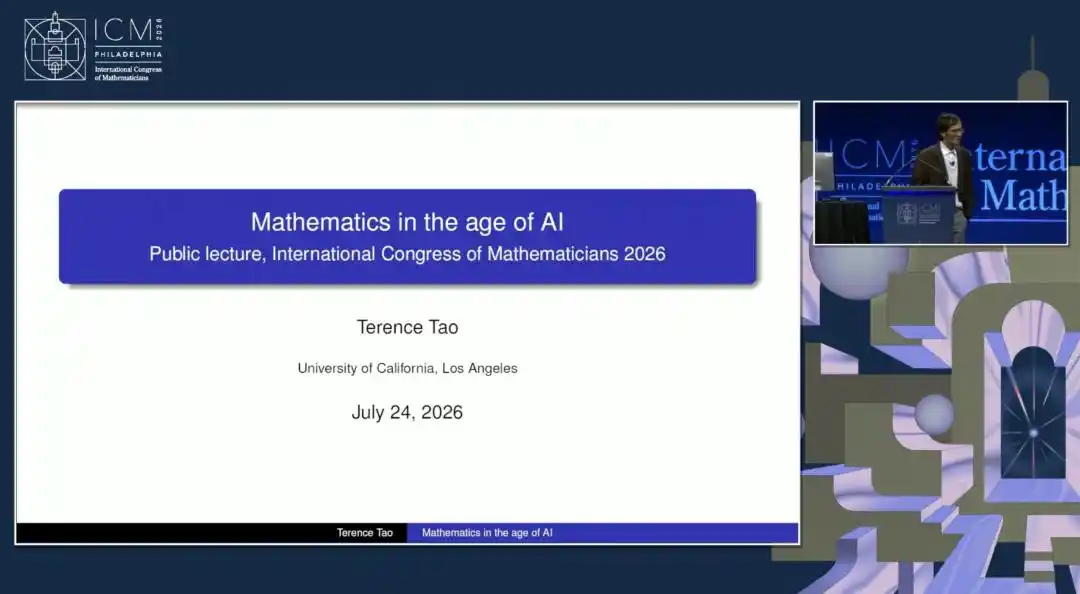
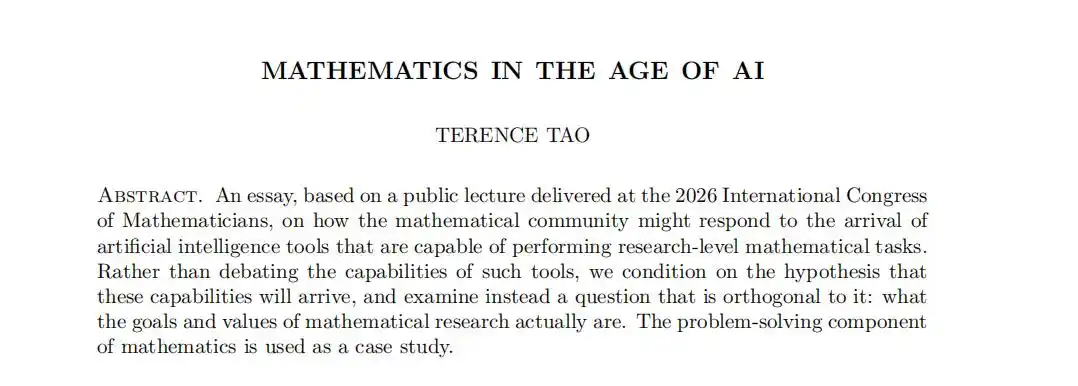
To put it bluntly, this is also Terence Tao's response to the question he left in his ICM lecture a month ago:
If answers can be mass-produced by AI, what is mathematical research really pursuing?
OpenAI's new model Astra solved 10 challenging problems in mathematics and theoretical computer science in a row, spanning high-dimensional geometry, coding theory, group theory, and more.
A neurosurgeon without formal higher mathematics training had ChatGPT 5.6 autonomously run for about 16 hours, producing a key proof for Crouzeix's conjecture in numerical linear algebra.
......
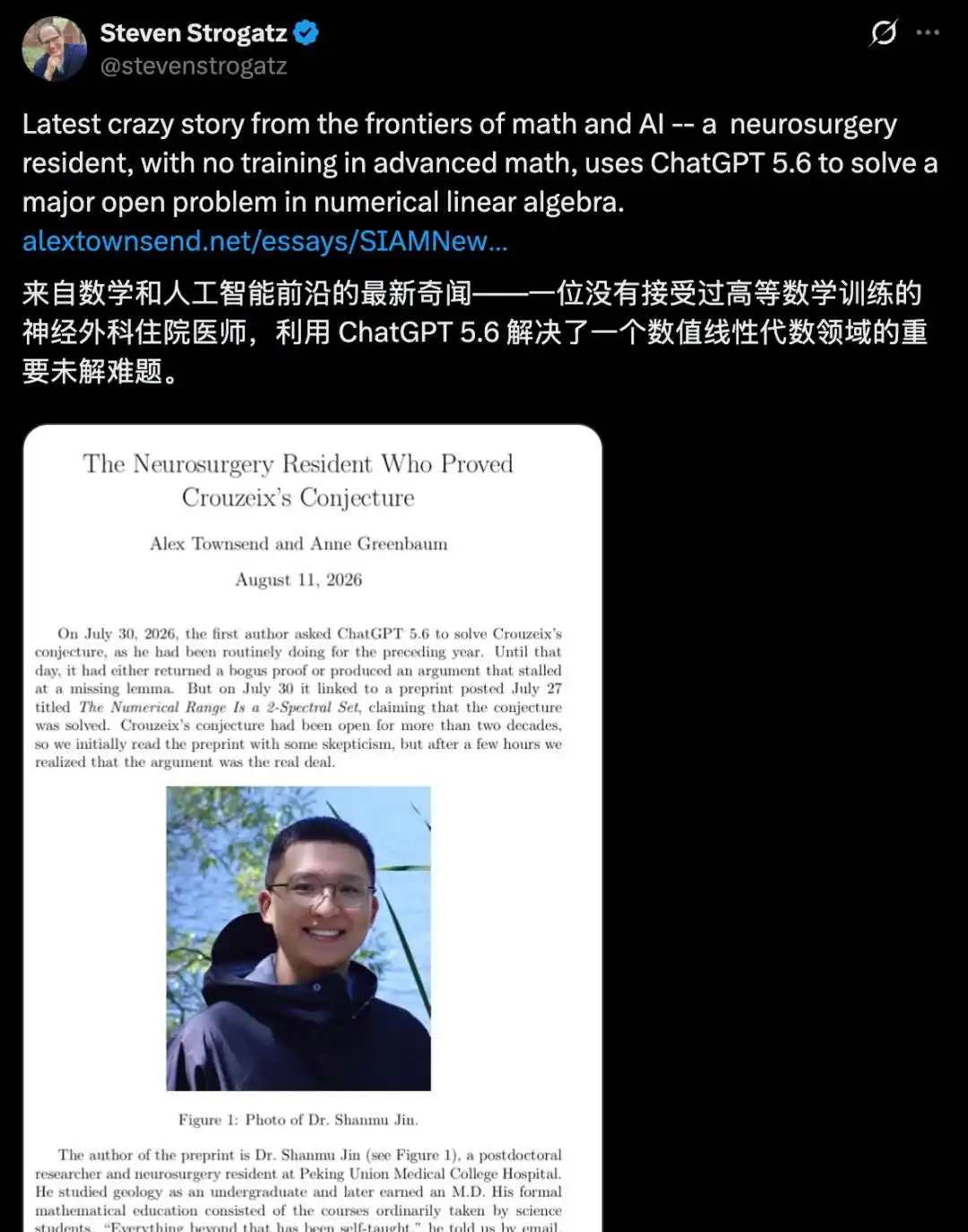
The high wall of mathematics seems to have had a back door chiseled open by AI.
Even laypeople can use it to break through cutting-edge problems. Is mathematics about to get its "next civil engineering" script? (doge)
Not at all! In fact, a complete mathematical achievement is never just about 'obtaining a proof'.
Terence Tao breaks it down into five stages:
First, generate the argument; then verify its correctness; next, explain the idea to peers, letting it undergo publication and community verification; finally, reorganize the results, find their relationship to old theories, and solidify them into standard knowledge for future use.
AI currently excels at accelerating the first two steps. The further along you go, the more you need mathematicians to judge what's truly core and what the results mean.
And the Sęndov conjecture Tao just processed is almost a 1:1 live demonstration of this workflow.
The conjecture studies the distance between polynomial zeros and critical points. Lower-degree cases and sufficiently high-degree cases had already been solved, but the middle range remained vacant for a long time.
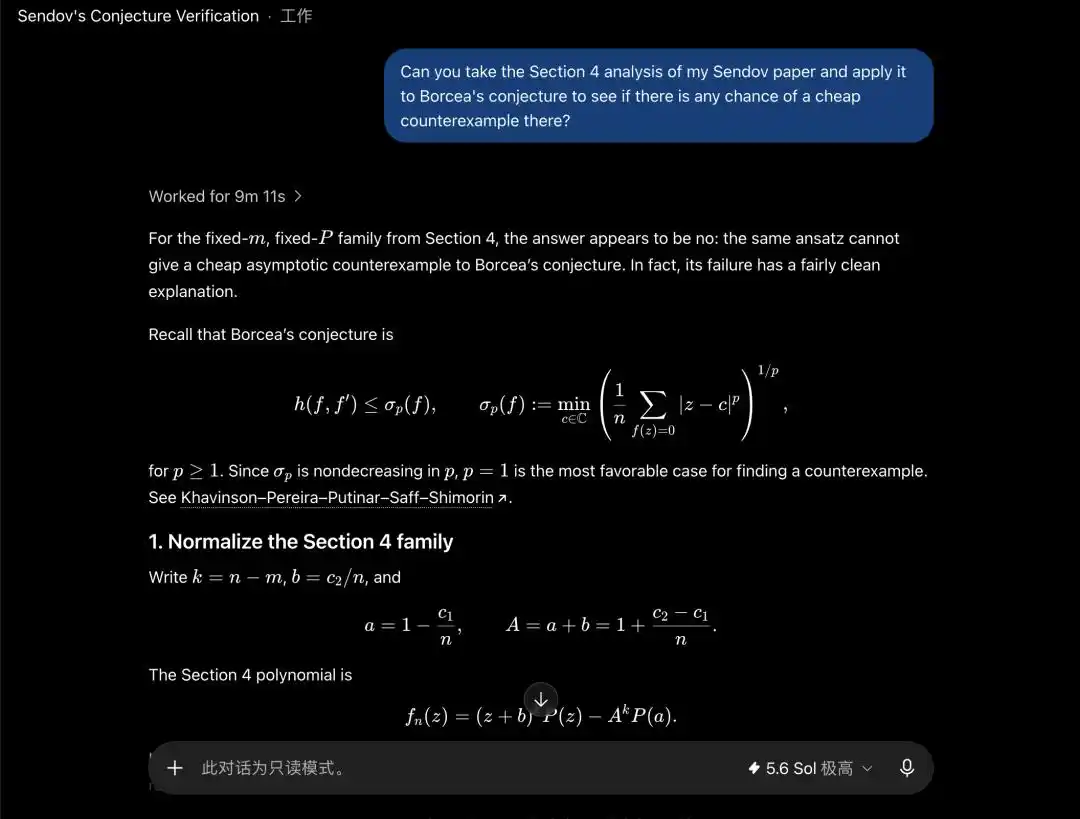
A few days ago, math enthusiast Lech Mazur used AI to fill this gap, providing a formalized proof verified by Lean.
It seemed the story should end there. But Terence Tao noted that this original proof hadn't been organized into mathematical text suitable for human reading and publication, meaning the mathematical result was not yet usable.
So he spent several days, with the assistance of both ChatGPT and pen-and-paper derivation, conducting a complete digestion of the result:
Tracing literature sources → Extracting the identities that truly mattered → Removing detours → Rewriting the machine-discovered argument into a version showing a clear main line.
Reading it this way, he actually uncovered something new.
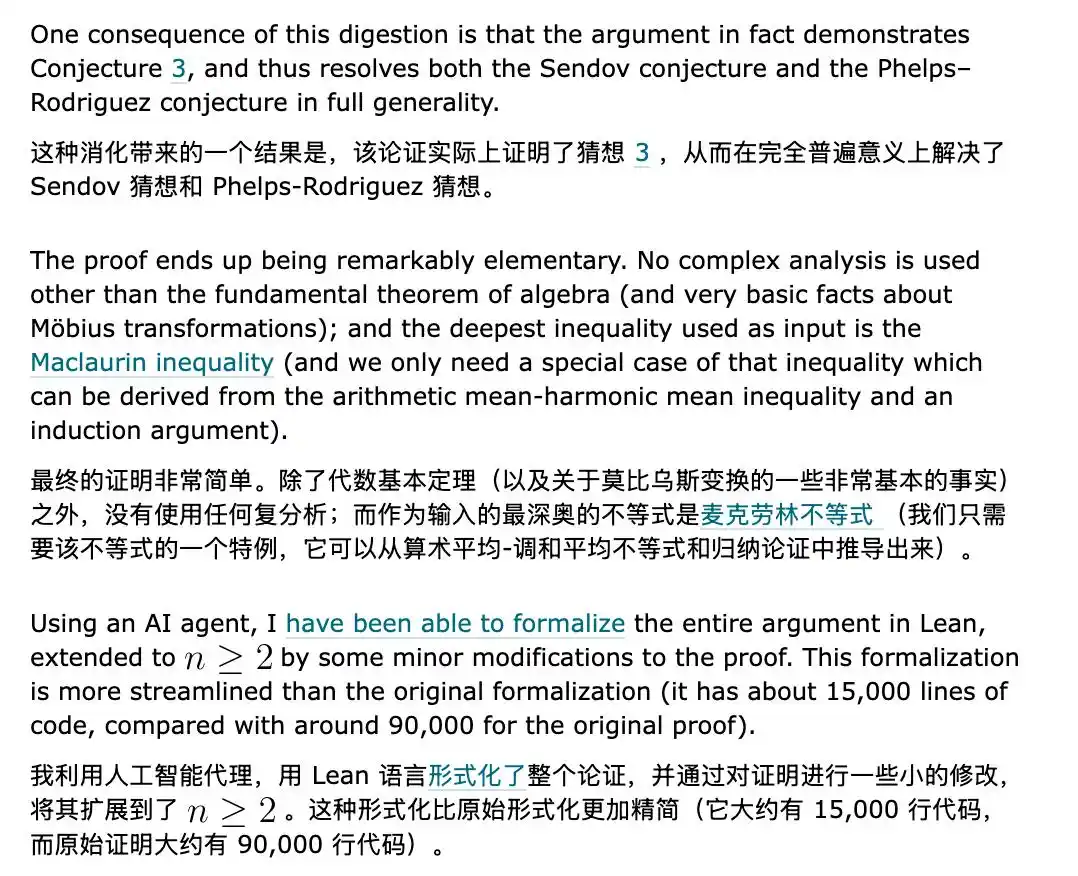
The reorganized argument not only solves the Sęndov conjecture but can also cover the stronger Phelps–Rodriguez conjecture. The core tools required are also much more elementary than what the original formalization presented, compressing the Lean code from about 90,000 lines to 15,000 lines.
In other words, digestion is not just a re-verification of an AI proof, but also an effective way to broaden mathematical achievements.
More importantly, Tao wants to use digestion to overturn the old rule in mathematics of "whoever announces first gets priority."
The attribution of mathematical results was first based on journal publication date, then changed to arXiv timestamp.
Now AI proofs come too fast, and even arXiv is considered too slow by some. Some results are thrown onto social platforms immediately after generation. In the race to be first, verification and interpretation are all skipped, ultimately creating an artificial burden for the mathematics community.
Therefore, in his ICM speech, Tao argued that the mathematics community should stop blindly celebrating "the first person to give a proof" and elevate the status of "digesting and organizing proofs."
Work like explaining proofs, peer review, and organizing results into classical theory should also be valued; not only producing new theorems counts as merit.
If the paper's authors themselves cannot give a competent lecture at a professional level to explain the results clearly, no matter how correct the AI verification is, this achievement should not be published.
If even humans can't understand the proof, how can it be considered a complete result?
So Tao calls on the academic community to calmly sit down, engage in a profound discussion about AI's capability limits and the values of mathematics, while emphasizing those parts of mathematical work that cannot be replaced by machines.
One More Thing
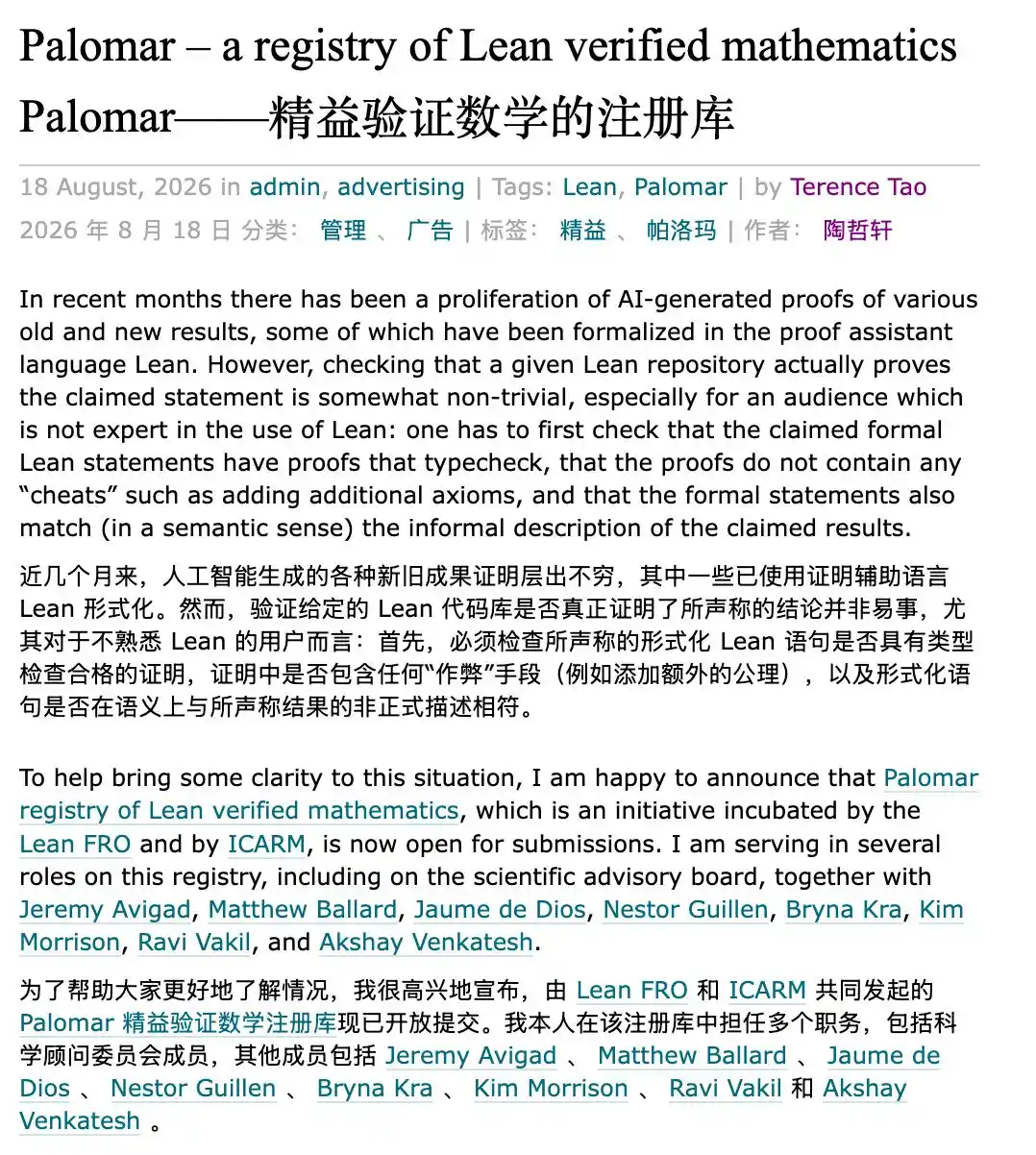
Meanwhile, Terence Tao has also publicly released a real registry for Lean verification results — Palomar.
Palomar clearly registers the problem statement, proof code, AI involvement method, and version information. After independent kernel re-evaluation, it gathers AI proofs scattered across GitHub, social media, and news in one place.
It will serve as a digestion relay station between verification and publication, letting future researchers know where AI and peers have reached and what work remains to be done.
Teams interested in the same problem can collaborate via Palomar.
Notably, Palomar does not judge the importance of a particular result, nor does it replace peer review.
The attribution of specific results will be determined in the future by the chronological order of four key stages:
Generative achievement documenting how the proof was produced, e.g., AI chat logs;
Verification achievement confirming logical correctness, e.g., Lean code;
Interpretation achievement clearly explaining the idea, e.g., public lecture;
Publication achievement formally presenting the result, e.g., paper.
In other words, priority is granted to whoever first submits a complete set of all achievements.
Currently, Terence Tao's digested version of the Sęndov conjecture has become one of the first entries in Palomar's archives.
References:
[1]https://arxiv.org/abs/2608.16753
[2]https://mathstodon.xyz/@tao/117123957813926355
[3]https://www.youtube.com/watch?v=M0--ZH1lOzg
[4]https://mp.weixin.qq.com/s/w-UfVMmwTZqXjNsC81CzYw
This article is from the WeChat public account "QbitAI", author: Focus on Frontier Technology