Crude Oil Surges 10% in Intraday Trading! US Military Restores Blockade on Iran, Trump Warns of 'Heavy Blows' Tonight and Tomorrow, Imposes 20% Fee on Strait Shipping

marsbitPublished on 2026-07-14Last updated on 2026-07-14

Abstract

Crude oil prices surged up to 10% intraday as tensions between the US and Iran escalated sharply. President Trump announced the reinstatement of a maritime blockade against Iran, targeting its ships and their customers, while stating the Strait of Hormuz would remain open to all other nations. He further declared that the US, as the "guardian" of the strait, would impose a 20% fee on all cargo transiting the strategic waterway to compensate for security costs. The US Central Command confirmed the naval blockade would commence on July 14 (GMT). Following Trump's statements, reports emerged of explosions near Iran's Larak Island and the port of Bandar Abbas, though Iranian authorities did not confirm their nature. Iran's Foreign Minister criticized the proposed 20% fee as excessive, asserting Iran's role as the guardian of the strait. An Iranian military spokesperson warned of a strong response to any unauthorized US interference in the waterway. The United Nations' International Maritime Organization (IMO) expressed opposition to charging tolls for passage through international straits, stating such measures lack legal foundation. Market reactions were pronounced, with Brent crude briefly surpassing $83 and WTI above $78. The situation intensified as Trump notified Congress of renewed hostilities with Iran, following US airstrikes on Iranian targets.

Authors: Li Dan, Li Jia

The situation between the US and Iran has escalated abruptly, with transit risks through the Strait of Hormuz sharply rising, leading to a robust rebound in international crude oil futures.

According to Xinhua News Agency, US President Trump stated on Monday the 13th that he is restoring a maritime blockade on Iran. According to CCTV News, Trump posted on his social media platform on Monday, saying the Strait of Hormuz is currently open and will remain open regardless of Iran's involvement. The US will reinstate "blockade measures against Iran," targeting only Iranian vessels or their clients, restricting their access to the strait, while all other countries can use the strait fairly and openly. He also stated that the US will impose a 20% fee on all goods transported through here, with the relevant procedures and deployment to commence immediately.

In his social media post, Trump framed this fee as "compensation" for the US acting as the guardian of the strait. He wrote: "From now on, the United States will be regarded as the 'Guardian of the Strait of Hormuz'; as the guardian, and in the spirit of 'fairness,' the US will impose a 20% fee on all transported goods to compensate for the necessary expenditures required to maintain the security and safety of this turbulent region of the world."

After Trump's post during early US stock market hours on Monday, international crude oil prices rose further, with WTI crude breaking above $75, expanding its intraday gain to 5%, and Brent crude approaching the $80 mark, also up nearly 5%; the US Dollar Index and Treasury yields rose in tandem, the S&P 500 extended its decline to 0.5%, while spot gold plummeted nearly 3%.

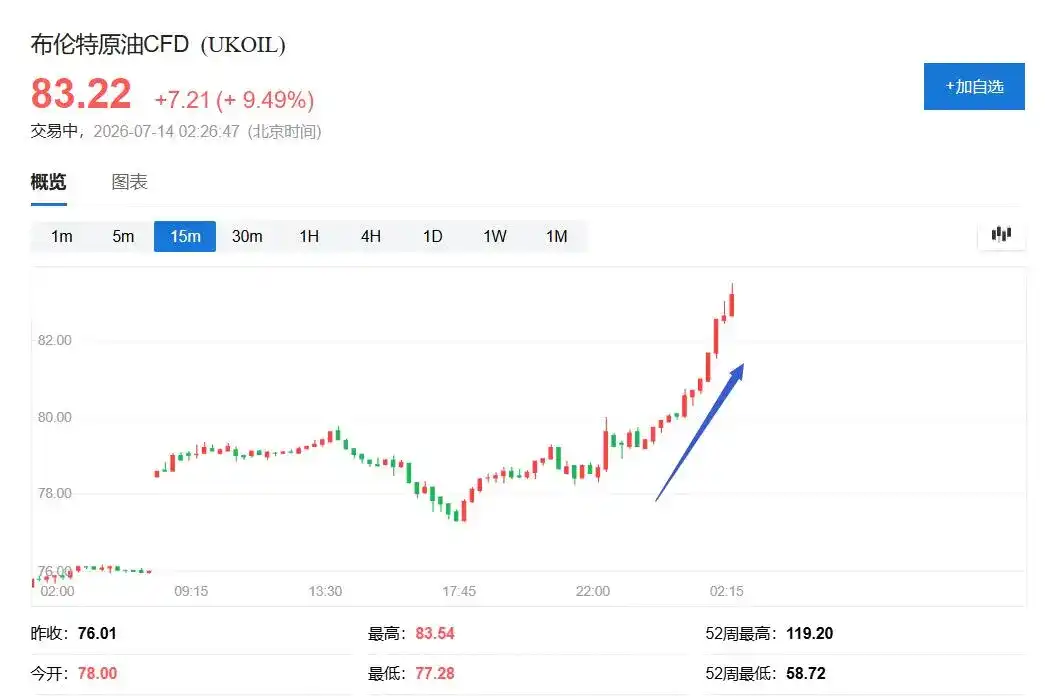
During the US stock market's lunch hour, the US Central Command confirmed that US forces would begin the maritime blockade on Iran at 4:00 PM EST on Tuesday, July 14, which is 4:00 AM Beijing time on Wednesday. International crude oil gains expanded to nearly 10%. Iranian Foreign Minister Araghchi stated that Trump's proposed 20% fee for the Strait of Hormuz was "too much" and added that Iran has always been the guardian of the Strait of Hormuz.

During the US stock market's late trading hours, according to Iranian media Tasnim, explosions were heard on Iran's Larak Island, located in the Strait of Hormuz, and explosions were also reported in the southern Iranian ports of Bandar Abbas and Konarak. Subsequently, CCTV reported that on the evening of the 13th local time, four explosions were heard east of Bandar Abbas port. After the US market closed, CCTV reported at around 2:00 AM local time on the 14th that three more explosions were heard in Bandar Abbas port. Iranian authorities have not confirmed the nature of the explosions.

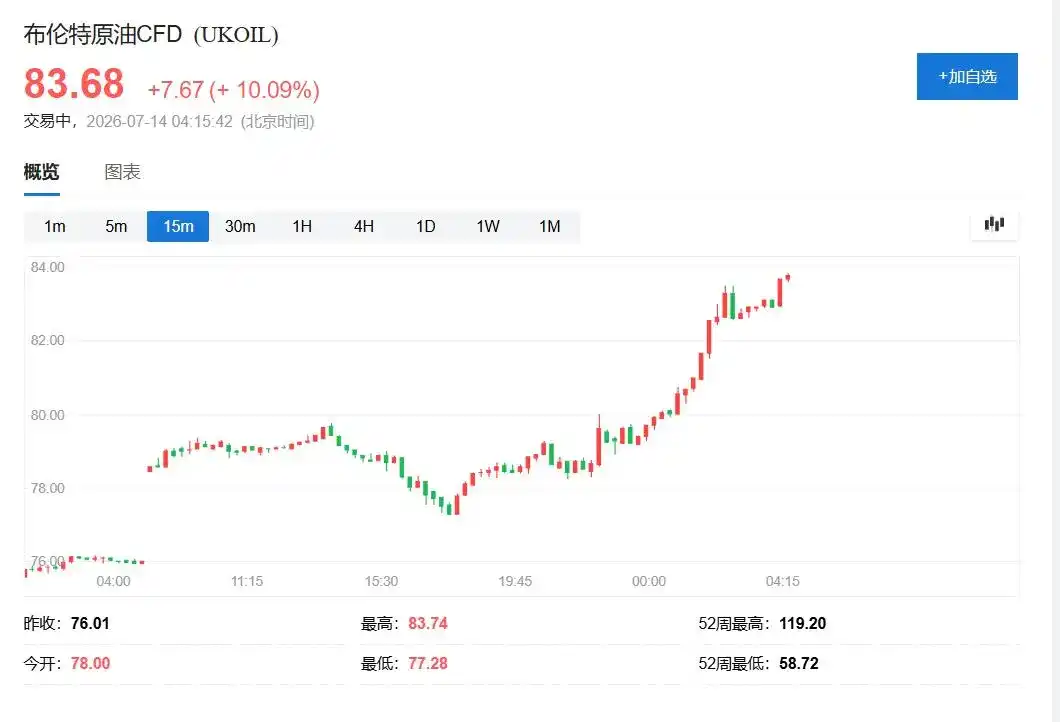
During late US trading, after the news about explosions in the mentioned Iranian areas was released, international crude oil maintained gains of around 9%. After the US market closed on Monday, Trump stated that the US would deliver "heavy blows" to Iran tonight and tomorrow. Crude oil remained high, with Brent crude up over 10% compared to Friday's close.

Later, Trump claimed that he believed an Iran deal might be reached. He said, "I want 'compensation' for the Strait of Hormuz. The US is providing protection for shipping in the Strait of Hormuz and will receive compensation from countries that have benefited from US assistance."
After the US market closed on Monday, according to Xinhua citing Iran's Fars News Agency on Monday the 13th, a US MQ-1 drone was shot down by Iran's Islamic Revolutionary Guard Corps (IRGC) air defense system late that night over the Strait of Hormuz. Earlier on Monday, the US Central Command revealed on social media that US forces had struck a submarine and ship repair facility at Iran's Bandar Abbas naval base on Sunday, marking the first combat use of armed unmanned surface vessels by the US military.

Citing a post from the US Central Command, CCTV reported that under Trump's directive, US forces began a third consecutive night of airstrikes on Iran starting at 4:45 PM EST on Monday. The post also stated that the operations would continue to inflict heavy costs on Iran's armed forces and degrade their ability to attack innocent civilians and commercial shipping in the Strait of Hormuz.

US Military to Begin Maritime Blockade on Iran Starting Tuesday, US/Europe Time

The United Nations' International Maritime Organization (IMO) stated after Trump's post that it opposes charging fees for ships passing through international sea lanes but would wait for more details. During the US stock market's lunch hour, according to CCTV, the Joint Maritime Information Center, overseen by the US Navy, indicated that US forces will begin enforcing a maritime blockade on all Iranian ports and coastal areas starting at 20:00 GMT on July 14 (4:00 AM Beijing time on the 15th).

The blockade applies to all vessels, regardless of their flag. The blockade area covers the entire coastline of Iran, including but not limited to Iranian ports and oil terminals. The blockade operation will not hinder the transit passage of neutral vessels through the Strait of Hormuz to or from non-Iranian destinations. Humanitarian shipments will be permitted passage but subject to inspection.

After the news of the US maritime blockade during the US lunch hour, oil price gains continued to expand. WTI and Brent crude rose above $78 and $83 respectively, with intraday gains reaching 9.86% and 9.9%, approaching 10%.
Although Trump said the fee plan would begin formulation and implementation immediately, the White House did not immediately provide more details about the proposal, including how it would be enforced or whether communication had occurred with US allies. Comments suggest that Trump's remarks have intensified the dispute between the US and Iran over whether this crucial shipping corridor remains open to traffic.

Previously, according to Xinhua citing Iranian media reports on the 13th, a spokesperson for Iran's Armed Forces General Staff's Khatam al-Anbiya Central Headquarters stated on that day that they would never allow the US to interfere in the management of the Strait of Hormuz.

The spokesperson said that the Iranian armed forces would respond forcefully to any unauthorized entry by US forces into designated sea lanes or interference with the passage of merchant ships and oil tankers. "The recent actions of Iran's Islamic Revolutionary Guard Corps and the Iranian Islamic Republic Army are clear proof."

Earlier on Monday, Trump said in a phone interview with Fox News Channel that the US plans to control the Strait of Hormuz and should be compensated for "guarding" this vital waterway. He said, "We've been guarding that strait for 50 years and have never gotten a penny. We want to be compensated because we're putting our people in harm's way."

Iran Calls Southern Route in Strait of Hormuz 'Unsafe'

Additionally, according to Xinhua, the Iranian embassy in the UK stated on social media on the 13th that the southern route in the Strait of Hormuz is "unsafe, unreliable, and prone to accidents."

The Iranian embassy in the UK said that in compliance with the Islamabad Memorandum of Understanding, Iran established a temporary maritime security corridor. This corridor has no technical or military obstacles and has been notified to the IMO. However, "the US is directing vessels towards a dangerous southern parallel route. This route is not only legally questionable but also unsafe, unreliable, and prone to accidents."

The Iranian embassy said that US "acts of military aggression," such as attacking Iranian ports, have made the Strait of Hormuz a highly tense and high-risk area.

After the US-Iran understanding was reached, two traffic routes formed in the strait: the northern route controlled by Iran and the southern route closer to Oman's side, where US forces provide navigation assistance.

The Iranian IRGC Navy announced early Sunday morning local time on the 12th that, due to the unsafe situation caused by illegal foreign interference, the Strait of Hormuz is closed as of now until further notice and until the US ceases interference in the region. The US Central Command posted on social media on Sunday morning Eastern Time, stating that "transit continues" in the Strait of Hormuz. Iran does not control the strait.

International Maritime Organization: Opposes Toll Charges for Transit Through Straits Used for International Navigation

After Trump's post, a spokesperson for the International Maritime Organization (IMO) said: "We have noted the remarks and are awaiting further details."

The spokesperson stated: "Our position on fees is clear and consistent—the IMO firmly opposes the imposition of charges for transit through straits used for international navigation. Mandatory transit fees levied solely for passing through a strait are legally untenable."

Media noted that shipping industry officials expressed concern about Trump's latest move regarding fees, saying their assessment is that such measures would violate international law.

One industry official questioned Trump's remarks: "How exactly will this make navigation safer? And what kind of guarantee will it provide?"

Trump Has Notified Congress of Resumption of Hostilities with Iran

According to CCTV citing US reports on Monday the 13th, Trump has formally notified Congress that hostilities with Iran have resumed. Trump wrote in a letter to congressional leaders dated the 10th that US forces conducted a "defensive strike" on targets within Iran on the 7th.

It is reported that this letter has reignited the dispute between Congress and the White House. Although both houses of Congress previously voted to require the President to end the war or seek approval to continue actions, the White House insists that Trump is acting within his constitutional powers as Commander-in-Chief.


Trending Cryptos

Related Questions

QWhat major action did President Trump announce regarding the Strait of Hormuz and what was the stated reason?

APresident Trump announced the U.S. would begin charging a 20% fee on all cargo transported through the Strait of Hormuz. He stated this was 'compensation' for the U.S. acting as the 'guardian of the Strait of Hormuz,' covering the necessary costs for maintaining security and safety in the turbulent region.

QHow did the announcement of U.S. actions against Iran impact international oil prices?

AThe announcements of U.S. actions, including the planned blockade and fee, caused international oil prices to surge sharply. U.S. crude oil prices rose by up to nearly 10%, briefly surpassing $78 per barrel, while Brent crude neared $83 per barrel, also with a near 10% increase.

QWhen was the U.S. naval blockade of Iran scheduled to begin, and what are its key conditions?

AThe U.S. naval blockade of all Iranian ports and coastal areas was scheduled to begin at 20:00 GMT on July 14th (04:00 Beijing Time on July 15th). The blockade applies to all vessels regardless of flag but allows neutral ships transit through the Strait of Hormuz to non-Iranian destinations. Humanitarian shipments are permitted but subject to inspection.

QWhat was the response of the International Maritime Organization (IMO) to the proposed fee for the Strait of Hormuz?

AThe International Maritime Organization (IMO) stated its firm opposition to imposing fees on passage through straits used for international navigation. An IMO spokesperson said such a compulsory toll for merely passing through a strait is 'legally untenable.'

QWhat significant military incident involving a U.S. drone was reported following the announcements?

AAccording to Iran's Fars News Agency, an American MQ-1 drone was shot down over the Strait of Hormuz by Iran's Islamic Revolutionary Guard Corps air defense system late on Monday night (July 13th).

Related Reads

Bitcoin and Ethereum Soar Together! Eight Altcoins Worth Watching in the Later Market

Bitcoin and Ethereum Surge, Fueling Altcoin Speculation. Bitcoin Eyes $77,000, Ethereum Gains 20% in a Single Day. Market anticipates capital rotation from major cryptos to high-beta altcoins, but a selective rise is expected, favoring projects with genuine users, protocol revenue, and healthy tokenomics. Analysts highlight eight altcoins across key sectors: **High-Performance Blockchains:** * **SOL (Solana):** Market cap ~$51.88B. A dominant player with a strong ecosystem. Considered a relatively safe bet for potential catch-up growth. * **SUI (Sui):** Market cap ~$3.03B. High volatility potential but faces risks from its low circulating supply and future token unlocks. **DeFi Lending:** * **UNI (Uniswap):** Market cap ~$2.38B. Transitioning to a revenue-capturing asset post-fee switch implementation. * **AAVE (Aave):** Market cap ~$1.53B. Features balanced tokenomics and revenue but has seen significant recent gains. * **MORPHO:** Market cap ~$1.50B. Rapid protocol growth but weaker token value capture and opaque supply data. **Perpetual DEX:** * **HYPE (Hyperliquid):** Market cap ~$16.41B. The clear sector leader with strong revenue but high valuation and a large portion of tokens still locked, warranting caution. **RWA & On-Chain Finance Infrastructure:** * **LINK (Chainlink):** Market cap ~$8.09B. A key oracle provider positioned to benefit from multiple trends like RWA and institutional adoption, offering strong fundamentals. * **ONDO (Ondo Finance):** Market cap ~$1.77B. Shows strong business growth but carries high risks due to concentrated token holdings and a massive unlock scheduled for 2027. **Conclusion:** The altcoin rally is expected to be selective. Recommendations include a medium position in SOL, small allocations to SUI and UNI/AAVE for DeFi exposure, and caution with HYPE and ONDO due to their specific risks. LINK is suggested as a core holding for the RWA thematic.

marsbit1h ago

Bitcoin and Ethereum Soar Together! Eight Altcoins Worth Watching in the Later Market

marsbit1h ago

Shanghai's $10 Billion Unicorn Is About to Go Public

Shanghai-based automotive-grade millimeter-wave radar chip unicorn Calterah Microelectronics Technology (Shanghai) Co., Ltd. has filed for an IPO on Shanghai's STAR Market, aiming to raise 3.49 billion yuan. Founded in 2014 by Chen Jiashu, a UC Berkeley PhD graduate, and his professor Ali Niknejad, Calterah pioneered CMOS technology for 77GHz radar chips, breaking the decades-long monopoly of international giants like Texas Instruments. Its low-cost, highly integrated solutions enabled millimeter-wave radar to move from luxury to mass-market vehicles. By 2025, Calterah captured a 31.1% share in China's automotive millimeter-wave radar chip market (second domestically, fourth globally), with cumulative shipments exceeding 30 million units. Its client list includes BYD, Geely, Nio, and Volvo. The company has undergone 11 funding rounds, attracting high-profile investors such as the National Integrated Circuit Industry Investment Fund Phase II, China Capital Management, and GD Capital. Its valuation has reached tens of billions of yuan, with a projected post-IPO valuation of approximately 14 billion yuan. Despite rapid revenue growth—increasing from 206 million yuan in 2023 to 632 million yuan in 2025 with a 75.28% CAGR—Calterah remains unprofitable. It reported net losses of 323 million yuan, 334 million yuan, and 193 million yuan from 2023 to 2025, accumulating over 900 million yuan in losses over three and a half years. These losses are primarily attributed to heavy R&D investment, which totaled over 1.039 billion yuan in the reporting period, often exceeding annual revenue. The company faces significant risks, including high customer concentration (its top five customers accounted for over 99% of revenue from 2023-2025, with BYD alone representing over 50% in 2025) and supply chain concentration. Revenue pressure from key customers and dependencies on overseas suppliers for EDA tools and IP pose challenges to sustainable growth. The IPO is seen as crucial for securing capital to expand production, diversify its customer base, and reduce supply chain dependencies.

marsbit1h ago

Shanghai's $10 Billion Unicorn Is About to Go Public

marsbit1h ago

Ray Dalio's Latest Macro Analysis Full Text: Buy More Gold, Add Some Bitcoin

In his latest macro analysis, Ray Dalio applies his framework from "How Countries Go Broke: The Big Cycle" to the current global debt environment. He highlights recent events like Japan selling U.S. Treasuries and rising U.S. long-term yields as signs of an unsustainable debt dynamic. Dalio explains that excessive government debt leads to either unacceptably high interest rates, severe economic downturns, or significant currency debasement through central bank money printing. He summarizes the U.S. fiscal situation: with $5.5 trillion in revenue, $7.5 trillion in spending, a $2 trillion deficit, and total debt at six times annual revenue, debt servicing costs are immense. Without correction, U.S. debt could reach $55-$60 trillion in a decade. Dalio proposes a "3% Three-Way" solution: reducing the budget deficit to 3% of GDP through balanced spending cuts, tax increases, and interest rate reductions to avoid a traumatic adjustment. In response to FAQs, he argues that the risk of a U.S. debt crisis is high and could materialize within a few years if the current path continues. He dismisses the notion that the dollar's reserve status makes the U.S. immune, citing historical precedents of reserve currency declines. He is also unconvinced by Japan's high-debt stability, noting poor returns for yen-denominated assets. For investors, Dalio recommends diversifying globally, underweighting bonds, and overweighting assets like gold and a small allocation to Bitcoin (around 10-15% to gold) to hedge against currency debasement and poor debt returns.

marsbit2h ago

Ray Dalio's Latest Macro Analysis Full Text: Buy More Gold, Add Some Bitcoin

marsbit2h ago

Stripe’s 16-Year Chronicle: From 7 Lines of Code to a $100 Billion Valuation

Stripe's 16-year journey began with a simple promise: "7 lines of code to accept payments." Founded by Patrick and John Collison, the company started by hiding the complexity of bank integrations and merchant accounts behind a clean API, initially targeting developers at startups. This early focus on user experience and technical simplicity fueled rapid adoption. A key early milestone was establishing vital bank partnerships, a challenge overcome by hiring Billy Alvarado, who brought crucial institutional relationship skills. From this foundation, Stripe systematically expanded its product boundaries. It launched Connect for platform payments, Atlas for company formation, Radar for fraud prevention, and Billing for subscriptions. This transformed Stripe from a payment processor into a broader financial infrastructure suite for internet businesses. The COVID-19 pandemic accelerated growth but also led to over-hiring. A 14% layoff in 2022 marked a period of organizational correction. Subsequently, Stripe shifted its growth strategy towards strategic acquisitions to enter new domains quickly. It acquired Bridge (stablecoin infrastructure), Privy (wallet infrastructure), Metronome (usage-based billing), and agreed to buy OpenRouter (AI model routing). These moves signal Stripe's ambition to build a "programmable money system" for the emerging AI and agent-based economy, managing not just currency flows but also the measurement and pricing of computational resources like AI tokens. Internally, Stripe leverages AI agents (like "Minions") to boost engineering productivity. Despite scaling to nearly 8,000 employees and processing $1.9 trillion in payment volume annually, the company remains private. A recent employee tender offer valued it at $159 billion. The core question for Stripe's future is whether it can successfully integrate its expanding product matrix—spanning payments, crypto, and AI infrastructure—into a cohesive platform, positioning itself as the foundational economic layer for autonomous software agents.

marsbit3h ago

Stripe’s 16-Year Chronicle: From 7 Lines of Code to a $100 Billion Valuation

marsbit3h ago

Trading

Spot

Hot Articles

Discussions

Welcome to the HTX Community. Here, you can stay informed about the latest platform developments and gain access to professional market insights. Users' opinions on the price of AB (AB) are presented below.

活动图片