AAOI Defies Trend with Over 10% Surge, 'New Stock God' Serenity Predicts Potential to Double Again

marsbitXuất bản vào 2026-06-05Cập nhật gần nhất vào 2026-06-05

Tóm tắt

On June 4th, despite a significant sell-off in the broader AI and semiconductor sector triggered by Broadcom's disappointing guidance, Applied Optoelectronics (AAOI) surged over 11%, showcasing a sharp divergence in market sentiment. Broadcom's warning about potential supply chain diversification by key customer Google and a weaker-than-expected outlook punctured the high-flying AI valuation narrative. This led to heavy selling in names like Broadcom (-12.6%) and Micron (-7%), with funds rotating into traditional industrial stocks. AAOI defied this trend. The stock has experienced high volatility recently, driven by bullish analyst coverage, notably from Rosenblatt which raised its price target to $220. Key catalysts include initial 800G optical module revenue from Amazon, potential certification from Oracle, and strong demand across its product portfolio. The company has reported cumulative orders for 800G/1.6T modules exceeding $324 million and is aggressively expanding manufacturing capacity in Texas, targeting an annualized run-rate of $1.4 billion for its module business by Q3 2027. However, AAOI's fundamentals present a mixed picture. Its Q1 2026 results missed expectations, showing a GAAP net loss, and Q2 guidance points to merely breakeven adjusted EPS. Risks include a delayed 800G production ramp to the second half of the year and high dependence on a few key cloud customers. Recent stock sales by company executives near price highs also noted. The article sugges...

Author: Ada, Deep Tide TechFlow

On June 4th, US Eastern Time, US tech stocks experienced severe volatility triggered by Broadcom's earnings guidance, revealing the first cracks in the AI valuation narrative.

Broadcom's FY2Q results themselves were not poor, with revenue of $22.2 billion and EPS of $2.44 both beating consensus estimates, and AI semiconductor business growing 143% year-over-year. However, its guidance for the current quarter failed to meet the market's already elevated expectations. CEO Hock Tan also revealed during the earnings call that its major custom chip client Google might diversify its supply chain, and that the expansion of the chip business would drag down gross margins. This combination pierced the core narrative that had supported AI trading for the past several months, triggering sharp capital rotation that day.

The Dow Jones Industrial Average surged 1.7% to a new record high, driven by traditional sectors. However, the Nasdaq Composite Index closed down 0.09%, and the Nasdaq 100 closed down 0.5%. Within this "barbell-shaped" divergent market, AI and semiconductor stocks faced broad selling pressure: Broadcom -12.59%, Micron -7%, Marvell pre-market down as much as 7%, AMD pre-market down over 4%.

Yet, amidst this wave of selling, AAOI charted an independent course starkly opposed to the sector sentiment.

Broadcom's Guidance Punctures Expectations, First AI Sector Valuation Correction

Broadcom became the catalyst that broke the AI trade not because its performance was bad, but because its guidance failed to match expectations that had been pushed to the limit.

Hock Tan disclosed during the earnings call that AI chip sales for this fiscal year (ending October) would reach $56 billion. While a massive number, it fell short of market expectations. Coupled with his comments about Google diversifying its supply chain, the market began to question the valuation premium Broadcom had enjoyed over the past year, supported by its ASIC business. Broadcom hit an intraday low of $403, erasing approximately $300 billion in market cap for the day, marking its largest single-day drop since January 2025.

The selling pressure quickly spread across the entire AI compute chain. The memory sector also saw heavy selling. Micron, viewed as a core supplier of HBM for AI accelerators and deeply tied to AI capital expenditure sentiment, fell about 7% for the day. Other storage-related names like SanDisk and Western Digital also weakened. While CrowdStrike's own Q2 revenue guidance wasn't poor, it was indiscriminately sold off amid the overall cooling of the AI trade.

Bridgewater founder Ray Dalio joined the chorus warning about AI valuations that day, explicitly distinguishing between "buying AI stocks" and "investing in AI technology," cautioning that current valuations "may be getting excessive." This echoed recent consecutive warnings about AI capital expenditures and high valuations from JPMorgan CEO Jamie Dimon and Apollo CEO Marc Rowan.

The direction of capital rotation was also telling—it flowed into traditional economy stocks represented by the Dow Jones, rather than a systemic retreat from risk assets. This indicates the market wasn't engaging in broad risk-off behavior but was structurally reducing positions within the AI sector.

AAOI's Independent Rally: Over 10% Gain in a Single Day, Reaching New Short-Term High Intraday

In this environment, AAOI posted a single-day gain of 11.76%, rising intraday from around $171 to $209.64 and closing at $202.89, forming a sharp contrast with the steep declines of Broadcom and Micron.

AAOI has experienced multiple rounds of intense volatility prior to this. The stock hit an all-time high of $233.67 on May 13th, fell 9% in a single day on May 29th, rebounded 17.18%-18.81% on June 1st, and again charted an independent 11.76% gain on June 4th. In the past 30 days alone, there have been over four trading sessions with single-day price swings exceeding 10%. This level of volatility has itself become the norm for AAOI's current valuation structure, with its trading volume on May 11th reaching 214% of its three-month average.

The medium-term catalysts driving AAOI's strength are relatively clear. On May 8th (the day after the company reported Q1 earnings), Rosenblatt raised its price target for AAOI from $140 to $220 in one go, reaffirmed its "Buy" rating, and listed it as a "Top Pick." Raymond James raised its target from $72.50 to $160 around the same time, while B. Riley raised its target to $129 but maintained a Neutral rating. Rosenblatt's core logic includes: 800G optical module revenue from Amazon beginning to contribute; potential qualification with Oracle opening a second revenue stream; and strong demand across the company's product generations from 100G/400G/800G to the emerging 1.6T.

The supporting data for the company's fundamentals are also specific. AAOI has publicly disclosed cumulative orders for 800G and 1.6T optical modules exceeding $324 million; in April 2026, it received a $20.9 million grant from the Texas Semiconductor Innovation Fund to expand its Sugar Land, Texas factory to 210,000 square feet; it also announced new 388,000 square feet of capacity in Pearland, targeting monthly production capacity of 700,000 units for 800G and 1.6T optical modules by 2027. Management guides to reaching an annualized run rate of $1.4 billion for its optical module business by Q3 2027.

However, AAOI's fundamentals are not without flaws. Its actual Q1 2026 earnings missed expectations, with a GAAP net loss of $14.3 million and revenue of $151.1 million, both slightly below market consensus. Q2 guidance for adjusted EPS is between -$0.03 and +$0.03, hovering around breakeven. When maintaining its Neutral rating, B. Riley noted that AAOI's 800G volume production would be delayed to the second half of the year, and there were execution risks from over-reliance on customer forecasts. Additionally, AAOI executives collectively sold approximately $12.6 million worth of stock in mid-May. While their remaining holdings are still substantial, the timing of the sales coincided with the stock's peak.

In short, AAOI is currently in a state of tension characterized by a "strong narrative, weak Q1 earnings, and significant valuation premium," which is the fundamental reason for its high single-day price volatility.

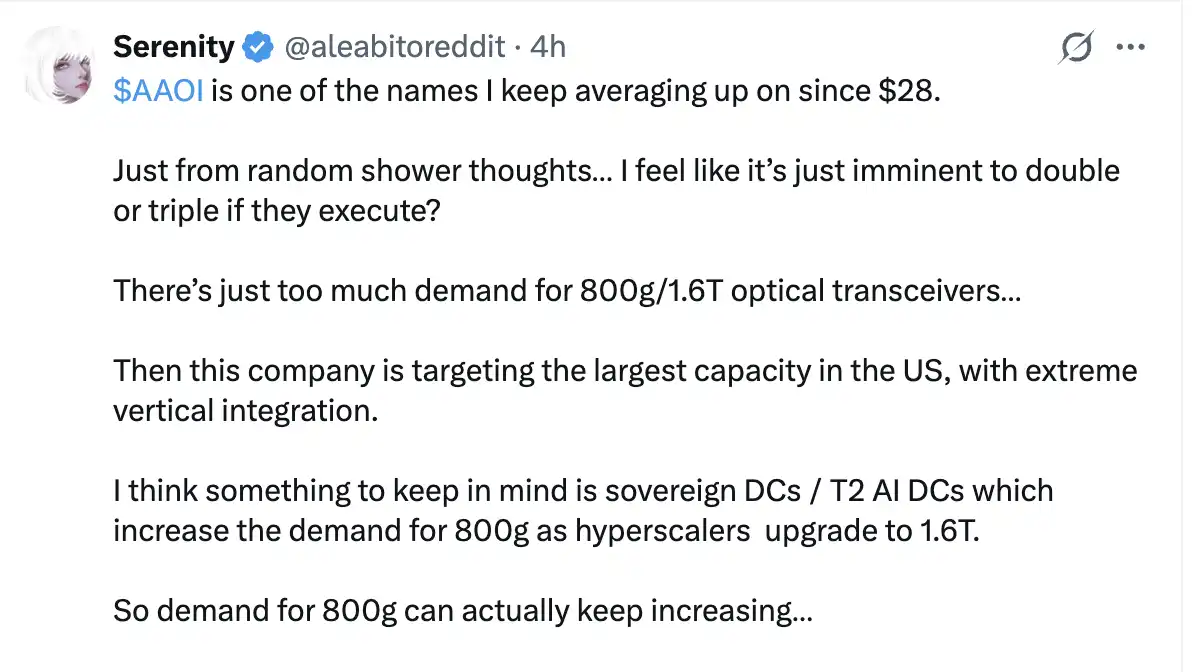
It's worth noting that AAOI has a potential additional driver: Serenity, known in Chinese circles as the "New Stock God," has posted multiple times expressing bullishness on AAOI, considering it his most favored optical communications exposure in the US stock market. He started building a position from $28 and believes it could be "the next SanDisk."
Logic Behind the Counter-Trend Strength: 'Differentiated Pricing' Within the AI Sector

AAOI's counter-trend strength on June 4th should not be interpreted as a counterexample to AI valuation concerns, but rather as an early signal that the market is beginning to engage in "differentiated pricing" within the AI sector.

One of Serenity's public judgments in April was that optical communication stocks might exhibit greater resilience than large-cap tech stocks: "Even if the S&P 500 falls another 20%, optical communication companies could still outperform." This logic is rooted in supply chain scarcity, with InP substrates, laser light sources, and 800G optical module capacity all in a state of structural tightness in the near-to-medium term, placing pricing power on the supply side rather than the demand side.

The selling pressure triggered by Broadcom's guidance essentially represents a correction to the "custom ASIC + high customer concentration" narrative, not a correction to the total demand for AI infrastructure. From this perspective, optical communication stocks, strongly tied to downstream compute deployment, do not directly overlap in narrative terms with Broadcom's core issues (customer concentration, potential Google supply chain diversification).

However, risks remain. AAOI's current stock price implies a valuation that already incorporates extremely high execution expectations, assuming it achieves the $1.4 billion annualized optical module revenue run rate by Q3 2027 while maintaining high margins. If Q2 or Q3 earnings fail to validate the 800G production ramp-up timeline, or if any issues arise with customer concentration risks (Amazon, Microsoft), the valuation structure could experience severe turbulence. The actual Q1 earnings were already weak; this crack is currently masked by order growth and capacity expansion narratives but has not been fully eliminated.

For observers in the Chinese market, what is noteworthy about AAOI's counter-trend move is not the gain itself, but the directional choice of capital differentiation within the market. When the overarching AI narrative shows its first cracks, the willingness of capital to buy into AAOI precisely during Broadcom's sell-off itself indicates a judgment: Broadcom's problems are not equivalent to all AI capital expenditure problems, and optical communications remains a recognized "physical bottleneck" narrative. Whether this judgment holds true will ultimately depend on the actual earnings reports in the coming quarters.


Câu hỏi Liên quan

QWhat was the main catalyst that led to the sell-off in AI and semiconductor stocks on June 4th, according to the article?

AThe main catalyst was Broadcom's Q2 earnings report. While the revenue and EPS beat expectations, the company's guidance for the current quarter failed to meet the market's elevated expectations. Additionally, CEO Hock Tan's comments about major customer Google potentially diversifying its supply chain and the expansion of chip business hurting margins undermined the core AI valuation narrative.

QHow did AAOI's stock price perform on June 4th, in contrast to the broader AI/semiconductor sector?

AWhile stocks like Broadcom, Micron, and AMD fell sharply, AAOI experienced a strong independent rally. Its stock price rose over 10%, climbing from around $171 intraday to close at $202.89, sharply contrasting with the sector-wide sell-off.

QWhat are the key fundamental drivers supporting AAOI's positive outlook, as mentioned by analysts?

AKey drivers include: 1) The start of revenue contribution from 800G optical modules for Amazon. 2) Potential qualification with Oracle opening a second major revenue line. 3) Strong demand across its 100G/400G/800G to emerging 1.6T product portfolio. 4) A disclosed order book of over $324 million for 800G/1.6T modules. 5) Significant capacity expansion plans, aiming for a $1.4 billion annualized run rate for its module business by Q3 2027.

QWhat significant risk or weakness in AAOI's current situation does the article highlight?

AThe article highlights that AAOI's Q1 2026 earnings actually missed expectations, with a GAAP net loss of $14.3 million. Its Q2 guidance for adjusted EPS is only between -$0.03 and +$0.03, indicating it is barely at breakeven. Risks include a delay in 800G mass production to the second half of the year, execution risks from over-reliance on customer forecasts, and recent insider stock sales by executives.

QHow does the article interpret AAOI's rally amid a sector sell-off? What does it signal about market behavior?

AThe article interprets it not as a counter-example to AI valuation concerns, but as an early signal of 'differentiated pricing' within the AI sector. It suggests the market is distinguishing between Broadcom's specific issues (custom ASIC, customer concentration) and the broader AI infrastructure demand. The willingness to buy AAOI while selling Broadcom indicates a belief that the 'physical bottleneck' narrative for optical communication remains valid, even as the initial AI hype faces a correction.

Nội dung Liên quan

Thị Trường Trước Niêm Yết của Anthropic Sụt Giảm Sau Lệnh Hoa Kỳ Buộc Ngừng Hoạt Động Mô Hình

Công ty trí tuệ nhân tạo Anthropic thông báo đã nhận chỉ thị từ chính phủ Mỹ vào ngày 12/6, yêu cầu ngừng cung cấp quyền truy cập hai mô hình Claude Fable 5 và Claude Mythos 5 cho người nước ngoài, kể cả nhân viên nước ngoài trong công ty. Để tuân thủ, Anthropic đã vô hiệu hóa cả hai mô hình trên toàn cầu. Lệnh này được mô tả là một biện pháp kiểm soát xuất khẩu khẩn cấp liên quan đến an ninh quốc gia. Các mô hình khác như Claude Opus 4.8 không bị ảnh hưởng. Anthropic phản đối quyết định này, cho biết chính phủ chỉ cung cấp bằng chứng bằng lời nói về một lỗ hổng "jailbreak" hẹp và không phổ biến, liên quan đến việc yêu cầu mô hình xem xét một mã nguồn cụ thể. Công ty lập luận lỗ hổng này nhỏ, đã biết trước và có thể được tìm thấy bởi các mô hình công khai khác, không cần thiết phải đóng cửa toàn bộ mô hình thương mại. Họ cảnh báo tiêu chuẩn này nếu áp dụng rộng rãi có thể đình chỉ mọi triển khai mô hình mới của các nhà cung cấp AI tiên phong. Thị trường tiền điện tử đang theo dõi sự việc do các hợp đồng phái sinh liên kết pre-IPO của Anthropic, cho phép giao dịch phản ánh tâm lý về lĩnh vực AI. Ngay sau chỉ thị, hợp đồng vĩnh viễn Anthropic trên Hyperliquid đã giảm 3.7%. Sự kiện này cho thấy quy định AI đang trở thành yếu tố có thể giao dịch được, và cơ sở hạ tầng AI đang hòa vào bản đồ thị trường đầu cơ cùng với crypto. Tuy nhiên, rủi ro là các thị trường này có thể biến động mạnh dựa trên thông tin không đầy đủ, trong khi báo cáo kỹ thuật của chính phủ chưa được công khai.

bitcoinist3 giờ trước

Thị Trường Trước Niêm Yết của Anthropic Sụt Giảm Sau Lệnh Hoa Kỳ Buộc Ngừng Hoạt Động Mô Hình

bitcoinist3 giờ trước

Ví Khai Thác Chuyển Đổi Token Bị Đánh Cắp Thành 18,510 ETH Và 1,548 BNB

Ví tiền liên quan đến một vụ khai thác lỗ hổng bảo mật đã chuyển đổi tài sản bị đánh cắp thành 18,510 ETH (khoảng 30,83 triệu USD) và 1.548 BNB (khoảng 924.000 USD), theo cảnh báo theo dõi trên chuỗi được WuBlockchain chia sẻ, trích dẫn dữ liệu từ Lookonchain. Việc chuyển đổi này đáng chú ý vì sau khi khai thác, các ví thường chuyển từ các token kém thanh khoản hoặc dễ bị truy vết sang các tài sản có tính thanh khoản cao hơn như ETH và BNB trước khi cố gắng rút tiền. Kẻ tấn công được cho là liên quan đến token "H" bị xâm phạm và vẫn đang nắm giữ số token trị giá khoảng 14 triệu USD. Các giao dịch hoán đổi lớn sau khai thác quan trọng vì chúng có thể gây áp lực bán lên tài sản, hé lộ bước di chuyển tiếp theo của kẻ tấn công và cung cấp manh mối cho các nhà điều tra. Trong khi theo dõi trên chuỗi (on-chain) giúp hiển thị các chuyển động này, việc xác định danh tính thực tế của người kiểm soát ví vẫn là thách thức. Các ví có thể nhanh chóng chia nhỏ hoặc chuyển tài sản xuyên chuỗi, làm phức tạp công tác truy vết. Báo cáo nhấn mạnh tầm quan trọng của việc theo dõi dữ liệu để hiểu cách quỹ bị đánh cắp được hợp nhất, đồng thời lưu ý rằng thông tin từ các nguồn như Lookonchain và WuBlockchain cung cấp cái nhìn nhanh chóng, nhưng không thay thế cho báo cáo điều tra chính thức. Việc chuyển đổi sang các tài sản có tính thanh khoản cao như ETH và BNB thường là giai đoạn phổ biến, làm phức tạp thêm các lựa chọn thu hồi tài sản sau đó.

bitcoinist6 giờ trước

Ví Khai Thác Chuyển Đổi Token Bị Đánh Cắp Thành 18,510 ETH Và 1,548 BNB

bitcoinist6 giờ trước

Từ 119 đến 176 USD: Phía sau vụ IPO của SpaceX, MSX một lần nữa chứng minh vòng khép kín Pre-IPO

Tiếp nối thành công từ Cerebras với lợi nhuận 300% vào tháng 5, MSX một lần nữa chứng minh mô hình Pre-IPO của mình qua vụ IPO lịch sử của SpaceX. Ngày 12 tháng 6, SpaceX (SPCX) chính thức lên sàn Nasdaq với mức vốn hóa đỉnh điểm đạt 2,3 nghìn tỷ USD. Đối với người dùng MSX, đây là thời điểm then chốt để hiện thực hóa lợi nhuận từ dự án Pre-IPO SpaceX được mở bán từ tháng 3 với giá 119 USD. Tính theo giá đóng cửa phiên đầu tiên (166,85 USD), lợi nhuận đạt khoảng 40%. Thành công này đánh dấu lần thứ hai MSX hoàn tất một cách trọn vẹn vòng khép kín Pre-IPO, từ đăng ký mua, nắm giữ, đến niêm yết, giao dịch và chốt lời. Quy trình 6 bước này đã được kiểm chứng trong đợt IPO SpaceX, khi một số nền tảng khác gặp sự cố về hạn ngạch và phải hoàn tiền cho người dùng. Trước đó, vào tháng 5, MSX đã giao dịch thành công cổ phiếu Cerebras (CBRS) ngay sau khi công ty này lên sàn, mang về lợi nhuận lên tới 300% cho những người tham gia từ giai đoạn Pre-IPO. Hai trường hợp liên tiếp này cho thấy giá trị thực sự của sản phẩm Pre-IPO không chỉ nằm ở việc cung cấp cổ phần sớm, mà quan trọng hơn là khả năng tạo ra một lộ trình rõ ràng và khả thi để chuyển đổi tài sản và thoát vốn sau khi công ty niêm yết. MSX tiếp tục mở rộng danh mục dự án Pre-IPO tiềm năng, tập trung vào các lĩnh vực như AI và công nghệ tiên phong, nhằm mang đến cho người dùng Web3 cơ hội tham gia vào các tài săng tăng trưởng toàn cầu trước khi chúng lên sàn chính thức.

Odaily星球日报10 giờ trước

Từ 119 đến 176 USD: Phía sau vụ IPO của SpaceX, MSX một lần nữa chứng minh vòng khép kín Pre-IPO

Odaily星球日报10 giờ trước

Giao dịch

Giao ngay
Hợp đồng Tương lai

Bài viết Nổi bật

Làm thế nào để Mua ADA

Chào mừng bạn đến với HTX.com! Chúng tôi đã làm cho mua Cardano (ADA) trở nên đơn giản và thuận tiện. Làm theo hướng dẫn từng bước của chúng tôi để bắt đầu hành trình tiền kỹ thuật số của bạn.Bước 1: Tạo Tài khoản HTX của BạnSử dụng email hoặc số điện thoại của bạn để đăng ký tài khoản miễn phí trên HTX. Trải nghiệm hành trình đăng ký không rắc rối và mở khóa tất cả tính năng. Nhận Tài khoản của tôiBước 2: Truy cập Mua Crypto và Chọn Phương thức Thanh toán của BạnThẻ Tín dụng/Ghi nợ: Sử dụng Visa hoặc Mastercard của bạn để mua Cardano (ADA) ngay lập tức.Số dư: Sử dụng tiền từ số dư tài khoản HTX của bạn để giao dịch liền mạch.Bên thứ ba: Chúng tôi đã thêm những phương thức thanh toán phổ biến như Google Pay và Apple Pay để nâng cao sự tiện lợi.P2P: Giao dịch trực tiếp với người dùng khác trên HTX.Thị trường mua bán phi tập trung (OTC): Chúng tôi cung cấp những dịch vụ được thiết kế riêng và tỷ giá hối đoái cạnh tranh cho nhà giao dịch.Bước 3: Lưu trữ Cardano (ADA) của BạnSau khi mua Cardano (ADA), lưu trữ trong tài khoản HTX của bạn. Ngoài ra, bạn có thể gửi đi nơi khác qua chuyển khoản blockchain hoặc sử dụng để giao dịch những tiền kỹ thuật số khác.Bước 4: Giao dịch Cardano (ADA)Giao dịch Cardano (ADA) dễ dàng trên thị trường giao ngay của HTX. Chỉ cần truy cập vào tài khoản của bạn, chọn cặp giao dịch, thực hiện giao dịch và theo dõi trong thời gian thực. Chúng tôi cung cấp trải nghiệm thân thiện với người dùng cho cả người mới bắt đầu và người giao dịch dày dạn kinh nghiệm.

Tổng lượt xem 1.2kXuất bản vào 2024.12.10Cập nhật vào 2026.06.02

Làm thế nào để Mua ADA

Thảo luận

Chào mừng đến với Cộng đồng HTX. Tại đây, bạn có thể được thông báo về những phát triển nền tảng mới nhất và có quyền truy cập vào thông tin chuyên sâu về thị trường. Ý kiến ​​của người dùng về giá của ADA (ADA) được trình bày dưới đây.

活动图片