Behind Changxin Technology, Stands a Group of A-Share Companies

marsbitXuất bản vào 2026-05-28Cập nhật gần nhất vào 2026-05-28

Tóm tắt

Changxin Technology, a leading Chinese DRAM (Dynamic Random Access Memory) manufacturer, has passed the review by the STAR Market listing committee, moving closer to an IPO. The company, seeking to raise 29.5 billion yuan, is the first to utilize the new "pre-review mechanism" on the STAR Market, expediting its approval process within five months. As China's largest and most technologically advanced integrated DRAM company, Changxin has achieved mass production of mainstream DDR5 and LPDDR5X products. It holds the fourth-largest global market share and ranks first in China, though it still trails behind industry leaders Samsung, SK Hynix, and Micron in areas like HBM technology. The company reported its first annual profit in 2025, with net profit surging to 24.762 billion yuan in Q1 2026, driven by booming AI-related demand. The IPO has drawn significant market attention due to Changxin's extensive and prestigious shareholder base. This includes state-backed funds like the National Integrated Circuit Industry Investment Fund II, industrial partner GigaDevice, internet giants (Xiaomi, Alibaba, Tencent), and several securities firms and A-share listed companies such as InfoMotion, Shangfeng Cement, and Hefei Urban Construction, which stand to benefit from the listing. The company's founder, Zhu Yiming, a pivotal figure in China's semiconductor industry who also founded GigaDevice, has committed to an unprecedented long-term lock-up of his shares and a massive personal equit...

Source: Cailian Press

Today (May 27), the domestic DRAM (Dynamic Random-Access Memory) leader—Changxin Technology Group Co., Ltd. (hereinafter referred to as "Changxin Technology")—successfully passed the review by the STAR Market listing committee and is about to enter the capital market.
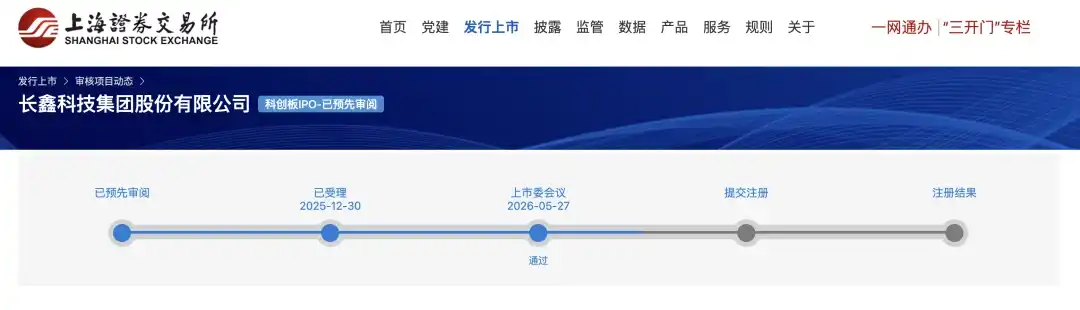
As the first "pre-review" project on the STAR Market and a hard-tech behemoth aiming to raise 29.5 billion yuan, Changxin Technology's passage of the review coincides with its tenth anniversary. This is not only a milestone for the company's own development but also marks a crucial step for China's memory chip industry in breaking the long-term overseas monopoly and moving towards self-reliance and controllability.

From Acceptance to Passing Review: Less Than 5 Months

It took Changxin Technology less than five months from IPO acceptance on the STAR Market to passing the review.

As the first company to apply for listing using the IPO "Pre-Review Mechanism" after the STAR Market reform policy in July 2025, Changxin Technology's listing review process was special and high-priority, significantly shortening the listing cycle while avoiding targeted competition from peers due to early disclosure of business and technical information.

Judging from previous rounds of inquiries by the exchange, concerns primarily focused on three core issues: the industry cycle, technological gap, and sustainability of profitability, all directly addressing the pain points of the DRAM industry and key aspects of the company's development.

In response, Changxin Technology stated in its inquiry replies that the DRAM industry is significantly influenced by market supply-demand fluctuations and exhibits pronounced cyclical characteristics. Furthermore, as the supply side of the DRAM market is highly concentrated, with Samsung Electronics, SK Hynix, and Micron Technology holding the vast majority of market share, their capital expenditures are relatively concentrated. Decisions to add or reduce capacity are often released simultaneously, thereby intensifying the industry's cyclical nature and causing significant volatility in DRAM market prices. DRAM products have a high degree of standardization, and the company sets product prices with reference to market prices. Fluctuations in market prices directly affect the company's product unit prices and revenue, thereby impacting its profits.

Samsung Electronics, SK Hynix, and Micron Technology have developed over several decades, possessing first-mover technological advantages and cost advantages, making them more resilient to risks and market shocks. In contrast, Changxin Technology started its development relatively late and is still in the capacity construction and ramp-up phase. Ramping up production capacity for new production lines typically takes multiple quarters, and building a new wafer fab from capital expenditure to capacity release can take several years. Consequently, at this stage, the company still lags behind international leading manufacturers in terms of revenue scale, production capacity scale, and product portfolio. Not only are its production costs relatively higher, but it is also more prone to negative product gross margins or increased inventory write-downs when market competition intensifies and product prices fall compared to leading manufacturers.

In the 2024 global DRAM market, Samsung Electronics, SK Hynix, and Micron Technology held market shares of 40.35%, 33.19%, and 20.73% respectively. Changxin Technology ranked fourth globally and first in China in terms of global market share.

In its inquiries, the exchange also focused on the technological gap between Changxin Technology and the aforementioned overseas leaders, as well as the progress of industry localization.

Changxin Technology has achieved mass production of DDR5/LPDDR5X, filling the domestic gap for general-purpose DRAM. However, a gap still exists in HBM (High Bandwidth Memory) compared to Samsung and SK Hynix.

Changxin Technology stated that after years of development, it has become China's largest, most technologically advanced, and most comprehensively positioned DRAM research, design, and manufacturing integrated enterprise. It has established product portfolios covering the two major mainstream product series: DDR and LPDDR. Moreover, each series can provide the most advanced DDR5, LPDDR5/5X products currently on the market. Its products are widely used in markets such as servers, mobile devices, personal computers, and smart vehicles. The performance of its main products has reached internationally advanced levels, demonstrating strong product competitiveness.

Starting from the second half of 2025, the AI computing power explosion drove a surge in memory prices, allowing Changxin Technology to achieve its first annual profit turnaround. For the full year 2025, the company achieved a net profit attributable to shareholders of 1.875 billion yuan. By the first quarter of 2026, its net profit attributable to shareholders reached 24.762 billion yuan, with a daily profit exceeding 275 million yuan.

In the SSE's inquiry, Changxin was required to disclose its future profit prospects and uncertainties regarding its future development.

Changxin Technology stated that DRAM, as the core hub of artificial intelligence computing power systems, has seen explosive growth in market demand driven by the rapid development of AI and high-speed growth in related infrastructure investment. This was one of the main reasons for the company's performance growth since the second half of 2025.

However, the performance of companies in the DRAM industry is susceptible to cyclical fluctuations. Represented by Samsung Electronics, SK Hynix, and Micron Technology, these companies started relatively early and, after years of development and accumulation, have built strong scale, product, and technological advantages, equipping them with a certain degree of resilience against cyclical fluctuations.

Nevertheless, Changxin Technology also stated, "As production capacity continues to be released, the company's production capacity scale is rapidly catching up with the top three international manufacturers, and its competitiveness continues to strengthen. Meanwhile, with product sales achieving rapid growth, the company has developed strong resilience against cyclical fluctuations. Therefore, under the current favorable market expectations, the company expects to achieve profitability in 2026 or 2027, which is reasonable and prudent."

Luxurious Shareholder List, Many A-Share Companies May Benefit

Due to the extremely high upfront production and R&D investments required for storage chip manufacturers using the IDM model, Changxin Technology's development has undergone multiple rounds of financing, ultimately forming a large-scale and diverse shareholder base.

Changxin Technology has no controlling shareholder or actual controller. Its largest shareholder is Hefei Qinghui Jidian Enterprise Management Partnership (Limited Partnership), directly holding 21.67% of the company's shares.

Among Changxin Technology's shareholders are state-backed investors such as the National Integrated Circuit Industry Investment Fund Phase II (Big Fund II), Anhui Provincial Investment Group, and Guotiao Fund.

Simultaneously, industrial capital like Gigadevice is deeply bound with it, and internet and consumer electronics giants such as Midea Capital, Xiaomi, Alibaba, and Tencent also appear on the shareholder list.

Furthermore, Changxin Technology's early-stage investors include a host of well-known market-oriented investment institutions such as China Merchants Capital, Legend Capital, An Yuan Fund, Cornerstone Capital, Yanchuang Capital, Lanpu Investment, Yunfeng Capital, Yan Yuan Venture Capital, Mingsheng Capital, Qianhai Fund of Funds, and Huafu Jiaye.

On the eve of Changxin Technology's listing, as several listed companies' affiliated funds had previously invested in Changxin, the market derived a related concept sector for Changxin Technology. Every time its listing progress was updated, from its tutoring filing to the review meeting, it attracted high market attention.

In Changxin Technology's latest prospectus, five brokerages—China Merchants Securities, Huaan Securities, China Securities Co., Ltd., Founder Securities, and China International Capital Corporation Limited—appeared, having invested in Changxin Technology through their subsidiaries or participating funds respectively. Considering that Changxin Technology's market capitalization may reach trillions of yuan upon listing, the book value of these brokerages' equity holdings is expected to significantly boost their net profit figures. Brokerage stocks have also been sought after by market funds due to the progress of Changxin's IPO.

Additionally, since the beginning of this year, several listed companies have disclosed their equity investment ties with Changxin Technology through channels such as investor interaction platforms.

Apart from Gigadevice, multiple A-share companies including Infusion, Shangfeng Cement, Hefei Urban Construction, Hefei Department Store Group, and Zhongshan Public Utilities have successively revealed that they had invested in Changxin Technology through their affiliated private equity funds.

According to an announcement disclosed by Gigadevice in 2024, after participating in Changxin Technology's financing with 1.5 billion yuan of its own funds, its shareholding increased to approximately 1.88% post-investment. Infusion indicated on an interactive platform as early as July 2025 that it had made early-stage investments in Changxin Storage. Infusion is a long-term partner and important supplier of Changxin Storage, cooperating with Changxin's Hefei, Beijing, and Shanghai plants. Shangfeng Cement also stated on an interactive platform in October 2025 that the company invested 200 million yuan in Changxin Technology through the private equity investment fund Shanghai Junzhipu Venture Capital Partnership (Limited Partnership), indirectly holding about 0.15% of the shares.

Zhu Yiming's Hardcore Chip Making and Breakthrough Path

In the wave of domestic DRAM breaking through from being "strangled" to achieving breakthroughs, Zhu Yiming is an unavoidable core figure. He single-handedly founded Gigadevice, turning it into the "first domestic storage design stock," and on the other hand, established Changxin Technology, breaking the nearly four-decade DRAM monopoly of Samsung, SK Hynix, and Micron, making it the world's fourth-largest memory manufacturer.

Born in 1972 into an ordinary family in Funing, Yancheng, Jiangsu, Zhu Yiming came from a modest background but possessed exceptional talent. At 17, he entered the Physics Department of Tsinghua University with the second-highest college entrance examination score in the county, earning his bachelor's and master's degrees within five years, showcasing his technical aptitude.

In 1997, Zhu Yiming went to the United States for further studies, pursuing a master's degree in Electrical Engineering at Stony Brook University, State University of New York. After graduation, he successively worked at ipolicy Networks Inc. and Monolithic System Technologies Inc., rising from a senior engineer to project leader in the industry, with an annual salary of millions and settled in California. However, a comfortable life never eroded his original aspiration. After years of research and experience in the industry, Zhu witnessed firsthand the transfer of the storage industry from the US to Japan, South Korea, and Taiwan, China. He also deeply understood the "stranglehold" situation of China's annual hundred-billion-level chip imports, profoundly realizing that China cannot be "chip-less." "Being chip-less means being soul-less. Without mastering core technologies, the nation's prosperity is built on sand."

In 2004, after accumulating rich experience, Zhu Yiming decided to return to China to start a business, embarking on the path of chip making.

A widely circulated assertion by Zhu Yiming about the storage industry is: If a computer is likened to a crown, the CPU is the jewel on the crown, and the memory is the base of the crown. Naturally, the base requires more gold and jewels. The memory market is the largest in the IC industry; whenever a new process is born, the first thing it makes is memory. As semiconductor processes move into the deep sub-micron era, the proportion of various memory types in integrated circuits gradually increases. Whoever leads memory technology can dominate the entire integrated circuit industry.

In 2005, in a roughcast room at Tsinghua Science Park in Beijing, Zhu Yiming founded "Xin Ji Jia Yi," the predecessor of Gigadevice, with a startup capital of only $920,000. The initial stage of entrepreneurship could be described as a "hellish start." Therefore, in strategic choice, Zhu avoided the crowded DRAM track and chose the relatively niche NOR Flash memory field. Until 2016, Gigadevice was listed on the main board of the Shanghai Stock Exchange, becoming the first domestic memory stock. Today, Gigadevice has grown into the world's second-largest NOR Flash supplier and a leading domestic MCU chip enterprise, with a latest market capitalization of 360 billion yuan.

After what the world saw as "success and fame," Zhu Yiming resolutely turned around, choosing to partner with the Hefei Municipal Government to establish Changxin Technology in May 2016, targeting the DRAM track monopolized overseas, with a total project investment exceeding 50 billion yuan.

In July 2018, Zhu Yiming resigned as General Manager of Gigadevice and took up the positions of Chairman and CEO of Changxin Technology full-time, vowing: "Before Changxin turns a profit, I will not receive a single cent in salary or bonus." For eight years until Changxin Technology achieved its first annual profit in 2025, Changxin continued to incur losses and faced external skepticism that "China cannot make DRAM," but Zhu gritted his teeth and persevered.

In May 2026, as Changxin Technology's STAR Market listing review approached, Zhu Yiming released the largest personal equity incentive plan in A-share history.

The updated prospectus of Changxin Technology shows that Zhu Yiming voluntarily pledged to allocate 50% of his partnership interest in Hefei Jixin Sishiyihao Enterprise Management Partnership (Limited Partnership)—amounting to approximately 768 million shares—to the employees of Changxin Technology and its consolidated subsidiaries over the 10 natural years following the 36th month after Changxin Technology's listing, for employee incentive purposes.

It is noteworthy that the incentive recipients do not include Zhu Yiming himself.

Based on a conservative market estimate of a 2 trillion yuan market capitalization, the incentive value may exceed 20 billion yuan, setting an A-share record for personal equity incentives.

Simultaneously, Zhu Yiming also pledged an ultra-long share lock-up period, promising not to transfer his held shares for the first ten years after Changxin Technology's listing. In the second ten years after the tenth anniversary of the listing, he would sell no more than 20% of the remaining locked shares from the end of the previous year annually. This arrangement of an ultra-long share lock-up period is also relatively rare in A-share history.

An investor familiar with Changxin Technology told the STAR Market Daily reporter that the high-end development of domestic memory has entered a critical stage from breakthrough to volume production, with very broad prospects. Domestic memory enterprises represented by Changxin Technology have already transitioned from followers to runners alongside, and potentially future leaders.

At the technological level, represented by domestically mass-produced DDR5 memory chips entering mainstream server supply chains, domestic DRAM has achieved alignment with international mainstream product generations. At the industrial level, from storage media and chips to systems, China has achieved breakthroughs across the entire chain, with continuously enhancing industrial chain synergy and self-reliance and controllability capabilities. At the market level, AI computing power, data center construction, and the proliferation of smart terminals have created strong and sustained demand pull for high-end memory products such as HBM and DDR5.

Câu hỏi Liên quan

QWhat is the significance of ChangXin Technology's recent approval for listing on the STAR Market?

AChangXin Technology's approval marks a milestone as the first company to use the IPO 'pre-review mechanism' on the STAR Market, signifying a major step in China's semiconductor industry towards breaking long-term foreign monopolies and achieving self-sufficiency in DRAM production.

QWho are the major shareholders of ChangXin Technology?

AChangXin Technology's shareholders include state-backed funds like the National Integrated Circuit Industry Investment Fund II, Anhui Investment Group, and Guotiao Fund; industrial capital such as GigaDevice; internet and consumer electronics giants like Midea Capital, Xiaomi, Alibaba, and Tencent; and notable market investment institutions.

QWhat challenges does ChangXin Technology face compared to international DRAM leaders like Samsung and SK Hynix?

AChangXin Technology faces challenges including a later market entry, smaller production scale, higher relative costs, and technological gaps, particularly in HBM (High Bandwidth Memory) compared to leaders like Samsung and SK Hynix. It is also more vulnerable to market cyclical fluctuations and price competition.

QWhat personal commitment did Zhu Yiming make regarding his shares in ChangXin Technology?

AZhu Yiming committed to allocating 50% of his shares in Hefei Jixin Sishiyihao (approximately 768 million shares) to employees of ChangXin Technology and its subsidiaries over ten years after the company has been listed for 36 months. He also pledged an unusually long lock-up period for his remaining shares.

QWhich A-listed companies are expected to benefit from ChangXin Technology's IPO?

AA-listed companies expected to benefit include GigaDevice, Zhenfan Technology, Shangfeng Cement, Hefei Urban Construction, Hefei Department Store Group, and Zhongshan Public Utilities, which have invested in ChangXin Technology through private equity funds. Several securities firms like China Merchants Securities are also shareholders.

Nội dung Liên quan

Sự Ra Mắt Của Warsh: Chủ Tịch Fed Hiểu Crypto Nhất Lịch Sử Sẽ Mang Đến Bất Ngờ Hay Cú Sốc Cho Thị Trường?

Tân Chủ tịch Cục Dự trữ Liên bang Kevin Warsh, người được mệnh danh là chủ tịch FED "hiểu rõ về Crypto nhất trong lịch sử", sắp có buổi họp báo chính sách đầu tiên trong bối cảnh thử thách ba mặt: lạm phát quay trở lại, áp lực giảm lãi suất từ Tổng thống Trump và kỳ vọng thị trường về việc tăng lãi suất. Khác với người tiền nhiệm, Warsh có cái nhìn sâu sắc về tài sản số, từng coi Bitcoin như "cảnh sát tốt cho chính sách" và nhấn mạnh giá trị sản xuất của ngành công nghiệp blockchain. Tuy nhiên, ông cũng nổi tiếng là người theo chủ nghĩa diều hâu về lạm phát. Sự kết hợp giữa "lãi suất chặt chẽ" và "quy định thân thiện" từ ông có thể trở thành yếu tố cốt lõi định giá tài sản mã hóa. Bài viết phân tích tác động từ ba khía cạnh: 1. **Chuyển đổi khuôn mẫu kỳ vọng quy định:** Từ phòng thủ sang tích hợp và đổi mới, có thể thúc đẩy các khung pháp lý rõ ràng hơn, hỗ trợ ổn định do khu vực tư nhân phát hành. 2. **Định giá lại lộ trình lãi suất và phần bù rủi ro:** Một chủ tịch hiểu biết và giao tiếp rõ ràng có thể giảm bớt phí bảo hiểm bất định, có lợi về cấu trúc cho thị trường. 3. **Tái phân bổ dòng vốn toàn cầu:** Kinh nghiệm đầu tư cá nhân của Warsh truyền tải tín hiệu về sự chấp nhận chính thống, có thể thúc đẩy các quỹ thể chế truyền thống phân bổ tài sản số. Hai kịch bản chính được đưa ra: * **Ngạc nhiên thú vị:** Nếu Warsh thể hiện thái độ ôn hòa và công nhận giá trị của tài sản số, thị trường có thể được tiếp thêm sức mạnh. * **Cú sốc:** Nếu ông phát tín hiệu tăng lãi suất mạnh mẽ, tài sản rủi ro, bao gồm crypto, có thể chịu áp lực bán. Mặc dù Warsh đã bán các khoản nắm giữ liên quan đến crypto để tuân thủ quy tắc đạo đức, nhưng sự hiểu biết thực sự của ông về công nghệ blockchain được kỳ vọng sẽ đặt nền tảng cho việc chính thống hóa tài sản số về lâu dài, vượt ra ngoài các phản ứng thị trường ngắn hạn.

marsbit13 phút trước

Sự Ra Mắt Của Warsh: Chủ Tịch Fed Hiểu Crypto Nhất Lịch Sử Sẽ Mang Đến Bất Ngờ Hay Cú Sốc Cho Thị Trường?

marsbit13 phút trước

XRP Ledger Ra Mắt Rebrand XRPLd Cùng Với Bản Nâng Cấp Phiên Bản 3.2.0

Phiên bản 3.2.0 của XRP Ledger đã chính thức ra mắt, đánh dấu một bước nâng cấp quan trọng cho cơ sở hạ tầng blockchain cốt lõi. Lần này, các nhà phát triển đã đổi tên phần mềm vận hành mạng từ "rippled" thành "xrpld" để phù hợp hơn với toàn bộ hệ sinh thái của dự án. Bản cập nhật tập trung chủ yếu vào các cải tiến back-end và hiệu suất thay vì tính năng người dùng mới. Các tối ưu hóa bộ nhớ được giới thiệu có khả năng tiết kiệm tới 40% lượng bộ nhớ máy chủ, đồng thời chuẩn bị kiến trúc phần mềm cho việc mở rộng quy mô trong tương lai. Về mặt bảo mật, bản sửa đổi `fixCleanup3_2_0` mang lại nhiều cải thiện cho các mô-đun như kho lưu ký tài sản đơn, giao thức cho vay, sàn giao dịch phi tập trung và mã thông báo đa năng. Các kiểm tra bất biến mới được thêm vào để đảm bảo tính toàn vẹn của sổ cái khi tài khoản bị xóa. Một khả năng mới cho nhà phát triển là ứng dụng có thể truy xuất thông tin định nghĩa giao thức và máy chủ XRP Ledger mà không cần kết nối trực tiếp, hỗ trợ đáng kể việc phát triển ví, công cụ khám phá chuỗi khối và API. Các thay đổi về khả năng mở rộng và ổn định bao gồm kích thước khối có thể cấu hình, hỗ trợ lưu trữ cơ sở dữ liệu hiệu quả qua nuDB, và việc hỗ trợ máy chủ gRPC cho TLS/mutual TLS trở thành tùy chọn. Cổng kết nối ngang hàng mặc định cũng được đổi từ 51235 sang 2459. Các tính năng kiểm tra bất biến giao dịch tạm thời bị vô hiệu hóa trong phiên bản 3.2.0 do ảnh hưởng đến hiệu suất, nhưng không gây rủi ro bảo mật.

TheNewsCrypto43 phút trước

XRP Ledger Ra Mắt Rebrand XRPLd Cùng Với Bản Nâng Cấp Phiên Bản 3.2.0

TheNewsCrypto43 phút trước

AGI không phải là điểm kết thúc, nghiên cứu mới của DeepMind: Hướng tới ASI, tiến bộ AI thực sự mới chỉ bắt đầu

DeepMind mới đây công bố nghiên cứu cho rằng AGI (Trí tuệ nhân tạo phổ quát) không phải là điểm cuối. AI sẽ tiếp tục phát triển vượt qua khả năng của các nhóm chuyên gia con người hàng đầu, hướng tới ASI (Trí tuệ siêu nhân tạo). Báo cáo phân biệt ba khái niệm: AGI (năng lực nhận thức tương đương mức trung bình của con người), ASI (vượt trội con người trong hầu hết lĩnh vực quan tâm), và UAI (giới hạn lý thuyết tối thượng). Nghiên cứu đề xuất bốn con đường tiềm năng để chuyển từ AGI sang ASI: 1. Mở rộng quy mô tính toán, mô hình và dữ liệu. 2. Tiến hóa thuật toán, có thể thay đổi mô hình mới. 3. Tự cải thiện đệ quy, tạo phản hồi tích cực. 4. Điều phối đa tác tử và trí tuệ tập thể. Đồng thời, báo cáo chỉ ra sáu điểm nghẽn chính: giới hạn dữ liệu chất lượng cao, áp lực tài nguyên và kinh tế, hạn chế của mô hình mạng nơ-ron hiện tại, nghiên cứu ngày càng khó khăn, rào cản trừu tượng, cùng các vấn đề quản lý và phản ứng xã hội. Khi AI vượt con người, các phương pháp đánh giá truyền thống sẽ mất ý nghĩa. Cần xây dựng hệ thống đánh giá mới cho thời kỳ hậu AGI. ASI không phải là hệ thống toàn năng, vẫn chịu ràng buộc bởi các quy luật vật lý, độ phức tạp tính toán, dữ liệu, tài nguyên và tốc độ phản hồi thực tế. Tương lai phát triển của AI vẫn chứa nhiều bất định, đòi hỏi một nỗ lực liên ngành quy mô lớn để theo dõi và ứng phó.

marsbit1 giờ trước

AGI không phải là điểm kết thúc, nghiên cứu mới của DeepMind: Hướng tới ASI, tiến bộ AI thực sự mới chỉ bắt đầu

marsbit1 giờ trước

Kraken Ra Mắt Hợp Đồng Perpetual Trước IPO Cho OpenAI Và Anthropic Với Đòn Bẩy Lên Đến 5x

Kraken đã ra mắt hợp đồng tương lai vĩnh viễn (perps) tiền IPO cho hai công ty trí tuệ nhân tạo hàng đầu là OpenAI và Anthropic. Các hợp đồng này cho phép các nhà giao dịch đủ điều kiện mở vị thế mua (long) hoặc bán (short) đối với các công ty tư nhân được theo dõi sát sao này trước khi họ lên sàn chứng khoán, với đòn bẩy lên tới 5x. Sản phẩm này đánh dấu một bước tiến trong việc mở rộng cơ sở hạ tầng phái sinh tiền mã hóa sang các tài sản ngoài chuỗi, cung cấp cho các nhà giao dịch một cách tiếp cận thay thế để có thể tiếp xúc với các công ty tư nhân vốn thường khó tiếp cận. Tuy nhiên, hợp đồng tiền IPO có những rủi ro đặc thù. Khác với các hợp đồng vĩnh viễn cho tiền mã hóa có giá cả minh bạch, định giá công ty tư nhân phụ thuộc vào nhiều yếu tố như các vòng gọi vốn, giao dịch thứ cấp và kỳ vọng về thời điểm IPO. Điều này khiến việc định giá và quản lý rủi ro trở nên phức tạp hơn. Việc sử dụng đòn bẩy cao có thể khuếch đại lợi nhuận nhưng cũng làm gia tăng đáng kể rủi ro thua lỗ và thanh lý. Do đó, các nhà giao dịch cần hiểu rõ bản chất của sản phẩm mới và các rủi ro độc đáo của thị trường tư nhân trước khi tham gia.

bitcoinist1 giờ trước

Kraken Ra Mắt Hợp Đồng Perpetual Trước IPO Cho OpenAI Và Anthropic Với Đòn Bẩy Lên Đến 5x

bitcoinist1 giờ trước

Các giao dịch M&A trên thị trường tiền mã hóa đang diễn ra sôi động bất thường

Thị trường mua bán và sáp nhập (M&A) trong lĩnh vực tiền mã hóa đang trở nên sôi động bất thường. Theo số liệu từ RootData, trong tháng này, số vụ M&A đã lên tới 10, trong khi số vòng gọi vốn chỉ là 14. Tỷ lệ M&A trong tổng số giao dịch thị trường sơ cấp đã đạt khoảng 42%, mức cao nhất từ trước đến nay. Hiện tượng này phản ánh trước hết là sự suy giảm kéo dài của thị trường gọi vốn. Kể từ tháng 11/2024, số lượng giao dịch M&A hàng tháng duy trì ở mức 10-20 vụ, trong khi giao dịch gọi vốn giảm mạnh từ khoảng 100 xuống còn khoảng 50 vụ. Điều này có nghĩa là M&A không thay thế cho sự sôi động của thị trường vốn, mà trở thành hình thức giao dịch ổn định hơn khi thị trường vốn thu hẹp. Các công ty lớn như Coinbase, Kraken, Ripple, MoonPay... đang tận dụng thời kỳ giá trị định thấp để mua lại các đội ngũ, giấy phép, công nghệ với chi phí thấp hơn, ít cạnh tranh hơn và có thêm quyền thương lượng. Bốn lý do chính thúc đẩy M&A là: định giá đủ rẻ, tiết kiệm chi phí thời gian và thử sai, tiếp cận nguồn lực giấy phép/tuân thủ, và hợp nhất chuỗi giá trị thượng-nhượng nguồn. Các lĩnh vực trọng tâm của M&A hiện nay bao gồm: cơ sở hạ tầng giao dịch (đặc biệt là phái sinh), thanh toán & stablecoin, giấy phép tuân thủ, và phát hành/phân phối tài sản (RWA). Làn sóng M&A này đang viết lại logic thoái vốn cho thị trường sơ cấp, cung cấp một lối thoát khác ngoài việc phụ thuộc vào phát hành token. Nó buộc các dự án phải chú trọng hơn vào giá trị sản phẩm, doanh thu thực và khả năng tích hợp chiến lược thay vì chỉ đóng gói câu chuyện để gọi vốn. Tuy nhiên, xu hướng này cũng cho thấy ngành công nghiệp tiền mã hóa đang trở nên tập trung hơn. Các nền tảng lớn dần nắm giữ tài sản, thanh khoản và giấy phép, khiến việc gia nhập thị trường của các startup mới ngày càng khó khăn, đánh dấu sự kết thúc của thời kỳ khởi nghiệp dễ dàng.

链捕手2 giờ trước

Các giao dịch M&A trên thị trường tiền mã hóa đang diễn ra sôi động bất thường

链捕手2 giờ trước

Giao dịch

Giao ngay
Hợp đồng Tương lai

Bài viết Nổi bật

Làm thế nào để Mua USOIL

Chào mừng bạn đến với HTX.com! Chúng tôi đã làm cho mua WTI Crude USOil/ CL (USOIL) trở nên đơn giản và thuận tiện. Làm theo hướng dẫn từng bước của chúng tôi để bắt đầu hành trình tiền kỹ thuật số của bạn.Bước 1: Tạo Tài khoản HTX của BạnSử dụng email hoặc số điện thoại của bạn để đăng ký tài khoản miễn phí trên HTX. Trải nghiệm hành trình đăng ký không rắc rối và mở khóa tất cả tính năng. Nhận Tài khoản của tôiBước 2: Truy cập Mua Crypto và Chọn Phương thức Thanh toán của BạnThẻ Tín dụng/Ghi nợ: Sử dụng Visa hoặc Mastercard của bạn để mua WTI Crude USOil/ CL (USOIL) ngay lập tức.Số dư: Sử dụng tiền từ số dư tài khoản HTX của bạn để giao dịch liền mạch.Bên thứ ba: Chúng tôi đã thêm những phương thức thanh toán phổ biến như Google Pay và Apple Pay để nâng cao sự tiện lợi.P2P: Giao dịch trực tiếp với người dùng khác trên HTX.Thị trường mua bán phi tập trung (OTC): Chúng tôi cung cấp những dịch vụ được thiết kế riêng và tỷ giá hối đoái cạnh tranh cho nhà giao dịch.Bước 3: Lưu trữ WTI Crude USOil/ CL (USOIL) của BạnSau khi mua WTI Crude USOil/ CL (USOIL), lưu trữ trong tài khoản HTX của bạn. Ngoài ra, bạn có thể gửi đi nơi khác qua chuyển khoản blockchain hoặc sử dụng để giao dịch những tiền kỹ thuật số khác.Bước 4: Giao dịch WTI Crude USOil/ CL (USOIL)Giao dịch WTI Crude USOil/ CL (USOIL) dễ dàng trên thị trường giao ngay của HTX. Chỉ cần truy cập vào tài khoản của bạn, chọn cặp giao dịch, thực hiện giao dịch và theo dõi trong thời gian thực. Chúng tôi cung cấp trải nghiệm thân thiện với người dùng cho cả người mới bắt đầu và người giao dịch dày dạn kinh nghiệm.

Tổng lượt xem 134Xuất bản vào 2026.05.25Cập nhật vào 2026.05.25

Làm thế nào để Mua USOIL

Làm thế nào để Mua WALLI

Chào mừng bạn đến với HTX.com! Chúng tôi đã làm cho mua Wallitelli (WALLI) trở nên đơn giản và thuận tiện. Làm theo hướng dẫn từng bước của chúng tôi để bắt đầu hành trình tiền kỹ thuật số của bạn.Bước 1: Tạo Tài khoản HTX của BạnSử dụng email hoặc số điện thoại của bạn để đăng ký tài khoản miễn phí trên HTX. Trải nghiệm hành trình đăng ký không rắc rối và mở khóa tất cả tính năng. Nhận Tài khoản của tôiBước 2: Truy cập Mua Crypto và Chọn Phương thức Thanh toán của BạnThẻ Tín dụng/Ghi nợ: Sử dụng Visa hoặc Mastercard của bạn để mua Wallitelli (WALLI) ngay lập tức.Số dư: Sử dụng tiền từ số dư tài khoản HTX của bạn để giao dịch liền mạch.Bên thứ ba: Chúng tôi đã thêm những phương thức thanh toán phổ biến như Google Pay và Apple Pay để nâng cao sự tiện lợi.P2P: Giao dịch trực tiếp với người dùng khác trên HTX.Thị trường mua bán phi tập trung (OTC): Chúng tôi cung cấp những dịch vụ được thiết kế riêng và tỷ giá hối đoái cạnh tranh cho nhà giao dịch.Bước 3: Lưu trữ Wallitelli (WALLI) của BạnSau khi mua Wallitelli (WALLI), lưu trữ trong tài khoản HTX của bạn. Ngoài ra, bạn có thể gửi đi nơi khác qua chuyển khoản blockchain hoặc sử dụng để giao dịch những tiền kỹ thuật số khác.Bước 4: Giao dịch Wallitelli (WALLI)Giao dịch Wallitelli (WALLI) dễ dàng trên thị trường giao ngay của HTX. Chỉ cần truy cập vào tài khoản của bạn, chọn cặp giao dịch, thực hiện giao dịch và theo dõi trong thời gian thực. Chúng tôi cung cấp trải nghiệm thân thiện với người dùng cho cả người mới bắt đầu và người giao dịch dày dạn kinh nghiệm.

Tổng lượt xem 457Xuất bản vào 2026.05.27Cập nhật vào 2026.06.10

Làm thế nào để Mua WALLI

Làm thế nào để Mua GRAM

Chào mừng bạn đến với HTX.com! Chúng tôi đã làm cho mua prev. Toncoin (GRAM) trở nên đơn giản và thuận tiện. Làm theo hướng dẫn từng bước của chúng tôi để bắt đầu hành trình tiền kỹ thuật số của bạn.Bước 1: Tạo Tài khoản HTX của BạnSử dụng email hoặc số điện thoại của bạn để đăng ký tài khoản miễn phí trên HTX. Trải nghiệm hành trình đăng ký không rắc rối và mở khóa tất cả tính năng. Nhận Tài khoản của tôiBước 2: Truy cập Mua Crypto và Chọn Phương thức Thanh toán của BạnThẻ Tín dụng/Ghi nợ: Sử dụng Visa hoặc Mastercard của bạn để mua prev. Toncoin (GRAM) ngay lập tức.Số dư: Sử dụng tiền từ số dư tài khoản HTX của bạn để giao dịch liền mạch.Bên thứ ba: Chúng tôi đã thêm những phương thức thanh toán phổ biến như Google Pay và Apple Pay để nâng cao sự tiện lợi.P2P: Giao dịch trực tiếp với người dùng khác trên HTX.Thị trường mua bán phi tập trung (OTC): Chúng tôi cung cấp những dịch vụ được thiết kế riêng và tỷ giá hối đoái cạnh tranh cho nhà giao dịch.Bước 3: Lưu trữ prev. Toncoin (GRAM) của BạnSau khi mua prev. Toncoin (GRAM), lưu trữ trong tài khoản HTX của bạn. Ngoài ra, bạn có thể gửi đi nơi khác qua chuyển khoản blockchain hoặc sử dụng để giao dịch những tiền kỹ thuật số khác.Bước 4: Giao dịch prev. Toncoin (GRAM)Giao dịch prev. Toncoin (GRAM) dễ dàng trên thị trường giao ngay của HTX. Chỉ cần truy cập vào tài khoản của bạn, chọn cặp giao dịch, thực hiện giao dịch và theo dõi trong thời gian thực. Chúng tôi cung cấp trải nghiệm thân thiện với người dùng cho cả người mới bắt đầu và người giao dịch dày dạn kinh nghiệm.

Tổng lượt xem 3Xuất bản vào 2026.06.15Cập nhật vào 2026.06.15

Làm thế nào để Mua GRAM

Thảo luận

Chào mừng đến với Cộng đồng HTX. Tại đây, bạn có thể được thông báo về những phát triển nền tảng mới nhất và có quyền truy cập vào thông tin chuyên sâu về thị trường. Ý kiến ​​của người dùng về giá của M (M) được trình bày dưới đây.

活动图片