Slonks:一个会主动消失的 NFT 项目

marsbitPublished on 2026-05-07Last updated on 2026-05-07

作者:798.eth,web3.devmeebits 中文社区创建者

http://slonks.xyz 上有一个 Merge Lab。打开 https://slonks.xyz/merge-lab 能看到一个奇怪的画面。左边是 Slonk #608,普通男性 punk 头像,slop=15。右边是 Slonk #645,普通女性 punk,slop=3。中间是合体后的样子,黑发蓝眼黄发碎片混在一起,slop=161,+146 slop。

把这张图当成 Slonks 经济学的入口,比读 whitepaper 直观 100 倍。
机制

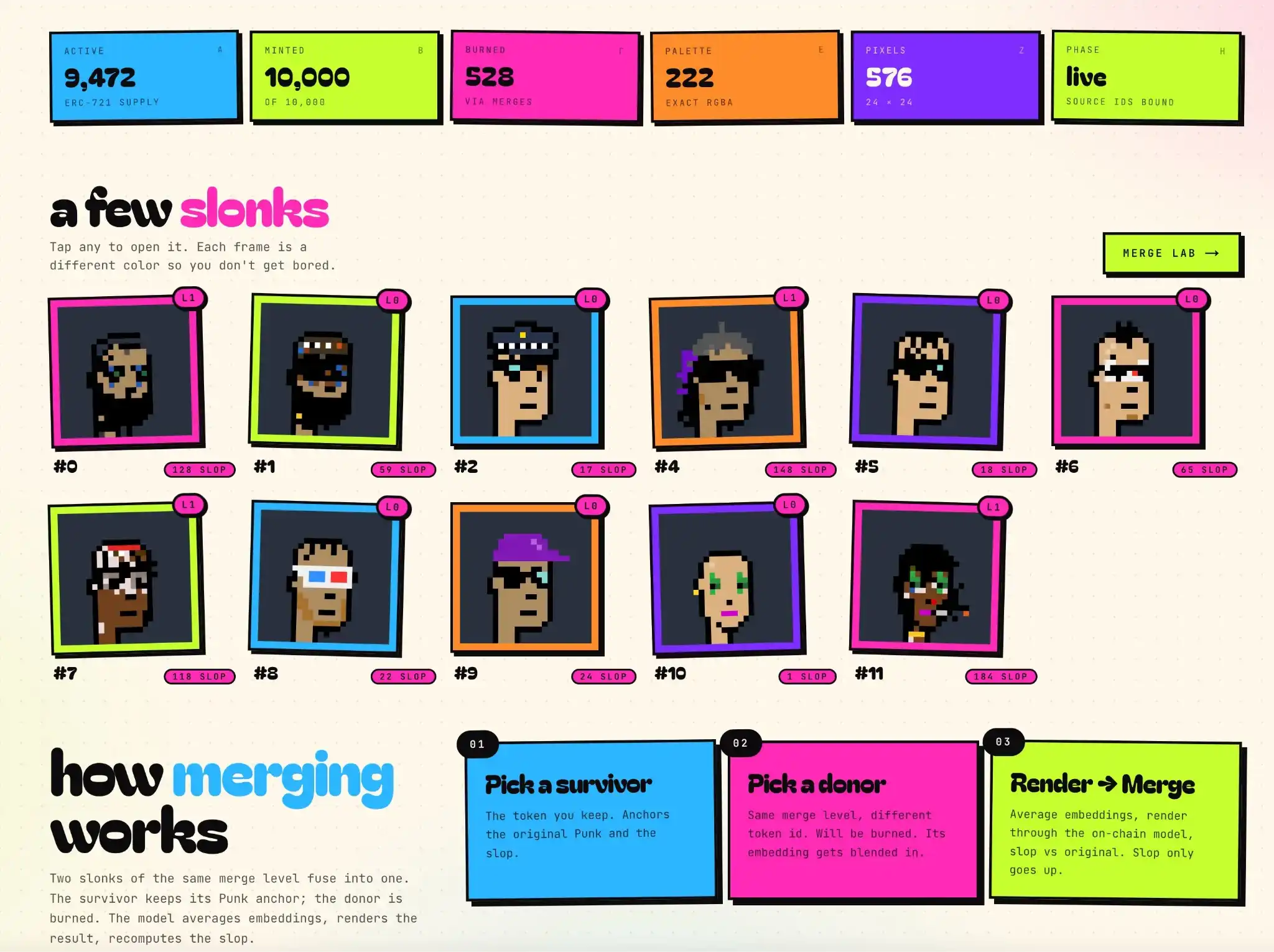
Slonks 是一个用链上神经网络模型重建 CryptoPunks 的 NFT 集合。每个 Slonk 对应一个 CryptoPunk source,模型用 24×24 像素 + 222 色调色板渲染重建图。模型并不完美,渲染图跟原 punk 之间的像素差就是这个 Slonk 的 slop 值。slop 范围 0 到 576,因为画布总共 576 像素。

正在写的 $SLOP 代币方案核心机制叫 voiding。持有者把 Slonk 送进虚空合约,合约按当前 slop 值铸出对应数量的 $SLOP。slop=15 的 Slonk void 出 15 个 $SLOP。slop=400 的 void 出 400 个。$SLOP 上限是 5,760,000,等于 10000 × 576,即每个 Slonk 全错的极限值。

merge 是另外一条路。一只 Slonk 当 survivor,另一只当 donor,donor 永久销毁,survivor 升级到下一个 merge level,拿一个新 embedding。新 embedding 渲染出新图,跟 survivor 的 source 重新对比,slop 值重新计算。

关于 merge 后 slop 升高的逻辑,此前存在误解,这里需要纠正一个机制层的细节(感谢 jef 的回复): slop 的涨幅并不是随机的,也不是单纯因为混血模型模拟能力下降,而是由两只 source punk 之间的形态差异(DIFFERENCE)决定的。例如,hoodie 大头型配上 female 小头型,形态差最大,合体后的 slop 就会飙到最高。因此,想要实现 max $SLOP yield,就要找形态差最大的搭配,小伙伴们可以去 Merge Lab 试试。

merge 自己不铸 $SLOP,但 merge 完之后 void 能铸出更多 $SLOP。这条路径在 whitepaper 里没明说,但数学上成立。#608 + #645 那个例子里,原本两只一起 void 只能铸 18 $SLOP,merge 之后 #608 单只就能铸 161 $SLOP。代价是永久失去 #645 这只 Slonk。

数据与通缩:等级是销毁的伤疤

Slonks 5 月 1 日部署,5 天过去了。当前 totalSupply 9,505,累计 mint 10,012,累计 burn 507。5.06% 的 Slonks 已经永久从链上消失。

每天 burn 数:第 1 天 0,第 2 天 79,第 3 天 175,第 4 天 60,第 5 天 69,第 6 天 124。第 3 天那个 175 是社区集中测试 merge 的爆发,第 6 天又冲到 124 是 $SLOP whitepaper 引发的策略升温。merge 速率在加速,不在减速。

值得注意的是 voiding 还没启动。$SLOP 合约还没部署,所有现在发生的 burn 都是纯 merge 行为,玩家在 $SLOP launch 之前就已经按 slop 值在做策略性消耗。

销毁让 Slonks 持续通缩,而 Slonks 的等级(mergeLevel)就是销毁的伤疤。
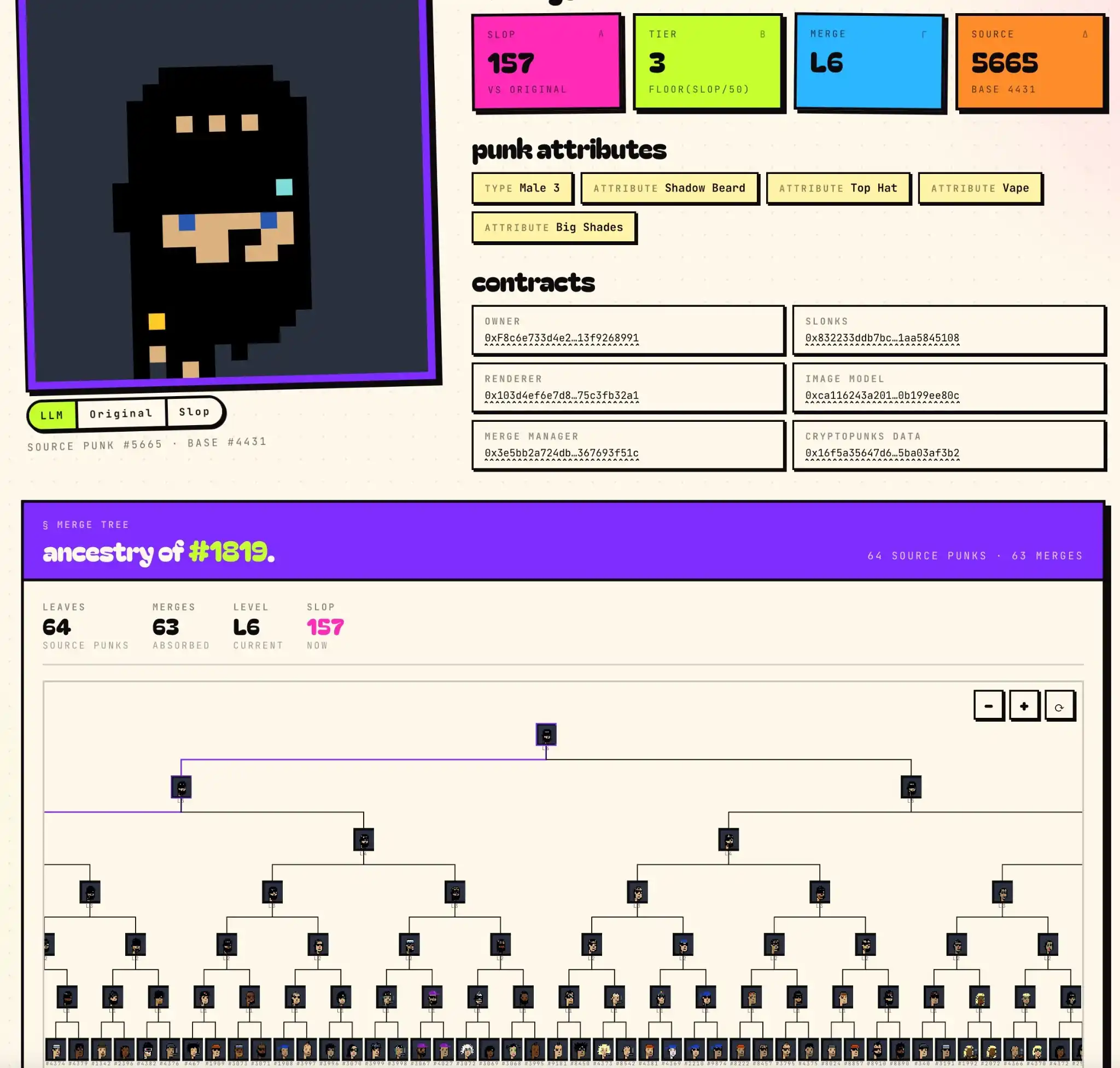
整个 collection 里 mergeLevel 大于 0 的应该不到 5%。mergeLevel 是合约里一个奇怪的字段。tokenURI 显示了,OpenSea 上能筛了,链上每只 Slonk 都记着等级数字,但合约里没有任何 view function 暴露它,没有任何机制依赖它发奖励。

它唯一的硬约束是 same-level merge。L0 只能配 L0,L1 只能配 L1。也就是说每升一级要销毁 2 倍同级 Slonks。L1 烧 2 只 L0,L2 烧 4 只 L0,L5 烧 32 只 L0,L10 烧掉 collection 总量 10% 的 Slonks。理论极限是 L13,需要烧掉 8192 只 L0 才换一只,整个 collection 根本撑不到这一级。

升级是几何级数代价,却没有几何级数奖励。跟传统游戏完全反过来,Slonks 里升级是把同类一只一只投进焚化炉。等级数字记的不是你赢过几次,是你把多少只同代 burn 掉了。mergeLevel 当前是个空 trait。team 保留了它存在的接口,未来是否可能挂 $SLOP 经济激励还未可知。但从合体后的画面可以看出,等级就是销毁过同类的痕迹。

双重估值

到这里事实层夯实了。Slonks 不存在单一估值逻辑,存在两套相互冲突的估值逻辑。

第一套估值看 source punk 的稀有度。CryptoPunks 圈内 9 只 Alien、24 只 Ape、88 只 Zombie 是公认稀有。如果一只 Slonk 的 source 是 Alien #2890 或 Ape #5275,模型不管渲染得多还原都没法消除 source 本身的稀缺溢价。这种 Slonk 越是 slop 低、还原度高,越能让 Alien 那张绿脸或者 Ape 那张猿脸保持视觉识别度。低 slop 是这类 Slonk 的核心价值。

第二套估值看 voiding 能铸出的 $SLOP 数量。slop 越高,void 出的 $SLOP 越多。这套估值跟 source punk 是不是稀有完全无关。一个普通男性 punk slop=400 的 Slonk,void 出 400 $SLOP。一个 Alien slop=15 的 Slonk,void 出 15 $SLOP。在 $SLOP 价格层面,普通 punk slop 高的远比 Alien slop 低的值钱。

两套估值在 merge 决策上直接冲突。

如果你持有 source 是 Alien 的低 slop Slonk,merge 会做两件事。

  • 一是给它一个新 embedding,渲染图不再忠实复刻 Alien 那张绿脸。
  • 二是销毁一只 donor Slonk。

结果是你拿到一个 slop 升高的 Slonk,但它视觉上看不出是 Alien 了。看不出是 Ape,看不出是 Zombie,看不出是任何稀有 punk。CryptoPunks 圈层赋予的稀缺性溢价归零。

换来的只是未来 voiding 多铸 100 $SLOP 的潜力。$SLOP 还没 launch 价格未知,但 Alien 二级市场价值有据可查。这笔交易在期望值上对持有稀有 source Slonk 的人是负的。

而对持有普通 source 低 slop Slonk 的人,merge 是正期望。这种 Slonk 既没有 source 稀缺性,又没有 $SLOP 数量价值,处于估值洼地。把它扔进 merge 改造成高 slop 是它能做的最有价值的事。

演化

把这个逻辑外推到全 collection 层面,会得到一个达尔文式的画面。

模型还原差的 Slonk 是适者。它们 slop 高,本来就是 voiding 的金矿,没人会去 merge 它们,它们活下来。

模型还原好的 Slonk 则分两层。source 稀有的活下来,没人敢 merge 因为会毁掉视觉识别度。source 普通的被回收,集中作为 donor 扔进 merge,给别的 Slonk 升级用。

最终 collection 会演化成两类共存。一类是高 slop 的“完美失败品”,模型把这些 punks 渲染得面目全非,但 voiding 价值高。另一类是低 slop 的“稀有忠实重建”,source 是 Alien/Ape/Zombie,slop 低保留视觉识别度,二级市场价值高。

中间地带的 Slonks 持续消失。普通 source 普通 slop 的 Slonks 没有任何估值优势,是 merge 的天然 donor。它们贡献给两类幸存者,自己永久退出。

5 天 5%。这个速率会随着 merge 工具普及和 $SLOP launch 临近继续上升。Slonks 是一个被设计成会主动消失的 NFT 项目。它的稀缺度不是 launch 时写死的 10000 这个数字,是市场每一笔 merge 决策共同计算的结果。

收尾

Slonks 跟 unipeg 都在玩稀缺,方向相反。unipeg 用 dust 累积让整数变得难以凑齐,NFT 数量在 6,000 上下震荡。Slonks 直接销毁,5 天少了 500 多只,速率没有放缓迹象,不可逆。

merge 这件事在 whitepaper 里被描述成中性机制。链上看不是。merge 是 Slonks 通过自我消耗实现集合估值优化的手段。每一笔 merge 都是市场在投票,把某一只 Slonk 永久从世界上移除,换取另一只的 slop 升级。

5 天前是 10,012。今天是 9,505。$SLOP 还没 launch,淘汰已经开始。

Related Reads

Sharplink CEO: One Million Ethereum Developers, Who Can Compete?

Etherean Ecosystem: One Million Developers and a Formidable Moat The Ethereum network has surpassed a significant milestone: over one million unique lifetime developers, with approximately 232,000 active in the past year. This vast and growing talent pool is Ethereum's core advantage, far more critical than transient metrics like speed or transaction fees. The central question is not which blockchain is fastest, but where the best builders choose to build long-term. Ethereum's answer lies in a decade-long accumulation of infrastructure, standards, tools, liquidity, and collaborative culture that is exceptionally difficult to replicate. It has become the default operating system for programmable finance. This massive developer base is actively working on complex, high-risk challenges that deepen Ethereum's strategic moat: * **Glamsterdam Upgrade (2026):** Focused on core protocol scalability (ePBS, parallel execution) while preserving core values like credible neutrality. * **Synchronous Composability:** Aims to make numerous Rollups interoperate like a single chain, directly addressing fragmentation concerns. * **Quantum Resistance:** Ethereum leads mainstream ecosystems in coordinated preparation for post-quantum cryptography, with a targeted migration plan around 2029. This developer advantage is self-reinforcing, fueled by: * **Deep Composability:** Applications interact like interoperable financial Lego bricks via shared standards (e.g., EVM, Solidity). * **Credible Neutrality:** Secured by over 900,000 validators, making it trusted by major institutions. * **Modularity:** Rollups (Base, Arbitrium, etc.) expand, rather than fracture, the ecosystem into a tightly connected modular internet economy. * **Culture:** Attracts top-tier researchers and standard-setters who guide the entire industry. In essence, while other chains generate activity, Ethereum is consolidating as the trusted, long-term coordination layer for internet-native finance. Its future is being built now by the architects of the next-generation financial infrastructure.

Odaily星球日报26m ago

Sharplink CEO: One Million Ethereum Developers, Who Can Compete?

Odaily星球日报26m ago

Ethereum Reaches the Milestone of One Million Developers, Sharplink CEO Delves Deep into Ethereum's Future Possibilities

Ethereum Surpasses One Million Developers Milestone: A Look at Its Unshakeable Dominance and Future Joseph Chalom, CEO of Sharplink, reflects on his recent Asia trip where he engaged deeply with Ethereum developers and ecosystem leaders. The most striking takeaway was not just the industry's vibrancy, but the rigorous, long-term vision of local builders. This context brings to life a pivotal statistic: Ethereum has now surpassed one million cumulative developers (1,012,824), with approximately 232,000 remaining active in the past year—a talent pool unmatched by any other crypto ecosystem. The critical question isn't which blockchain is fastest, but where top developers choose to build long-term. Ethereum's answer is unequivocal. Its decade-long lead stems from a unique convergence of technology, institutional culture, economic systems, and composability, cementing its role as the foundational operating system for programmable finance. This massive developer base is tackling the industry's hardest problems, continuously strengthening Ethereum's moat. Key initiatives include: * **The Glamsterdam Upgrade (planned 2026):** Introducing ePBS and Block-level Access Lists for parallel execution and higher throughput while preserving core values like credible neutrality and fair MEV distribution. * **Synchronous Composability:** Projects are working to enable atomic transactions across dozens of Rollups, making them function as one unified chain and eliminating ecosystem fragmentation. * **Post-Quantum Security:** Ethereum is far ahead in preparing for quantum computing threats, with a dedicated foundation working group and testnets targeting a full migration by ~2029—a crucial factor for institutional adoption. Beyond developers, Ethereum's core network effects are its unparalleled composability and unified standards (like EVM and Solidity), which create a powerful flywheel: more developers → better tools → greater liquidity → more institutional participation. Its other decisive advantages include credible neutrality (over 900k validators), a secure modular architecture with interconnected Rollups, and a deeply entrenched culture shaped by top-tier researchers. Ultimately, there's a vast difference between generating short-term activity and becoming the trusted, long-term coordination layer for global native finance. Major institutions prioritize security, trust, and liquidity—areas where Ethereum holds dominant mindshare. The industry's trajectory shows resources consolidating around unified standards, deep liquidity, and developer consensus. After meeting the builders in Seoul and Hong Kong, Chalom is more convinced than ever: Ethereum's unshakeable future is being built right now.

Foresight News37m ago

Ethereum Reaches the Milestone of One Million Developers, Sharplink CEO Delves Deep into Ethereum's Future Possibilities

Foresight News37m ago

Saylor's Latest Long Read: Bitcoin is Not Money, It's Digital Capital, and Money is Built Upon It

Michael Saylor presents his "Digital Asset Stack" theory, positioning Bitcoin as the foundational layer of digital capital. He argues Bitcoin itself should remain unchanged—no staking, inflation, or protocol alterations. Instead, a five-layer financial architecture should be built atop it: Digital Capital (BTC), Digital Credit (e.g., yield instruments like STRC), Digital Currency (stable, yield-bearing instruments pegged to fiat), Digital Yield (leveraged/structured products), and Digital Equity (e.g., MSTR stock, absorbing residual volatility). Saylor asserts this stack transforms Bitcoin's high-volatility, high-energy capital into tailored products: stable currencies for payments/savings, yield instruments for income seekers, and equity for growth investors. This approach meets diverse needs—corporate treasuries, banks, retirees, emerging market users—without compromising Bitcoin's core properties (scarcity, decentralization). The "killer use case" is rebuilding global money, credit, and capital markets on Bitcoin, bridging the fiat world with a superior digital asset foundation. The system leverages traditional finance principles (risk layering, structured products) while using Bitcoin as the ultimate collateral. This expands Bitcoin's utility, drives adoption, and offers a better monetary experience: digital, yield-bearing, stable-value tools for everyday use.

marsbit49m ago

Saylor's Latest Long Read: Bitcoin is Not Money, It's Digital Capital, and Money is Built Upon It

marsbit49m ago

Can SK Hynix's Stock Double Again in This Rally?

The article discusses the highly optimistic price target of approximately $3,500 for SK Hynix stock, set by Aletheia Capital. This target is significantly above the consensus range of $2,000-$2,520 from major brokerages. The core debate is whether SK Hynix deserves a fundamental re-rating beyond its traditional cyclical discount, based on the long-term impact of AI-driven demand. The $3,500 target hinges on three key assumptions holding simultaneously until at least 2027: 1) Continued shortage and high pricing for HBM (High Bandwidth Memory), a critical component for AI chips; 2) Sustained high prices for standard DRAM, as HBM production consumes capacity and constrains general supply; and 3) Strong AI server demand generating substantial, above-expectation free cash flow. SK Hynix's leading ~58% market share in HBM and its early certification with key clients like Nvidia provide a competitive advantage, allowing it to capture significant supply chain premiums. The HBM shortage is seen not just as a niche growth driver but as a catalyst that amplifies profitability across the entire memory business by tightening overall DRAM supply. However, the article cautions that this target represents an optimistic "tail scenario." Key risks include potential supply increases from competitors (Samsung, Micron) by 2027, a possible slowdown in HBM price growth, and high capital expenditures that could erode the projected free cash flow. The divergence in analyst targets reflects the market's uncertainty over whether the current AI-driven boom will temporarily elevate earnings or permanently raise the memory industry's profit baseline.

marsbit53m ago

Can SK Hynix's Stock Double Again in This Rally?

marsbit53m ago

Trading

Spot
Futures

Hot Articles

How to Buy NFT

Welcome to HTX.com! We've made purchasing AINFT (NFT) simple and convenient. Follow our step-by-step guide to embark on your crypto journey.Step 1: Create Your HTX AccountUse your email or phone number to sign up for a free account on HTX. Experience a hassle-free registration journey and unlock all features.Get My AccountStep 2: Go to Buy Crypto and Choose Your Payment MethodCredit/Debit Card: Use your Visa or Mastercard to buy AINFT (NFT) instantly.Balance: Use funds from your HTX account balance to trade seamlessly.Third Parties: We've added popular payment methods such as Google Pay and Apple Pay to enhance convenience.P2P: Trade directly with other users on HTX.Over-the-Counter (OTC): We offer tailor-made services and competitive exchange rates for traders.Step 3: Store Your AINFT (NFT)After purchasing your AINFT (NFT), store it in your HTX account. Alternatively, you can send it elsewhere via blockchain transfer or use it to trade other cryptocurrencies.Step 4: Trade AINFT (NFT)Easily trade AINFT (NFT) on HTX's spot market. Simply access your account, select your trading pair, execute your trades, and monitor in real-time. We offer a user-friendly experience for both beginners and seasoned traders.

7.0k Total ViewsPublished 2024.03.29Updated 2026.06.02

How to Buy NFT

What is Altura NFT?

Altura: Providing One-Stop NFT Solutions for Game Developers

56.0k Total ViewsPublished 2024.06.12Updated 2024.06.12

What is Altura NFT?

What is AINFT

EternaFi Agents and $AINFT: A Comprehensive Analysis of AI-Powered NFT Infrastructure in the Web3 Ecosystem The intersection of artificial intelligence (AI) and blockchain technology is rapidly evolving, establishing innovative platforms that redefine ownership models and economic participation. EternaFi Agents, along with its native token $AINFT, exemplifies a groundbreaking approach to the tokenization of AI infrastructures through the means of non-fungible tokens (NFTs). Launched in July 2025 by the development team at Nova Club, EternaFi merges the advancements of AI with the decentralized financial mechanisms of blockchain, presenting a unique investment opportunity for participants within the web3 ecosystem. This article aims to provide an in-depth assessment of EternaFi Agents, covering its core components, functionality, and significance within the crypto landscape. Introduction and Project Overview EternaFi Agents stands as a salient example of how blockchain technology can democratize access to advanced AI capabilities. The project endeavors to reshape the paradigm of AI ownership by diversifying economic participation, making sophisticated AI systems accessible to a larger pool of stakeholders. At its core, the project tokenizes a proprietary large language model (LLM) developed by Nova Club, allowing NFT holders to gain fractional exposure to the model's economic performance. By utilizing NFTs representing stakes in the LLM, EternaFi Agents fosters a model wherein stakeholders not only participate in AI service consumption but also enjoy sharing in the economic rewards generated by the platform. This transformative approach enables the development of sustainable revenue models for AI services, all the while promoting broad community engagement and facilitating transparent governance. What is EternaFi Agents? EternaFi Agents represents an AI-NFT infrastructure project that aims to blend the capabilities of AI with blockchain technology in a coherent ecosystem. The essential feature of this project is the creation of NFTs that serve as financial instruments, representing fractions of ownership in Nova Club's proprietary AI infrastructure. Each NFT symbolizes direct exposure to the economic performance of the underlying AI system, providing a lucrative opportunity for investors. The project operates on the Base blockchain, known for its scalability and efficiency, thus ensuring manageable transaction costs while facilitating a seamless operational experience. One of the notable features includes a revenue-sharing mechanism, wherein NFT holders can receive portions of subscription income generated by the AI services provided on the platform. This innovative approach establishes a connection between the success of the AI services and the economic dividends distributed among the holders, thus ensuring an alignment of interests across the community. Who is the Creator of EternaFi Agents? The creative force behind EternaFi Agents is Nova Club, a development team based in Singapore proficient in the amalgamation of AI and blockchain technology. Their prior experience in AI development and cryptocurrency analysis gives credence to the project, contributing a breadth of expertise to the creation of EternaFi Agents. Nova Club’s mission centers on democratizing access to cutting-edge AI technologies while building sustainable economic models that benefit users alongside developers. Their commitment to transparency, community governance, and innovation is reflected in the design and implementation of the EternaFi platform, aiming to establish a unique ecosystem that fosters positive engagement and long-term value creation. Who are the Investors of EternaFi Agents? The specific details concerning investors or investment organizations backing EternaFi Agents are not publicly available. However, EternaFi has adopted an inclusive approach to funding its development through the sale of NFTs to the public, allowing a wide array of participants to invest in the ecosystem. The project’s architecture ensures that core infrastructure is funded responsibly while allowing community members to partake in the ownership and economic returns generated from the AI services. This model emphasizes community engagement by aligning the interests of investors and project developers, creating a collaborative environment where long-term participation is incentivized. How Does EternaFi Agents Work? EternaFi Agents operates through a multifaceted ecosystem where NFTs serve as a primary means of ownership representation within the project. Each NFT holder is entitled to a share of the monthly subscription income produced by the underlying AI-powered platform, thereby positioning NFT ownership as a lucrative investment vehicle. Revenue Generation Mechanism The primary source of revenue generation for the EternaFi platform stems from subscription fees related to the AI services provided. Users can access various tiered services, ranging from basic market analysis tools to comprehensive AI-assisted trading solutions. These services are monetized and form the basis for the revenue-sharing framework, which distributes profits to NFT holders through automated smart contracts. An innovative feature of the EternaFi ecosystem is the revenue-sharing mechanism that operates transparently, ensuring that rewards are allocated based on verifiable metrics from the AI platform's operations. This creates a direct link between the performance of AI services and the returns available to community investors, establishing a sustainable economic model. Staking and Vesting Mechanisms Participants within EternaFi can engage in staking their NFTs to unlock additional economic benefits. The vesting schedule is designed to promote long-term commitment among participants, rewarding those who exhibit ongoing support for the project. This ensures a robust alignment of interests and fosters a sense of community engagement essential for achieving the project's long-term goals. Transparent Governance EternaFi Agents embraces decentralized governance, allowing NFT holders to play an active role in decision-making regarding the platform's development and future directions. The governing structure includes community voting mechanisms, providing NFT holders with the opportunity to influence significant decisions and contributing to a collaborative approach to project growth. Timeline of EternaFi Agents The development trajectory of EternaFi Agents showcases a systematic approach toward building a sustainable AI infrastructure while meeting the needs of community participants. Below is a timeline of important milestones in the project’s history: July 2025: Launch of EternaFi Agents, including the public sale of NFTs and deployment of the $AINFT token on the Base blockchain. Q4 2025: Establishment of market infrastructure including liquidity pools and launch of staking dashboards for NFT holders. 2026: Initiation of community engagement programs, expanding AI capabilities, and integration with cross-chain technologies. Q4 2026: Implementation of the dividend distribution system, allowing NFT holders to reap economic benefits from their investments. These milestones signify the focus on establishing a functional and participative ecosystem while ensuring continuous evolution to meet market demands. Technological Infrastructure and Blockchain Integration EternaFi Agents is anchored in an advanced technological framework combining AI systems with blockchain capabilities. Operating on the Base blockchain, the project leverages the advantages of scalability and low transaction costs. The underlying smart contract architecture governs the NFT ownership, revenue sharing, and community management features, ensuring efficiency and transparency. AI System Development The proprietary large language model underpinning EternaFi Agents has been independently developed and designed to cater to revenue-generating applications without reliance on proprietary external frameworks. This endeavor reflects a commitment to creating a versatile and adaptable AI infrastructure capable of delivering meaningful services to users, thus generating economic value for investors. Security Measures The robustness of EternaFi’s security infrastructure is paramount. Regular audits and stringent security measures ensure the integrity of the AI systems and blockchain mechanisms, safeguarding against potential vulnerabilities while fostering confidence among participants. Conclusion EternaFi Agents signifies a landmark innovation within the realm of artificial intelligence and blockchain technology, opening avenues for community ownership and economic participation in advanced AI capabilities. The project’s comprehensive strategy to tokenize AI infrastructure via NFTs establishes a precedent for future decentralized ecosystems. By harmonizing technical sophistication with user-centric economic models, EternaFi not only fosters engagement but also generates a sustainable revenue-sharing framework for community participants. The significance of EternaFi extends well beyond its operational success as it exemplifies how blockchain can democratize cutting-edge AI technologies, paving the way for future ventures in this intersectional space. The evolution of EternaFi Agents may herald a new era of AI development characterized by participant-driven governance, sustainable economic models, and transparent verification, ultimately contributing to the broader democratization of AI and technology accessibility across industries.

4.0k Total ViewsPublished 2025.08.14Updated 2025.08.14

What is AINFT

Discussions

Welcome to the HTX Community. Here, you can stay informed about the latest platform developments and gain access to professional market insights. Users' opinions on the price of NFT (NFT) are presented below.

活动图片