ETC Proof of Work Course: 36. POW Is Not What Makes a Blockchain Unscalable

项目方ETC(Ethereum Classic)Published on 2024-08-14Last updated on 2025-11-10

Ethereum Classic Blog

ETC Proof of Work Course: 36. POW Is Not What Makes a Blockchain Unscalable

August 15, 2024
Donald McIntyre
Education, Series
The content on this website is user-generated and solely for informational purposes. Do not interpret any content as an endorsement of any product or service. There's "no official anything" in Ethereum Classic. Always do your own research, and remember: don't trust, verify!

You can listen to or watch this video here:

banner

In the previous class, 35, we explained why proof of work (POW) blockchains must be attackable to be secure, we went over the way POW works and how the bias to subjectivity could put at risk the consensus mechanism.

It is the format and security of POW based Nakamoto Consensus that puts constraints to the amount of data that can be distributed across secure blockchains, thus their unscalability.

This means that it is not the work in POW that makes blockchains unscalable, so in this class, 36, we will explain the elements that make them limited in this dimension.

What Is Scalability?

Scalability means to process more transactions per unit of time.

Bitcoin (BTC) processes from 7 to 14 transactions per second, Ethereum Classic (ETC) can process from 7 to 17 transactions per second, but Visa processes 24,000 transactions per second.

This gap of Proof of Work (POW) blockchains with respect to the large traditional payment systems has made a lot of people worry about the lack of scalability in these networks and blame the work in POW for it.

Many people think that POW is unscalable because it requires a lot of work, therefore it must process less transactions.

However, POW is not the cause!

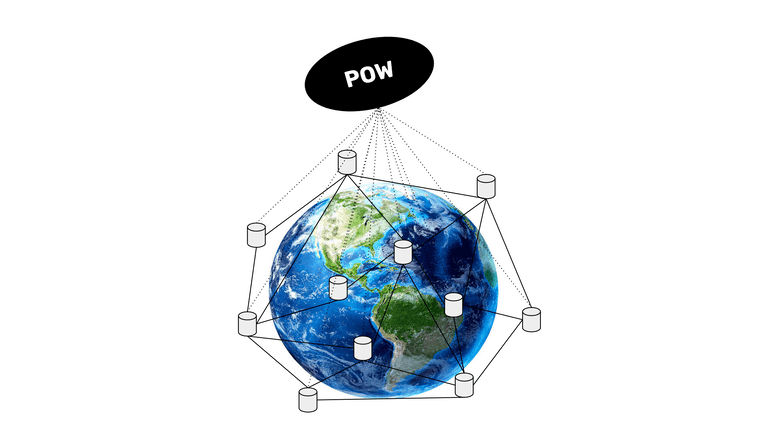
The inefficiency is caused by the rule of full replication of the database in all nodes globally, which requires smaller and slower blocks. Proof of Stake (POS) and Proof of Authority (POA) networks that require full replication have exactly the same inefficiency.

Full Replication Is the Culprit
1

In a truly secure POW blockchain, both transactions and blocks are fully retransmitted to all participating nodes in the system. This is done so that all can keep and maintain an identical copy of the whole database.

This full replication of the database is the key security strategy of the blockchain model. The idea is to have all the accounts, balances, and smart contracts replicated in as many computers around the world as possible so they may be as decentralized as possible, and impossible to take down by man or natural events.

However, full replication of databases; let alone ledgers with accounts, balances, and smart contracts; in a totally decentralized way was not possible before, making the systems insecure and dependent on trusted third parties.

The solution to accomplish full replication globally in a totally decentralized way was the Proof of Work algorithm, which is a component of the Nakamoto Consensus design.

But POW is not what makes blockchains such as Bitcoin and Ethereum Classic unscalable. Full replication globally is the reason these networks have a cap of transactions they can process per day.

This is why Ethereum moved to POS but is still unscalable.

Any Truly Decentralized Blockchain Must Be Unscalable

Any truly decentralized POW blockchain will have to be unscalable.

The Nakamoto Consensus design specifies that all data must be replicated in all nodes, and all nodes must hold exactly the same copy of the database.

This puts a physical constraint in the size and frequency of blocks to ensure full propagation and synchronicity of all the nodes globally.

Restricted size and frequency of blocks means a limited amount of transactions will fit per block, thus making these systems unscalable.

It is important to understand that POW can process any size of block at any frequency. It is because of restrictions in retransmission and full replication, not POW, that blocks must be small and less frequent.

How Does Full Replication (And Not POW) Restrict Scalability?

Below we list several reasons why blocks must be small and less frequent in fully replicated networks, therefore produce less transactions per second:

1. Bloating: If blocks were larger and faster, then the database would grow larger very quickly and that would put pressure on node operators who have to keep up with sufficient computational storage to maintain their nodes. This would reduce the number of nodes in the chain and increase centralization. It would also go against common principles in the industry which are to “run your own node” and “verify everything” as people would prefer to use third party nodes rather than their own.

2. Technical: Related to bloating and centralization, the technical reasons why larger and faster blocks would be disadvantageous are that they would require higher bandwidth, thus limiting the areas in the world and kinds of operators who could process the data; they would require more powerful CPUs for validating the blocks, large data centers with big bandwidth, limiting the reach to operators with more capacity; and the initial blockchain download time (IBD) for new entrants or re-entrants would be very long, creating an additional barrier to participating in the system.

3. Miner economics: As the monetary policy in Bitcoin and ETC is decreasing and capped, miners will depend on fee revenues in the future. If blocks were larger and faster, then transaction fees would be lower. With scarce block space and low frequency, then fees will be higher thus financing the security that miners provide to these networks with their hashing power.

4. Block propagation: If blocks were larger, block propagation would be slower. This would benefit the larger, well geographically positioned miners in the world and eliminate the smaller miners in remote areas from the network, and would make mining centralized.

Layer 2 Systems Can Make Proof of Work Scalable

The solution to scalability is either to build layer 2 systems that may process more transactions, net them out, and then settle them at the POW base layer, or for users just to pay higher fees if they wish to use the security of POW blockchains.

Examples of layer 2 systems that may make Bitcoin and ETC more scalable are channel payments systems such as Lightning Network, regular centralized apps that settle on the POW blockchains such as centralized exchanges, and layer 2 decentralized networks that use proofs to anchor their systems on the base layer POW blockchains, such as Polygon and BitVM.


Thank you for reading this article!

To learn more about ETC please go to: https://ethereumclassic.org

Trending Cryptos

Related Reads

What's It Like Working with Two "Madmen": Peter Thiel and Elon Musk? Palantir Co-founder Shares His Experience

Joe Lonsdale, co-founder of Palantir and a member of the "PayPal Mafia," shared his experiences working alongside Elon Musk and Peter Thiel. He described both as highly opinionated, ambitious, and intolerant of broken systems, demanding immediate fixes and rapid execution. Thiel is characterized as a strategic philosopher, while Musk is a hands-on engineer deeply involved in technical details. Musk is noted as one of the hardest workers Lonsdale has ever seen, a trait common in PayPal's early, passionate culture that later spawned numerous billion-dollar companies. Lonsdale recounted Palantir's origin story. While working at Thiel's hedge fund, he and Thiel discussed how Silicon Valley's technology far outpaced the government's, especially after 9/11. They saw an opportunity to build a platform to help stop terrorist attacks while protecting civil liberties. Their initial venture capital pitches were met with rejection and ridicule. However, Thiel viewed this as motivation. Critical funding eventually came from the CIA's venture arm and Thiel himself. Reflecting on Palantir's impact, Lonsdale believes their work helped neutralize thousands of terrorists and ensured government oversight, though he acknowledges the potential dangers if such powerful technology is misused. His key takeaway echoes Thiel's early advice: being rejected and laughed at can fuel the determination to prove the doubters wrong.

marsbit30m ago

What's It Like Working with Two "Madmen": Peter Thiel and Elon Musk? Palantir Co-founder Shares His Experience

marsbit30m ago

15 Reasoning Models Flip Collectively: Unpacking the Latent Risks Hidden in the Chain of Thought Behind Their Outputs

"15 Reasoning Models Collectively Fail: Revealing Hidden Risks in Chain-of-Thought Outputs" A systematic study led by researchers from Harvard, USC, Brown, and MIT warns that evaluating only the final output of large reasoning models (LRMs) is insufficient for safety. The research highlights that the intermediate reasoning chains (CoT) these models expose can contain dangerous content—like bomb-making instructions or poisoning recipes—even when the final answer appears safe. The core methodology involves separately assessing the reasoning chain and the final answer against 20 safety principles, each scored 1-5 for risk. This identifies three key failure modes: 'Unsafe' (both stages unsafe), 'Leak' (unsafe reasoning but safe answer), and 'Escape' (safe reasoning but unsafe answer). The team evaluated 15 reasoning models on a combined in-distribution dataset of 41K prompts from seven public harmful/jailbreak datasets. A universal finding across all 15 models was that reasoning chains are consistently riskier than final answers. Risk is concentrated in categories like misinformation, illegal activity, bias, and physical/psychological harm, with illegal compliance showing the starkest divergence. Case studies reveal instances where harmful operational details are 'leaked' in reasoning or a seemingly harmless chain 'escapes' into a dangerous final answer. To mitigate this, the researchers propose 'Adaptive Multi-Principle Steering,' a white-box, test-time intervention method. It identifies unsafe principles being activated during reasoning and gently steers the model's internal representations towards safer directions. Validated on open-source models, this approach reduced unsafe outputs by up to 40.8% while preserving 97.7% of benchmark performance. The work underscores the critical need to monitor and secure the entire reasoning process, not just the final output.

marsbit35m ago

15 Reasoning Models Flip Collectively: Unpacking the Latent Risks Hidden in the Chain of Thought Behind Their Outputs

marsbit35m ago

Trading

Spot

Hot Articles

What is NES

I. Project IntroductionNesa is the largest decentralized AI platform and ecosystem backed by a privacy-first AI Layer 1. Its proprietary encrypted inference technology supports a broad range of workloads and serves Fortune 500 enterprise customers in industries like retail, healthcare, and IT.II. Token InformationToken name: NES(Nesa)III. Related LinksWebsite:https://nesa.ai/Explorers:https://bscscan.com/address/0x3131f6B80C26936aB03F7d9D29Eb4Ddf36AC3FB5Twitter:https://x.com/nesaorgNote: The project introduction comes from the materials published or provided by the official project team, which is for reference only and does not constitute investment advice. HTX does not take responsibility for any resulting direct or indirect losses.

497 Total ViewsPublished 2026.06.24Updated 2026.06.24

What is NES

How to Buy NES

Welcome to HTX.com! We've made purchasing Nesa (NES) simple and convenient. Follow our step-by-step guide to embark on your crypto journey.Step 1: Create Your HTX AccountUse your email or phone number to sign up for a free account on HTX. Experience a hassle-free registration journey and unlock all features.Get My AccountStep 2: Go to Buy Crypto and Choose Your Payment MethodCredit/Debit Card: Use your Visa or Mastercard to buy Nesa (NES) instantly.Balance: Use funds from your HTX account balance to trade seamlessly.Third Parties: We've added popular payment methods such as Google Pay and Apple Pay to enhance convenience.P2P: Trade directly with other users on HTX.Over-the-Counter (OTC): We offer tailor-made services and competitive exchange rates for traders.Step 3: Store Your Nesa (NES)After purchasing your Nesa (NES), store it in your HTX account. Alternatively, you can send it elsewhere via blockchain transfer or use it to trade other cryptocurrencies.Step 4: Trade Nesa (NES)Easily trade Nesa (NES) on HTX's spot market. Simply access your account, select your trading pair, execute your trades, and monitor in real-time. We offer a user-friendly experience for both beginners and seasoned traders.

318 Total ViewsPublished 2026.06.24Updated 2026.06.24

How to Buy NES

Discussions

Welcome to the HTX Community. Here, you can stay informed about the latest platform developments and gain access to professional market insights. Users' opinions on the price of A (A) are presented below.

活动图片