NAKA CEO Addresses 96% Stock Crash Amid Sell-Off

TheCryptoTimesPublished on 2025-09-15Last updated on 2025-09-15

David Bailey, CEO of the Bitcoin treasury company Nakamoto (NAKA), has publicly addressed the firm’s catastrophic 96% stock price collapse from its peak in May. After a week of relative silence, Bailey stated on the social media platform X, “The only way out is through. We’ll get this over with as quickly as possible,” as he attempts to rally long-term supporters amid extreme selling pressure and investor losses.

The company, which went public on May 12, saw its stock plummet from an all-time high of $34.77 on May 22 to a low of $1.16 by the morning of September 15. The dramatic decline included a 60% drop over the past weekend alone, prompting an emergency audio space on X where investors voiced their concerns. In a post on X, Bailey acknowledged the brutal period, stating, “Despite the last two weeks being brutal for NAKA stock they’ve also been our most productive.”

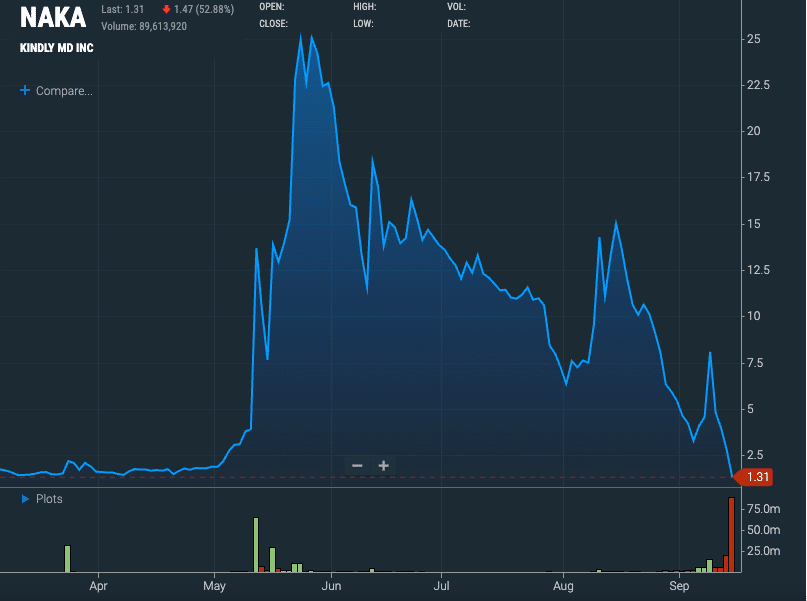
Image 40Image 40
Naka Price Chart, Source: Nasdaq

Selling Pressure and Investor Disparity

Sustained selling pressure, which was partly caused by news regarding the company’s private placement financing, seems to be the main reason for the drop. Early investors, such as Jameson Lopp and Adam Back, bought shares for as little as $1.12. This price stands in stark contrast to the stock’s public debut, where it opened at $28.51, creating significant concern among retail investors who bought in at much higher valuations.

In response to the sell-off, Bailey characterized the situation as “upgrading our shareholder base” and urged those who believe in the company’s long-term vision to “brave the storm.” He also highlighted the intense negative market sentiment, noting the implied 2000% cost to borrow NAKA shares, which he claimed was the “highest in the nation,” indicating that a large portion of the market is betting against the company. This is a sharp reversal from the initial hype in May when he claimed, “I can feel the stampede building, the fomo is very real.”

Volatility Risks

Nakamoto’s quick rise and fall is a warning about how unstable new enterprises in the crypto sector might be, especially those that are linked to a Bitcoin treasury model. The huge difference between private placement and public offering prices shows how risky it is for regular investors to get into the market when there is a lot of buzz. Bailey’s attempts to change the story will be very important in deciding if the company can win back investors’ trust or if it will just be another footnote in the history of crypto-related market crashes.

Also read: David Bailey’s Nakamoto Joins KindlyMD to Build Bitcoin Treasury


Mobile Only ImageMobile Only Image

Trending Cryptos

Related Reads

Stablecoins Becoming the Next Policy Challenge for the Fed's Walsh Version

Fed Governor Christopher Waller's speech at the June 22 conference on the U.S. dollar's international role signifies a notable policy shift: stablecoins like USDT and USDC are now being formally considered as potential channels for transmitting U.S. dollar liquidity globally. With their combined market cap surpassing $250 billion and high transaction volumes, these digital assets are moving from the periphery of crypto policy to the core of monetary system research. The key concern for policymakers is how stablecoin flows interact with traditional dollar infrastructure. Their growth could affect bank deposits, demand for short-term Treasury securities (like T-bills), and global access to dollars, depending on whether demand originates overseas or substitutes for domestic bank balances. Issuers' reserve management—holding assets in banks, money market funds, or Treasuries—links stablecoin activity directly to these core markets. The Fed's research agenda now examines whether stablecoins, by combining payment and balance-holding functions on digital rails, could complicate monetary policy implementation or transmit liquidity stress to banks. While current Treasury holdings by issuers are under 1% of the total market, their concentrated demand could marginally impact yields, especially during periods of stress. Consequently, stablecoins are evolving from mere crypto trading tools into a private-layer dollar transmission system with public policy implications, prompting closer regulatory scrutiny of their reserve robustness, redemption mechanisms, and systemic integration.

marsbit1m ago

Stablecoins Becoming the Next Policy Challenge for the Fed's Walsh Version

marsbit1m ago

A 380% Soar, Shenzhen’s 100-Billion-Yuan IPO Rings the Bell

HKC Holdings, a major Chinese display panel manufacturer, has successfully listed on the Shenzhen Stock Exchange's main board. The company's shares surged over 380% on its debut, pushing its market capitalization to around 350 billion yuan (formerly reaching 500 billion yuan). Founded by Wang Zhiyong in Shenzhen's Huaqiangbei electronics market nearly three decades ago, HKC evolved from assembling monitors to becoming a global top-tier supplier of semiconductor display panels for TVs, monitors, and smartphones. The IPO marks a significant milestone for HKC and its backers. The company's growth into the capital-intensive panel manufacturing sector was supported through partnerships with state-owned capital from regions like Chongqing, Mianyang, and Chuzhou. Its shareholder list also includes BOE Technology's investment arm. In recent years, HKC reported strong financials, with core panel business contributing over 70% of revenue and clients including Samsung, TCL, and Xiaomi. This listing is seen as part of a broader trend in Shenzhen's evolving tech landscape. Beyond established giants, the city is nurturing clusters of leading companies in specialized sectors like robotics—exemplified by the "Shenzhen Robot Valley"—and storage chips, where a group of firms dubbed the "Storage Five Tigers" has achieved a combined trillion-yuan market valuation. Shenzhen's strategic focus on emerging industries such as AI terminals, low-altitude economy, and humanoid robotics aims to build new industrial depth and foster the next generation of tech champions.

marsbit13m ago

A 380% Soar, Shenzhen’s 100-Billion-Yuan IPO Rings the Bell

marsbit13m ago

Domestic First Explosion-Proof Certification, World's First Fueling Brain Solution: How Did They Secure Two 'Firsts'?

China's embodied AI sector is booming, with over ¥37 billion in funding this year. The focus has shifted decisively to real-world application, particularly in hazardous, repetitive tasks humans should avoid. A key, often prohibitive, barrier to entry for robots in environments like gas stations and oil fields is obtaining explosion-proof certification, requiring meticulous hardware and circuit design from the ground up. The article explores three main application areas. At gas stations, the challenge lies in executing a long, precise sequence of actions (opening caps, handling the fuel nozzle) with millimeter accuracy across diverse car models. For facility inspections, robots need sustained autonomous patrols combined with real-time anomaly detection and response. Port scenarios introduce the complexity of multi-robot coordination. Addressing the core challenge of long-horizon tasks, the piece highlights a technical breakthrough: a "world model"-driven approach. This enables predictive planning, allowing the AI to visualize the desired end-state (e.g., nozzle returned, cap closed) and work backward to synthesize intermediate visual frames. This "imagination" of the task trajectory, as implemented in the H-GAR architecture, guides action generation, significantly reducing cumulative error in multi-step operations. The three-step H-GAR process involves generating a coarse action draft, synthesizing target-conditioned observation frames, and then refining actions based on visual context and a memory of past successful motions. The conclusion emphasizes that success in specialized, safety-critical fields requires long-term commitment and deep integration of the "embodied brain" (AI) with a purpose-built, certified physical "body." Mastering this brain-body-data闭环 (closed-loop) is positioned as a crucial competitive advantage for commercialization.

marsbit1h ago

Domestic First Explosion-Proof Certification, World's First Fueling Brain Solution: How Did They Secure Two 'Firsts'?

marsbit1h ago

Trading

Spot
Futures

Hot Articles

How to Buy NAKA

Welcome to HTX.com! We've made purchasing Nakamoto Games (NAKA) simple and convenient. Follow our step-by-step guide to embark on your crypto journey.Step 1: Create Your HTX AccountUse your email or phone number to sign up for a free account on HTX. Experience a hassle-free registration journey and unlock all features.Get My AccountStep 2: Go to Buy Crypto and Choose Your Payment MethodCredit/Debit Card: Use your Visa or Mastercard to buy Nakamoto Games (NAKA) instantly.Balance: Use funds from your HTX account balance to trade seamlessly.Third Parties: We've added popular payment methods such as Google Pay and Apple Pay to enhance convenience.P2P: Trade directly with other users on HTX.Over-the-Counter (OTC): We offer tailor-made services and competitive exchange rates for traders.Step 3: Store Your Nakamoto Games (NAKA)After purchasing your Nakamoto Games (NAKA), store it in your HTX account. Alternatively, you can send it elsewhere via blockchain transfer or use it to trade other cryptocurrencies.Step 4: Trade Nakamoto Games (NAKA)Easily trade Nakamoto Games (NAKA) on HTX's spot market. Simply access your account, select your trading pair, execute your trades, and monitor in real-time. We offer a user-friendly experience for both beginners and seasoned traders.

3.0k Total ViewsPublished 2024.03.29Updated 2026.06.02

How to Buy NAKA

Discussions

Welcome to the HTX Community. Here, you can stay informed about the latest platform developments and gain access to professional market insights. Users' opinions on the price of NAKA (NAKA) are presented below.

活动图片