JPMorgan sees yield-bearing stablecoins growing from 6% to 50% of market share

THE BLOCKPublished on 2025-03-28Last updated on 2025-03-28

Abstract

JPMorgan analysts forecast that yield-bearing stablecoins could rise from the current 6% to as much as 50% of the stablecoin market cap in the future.

JPMorgan analysts forecast that yield-bearing stablecoins could rise from the current 6% to as much as 50% of the stablecoin market cap in the future.

Yield-bearing stablecoins are attracting investors similarly to traditional money market funds, particularly in today’s high-interest-rate environment, the analysts said.

Yield-bearing stablecoins, including tokenized Treasurys, which offer interest returns similar to traditional financial products, could experience massive growth ahead, according to JPMorgan analysts.

Yield-bearing stablecoins currently make up just 6% of the total stablecoin market cap but could expand significantly, potentially capturing up to 50% of the market unless regulatory changes intervene, JPMorgan analysts led by managing director Nikolaos Panigirtzoglou wrote in a report released Wednesday.

The top five yield-bearing stablecoins — Ethena's USDe, Sky Dollar's USDS, BlackRock's BUIDL, Usual Protocol's USD0 and Ondo Finance's USDY— have seen rapid growth since the U.S. election in November, rising from around $4 billion to over $13 billion in combined market cap, Panigirtzoglou told The Block.

According to analysts, this growth is expected to continue. They added that the U.S. Securities and Exchange Commission's recent approval of Figure Markets' application for a yield-bearing stablecoin, YLDS, which is registered as a security, provides further momentum to this segment.
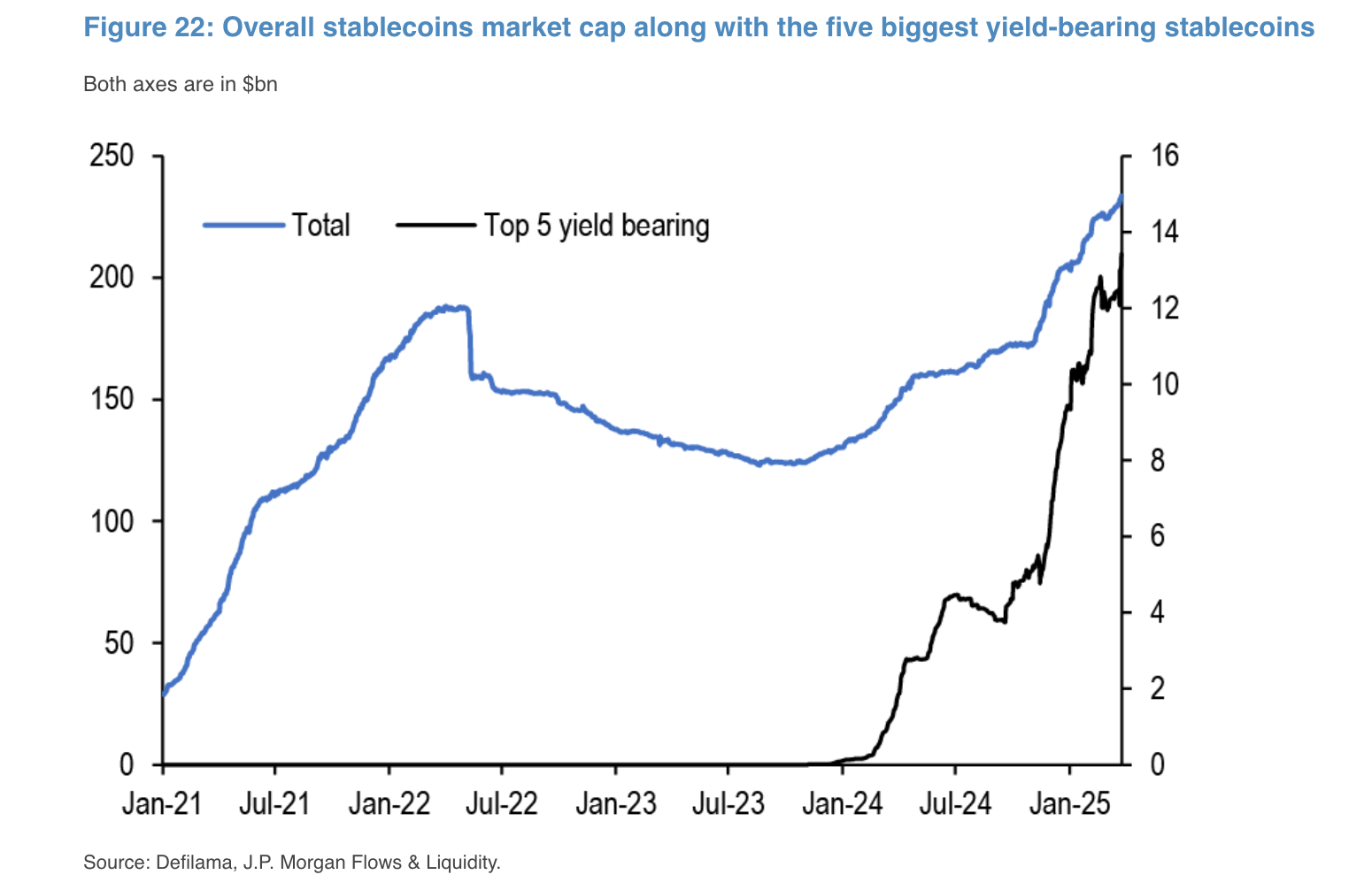
Traditional stablecoins, such as Tether's USDT and Circle's USDC, do not share reserve yields with their users because doing so would classify these assets as securities, according to the analysts. Such a classification would also impose additional compliance requirements, hindering their current seamless use as collateral within the crypto ecosystem, they said.

Why yield-bearing stablecoins are on the rise

The JPMorgan analysts identified several factors driving the rapid growth of yield-bearing stablecoins.

First, investors prefer these assets because they offer interest without requiring holders to engage in risky trading or lending activities or give up custody of their assets.

Second, major crypto trading platforms such as Deribit and FalconX now accept tokenized Treasurys as collateral, enabling traders to earn yield on posted collateral.

Additionally, crypto investors are increasingly turning to tokenized Treasurys in decentralized finance (DeFi) to obtain higher yields, as typical DeFi yields have significantly decreased from their peak levels of 2022. Projects like Frax Finance are also adopting tokenized Treasurys as underlying assets, further fueling this growth.

Despite this positive outlook, the JPMorgan analysts noted barriers. Yield-bearing stablecoins are classified as securities, subjecting them to regulatory restrictions that limit their adoption, especially among retail investors. Moreover, traditional non-yield-bearing stablecoins continue to hold a notable liquidity advantage.

With a combined market cap of around $220 billion across multiple blockchains and centralized exchanges, traditional stablecoins offer efficient, fast and low-cost transactions, even at large volumes. In contrast, yield-bearing stablecoins are newer, smaller and comparatively less liquid.

However, "This liquidity disadvantage could potentially be lessened over time as yield-bearing stablecoins gain further traction in the future in crypto derivative trading as source of collateral, in DAO treasuries, liquidity pools, and idle cash with crypto venture funds," according to the analysts.

As a result, over time, yield-bearing stablecoins could attract much of the idle cash currently sitting in traditional stablecoins, the analysts said. While the exact amount of this idle cash is difficult to estimate, it's unlikely to represent the majority of the stablecoin market, according to the analysts.


Related Reads

7 Key Questions Regarding 'DeepSeek Completes Over 50 Billion Yuan in Financing'

DeepSeek, the prominent Chinese AI company, has reportedly completed its first external funding round, raising over 50 billion RMB (approximately $6.9 billion USD), according to foreign media reports. This financing values the company at over $50 billion USD, a significant increase from a $10 billion valuation when the round began in April 2026. Founder Liang Wenfeng personally contributed 20 billion RMB, with other investors including Tencent, CATL (Contemporary Amperex Technology), JD.com, NetEase, and IDG Capital. Notably, the National Artificial Intelligence Industry Investment Fund also participated with a direct investment of 1 billion RMB. The funding round is distinctive for its structure. Most investors' capital is channeled into a limited partnership controlled by CEO Liang Wenfeng, rather than directly into DeepSeek. These investors face a five-year lock-up period, have no voting rights, but receive priority financial information and future investment rights. This arrangement is seen as a measure to ensure Liang's absolute control over the company's direction, aligning with its stated principles of prioritizing groundbreaking AGI (Artificial General Intelligence) research over short-term profitability. The report highlights strategic reasons for key investors. Tencent's involvement is viewed as a strategic alignment, building on existing collaborations. CATL's investment is linked to the critical energy and power infrastructure needed for AI data centers, a key growth area for the battery giant. The participation of a state-backed fund underscores the national strategic importance of AI development. Post-funding, DeepSeek is expected to accelerate infrastructure development, including building its own data centers, hire more talent, and release new model versions with enhanced capabilities like image and audio support. While this marks a major step, the company's long-term journey towards AGI remains a challenging path that will require balancing its foundational ideals with the expectations of its new investors.

marsbit7m ago

7 Key Questions Regarding 'DeepSeek Completes Over 50 Billion Yuan in Financing'

marsbit7m ago

The World Cup is Here: The Battle for Entry into Prediction Markets Has Begun

The 2026 FIFA World Cup has begun, and alongside the on-field competition, a new off-field battleground is emerging: prediction markets. These blockchain-based platforms, which convert crowd wisdom into tradable probabilities, are gaining significant traction. However, their complexity—involving wallets, gas fees, and smart contracts—has historically limited participation to crypto-native users. Centralized exchanges (CEXs), like Gate, are tackling this adoption barrier. By integrating with leading prediction market protocol Polymarket, Gate simplifies the user experience. Users can participate directly with their exchange account and USDT, bypassing complex Web3 steps. Gate offers a streamlined "Prediction Mode" for casual users and a professional "Trading Mode" with advanced tools. Key features include two-way trading (allowing users to buy or sell positions before event resolution), support for diverse markets (sports, crypto, macroeconomics), and a suite of information tools like a "Smart Money" leaderboard, wallet tracking, and AI-powered insights. For the World Cup, Gate launched a dedicated hub aggregating schedules, standings, and relevant markets. This allows fans to seamlessly follow games and trade on outcomes, transforming passive viewing into active participation where they can monetize their predictions and trade on shifting consensus throughout a match. The article argues that prediction markets have proven their value in event forecasting. The next challenge is mass adoption. The competition is shifting from building effective protocols to creating accessible user entry points. By lowering technical barriers and building a complete ecosystem for information and trading, platforms like Gate aim to transition prediction markets from a niche crypto tool to a mainstream platform for expressing and trading on collective intelligence.

Odaily星球日报17m ago

The World Cup is Here: The Battle for Entry into Prediction Markets Has Begun

Odaily星球日报17m ago

Spain Held to a Draw by Cape Verde, Jucom Prediction Market Witnesses Historic Upset

In a major upset at the 2026 FIFA World Cup, tournament favorites Spain were held to a surprising 0-0 draw by debutants Cape Verde in their Group H opener on June 16, Beijing time. Despite dominating possession (74%) and recording 27 shots with an expected goals figure of 2.16, Spain failed to break down a resilient Cape Verde defense, with their 40-year-old goalkeeper Vozinha making 7 saves to earn Man of the Match. Pre-match predictions on the Jucom prediction market had heavily favored Spain, assigning them a 92% win probability. The actual result, a goalless draw, triggered significant volatility across related prediction markets. This outcome forces a market-wide reassessment of several key probabilities, including Spain's likelihood of winning the group and the tournament itself, while Cape Verde's previously near-zero chance of advancing is now being re-evaluated. The event highlights both the efficiency and the inherent limitations of prediction markets. While prices aggregate known information, football's low-scoring, high-variance nature means unquantifiable in-game factors can lead to unlikely results. The core value of such markets lies not in perfect foresight but in their ability to dynamically reflect how new information is incorporated into collective expectations. Platforms like Jucom, which track outcomes from single matches to the final champion, provide a real-time lens into how global consensus evolves with each game.

链捕手21m ago

Spain Held to a Draw by Cape Verde, Jucom Prediction Market Witnesses Historic Upset

链捕手21m ago

Trading

Spot
Futures

Hot Articles

How to Buy ONDO

Welcome to HTX.com! We've made purchasing OndoFinance (ONDO) simple and convenient. Follow our step-by-step guide to embark on your crypto journey.Step 1: Create Your HTX AccountUse your email or phone number to sign up for a free account on HTX. Experience a hassle-free registration journey and unlock all features.Get My AccountStep 2: Go to Buy Crypto and Choose Your Payment MethodCredit/Debit Card: Use your Visa or Mastercard to buy OndoFinance (ONDO) instantly.Balance: Use funds from your HTX account balance to trade seamlessly.Third Parties: We've added popular payment methods such as Google Pay and Apple Pay to enhance convenience.P2P: Trade directly with other users on HTX.Over-the-Counter (OTC): We offer tailor-made services and competitive exchange rates for traders.Step 3: Store Your OndoFinance (ONDO)After purchasing your OndoFinance (ONDO), store it in your HTX account. Alternatively, you can send it elsewhere via blockchain transfer or use it to trade other cryptocurrencies.Step 4: Trade OndoFinance (ONDO)Easily trade OndoFinance (ONDO) on HTX's spot market. Simply access your account, select your trading pair, execute your trades, and monitor in real-time. We offer a user-friendly experience for both beginners and seasoned traders.

5.0k Total ViewsPublished 2024.03.29Updated 2026.06.02

How to Buy ONDO

Discussions

Welcome to the HTX Community. Here, you can stay informed about the latest platform developments and gain access to professional market insights. Users' opinions on the price of ONDO (ONDO) are presented below.

活动图片