Zora Launches Solana-Based Attention Markets to Revolutionize Trend Trading

TheNewsCryptoPublished on 2026-02-18Last updated on 2026-02-18

Abstract

On February 17, Zora launched "attention markets" on the Solana blockchain, marking a significant shift from its previous Ethereum and Base-based operations. This new product enables users to trade tokens based on internet trends and social media topics, allowing them to buy or sell based on whether they believe a trend will grow or fade. Anyone can create a new market by paying a 1 SOL fee. Initial trading activity was limited, with tokens like bitcoin, cats, and dogs among the first trends. The main token reached a market value of around $70,000. The crypto community had mixed reactions, with some supporting the move to Solana and others questioning the departure from Ethereum. While experts warn of high risk due to low liquidity and potential volatility, supporters see it as an innovative way to measure public interest by blending social media trends with on-chain trading.

On February 17, Zora launched a new product called “attention markets” on the Solana blockchain, and the launch was announced by both Zora and Solana. This move from Zora marked a major shift from NFTs and Ethereum-based tools to Solana, which is known for its faster transactions and lower fees.

What is the attention market?

Attention markets basically allow users to trade based on internet trends. Instead of betting on the financial markets, users can now bet on the topics or memes that they believe will become popular on social media and can buy the token of it. If they think it will fade, then they can sell it. Anyone can create a new market trend by paying a 1 SOL fee. Once they are created, users can trade in the market and close the positions at any time.
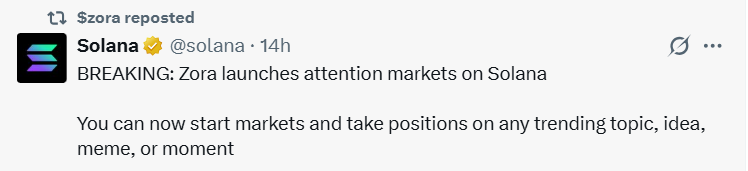
Image Source: https://x.com/solana/status/2023799108545503709

Once after the launch, the initial trading activity has been limited. Some of the feisty trending markets included bitcoin, cats, dogs, and attention markets. The main attention market’s token reached the market value of around $70,000 with a trading volume of $200,000 after the launch. Analysts noted that some of the tokens showed sharp gains, and the liquidity remained limited.

Mixed reactions to this Launch

This launch received mixed comments from the crypto community. Some users have supported Zora’s move to Solana, but others questioned the shift from Ethereum and Base, where Zora originally built its ecosystem. Following this launch, Zora’s native token rose more than 5% and is trading near $0.022.

Right now, Zora is entering the competitive market, and experts describe attention markets as high risk when trading volume is low because the low liquidity can lead to sharp price swings and volatility. However, supporters believe this model could be a new way to measure the public interest. This move from Zora aims to blend the social media interest with in-chain trading.

Highlighted Crypto News:

‌World Liberty Financial (WLFI) Posts 18% Surge: Are Buyers Taking the Driver’s Seat?

TagsSolanaZora

Related Questions

QWhat is the main purpose of Zora's newly launched 'attention markets' on Solana?

AAttention markets allow users to trade based on internet trends, enabling them to buy tokens representing topics or memes they believe will gain popularity on social media or sell them if they think they will fade.

QWhy did Zora's move to launch on Solana attract mixed reactions from the crypto community?

ASome users supported the shift to Solana for its faster transactions and lower fees, while others questioned Zora's departure from Ethereum and Base, where it originally built its ecosystem.

QWhat was the initial trading activity and market performance like for attention markets after launch?

AInitial trading activity was limited. The main attention market's token reached a market value of around $70,000 with a trading volume of $200,000, with some tokens showing sharp gains but liquidity remained low.

QWhat is the risk associated with trading on these attention markets according to experts?

AExperts describe attention markets as high risk when trading volume is low because the low liquidity can lead to sharp price swings and high volatility.

QHow can a user create a new market trend on Zora's attention markets platform?

AAnyone can create a new market trend by paying a fee of 1 SOL.

Related Reads

Google and Amazon Simultaneously Invest Heavily in a Competitor: The Most Absurd Business Logic of the AI Era Is Becoming Reality

In a span of four days, Amazon announced an additional $25 billion investment, and Google pledged up to $40 billion—both direct competitors pouring over $65 billion into the same AI startup, Anthropic. Rather than a typical venture capital move, this signals the latest escalation in the cloud wars. The core of the deal is not equity but compute pre-orders: Anthropic must spend the majority of these funds on AWS and Google Cloud services and chips, effectively locking in massive future compute consumption. This reflects a shift in cloud market dynamics—enterprises now choose cloud providers based on which hosts the best AI models, not just price or stability. With OpenAI deeply tied to Microsoft, Anthropic’s Claude has become the only viable strategic asset for Google and Amazon to remain competitive. Anthropic’s annualized revenue has surged to $30 billion, and it is expanding into verticals like biotech, positioning itself as a cross-industry AI infrastructure layer. However, this funding comes with constraints: Anthropic’s independence is challenged as it balances two rival investors, its safety-first narrative faces pressure from regulatory scrutiny, and its path to IPO introduces new financial pressures. Globally, this accelerates a "tri-polar" closed-loop structure in AI infrastructure, with Microsoft-OpenAI, Google-Anthropic, and Amazon-Anthropic forming exclusive model-cloud alliances. In contrast, China’s landscape differs—investments like Alibaba and Tencent backing open-source model firm DeepSeek reflect a more decoupled approach, though closed-source models from major cloud providers still dominate. The $65 billion bet is ultimately about securing a seat at the table in an AI-defined future—where missing the model layer means losing the cloud war.

marsbit1h ago

Google and Amazon Simultaneously Invest Heavily in a Competitor: The Most Absurd Business Logic of the AI Era Is Becoming Reality

marsbit1h ago

Computing Power Constrained, Why Did DeepSeek-V4 Open Source?

DeepSeek-V4 has been released as a preview open-source model, featuring 1 million tokens of context length as a baseline capability—previously a premium feature locked behind enterprise paywalls by major overseas AI firms. The official announcement, however, openly acknowledges computational constraints, particularly limited service throughput for the high-end DeepSeek-V4-Pro version due to restricted high-end computing power. Rather than competing on pure scale, DeepSeek adopts a pragmatic approach that balances algorithmic innovation with hardware realities in China’s AI ecosystem. The V4-Pro model uses a highly sparse architecture with 1.6T total parameters but only activates 49B during inference. It performs strongly in agentic coding, knowledge-intensive tasks, and STEM reasoning, competing closely with top-tier closed models like Gemini Pro 3.1 and Claude Opus 4.6 in certain scenarios. A key strategic product is the Flash edition, with 284B total parameters but only 13B activated—making it cost-effective and accessible for mid- and low-tier hardware, including domestic AI chips from Huawei (Ascend), Cambricon, and Hygon. This design supports broader adoption across developers and SMEs while stimulating China's domestic semiconductor ecosystem. Despite facing talent outflow and intense competition in user traffic—with rivals like Doubao and Qianwen leading in monthly active users—DeepSeek has maintained technical momentum. The release also comes amid reports of a new funding round targeting a valuation exceeding $10 billion, potentially setting a new record in China’s LLM sector. Ultimately, DeepSeek-V4 represents a shift toward open yet realistic infrastructure development in the constrained compute landscape of Chinese AI, emphasizing engineering efficiency and domestic hardware compatibility over pure model scale.

marsbit2h ago

Computing Power Constrained, Why Did DeepSeek-V4 Open Source?

marsbit2h ago

Trading

Spot
Futures
活动图片