Zora Launches Solana-Based Attention Markets to Revolutionize Trend Trading

TheNewsCryptoPublished on 2026-02-18Last updated on 2026-02-18

Abstract

On February 17, Zora launched "attention markets" on the Solana blockchain, marking a significant shift from its previous Ethereum and Base-based operations. This new product enables users to trade tokens based on internet trends and social media topics, allowing them to buy or sell based on whether they believe a trend will grow or fade. Anyone can create a new market by paying a 1 SOL fee. Initial trading activity was limited, with tokens like bitcoin, cats, and dogs among the first trends. The main token reached a market value of around $70,000. The crypto community had mixed reactions, with some supporting the move to Solana and others questioning the departure from Ethereum. While experts warn of high risk due to low liquidity and potential volatility, supporters see it as an innovative way to measure public interest by blending social media trends with on-chain trading.

On February 17, Zora launched a new product called “attention markets” on the Solana blockchain, and the launch was announced by both Zora and Solana. This move from Zora marked a major shift from NFTs and Ethereum-based tools to Solana, which is known for its faster transactions and lower fees.

What is the attention market?

Attention markets basically allow users to trade based on internet trends. Instead of betting on the financial markets, users can now bet on the topics or memes that they believe will become popular on social media and can buy the token of it. If they think it will fade, then they can sell it. Anyone can create a new market trend by paying a 1 SOL fee. Once they are created, users can trade in the market and close the positions at any time.
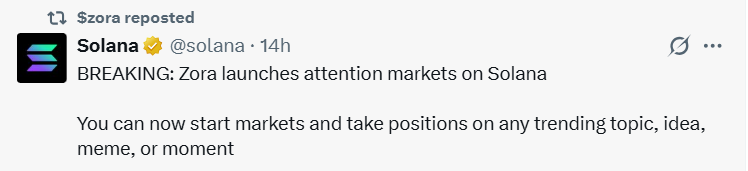
Image Source: https://x.com/solana/status/2023799108545503709

Once after the launch, the initial trading activity has been limited. Some of the feisty trending markets included bitcoin, cats, dogs, and attention markets. The main attention market’s token reached the market value of around $70,000 with a trading volume of $200,000 after the launch. Analysts noted that some of the tokens showed sharp gains, and the liquidity remained limited.

Mixed reactions to this Launch

This launch received mixed comments from the crypto community. Some users have supported Zora’s move to Solana, but others questioned the shift from Ethereum and Base, where Zora originally built its ecosystem. Following this launch, Zora’s native token rose more than 5% and is trading near $0.022.

Right now, Zora is entering the competitive market, and experts describe attention markets as high risk when trading volume is low because the low liquidity can lead to sharp price swings and volatility. However, supporters believe this model could be a new way to measure the public interest. This move from Zora aims to blend the social media interest with in-chain trading.

Highlighted Crypto News:

‌World Liberty Financial (WLFI) Posts 18% Surge: Are Buyers Taking the Driver’s Seat?

TagsSolanaZora

Related Questions

QWhat is the main purpose of Zora's newly launched 'attention markets' on Solana?

AAttention markets allow users to trade based on internet trends, enabling them to buy tokens representing topics or memes they believe will gain popularity on social media or sell them if they think they will fade.

QWhy did Zora's move to launch on Solana attract mixed reactions from the crypto community?

ASome users supported the shift to Solana for its faster transactions and lower fees, while others questioned Zora's departure from Ethereum and Base, where it originally built its ecosystem.

QWhat was the initial trading activity and market performance like for attention markets after launch?

AInitial trading activity was limited. The main attention market's token reached a market value of around $70,000 with a trading volume of $200,000, with some tokens showing sharp gains but liquidity remained low.

QWhat is the risk associated with trading on these attention markets according to experts?

AExperts describe attention markets as high risk when trading volume is low because the low liquidity can lead to sharp price swings and high volatility.

QHow can a user create a new market trend on Zora's attention markets platform?

AAnyone can create a new market trend by paying a fee of 1 SOL.

Related Reads

Once-Popular Web3 Enters Wave of Layoffs

The once-hot Web3 industry is experiencing a severe wave of layoffs. While many companies attribute job cuts to AI-driven restructuring, the primary reason is often financial pressure. The Web3 sector, at the intersection of tech and finance, has been hit particularly hard. Employees at major cryptocurrency exchanges report sudden, impersonal layoffs—often with system access revoked overnight—and minimal or no severance. Common tactics include setting impossible performance targets or terminating employees for minor policy violations. The working atmosphere has become toxic, marked by intense monitoring, excessive meetings, and management obsessed with control and internal politics rather than product innovation. The industry's core business model is collapsing. Exchange revenue from trading fees and listing charges has plummeted due to a decline in quality projects and retail investor exodus. Events like the massive forced liquidation on October 10th further shattered confidence. Competition from on-chain derivatives platforms and prediction markets is intensifying the downturn. As layoffs continue, displaced workers struggle to find new opportunities. Many transition to the AI sector, but face significant bias from traditional finance and even some AI firms, which view crypto industry experience with suspicion. The current downturn appears more structural than cyclical, driven by unsustainable practices, internal strife, and a failure to innovate, raising questions about the industry's future trajectory.

marsbit11m ago

Once-Popular Web3 Enters Wave of Layoffs

marsbit11m ago

Sales Drop 26% But Prices Rise? Xiaomi's Dilemma

Xiaomi, facing a significant 26.3% year-on-year decline in global smartphone shipments in Q2 2026, has implemented its third price hike of the year. On August 2nd, prices were raised for nine models, including the flagship Mi 17 series (up 400-500 yuan) and Redmi K90/Turbo 5 series (up 300 yuan). This move completes a pattern where cost pressure, originating from surging memory chip prices, has climbed from entry-level to mid-range and now flagship products. The primary driver is a severe supply squeeze on consumer-grade DRAM and NAND flash memory, as major manufacturers like Samsung shift advanced capacity to more profitable HBM for AI applications. According to Xiaomi President Lu Weibing, memory prices for the same configuration have skyrocketed nearly fourfold since Q1 2025, adding roughly 1500 yuan to the cost of a mainstream 12GB+512GB phone. IDC estimates consumer memory costs have risen nearly 300% year-on-year. While the price increases hurt demand and contributed to the sales slump, Xiaomi's strategy of reducing entry-level models and upgrading its product mix also played a role. Domestically, its market share in China fell to 12% (5th place), while leaders Huawei and Apple saw shipments grow over 24%. To mitigate future risks, Xiaomi is accelerating its in-house "Surge" chip development and optimizing memory configurations across its lineup. Xiaomi is not alone; major brands like OPPO, vivo, and Apple have already raised prices in 2026, with industry insiders predicting another round of increases (200-800 yuan) in the second half. A full-scale industry-wide涨价 cycle is underway, forcing both manufacturers and consumers to recalibrate their strategies and purchasing decisions amid sustained cost pressures.

marsbit22m ago

Sales Drop 26% But Prices Rise? Xiaomi's Dilemma

marsbit22m ago

Three Consecutive Quarters of Decline: The Crypto Market is Experiencing Its Longest Ebb Since 2022

The cryptocurrency market experienced its third consecutive quarterly decline in Q2 2026, marking its longest downturn since 2022, according to a CoinGecko report. The total market capitalization fell 12.6% to $2.1 trillion, a retreat of roughly 52% from its October 2025 peak. Multiple indicators signal an orderly capital exit from the sector. For the first time since Q3 2023, the total stablecoin market cap shrank (-1.6% to $305.1B), indicating funds are leaving the ecosystem entirely, not just rotating to safer crypto assets. Trading volumes on centralized exchanges dropped 27.9%, while DeFi's Total Value Locked (TVL) plummeted 23.4%. Both Bitcoin (-14.2%) and Ethereum (-25.4%) underperformed traditional risk assets like equities in Q2, breaking from previous correlative narratives. Ethereum saw its first-ever three-quarter losing streak, with its market share falling to around 10%. A few areas saw growth. Prediction market volumes surged 48.7%, largely driven by sports betting. Hyperliquid's HYPE token entered the top 10 by market cap, and tokenized collectibles platforms grew, though primarily via gamified mechanics. Despite a ~9.8% Bitcoin rebound in July, historical trends suggest caution for August. The market, now ~49% below its 2025 high, is undergoing a measured retreat. Its recovery hinges on future Federal Reserve policy and the industry's ability to develop sustainable revenue streams beyond speculation.

marsbit36m ago

Three Consecutive Quarters of Decline: The Crypto Market is Experiencing Its Longest Ebb Since 2022

marsbit36m ago

Trading

Spot
活动图片