Zashi Becomes Zodl: Zcash Wallet Rebrands Following Internal Split

bitcoinistPublished on 2026-02-17Last updated on 2026-02-17

Abstract

Zashi, the flagship mobile wallet for Zcash, has been rebranded to "Zodl" following a formal split from the Electric Coin Company (ECC), its original developer. The rebrand signals continuity in the product and team, but under a new corporate entity called the Zcash Open Development Lab (ZODL). Users are not required to take any action, as the update will not impact the wallet's functionality. The change comes after a governance rupture in January 2025, when the entire ECC team left due to a dispute with Bootstrap, the nonprofit governing ECC. The conflict centered around a proposal to move Zashi into a for-profit structure and attract external investment, which Bootstrap argued required careful handling due to nonprofit fiduciary duties. Despite the corporate restructuring, the team's mission remains focused on privacy-first payments and financial sovereignty. The wallet will continue operating as Zcash's flagship product, now independently developed and funded outside the Zcash development fund.

Zashi, the flagship mobile wallet built by Zcash’s original engineering team, is rebranding to “Zodl” as its developers formally operate outside the Electric Coin Company (ECC) structure. The change matters less as a cosmetic refresh than as a signal: the same builders are continuing product work, but under a new corporate banner after a governance rupture that spilled into public view in early January.

Zcash Wallet Zashi Renamed Zodl

In a post on X dated Feb. 16, the wallet team said the next app update will rename Zashi to Zodl “without impacting the user experience,” stressing there is “no action required” from users. “It’s a new brand for a new chapter, but everything else stays the same: the wallet, the team behind it, and our commitment to Zcash,” the announcement read. “We’re moving forward with clarity and purpose, and this change reflects the building momentum.”

The post also tied the rebrand to a broader organizational reset. “In January of this year, the entire Electric Coin Company (ECC) team, the original creators of Zcash and Zashi, left ECC and formed a new company,” it said, naming the new entity Zcash Open Development Lab (ZODL) and positioning Zodl as the “Zcash flagship wallet.” The team framed the move as a way to pursue growth “without reliance on the Zcash development fund,” while keeping continuity on shipping and support.

On mission, the wallet team used language that will be familiar to long-time Zcash followers, explicitly anchoring the product roadmap to privacy-first payments. “We envision a world without mass financial surveillance. A world where law-abiding people can transact freely and privately, without fear that their data will be exploited or weaponized,” the post said. “There is no sovereignty without privacy. Our banner has changed, but our mission has not.”

The immediate practical effect for users is limited: the same app is expected to update in place, with branding changes rolling out across channels, including the Discord support presence. The more consequential change is governance and ownership context: the wallet is now explicitly presented as a product of ZODL rather than ECC, after weeks of public dispute about who could control, finance, and potentially commercialize consumer-facing efforts around Zashi.

The Background Story

The break traces back to a late-2025 clash between ECC leadership and Bootstrap, the 501(c)(3) nonprofit that governs ECC. In early January, former ECC CEO Josh Swihart said board actions left the team no viable path inside the existing structure. “Unfortunately, decisions made by four of Bootstrap’s board members forced every person at ECC to exit the company, very quickly,” Swihart wrote on the Zcash Community Forum on Jan. 9. “I wish we hadn’t been forced to move so quickly. But we had no choice. This is a serious matter. It is not a game. And as you see, the consequences, severe.”

Bootstrap, for its part, has argued the flashpoint was a proposed transaction to move Zashi into a for-profit structure and attract outside capital, which it says had to be handled as a related-party deal involving nonprofit-controlled assets.

In a public statement and accompanying timeline, Bootstrap described talks around external investment and “alternative structures to privatize Zashi” intensifying in late October 2025, then accelerating in December amid rushed deadlines, incomplete documentation, and legal constraints tied to nonprofit fiduciary duties. The timeline states that matters “rapidly escalated” around Dec. 20 when the board was presented with a Jan. 1 deadline to approve a deal, followed by leadership departures in early January and the broader team exit shortly after.

At press time, Zcash traded at $284.34.
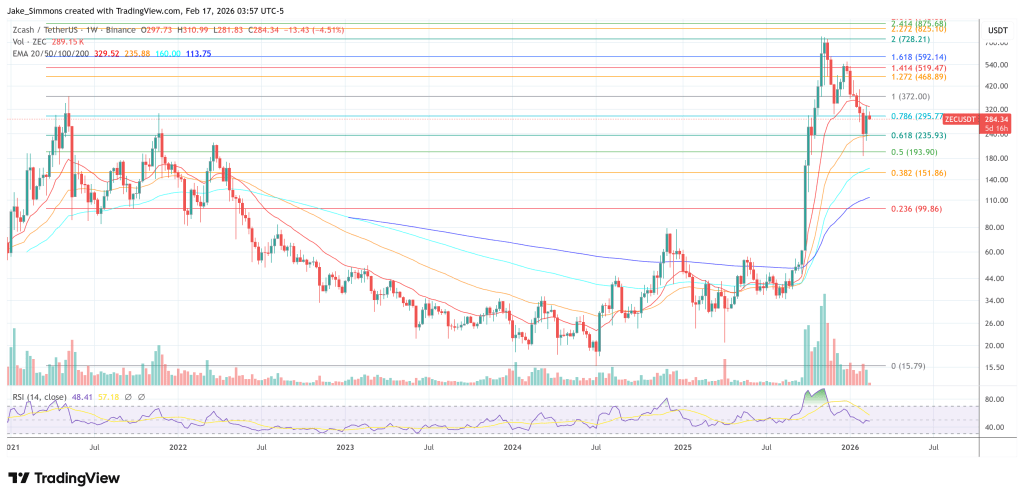
ZEC price remains below the 0.786 Fib, 1-week chart | Source: ZECUSDT on TradingView.com

Related Reads

MiCA is coming for DeFi vaults, but regulation will be difficult

The European Commission is exploring whether to extend the Markets in Crypto-Assets (MiCA) regulation to cover decentralized finance (DeFi) lending and borrowing, including lending vaults. These vaults, which channel billions into on-chain credit markets, present significant regulatory challenges because their decentralized structure doesn't map neatly onto existing financial frameworks. Their legal status is currently based on non-binding interpretations that they fall outside MiCA and EU fund rules. The article uses Morpho's decentralized lending protocol as an example, illustrating how responsibilities are divided among various participants (owner, curator, allocator, sentinel), making it difficult to identify a single "provider" to regulate. Experts warn that broadly categorizing "DeFi lending" could inadvertently capture vastly different structures. They argue that any regulatory approach should focus on the specific structure and control mechanisms of a vault, rather than using decentralization as a simple dividing line, and that DeFi lending may require a dedicated, carefully crafted framework distinct from traditional finance. The Commission's consultation closes on September 30, 2026. The core challenge for regulators is not just whether to regulate DeFi lending, but how to design rules that distinguish between different forms of on-chain lending and the entities that control them.

cointelegraph1h ago

MiCA is coming for DeFi vaults, but regulation will be difficult

cointelegraph1h ago

Grayscale Report: Financial Privacy in the AI Era, Why Zcash Should Not Be Overlooked?

Title: Grayscale Report: Financial Privacy in the AI Era – Why Zcash Should Not Be Overlooked The article argues that privacy is a fundamental, not niche, attribute of functional money. It highlights that technological shifts, like the rise of AI and stablecoins, are driving a new wave of public focus on financial privacy. Zcash, a decentralized digital currency similar to Bitcoin but with built-in privacy via zero-knowledge proofs, is positioned to address this need. Unlike transparent blockchains, Zcash offers users the option to conduct "shielded" transactions that hide sender, receiver, and amount while remaining verifiable. The report details Zcash's evolution, noting key upgrades that improved usability and security. It points to rising on-chain usage of privacy features as evidence of real demand. Currently, ZEC holds a minimal share (~0.4%) of the total crypto market cap. Grayscale suggests this reflects a market assumption that privacy is a marginal concern. The investment thesis hinges on a potential market re-evaluation: if privacy is recognized as a core monetary feature in an era of enhanced surveillance, Zcash's current valuation represents significant upside potential. Key risks discussed include regulatory challenges, historical trusted setup concerns for older pools (mitigated by newer protocols), quantum computing threats, and execution risks associated with future technical upgrades. The conclusion is that while the future scale of private digital currency is uncertain, the market currently prices in little chance of its value increasing substantially, presenting a potential opportunity for investors.

marsbit3h ago

Grayscale Report: Financial Privacy in the AI Era, Why Zcash Should Not Be Overlooked?

marsbit3h ago

Trading

Spot
活动图片