XRP, Solana Holders Deeper In The Red Compared To Bitcoin, Data shows

bitcoinistPublished on 2026-04-16Last updated on 2026-04-16

Abstract

According to on-chain data from Glassnode, altcoins like XRP and Solana are experiencing significantly higher levels of investor losses relative to their market capitalizations compared to Bitcoin. The "Relative Unrealized Loss" metric, which calculates the total unrealized losses as a percentage of market cap, shows Bitcoin and Ethereum at 11.9% and 16.6%, respectively. In contrast, XRP and Solana are facing much steeper losses at 31.8% and 54.8%. This indicates that a larger portion of their supply is held by investors who bought near cycle highs. Despite the elevated loss levels, they remain below those seen during the 2022 bear market lows. At the time of writing, XRP is trading around $1.35, down 2% over the past week.

On-chain data shows altcoins like XRP and Solana are observing a higher amount of investor loss relative to their market caps than Bitcoin.

XRP & Solana Are Observing A High Value On The Relative Unrealized Loss

In a new post on X, on-chain analytics firm Glassnode has talked about how the Relative Unrealized Loss compares between the various top coins in the cryptocurrency sector. The “Unrealized Loss” is an indicator that keeps track of the total amount of loss that’s held by investors as a whole on a given digital asset network.

The metric works by going through the transaction history of each coin on the blockchain to determine the last price at which it was involved in a move. If this previous transfer value was more than the current spot price for any token, then that particular token is considered to be held at an unrealized loss right now.

The exact amount of loss held by the coin is naturally equal to the difference between the two prices. The Relative Unrealized Loss, which is the version of the metric that’s of relevance here, sums up this difference for all loss tokens and finds what percentage of the market cap that it makes up for.

A counterpart metric called the Relative Unrealized Profit finds the same for the profit portion of the supply. That is, the tokens that have a cost basis lower than the current spot price. Now, here is the chart shared by Glassnode that shows the trend in the Relative Unrealized Loss for the four top cryptocurrencies: Bitcoin, Ethereum, XRP, and Solana.
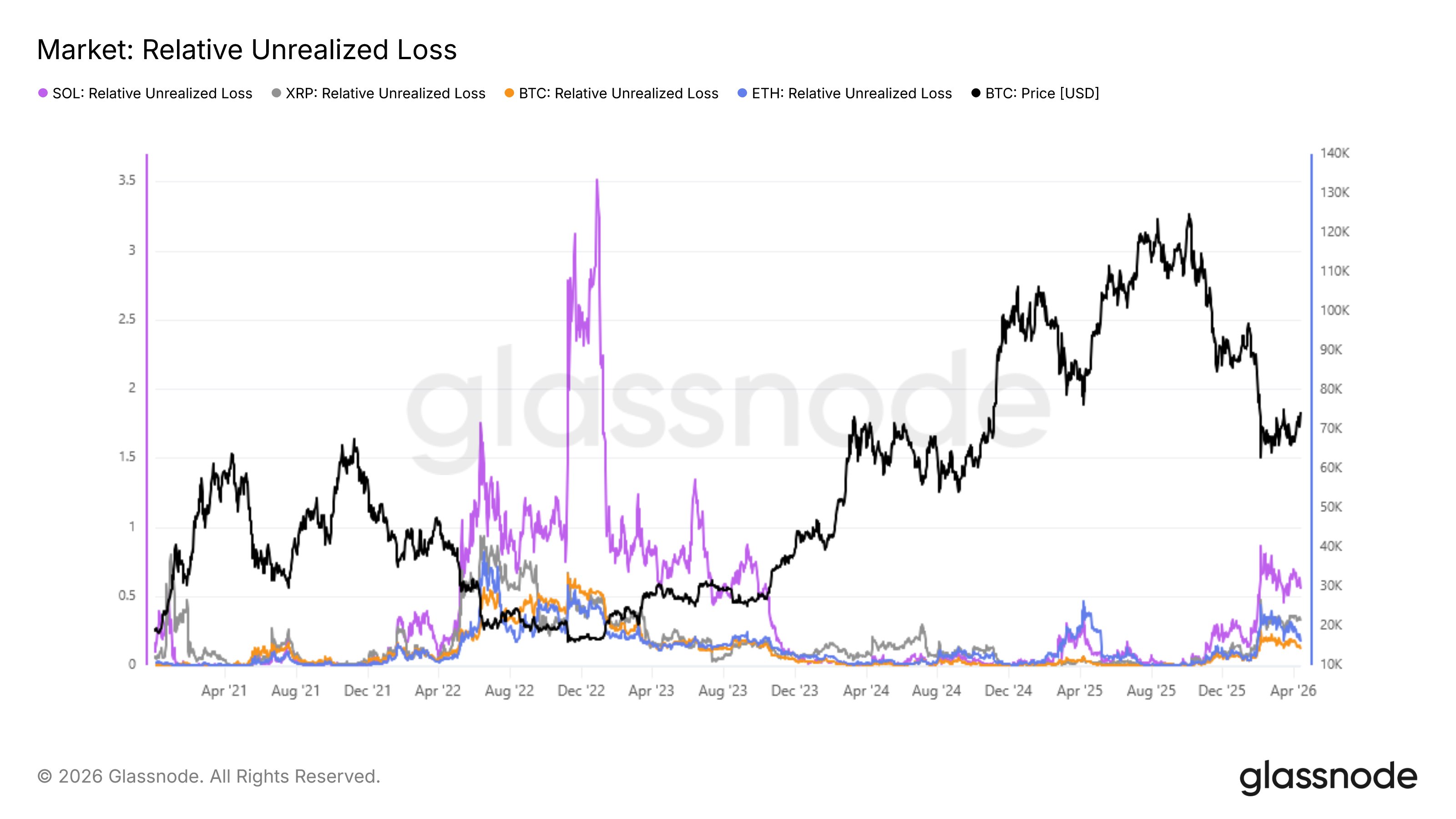
Looks like the indicator has gone up for all of these assets in recent months | Source: Glassnode on X

As is visible in the above graph, the Relative Unrealized Loss has witnessed a rise across the sector during the last few months. This increase is a natural consequence of the bearish price action that the various assets have seen in this window.

While the trend has been more-or-less uniform, the indicator’s value has differed in scale for the coins. Bitcoin and Ethereum, the two cryptocurrencies largest by market cap, have the metric sitting at relatively modest levels of 11.9% and 16.6%, respectively. Meanwhile, XRP and Solana have faced much heavier losses, with the Relative Unrealized Loss at 31.8% and 54.8%, respectively.

“The elevated loss levels in altcoins reflect how heavy the top is in these markets, where supply is more concentrated among buyers who entered near cycle highs,” explained the analytics firm. While the altcoins are facing high levels of losses, they are still lower than those observed at the lows of the 2022 bear market. XRP isn’t too far off, but Solana’s losses remain magnitudes lower.

XRP Price

At the time of writing, XRP is floating around $1.35, down 2% in the last seven days.

The price of the coin has retraced from Tuesday's high | Source: XRPUSDT on TradingView


Related Questions

QWhat does the Relative Unrealized Loss metric measure for a cryptocurrency?

AThe Relative Unrealized Loss metric tracks the total amount of loss held by all investors in a cryptocurrency. It calculates the difference between the current spot price and the price at which each coin was last moved for all tokens currently held at a loss, and expresses this total as a percentage of the asset's market capitalization.

QAccording to the data, which two cryptocurrencies have the highest Relative Unrealized Loss?

AAccording to the data, XRP and Solana have the highest Relative Unrealized Loss, with values of 31.8% and 54.8% of their market caps, respectively.

QHow do Bitcoin and Ethereum's Relative Unrealized Loss levels compare to those of XRP and Solana?

ABitcoin and Ethereum have significantly lower Relative Unrealized Loss levels, at 11.9% and 16.6% respectively, compared to the much higher levels of XRP (31.8%) and Solana (54.8%).

QWhat reason does Glassnode give for the elevated loss levels in altcoins like XRP and Solana?

AGlassnode explains that the elevated loss levels in altcoins reflect how heavy the top is in these markets, meaning that the supply is more concentrated among buyers who entered near the cycle highs.

QWhat was the price of XRP at the time of writing, and how had it performed over the previous week?

AAt the time of writing, XRP was trading around $1.35, which was down 2% over the last seven days.

Related Reads

Cook's Curtain Call and Ternus Takes the Helm: The Disruption and Reboot of Apple's 4 Trillion Dollar Empire

Tim Cook has officially announced he will step down as CEO of Apple in September, transitioning to executive chairman after a 15-year tenure during which he grew the company’s market value from around $350 billion to nearly $4 trillion. He will be succeeded by John Ternus, a 50-year-old hardware engineering veteran who has been groomed for the role through increasing public visibility and internal responsibility. Ternus’s appointment signals a strategic shift toward hardware and engineering leadership, with Johny Srouji—head of Apple Silicon—taking on an expanded role as Chief Hardware Officer. This consolidation aims to strengthen Apple’s core technological capabilities. However, Cook’s departure highlights a significant unresolved issue: Apple’s delayed and fragmented approach to artificial intelligence. Despite early efforts, such as hiring John Giannandrea from Google in 2018, Apple’s AI initiatives—particularly around Siri—have struggled with internal restructuring and reliance on external partnerships, including with Google. The transition comes at a critical moment as Apple faces paradigm shifts with the rise of artificial general intelligence (ASI). The company’s closed ecosystem of hardware, software, and services—once a major advantage—now presents challenges in adapting to an AI-centric world where intelligence may matter more than the device itself. Ternus must quickly articulate a clear AI strategy, possibly starting at WWDC, to reassure markets and redefine Apple’s role in a new technological era. His task is not only to maintain Apple’s operational excellence but also to reinvigorate its capacity to innovate and lead in the age of AI.

marsbit33m ago

Cook's Curtain Call and Ternus Takes the Helm: The Disruption and Reboot of Apple's 4 Trillion Dollar Empire

marsbit33m ago

Trading

Spot
Futures

Hot Articles

How to Buy XRP

Welcome to HTX.com! We've made purchasing XRP (XRP) simple and convenient. Follow our step-by-step guide to embark on your crypto journey.Step 1: Create Your HTX AccountUse your email or phone number to sign up for a free account on HTX. Experience a hassle-free registration journey and unlock all features.Get My AccountStep 2: Go to Buy Crypto and Choose Your Payment MethodCredit/Debit Card: Use your Visa or Mastercard to buy XRP (XRP) instantly.Balance: Use funds from your HTX account balance to trade seamlessly.Third Parties: We've added popular payment methods such as Google Pay and Apple Pay to enhance convenience.P2P: Trade directly with other users on HTX.Over-the-Counter (OTC): We offer tailor-made services and competitive exchange rates for traders.Step 3: Store Your XRP (XRP)After purchasing your XRP (XRP), store it in your HTX account. Alternatively, you can send it elsewhere via blockchain transfer or use it to trade other cryptocurrencies.Step 4: Trade XRP (XRP)Easily trade XRP (XRP) on HTX's spot market. Simply access your account, select your trading pair, execute your trades, and monitor in real-time. We offer a user-friendly experience for both beginners and seasoned traders.

15.9k Total ViewsPublished 2024.03.29Updated 2025.03.21

How to Buy XRP

What is XRP 2.0

XRP 2.0: A New Frontier in the Cryptocurrency Landscape Introduction to XRP 2.0 In the ever-evolving realm of cryptocurrency, new projects continuously emerge, vying for attention and adoption. One such promising initiative is XRP 2.0, a novel cryptocurrency project designed to leverage advanced blockchain technology and robust encryption methodologies. While the name draws parallels with Ripple’s XRP, it’s crucial to note that XRP 2.0 operates independently, focusing on enhancing transaction security, privacy, and scalability. As the digital financial landscape increasingly embraces decentralized solutions, XRP 2.0 aims to contribute meaningfully to web3 and the overall expansion of crypto projects. What is XRP 2.0? At its core, XRP 2.0 is a cryptocurrency project that aims to create a secure and decentralized digital currency ecosystem. Its foundational technology integrates sophisticated blockchain principles with cutting-edge encryption techniques. The overarching goal of XRP 2.0 is to establish itself as a reliable and efficient platform enabling swift transaction execution while prioritizing enhanced privacy protections for its users. The project is promoted as a solution to many limitations faced by existing cryptocurrencies, proposing a system that can handle a higher volume of transactions with improved speed and privacy. This versatility positions XRP 2.0 as a significant contender in a marketplace riddled with various digital currencies. Who is the Creator of XRP 2.0? The identity of the creator behind XRP 2.0 has been flagged as ‘Wilbur.’ However, comprehensive details regarding Wilbur or their associated entity remain elusive. The anonymity of many cryptocurrency creators is not an uncommon phenomenon in the industry, often designed to maintain a degree of privacy and security. Who are the Investors of XRP 2.0? As of now, specific information related to the investment foundations or organizations supporting XRP 2.0 is not publicly available. In the cryptocurrency sector, the backing by reputed investors can significantly influence a project's credibility and success, yet the transparency regarding the financial supporters of XRP 2.0 has not been established. How Does XRP 2.0 Work? XRP 2.0 stands out by employing a combination of blockchain technology and advanced encryption algorithms that ensures secure and decentralized transactions. Its innovative structure includes unique features designed to foster user engagement and broaden functionalities beyond conventional cryptocurrency transactions. Among these features, XRP 2.0 incorporates AI-powered capabilities, such as text-to-image and text-to-speech functionalities. These additions are designed to enhance the interactive experience for users, promoting broader applicability across various sectors. By bridging technological advancements with user-centered design, XRP 2.0 aims to capture the attention of a diverse range of individuals and enterprises looking to integrate cryptocurrency solutions into their operational frameworks. Timeline of XRP 2.0 Understanding XRP 2.0 requires examining the milestones that have defined its journey thus far: July 23, 2023: XRP 2.0 is introduced as a novel cryptocurrency project, aiming to revolutionize secure and decentralized transaction capabilities in the blockchain domain. September 8, 2023: The launching of another project, XRP20, occurs, marking the emergence of an ERC-20 token on the Ethereum blockchain that remains unrelated to XRP 2.0. November 13, 2023: The XRP Ledger undergoes a significant update with the release of rippled server software version 2.0.0. It is essential to note that this development is disconnected from the XRP 2.0 cryptocurrency project. Key Points About XRP 2.0 To distill the essence of XRP 2.0, several critical factors emerge: Unique Features: The inclusion of features like AI-powered text-to-image and text-to-speech further diversifies the potential applications of XRP 2.0. Blockchain Technology: The framework utilizes advanced blockchain mechanisms and encryption protocols, ensuring a secure and decentralized environment for transactions. Scalability and Privacy: XRP 2.0 prioritizes enhanced privacy protections in transaction processes and the scalability necessary to accommodate a growing user base. No Affiliation with Ripple: Importantly, despite its name, XRP 2.0 does not have any allegiance or collaboration with Ripple’s XRP, distinguishing its operational framework and objectives within the cryptocurrency ecosystem. Conclusion XRP 2.0 represents an ambitious venture into the cryptocurrency sphere, aiming to offer a combination of security, privacy, and efficiency in digital transactions. By integrating sophisticated technologies and user-friendly features, the project sets out to broaden the horizons of what cryptocurrency can achieve in today's digital economy. While the anonymity of its creator and lack of disclosed investors might raise questions for some, XRP 2.0's focus on advanced functionalities and decentralisation enhances its appeal amidst an increasingly crowded crypto market. As the cryptocurrency landscape continues to evolve, XRP 2.0 may yet emerge as a pivotal player in the expansion of secure and scalable blockchain solutions.

941 Total ViewsPublished 2024.04.01Updated 2024.12.03

What is XRP 2.0

Discussions

Welcome to the HTX Community. Here, you can stay informed about the latest platform developments and gain access to professional market insights. Users' opinions on the price of XRP (XRP) are presented below.

活动图片














