XRP Mirrors The Russell 2000, What This Means And Why It’s Important

bitcoinistPublished on 2026-03-02Last updated on 2026-03-02

Abstract

A crypto analyst has identified a striking similarity between XRP's price chart and the historical performance of the Russell 2000 index. The analysis suggests that after a prolonged period of accumulation and consolidation, XRP recently retested its previous all-time high near $3.30 and is now completing an Elliott Wave ABC corrective pattern. The current C wave could potentially drive the price down to the $1.00-$1.27 range. However, like the Russell 2000, this may be the final shakeout before a dramatic V-bottom reversal. If the pattern holds, the analyst projects a rapid breakout into price discovery, with targets reaching the $7.5 to $10 range, representing a potential gain of over 645% from current levels.

A crypto analyst has drawn a striking comparison between XRP and the Russell 2000 index, a US stock market index that tracks the performance of smaller publicly traded companies. Based on the similarities found between the two assets, the analyst has suggested that the altcoin could be setting up for an explosive move into price discovery.

XRP Chart Mirrors Russell 2000 Index Trend

A new technical analysis by market analyst Austin compares XRP’s recent price action with historical price movements of the Russell 2000 index. In an X post, the analyst shared two parallel charts, explaining that in late 2021, the Russell 2000 underwent a massive rally followed by a lengthy period of accumulation and consolidation from 2022 through most of 2024.

When the small-cap index eventually retested its all-time highs in late 2024, it formed a sharp Elliott Wave ABC corrective pattern that shook out weak hands. Following this, the index staged a dramatic V-bottom reversal in early 2025 and broke out into full price discovery territory.

According to Austin’s analysis, XRP’s current chart appears to mirror a nearly identical blueprint to the Russell 2000 price action between 2021 and 2025. After its own massive pump and prolonged accumulation phase, XRP recently surged to retest its previous all-time high resistance near the $3.30 level on the chart. Following that retest, the cryptocurrency entered a similar ABC correction, mirroring almost step by step the movements of the Russell 2000 before its explosive breakout.
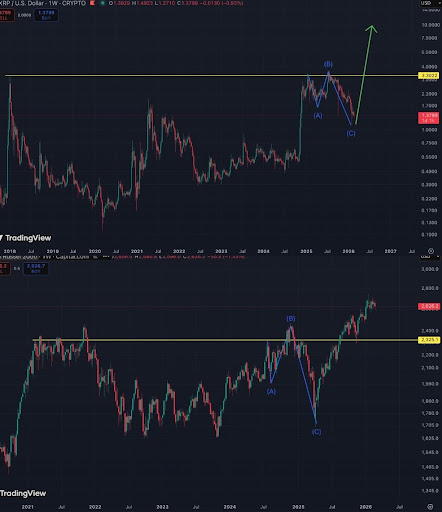
Source: Chart from Austin on X

Notably, the chart reveals that the A and B waves of the corrective three-wave pattern have already completed, and the price is currently working through the C wave. The chart structure suggests a potential crash to the $1.00-$1.27 range before any meaningful reversal attempt. If this occurs, it would represent a decline of roughly 5.22%- 25.37% from current levels of around $1.34.

The key question Austin is now asking is whether the token is on the verge of the same V-bottom inflection point that was observed in the Russell 2000 chart. If history repeats and structural parallel holds, the analyst suggests that the XRP correction currently unsettling holders could be the final shakeout before a launch into price discovery.

Analyst Shares Targets For Price Discovery

The most important aspect of the Russell 2000 analysis is the potential for XRP to enter price discovery mode and begin trading above its 2018 all-time high. The green arrow projection on the price chart points toward price discovery targets well above $5.

Once XRP completes its wave C correction, Austin predicts that the cryptocurrency could rapidly launch to the $7.5 to $10 range. With its price still hovering below $1.4, a breakout to $10 would represent a staggering increase of more than 645%.

XRP trading at $1.35 on the 1D chart | Source: XRPUSDT on Tradingview.com

Related Questions

QWhat is the main comparison made by the crypto analyst in the article?

AThe analyst draws a striking comparison between XRP's price action and the historical price movements of the Russell 2000 index, a US stock market index tracking smaller publicly traded companies.

QWhat specific Elliott Wave pattern is mentioned in the corrective phase for both the Russell 2000 and XRP?

AThe article mentions a sharp Elliott Wave ABC corrective pattern for both the Russell 2000 index and XRP.

QAccording to the analysis, what is the potential price target range for XRP's wave C correction?

AThe analysis suggests a potential crash to the $1.00-$1.27 range for the wave C correction.

QWhat is the predicted price range for XRP if it breaks out into price discovery after the correction?

AThe analyst predicts that XRP could rapidly launch to the $7.5 to $10 range after completing its wave C correction.

QWhat key event from the Russell 2000's history does the analyst suggest XRP might be on the verge of repeating?

AThe analyst suggests XRP might be on the verge of a dramatic V-bottom reversal, similar to the one the Russell 2000 staged in early 2025 before breaking out into price discovery.

Related Reads

Fu Peng's First Public Speech in 2026: What Exactly Are Crypto Assets? Why Did I Join the Crypto Asset Industry?

Fu Peng, a renowned macroeconomist and now Chief Economist at New火 Group, delivered his first public speech of 2026 at the Hong Kong Web3 Festival. He explained his perspective on crypto assets and why he joined the industry, framing it within the context of macroeconomic trends and financial evolution. Fu emphasized that crypto assets are transitioning from an early, belief-driven phase to a mature, institutionally integrated asset class. He drew parallels to the 1970s-80s, when technological advances (like computing) revolutionized traditional finance, leading to the rise of FICC (Fixed Income, Currencies, and Commodities). Similarly, current advancements in AI, data, and blockchain are reshaping finance, with crypto assets becoming part of a new "FICC + C" (C for Crypto) framework. He noted that institutional capital, including traditional hedge funds, avoided early crypto due to its speculative nature but are now engaging as regulatory clarity emerges (e.g., stablecoin laws, CFTC classifying crypto as a commodity). Fu predicted that 2025-2026 marks a turning point where crypto becomes a standardized, financially viable asset for diversified portfolios, akin to commodities or derivatives in traditional finance. Fu defined Bitcoin not as "digital gold" in a simplistic sense but as a value-preserving, financially tradable asset. He highlighted that crypto's future lies in regulated, institutional adoption, moving away from retail-dominated trading. His entry into crypto signals this maturation, where traditional finance integrates crypto into mainstream asset management.

marsbit34m ago

Fu Peng's First Public Speech in 2026: What Exactly Are Crypto Assets? Why Did I Join the Crypto Asset Industry?

marsbit34m ago

Justin Sun Sues Trump Family: What $75 Million Bought Was Only a Blacklist

Justin Sun, founder of Tron, has filed a lawsuit in federal court against World Liberty Financial (WLF), alleging he was made the "primary target of a fraudulent scheme" after investing $75 million. Sun claims the investment secured him an advisor title and WLFI tokens, which were later frozen by WLF, causing "hundreds of millions in losses." The dispute began in late 2024 when Sun's investment helped revive WLF's struggling token sale, which ultimately raised $550 million. Shortly after, the SEC dropped its lawsuit against Sun following Donald Trump's inauguration. However, relations soured when Sun refused WLF's demands for additional funding. In August 2025, WLF added a "blacklist" function to its smart contract, allowing it to unilaterally freeze tokens. Sun's holdings, worth approximately $107 million, were frozen, and he was threatened with token destruction. The lawsuit highlights WLF's structure, which directs 75% of token sale profits to the Trump family, who had earned $1 billion by December 2025. WLF's CEO is Zach Witkoff, son of U.S. Middle East envoy Steve Witkoff. The project faces scrutiny for opaque operations, including a controversial loan arrangement on the Dolomite platform, co-founded by a WLF advisor. Despite Sun's history with the SEC, the case underscores centralization risks within DeFi, as WLF controls governance and holds powers to freeze assets arbitrarily. Sun's tokens remain frozen as legal proceedings begin.

marsbit42m ago

Justin Sun Sues Trump Family: What $75 Million Bought Was Only a Blacklist

marsbit42m ago

$500 to Buy OpenAI Stock: Silicon Valley's Most Respectable Liquidity Invitation

Silicon Valley's largest venture capital platform, AngelList, has launched a new fund called USVC, allowing U.S. retail investors to buy into high-profile AI companies like OpenAI, Anthropic, and xAI with a minimum investment of $500—no accredited investor status required. Promoted by AngelList co-founder Naval Ravikant, the fund is framed as an opportunity for ordinary people to access high-growth private tech investments traditionally reserved for VCs. However, critics argue it functions more like an exit vehicle for early insiders. USVC acquires shares not through primary rounds but largely via secondary transactions—purchasing stakes from early investors, VC funds, and employees looking to cash out at peak valuations. With companies like xAI heavily weighted in the portfolio, the fund effectively channels retail money into providing liquidity for insiders who entered at much lower valuations. The fund’s structure raises concerns: shares are illiquid, with no secondary market, and buybacks are limited and discretionary. The actual annual fee reaches 3.61%, far above the advertised 1% management fee. This model parallels the "low float, high fully diluted valuation" strategy seen in crypto, where early investors profit by selling to latecomers at inflated prices. The timing—alongside similar moves by platforms like Robinhood—suggests that Silicon Valley’s sudden interest in retail inclusion may be less about democratizing access and more about securing exits for insiders.

marsbit1h ago

$500 to Buy OpenAI Stock: Silicon Valley's Most Respectable Liquidity Invitation

marsbit1h ago

Trading

Spot
Futures

Hot Articles

What is XRP 2.0

XRP 2.0: A New Frontier in the Cryptocurrency Landscape Introduction to XRP 2.0 In the ever-evolving realm of cryptocurrency, new projects continuously emerge, vying for attention and adoption. One such promising initiative is XRP 2.0, a novel cryptocurrency project designed to leverage advanced blockchain technology and robust encryption methodologies. While the name draws parallels with Ripple’s XRP, it’s crucial to note that XRP 2.0 operates independently, focusing on enhancing transaction security, privacy, and scalability. As the digital financial landscape increasingly embraces decentralized solutions, XRP 2.0 aims to contribute meaningfully to web3 and the overall expansion of crypto projects. What is XRP 2.0? At its core, XRP 2.0 is a cryptocurrency project that aims to create a secure and decentralized digital currency ecosystem. Its foundational technology integrates sophisticated blockchain principles with cutting-edge encryption techniques. The overarching goal of XRP 2.0 is to establish itself as a reliable and efficient platform enabling swift transaction execution while prioritizing enhanced privacy protections for its users. The project is promoted as a solution to many limitations faced by existing cryptocurrencies, proposing a system that can handle a higher volume of transactions with improved speed and privacy. This versatility positions XRP 2.0 as a significant contender in a marketplace riddled with various digital currencies. Who is the Creator of XRP 2.0? The identity of the creator behind XRP 2.0 has been flagged as ‘Wilbur.’ However, comprehensive details regarding Wilbur or their associated entity remain elusive. The anonymity of many cryptocurrency creators is not an uncommon phenomenon in the industry, often designed to maintain a degree of privacy and security. Who are the Investors of XRP 2.0? As of now, specific information related to the investment foundations or organizations supporting XRP 2.0 is not publicly available. In the cryptocurrency sector, the backing by reputed investors can significantly influence a project's credibility and success, yet the transparency regarding the financial supporters of XRP 2.0 has not been established. How Does XRP 2.0 Work? XRP 2.0 stands out by employing a combination of blockchain technology and advanced encryption algorithms that ensures secure and decentralized transactions. Its innovative structure includes unique features designed to foster user engagement and broaden functionalities beyond conventional cryptocurrency transactions. Among these features, XRP 2.0 incorporates AI-powered capabilities, such as text-to-image and text-to-speech functionalities. These additions are designed to enhance the interactive experience for users, promoting broader applicability across various sectors. By bridging technological advancements with user-centered design, XRP 2.0 aims to capture the attention of a diverse range of individuals and enterprises looking to integrate cryptocurrency solutions into their operational frameworks. Timeline of XRP 2.0 Understanding XRP 2.0 requires examining the milestones that have defined its journey thus far: July 23, 2023: XRP 2.0 is introduced as a novel cryptocurrency project, aiming to revolutionize secure and decentralized transaction capabilities in the blockchain domain. September 8, 2023: The launching of another project, XRP20, occurs, marking the emergence of an ERC-20 token on the Ethereum blockchain that remains unrelated to XRP 2.0. November 13, 2023: The XRP Ledger undergoes a significant update with the release of rippled server software version 2.0.0. It is essential to note that this development is disconnected from the XRP 2.0 cryptocurrency project. Key Points About XRP 2.0 To distill the essence of XRP 2.0, several critical factors emerge: Unique Features: The inclusion of features like AI-powered text-to-image and text-to-speech further diversifies the potential applications of XRP 2.0. Blockchain Technology: The framework utilizes advanced blockchain mechanisms and encryption protocols, ensuring a secure and decentralized environment for transactions. Scalability and Privacy: XRP 2.0 prioritizes enhanced privacy protections in transaction processes and the scalability necessary to accommodate a growing user base. No Affiliation with Ripple: Importantly, despite its name, XRP 2.0 does not have any allegiance or collaboration with Ripple’s XRP, distinguishing its operational framework and objectives within the cryptocurrency ecosystem. Conclusion XRP 2.0 represents an ambitious venture into the cryptocurrency sphere, aiming to offer a combination of security, privacy, and efficiency in digital transactions. By integrating sophisticated technologies and user-friendly features, the project sets out to broaden the horizons of what cryptocurrency can achieve in today's digital economy. While the anonymity of its creator and lack of disclosed investors might raise questions for some, XRP 2.0's focus on advanced functionalities and decentralisation enhances its appeal amidst an increasingly crowded crypto market. As the cryptocurrency landscape continues to evolve, XRP 2.0 may yet emerge as a pivotal player in the expansion of secure and scalable blockchain solutions.

941 Total ViewsPublished 2024.04.01Updated 2024.12.03

What is XRP 2.0

Discussions

Welcome to the HTX Community. Here, you can stay informed about the latest platform developments and gain access to professional market insights. Users' opinions on the price of XRP (XRP) are presented below.

活动图片