Will the U.S. Bond Market Trigger the Next Storm in U.S. Stocks? The Coming Week is Crucial

marsbitPublished on 2026-08-04Last updated on 2026-08-04

Abstract

"Will US Treasuries Trigger the Next Storm in the US Stock Market? The Coming Week Is Crucial" summarizes rising concerns in financial markets. Long-term US Treasury yields have surged sharply, with the 30-year yield reaching its highest level since 2007 and the 10-year yield breaking its trading range. This move is largely driven by growing market skepticism about the Federal Reserve's commitment to controlling inflation, especially after a rare dissent within the Fed's policy committee. Market volatility is increasing, as evidenced by the ICE BofA MOVE Index hitting a May high and demand for protective puts on long-term Treasury ETFs spiking to crisis-era levels. Analysts warn that stress in the bond market could soon spill over into equities, pressuring stock prices. The coming week is seen as critical, with several potential catalysts: the US Treasury's upcoming financing plan details and the key July nonfarm payrolls report. Both events could significantly influence interest rate expectations and potentially intensify market turbulence. The article concludes by noting the US Treasury market's foundational role in global finance, suggesting its ongoing instability could have widespread repercussions beyond bonds alone.

Original Author: Xu Chao

Original Source: Wall Street News

The U.S. Treasury market is sending increasingly strong signals of stress to other asset classes, with stocks being the first to feel the impact.

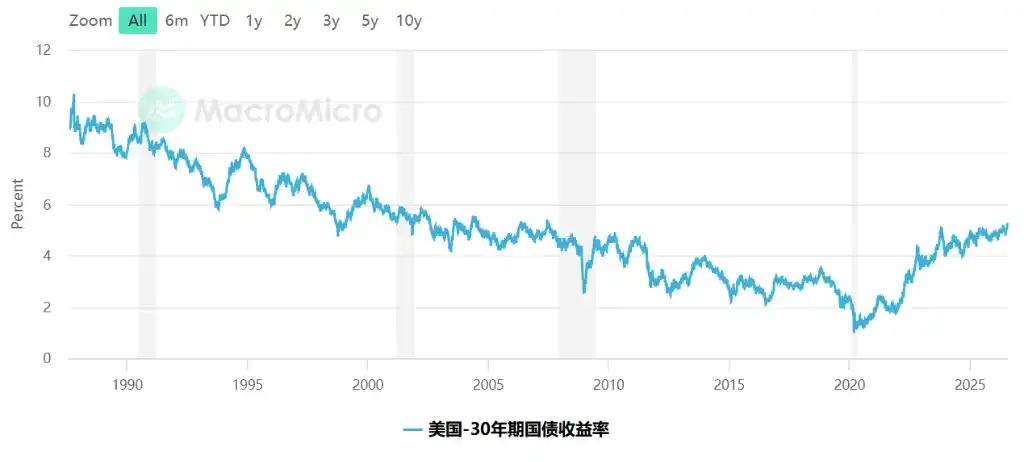
Long-term U.S. Treasury yields surged sharply last week, with the 30-year yield hitting its highest level since 2007, and the 10-year yield breaking out of the trading range it had maintained since late 2023.

Meanwhile, the ICE BofA MOVE Index, which measures expected volatility in the Treasury market, rose to its highest level since May, while demand for put options betting on falling bond prices surged. Data from the Chicago Board Options Exchange shows that the one-month put skew for options linked to the iShares 20+ Year Treasury Bond ETF soared to its highest level since the 2008 financial crisis.
In the coming week, the release of details from the U.S. Treasury's financing plans and the July non-farm payroll report could further intensify the volatility in the bond market.

Bob Elliott of Unlimited Funds recently wrote in a commentary: "It's difficult to gauge how much longer other asset markets, like equities, can withstand current interest rate levels without being dragged down." Gennadiy Goldberg, head of U.S. rates strategy at TD Securities, also warned that uncertainty surrounding the Federal Reserve's policy guidance, combined with geopolitical and other market noise, has created a precarious environment.

Fed Credibility Questioned, Long-Term Yields Break Out

The core driver of this recent surge in U.S. Treasury yields stems from market doubts about the Federal Reserve's policy credibility.

Since Federal Reserve Chair Kevin Warsh took the helm, he has adopted a tough stance on fighting inflation, yet the inflation rate has remained above the Fed's 2% target for five consecutive years. Investors are beginning to question whether the Fed truly has the will to raise interest rates again.

Last Wednesday, a rare divergence emerged within the Fed's rate-setting committee—three regional Fed presidents voted in favor of a rate hike, opposing the majority's position. As Warsh concluded his press conference last week, long-term yields jumped suddenly while short-term yields fell, sharply narrowing the spread between them. Analysis by Dow Jones Market Data shows this was the most significant compression of the yield curve on a 'Fed decision day' since 2023.

TD Securities' Goldberg stated: "The market is questioning just how determined the Fed is on controlling inflation." He also noted that while the base case remains no rate hikes this year or next, the probability of a hike has "increased significantly."

Bond Market Volatility Rises, Hedging Demand Expands Sharply

The unusual movement in yields quickly spread to the derivatives market, causing a sharp rise in hedging demand.

The ICE BofA MOVE Index reached its highest level since May, indicating traders are actively hedging against the risk of further rate increases.

At the same time, the ratio of trading volume in put options to call options linked to the iShares 20+ Year Treasury Bond ETF (TLT) has noticeably increased. Analysts at the Chicago Board Options Exchange pointed out that the one-month put skew for TLT options has surged to its highest level since the 2008 financial crisis.

Particularly noteworthy is that this rise in long-end yields has diverged from oil price movements—oil prices are falling, not rising in tandem with yields. This has further weakened the correlation between yields and oil prices, adding to market uncertainty.

Spillover Effects Emerge, Pressure on Stocks Rises

Turmoil in the U.S. Treasury market has historically been a precursor to stock market risks, and the current situation similarly has equity investors on edge.

Bob Elliott noted in his commentary that whenever Treasury yields reach or approach current levels, stress tends to begin spreading to other markets, with stocks being the first to be dragged down. Currently, the 30-year yield is at 5.239% and the 10-year yield is at 4.693%, both in historically high ranges.

Goldberg also admitted that geopolitical uncertainty stemming from the situation with Iran, ambiguity in the Fed's policy guidance, and a combination of other market noise are all contributing to the fragile environment. "All these uncertainties are intertwined," he said.

Multiple Event Windows Approach, A Critical Week of Testing Lies Ahead

The coming week will be a critical window to determine whether the stress in the Treasury market can spread further.

Later this week, the U.S. Treasury will release details of its latest government financing plans, and anything unexpected could trigger a new wave of volatility in the bond market. Several important economic data points will also be released throughout the week, culminating in Friday's July non-farm payroll report, which will significantly influence market expectations regarding the Fed's policy direction.

At the same time, last week, the U.S. Treasury and the Federal Reserve jointly conducted a historic coordinated intervention with Japanese authorities to stabilize the persistently weakening yen. Analysts believe the U.S. side's participation in the intervention was partly motivated by a desire to prevent renewed volatility in the U.S. Treasury market.

The $30 trillion U.S. Treasury market is the cornerstone of the global financial system, serving both as the core collateral for short-term institutional liquidity and as the benchmark pricing anchor for trillions of dollars in global debt. If this "sleeping giant" continues to stir, its tremors will extend far beyond the bond market itself.


Related Questions

QAccording to the article, what are the two key events in the upcoming week that could further intensify bond market volatility?

AThe two key events are: 1) The release of details of the U.S. Treasury's latest government financing plan, and 2) The release of the July non-farm payrolls report.

QWhat does the article suggest is the core driver behind the recent surge in long-term U.S. Treasury yields?

AThe core driver is the market's doubt about the credibility of the Federal Reserve's policy, specifically questioning how determined the Fed is in controlling inflation.

QWhat specific indicators mentioned in the article show a significant increase in demand for hedging against rising rates?

AThe indicators are: 1) The ICE BofA MOVE Index reaching its highest level since May, indicating traders are actively hedging against further rate hikes. 2) The one-month put option skew for the iShares 20+ Year Treasury Bond ETF (TLT) surging to its highest level since the 2008 financial crisis.

QWhy is the potential turmoil in the U.S. Treasury market a concern for the stock market, as highlighted by the analysts cited?

AAnalysts like Bob Elliott warn that pressure often spills over into other markets, with stocks being the first to be dragged down, when Treasury yields reach or approach current high levels. The high yields increase pressure on equity valuations.

QWhat did the article imply about one of the motivations behind the recent coordinated intervention to stabilize the Japanese yen involving U.S. authorities?

AThe article implied that part of the motivation for the U.S. to join the intervention was to prevent renewed volatility from erupting in the U.S. Treasury market.

Related Reads

The Biggest AI Black Hole: After Anthropic's Annual Revenue Hits $1 Trillion, Compute Power Prices Soar 10x

The article explores the potential for a dramatic surge in compute prices driven by the AI industry's explosive growth. It highlights a provocative prediction by tech podcaster Dwarkesh Patel: if AI labs like Anthropic continue their rapid revenue growth (projected to reach $1 trillion annually) while compute supply only expands at about 3x per year, the price of computing power could skyrocket by 10x or more. The core argument is a paradigm shift: GPUs are transitioning from mere hardware tools to carriers of "digital labor." If a single H100 GPU can host an AI agent capable of replacing a top-tier software engineer (with a Silicon Valley salary of $250k), its economic value should be recalibrated accordingly. Currently, the annual rental cost of an H100 is around $16k, creating a massive 15x valuation gap—a "labor arbitrage black hole." This imbalance stems from a critical mismatch: AI capabilities and commercial revenue are growing faster than the physical infrastructure (chips, data centers) can be built. With compute supply constrained by physical limits like chip manufacturing capacity, and demand soaring, prices are pressured upward. The piece further argues that expensive compute incentivizes using the most capable (and expensive) AI models, as cheaper, less efficient models waste more costly compute time—a phenomenon linked to the Alchian-Allen effect. Counterarguments are noted, suggesting AI's value may be capped in physical-world applications and that history often disproves predictions of resource scarcity. However, the response is that compute supply lacks the elasticity of traditional commodities. The conclusion is that before compute potentially becomes cheap and abundant, the industry may face an intense period of compute inflation and an arms race for this strategic resource.

marsbit22m ago

The Biggest AI Black Hole: After Anthropic's Annual Revenue Hits $1 Trillion, Compute Power Prices Soar 10x

marsbit22m ago

China's 'Bio DeepSeek' Emerges: 4 Oxford Prodigies Let AI Take Over Life Science

China's 'Biology DeepSeek' Emerges: Four Oxford Alumni Aim to Let AI Take Over Life Sciences Following DeepSeek-V4-Flash's global impact, a Chinese counterpart for life sciences has arrived. Jindu Bio, founded by four Oxford University alumni, has developed GeneLLM, a multi-omics large language model. Published in top journals *Nature Communications* and *Advanced Science*, GeneLLM is the first model pre-trained directly on raw omics data, aiming to understand the "language" and "system" of life. GeneLLM treats the four RNA bases (A, U, G, C) as fundamental tokens, learning from raw sequencing data without relying on pre-defined annotations. It uses a Transformer architecture to predict the next base, processing trillions of RNA reads. With versions ranging from 1.5 billion to 30 billion parameters, it achieves high accuracy in disease prediction with significantly lower-cost, shallow-depth sequencing, making precision medicine more accessible. Beyond the model, Jindu Bio is building BioFord Harness, an infrastructure to connect AI with physical labs. This system translates scientific intent into executable commands for various lab equipment, manages scheduling, and creates a data feedback loop. Its platform features five collaborative AI agents for literature review, experimental design, scientific reasoning, lab scheduling, and data analysis, drastically speeding up research cycles. Crucially, it turns all experimental data—including failures—into valuable learning material. The founding team combines expertise in bioengineering, AI, computational biology, and business. After initial challenges in securing funding, the company completed four financing rounds in 2023 following China's national push for "AI+" initiatives, supported by prominent investors like Sequoia Capital China and Gaotegaj Investment. In the broader AI for BioScience landscape, Jindu carves a unique niche. Unlike digital-only AI scientists or capital-intensive fully automated labs, it focuses on the "last mile" of infrastructure—orchestrating the entire research workflow by bridging AI models with existing laboratory hardware. Its long-term vision is to build an intelligent operating system for life sciences, defining a new, scalable paradigm for scientific discovery.

marsbit22m ago

China's 'Bio DeepSeek' Emerges: 4 Oxford Prodigies Let AI Take Over Life Science

marsbit22m ago

NVIDIA Has Moved the Mountain

**Title: NVIDIA Moves the Mountain** This article analyzes a dramatic two-day reversal in the AI and semiconductor stock markets, driven by a key announcement from NVIDIA. On Monday, August 3rd, Asian markets fell sharply, led by a crash in South Korean leveraged ETFs and panic selling in semiconductors. This spilled over to China's A-share market, where major indices dropped and semiconductor stocks like GigaDevice were hammered despite buyback announcements. The outlook for optical modules (a key AI infrastructure component) appeared bleak, weighed down by rumors of delays in CPO (Co-Packaged Optics) technology adoption. The turnaround came from the U.S. market later that same day. NVIDIA announced its Vera Rubin platform and, crucially, its senior VP declared that CPO technology had entered mass production and would be widely deployed in AI factories in the second half of the year. This directly countered the "CPO delay" narrative. Positive capex data from U.S. cloud giants added to the bullish sentiment. On Tuesday, August 4th, A-shares surged, particularly the ChiNext and STAR boards. The market saw heavy volume with over 2.2 trillion yuan in turnover. Optical module and CPO concept stocks skyrocketed, with leaders like Zhongji Innolight soaring over 13%. The rally was concentrated in growth sectors like tech and communications, while traditional "old economy" stocks like Kweichow Moutai declined. The article also notes other key developments: * A strong earnings report and raised guidance from WuXi AppTec sparked a rally in the CXO (pharma outsourcing) sector. * Mixed signals from the Middle East regarding the Strait of Hormuz. * New Chinese policies supporting the semiconductor industry and Hong Kong-China market cooperation. * Significant inflows into equity ETFs in July, suggesting institutional buying. The piece concludes by highlighting upcoming catalysts: AMD and SpaceX earnings, the potential reopening of the Strait of Hormuz, and NVIDIA's upcoming financial report later in August, which will be the next major test for the AI investment theme.

marsbit28m ago

NVIDIA Has Moved the Mountain

marsbit28m ago

Trading

Spot
活动图片