Will the Fed’s $8B liquidity injection create a turning point for crypto?

ambcryptoPublished on 2026-03-27Last updated on 2026-03-27

Abstract

Given the current macro environment marked by geopolitical tensions and rising oil prices, investors are closely monitoring Federal Reserve signals. The Fed's recent $8 billion liquidity injection is drawing significant attention, as shifts in liquidity often directly impact crypto markets. Technically, crypto showed early resilience but momentum is fading, with the total market cap dropping 3.4% in a day, erasing nearly $100 billion. Rising Treasury yields and a risk-off shift are pulling capital into safe havens, reminiscent of the 2022 cycle that triggered a major crypto bear market. The Fed's intervention may provide short-term support and slow the flight to safety, potentially acting as a key catalyst in the current cycle.

Given the current macro setup, investors are closely tracking every signal coming from the Federal Reserve.

The logic is simple: the ongoing West Asia crisis shows no signs of de-escalation. Instead, geopolitical tensions continue to spill into energy markets, pushing oil prices back above the $100/barrel mark. Consequently, countries are being forced to consider targeted fiscal responses to stabilize their economies.

Within this environment, liquidity has become the central narrative. That’s why the Federal Reserve’s recent decision to inject $8 billion into the financial system is drawing increased attention from investors, particularly for crypto traders, where shifts in liquidity often translate directly into price action.
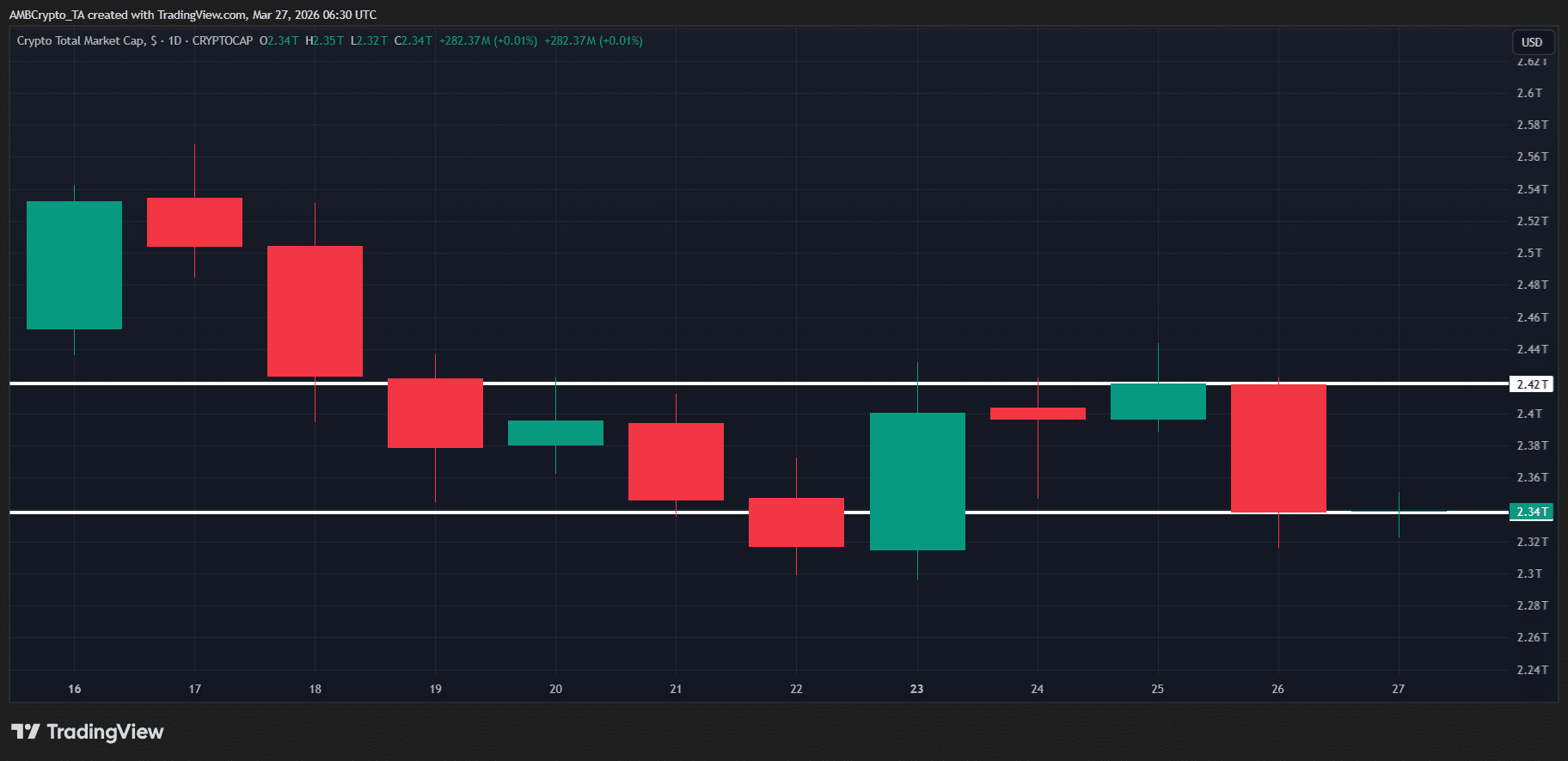
Source: TradingView (TOTAL/USDT)

From a technical perspective, the timing looks increasingly relevant.

While the crypto market initially showed resilience when the conflict first escalated, momentum now appears to be fading. Patience seems to be thinning, with the TOTAL crypto market cap closing 3.4% lower on the 26th of March, marking one of the sharper weekly pullbacks and wiping out nearly $100 billion in value.

Against this backdrop, the Federal Reserve’s liquidity injection could provide short-term support. The bigger question, however, is whether it will be enough to stabilize market sentiment if the conflict continues to drag on, especially as geopolitical uncertainty pushes investors toward safer assets.

If it does, this intervention could evolve into a key catalyst shaping the current crypto cycle.

Crypto markets fear a 2022 repeat as investors rotate into safety

In the current macro setup, risk management has naturally become the dominant trading priority.

From a technical angle, this shift reflects investors rotating back into cash and low-risk positions instead of actively deploying capital into risk assets, as they wait for clearer macro signals before increasing exposure.

Notably, this caution is most visible in the bond market. Real yields on 10-year Treasuries have climbed to their highest levels in nearly a year, signaling tightening financial conditions. At the same time, renewed geopolitical tensions with Iran have pushed the 10-year Treasury yield up to around 4.43%, reinforcing the broader risk-off tone across markets.
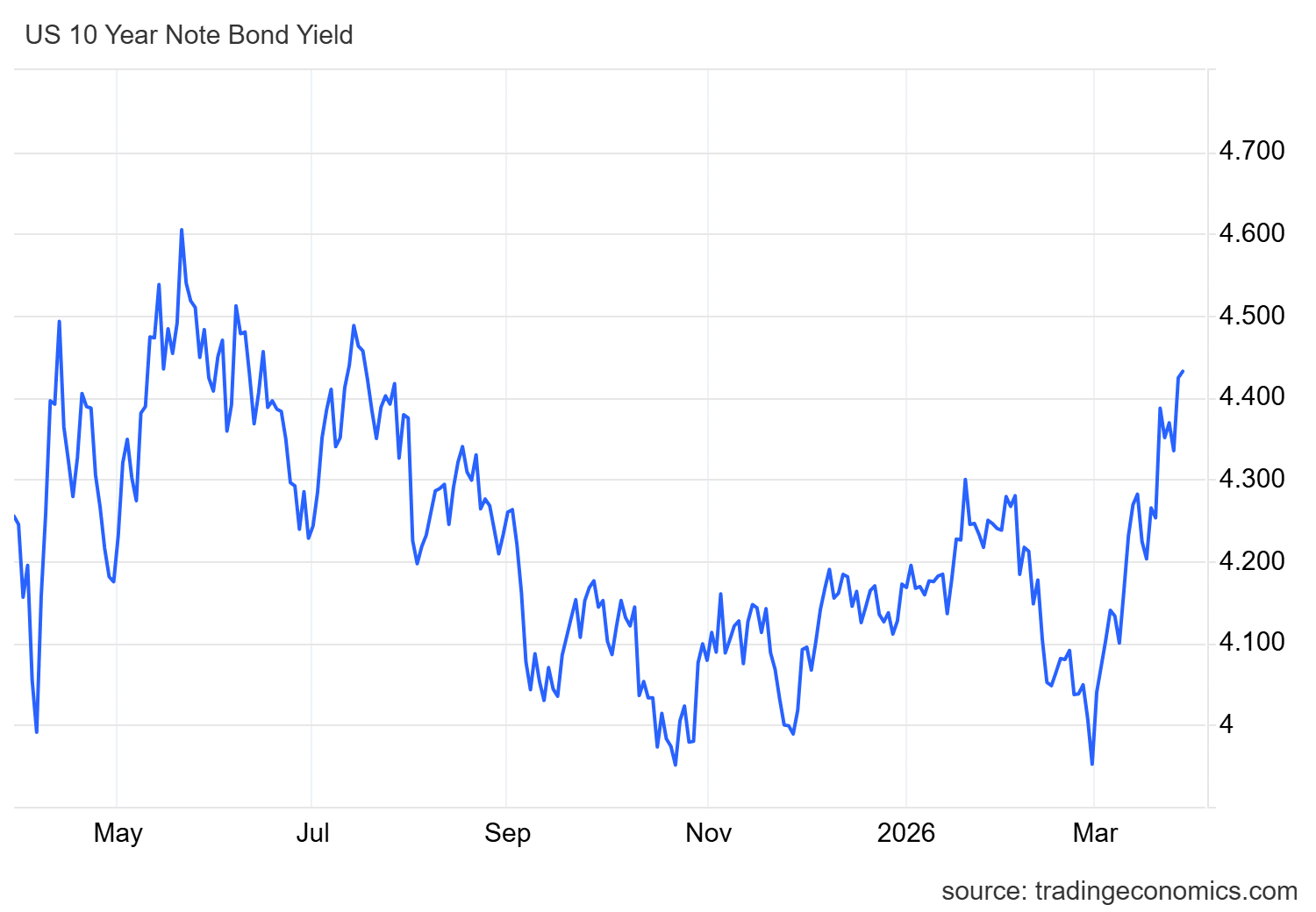
Source: TradingEconomics

In essence, higher yields are pulling liquidity away from risk assets.

And it doesn’t stop there. JPMorgan has pointed out that the ongoing rotation of capital into safe havens like cash is starting to resemble the 2022 setup. Back then, the shift toward safety triggered crypto’s first major bear market, sending the total crypto market cap down 65%+ and wiping out roughly $1.4 trillion in value.

In this context, the Federal Reserve’s $8 billion liquidity injection doesn’t just fit the technical picture. Instead, it also aligns with the broader “fundamental” backdrop too. As investors grow more risk-averse, this liquidity could help relieve pressure on risk assets and slow the flow into safe havens, making it a key signal for the current crypto cycle.


Final Summary

  • Rising yields and geopolitical tensions are driving capital toward safe havens, mirroring the 2022 cycle that triggered crypto’s first major bear market.
  • The Fed’s $8 billion injection provides support, easing pressure on risk assets and acting as a key signal in the current macro cycle.


Related Questions

QWhat is the main reason investors are closely watching the Federal Reserve's actions according to the article?

AInvestors are closely tracking every signal from the Federal Reserve because liquidity has become the central narrative, and shifts in liquidity often translate directly into price action in the crypto markets.

QHow did the crypto market perform on March 26th, as mentioned in the article?

AThe TOTAL crypto market cap closed 3.4% lower on March 26th, marking one of the sharper weekly pullbacks and wiping out nearly $100 billion in value.

QWhat specific action did the Federal Reserve take that is drawing attention from crypto traders?

AThe Federal Reserve decided to inject $8 billion into the financial system, which is drawing increased attention as it could provide short-term support to risk assets.

QWhy are rising yields on 10-year Treasuries significant for the crypto market?

ARising real yields on 10-year Treasuries signal tightening financial conditions and a risk-off tone, which pulls liquidity away from risk assets like crypto, mirroring the setup that triggered the 2022 bear market.

QWhat broader macroeconomic factor is contributing to the current risk-averse sentiment among investors?

ARenewed geopolitical tensions, particularly the ongoing West Asia crisis with no signs of de-escalation, are spilling into energy markets and pushing investors toward safer assets, contributing to the risk-averse sentiment.

Related Reads

Dialogue with a Macro Analyst: AI Drains All Liquidity from U.S. Stocks, $40K Bitcoin is the True Bottom

In a recent discussion, macro strategist Luke Groman, founder of FFT LC, presented a sobering analysis of current markets. He argues that while the S&P 500 hits new highs, this is largely driven by just seven AI stocks, which are "sucking all the oxygen and liquidity out of the room." Bitcoin, which he calls the "last working smoke alarm for liquidity," is signaling trouble, having entered a difficult period. Groman explains that the AI boom is fueled by accounting practices that front-load revenue, creating an illusion of high profits while cash is being depleted. He warns this cycle could reverse sharply when construction slows. His base case is that stocks will rise in dollar terms but fall significantly when measured in gold or Bitcoin, highlighting that long-term US Treasury futures have already lost 90% of their value against gold over the past decade. He points to major structural risks, including China's dominance in rare earths—a small commodity market underpinning trillions in tech stock value—and the prolonged closure of the Strait of Hormuz, which he calls a "Suez Moment" for the US. This, combined with a shift towards a "no ticky, no washy" proof-of-work system for settling trade (using gold, not trust), signals deeper systemic distrust. Regarding US debt, Groman notes that historically, all 58 countries that reached a 130% debt-to-GDP ratio defaulted, primarily through inflation. The US crossed this threshold in 2020. He also highlights a contradiction in the AI narrative: if it's as transformative as claimed, it must destroy white-collar jobs, threatening half of US tax revenue—a reality at odds with the "no job loss" messaging from tech leaders. On Bitcoin, Groman sold most of his position near the top and hasn't fully re-entered. Citing technical analysis from Northstar Bad Charts, he suggests a potential bottom around $40,000 could materialize in Q3 or Q4. He concludes that while he may be labeled a doomsayer, his view is simply realistic, grounded in historical precedents and current macro pressures.

marsbit55m ago

Dialogue with a Macro Analyst: AI Drains All Liquidity from U.S. Stocks, $40K Bitcoin is the True Bottom

marsbit55m ago

Apple's Desired On-Device AI Sees a Dark Horse Emerge: The First Cognitive Model is Born, 4B Matches GPT-5.4

A Chinese company, Tomorrow's Journey (Nextie), has introduced what it is calling the industry's first "cognitive model" for edge devices. Named New Journey Alpha, this 4-billion-parameter model reportedly matches the performance of trillion-parameter giants like GPT-5.4 in group intelligence tasks such as debate and collective decision-making. The development follows Andrej Karpathy's vision of stripping vast factual knowledge from large language models to retain only a smaller "cognitive core" capable of reasoning, planning, and knowing its own limits. This approach directly addresses the soaring computational costs and token expenses hindering AI's widespread deployment, as highlighted by incidents like Amazon shutting down an internal AI tool due to prohibitive costs. Trained via reinforcement learning on a corpus of academic papers from 1800-2020 to enhance generalization, the model enables three key advancements: 1) Improved decision quality in multi-agent systems, 2) Drastically reduced compute costs, allowing for cost-effective cloud or on-device (e.g., MacBook) deployment, and 3) The feasibility of "proactive" AI agents that act autonomously without user prompts, unlocking new commercial possibilities beyond today's reactive models. Built by the former Microsoft Xiaoice team—known for creating a 3.6B model that outperformed a 65B Llama model—the company is now focusing on the multi-agent systems sector, a field gaining significant investor interest. The model's economic impact is profound; by achieving high-level performance with minimal parameters, it fundamentally alters the cost structure of AI services, challenging the prevailing model of ever-larger parameter counts.

marsbit3h ago

Apple's Desired On-Device AI Sees a Dark Horse Emerge: The First Cognitive Model is Born, 4B Matches GPT-5.4

marsbit3h ago

Trading

Spot
Futures
活动图片