Will the Federal Reserve Definitely Raise Interest Rates in September? How Will Cryptocurrencies and US Stocks Bear the Pressure?

Odaily星球日报Published on 2026-08-03Last updated on 2026-08-03

Abstract

In early August 2024, market expectations for a September Federal Reserve rate hike surged dramatically, from below 50% to over 80%, driven by renewed inflation concerns. This shift followed a contentious July FOMC meeting where a 9-3 vote to hold rates revealed a growing hawkish faction advocating for an immediate hike, citing prolonged above-target inflation. The key catalyst is escalating conflict near the Strait of Hormuz, which has pushed oil prices up approximately 20% in July, threatening to reignite inflation. The next critical data point is the July CPI report on August 12th; a hot reading could solidify hike expectations. For crypto assets, particularly Bitcoin, this represents near-term pressure. Bitcoin continues to exhibit high-beta, risk-on characteristics, making it sensitive to tightening liquidity and higher opportunity costs. However, historical precedent suggests that if a hike is perceived as the cycle's end rather than its start, the negative impact may be brief, with markets quickly pivoting to anticipate future rate cuts. U.S. stocks, especially crypto-linked equities like Coinbase and high-valuation tech stocks, face amplified volatility. Higher rates increase discount rates in valuation models, pressuring growth stocks. This coincides with a pivotal tech earnings season where investor focus has shifted from massive AI capital expenditures to demonstrable revenue and cash flow generation. Companies with negative cash flows and weak growth narratives ...

Original | Odaily Planet Daily (@OdailyChina)

Author | jk

In the short span of the past week, market bets on a September rate hike have surged from less than 50% to over 80%.

Such speed in pricing changes is uncommon in the history of Fed watching over the past year, and Bitcoin and a host of crypto-related stocks have already begun to price in this possibility.

Last week, the Federal Reserve's July 29th policy meeting maintained the target range for the federal funds rate at 3.50% to 3.75% with a 9-3 vote, marking the fifth consecutive meeting of holding steady. However, unlike the almost certain decisions of previous meetings, this vote revealed a clear divergence. Cleveland Fed President Hammack, Minneapolis Fed President Kashkari, and Dallas Fed President Logan cast dissenting votes, advocating for an immediate 25 basis point hike, citing that inflation has been running above the 2% target for over five consecutive years. Fed Chair Wash, at the post-meeting press conference, used a vivid phrase, saying he "asked for a good family quarrel, and indeed got one."

This divergence directly pushed up market expectations for a September hike. According to data from the CME FedWatch Tool, just one week before this meeting, market pricing for a September hike was less than 53%. But within a short week, as rising oil prices fueled inflation concerns, this probability jumped to 82% at one point and is now reported at 73%. The 9-3 vote result represents a growing hawkish faction within the committee hoping for a hike, which the market widely interprets as a significant increase in the likelihood of a September rate increase.
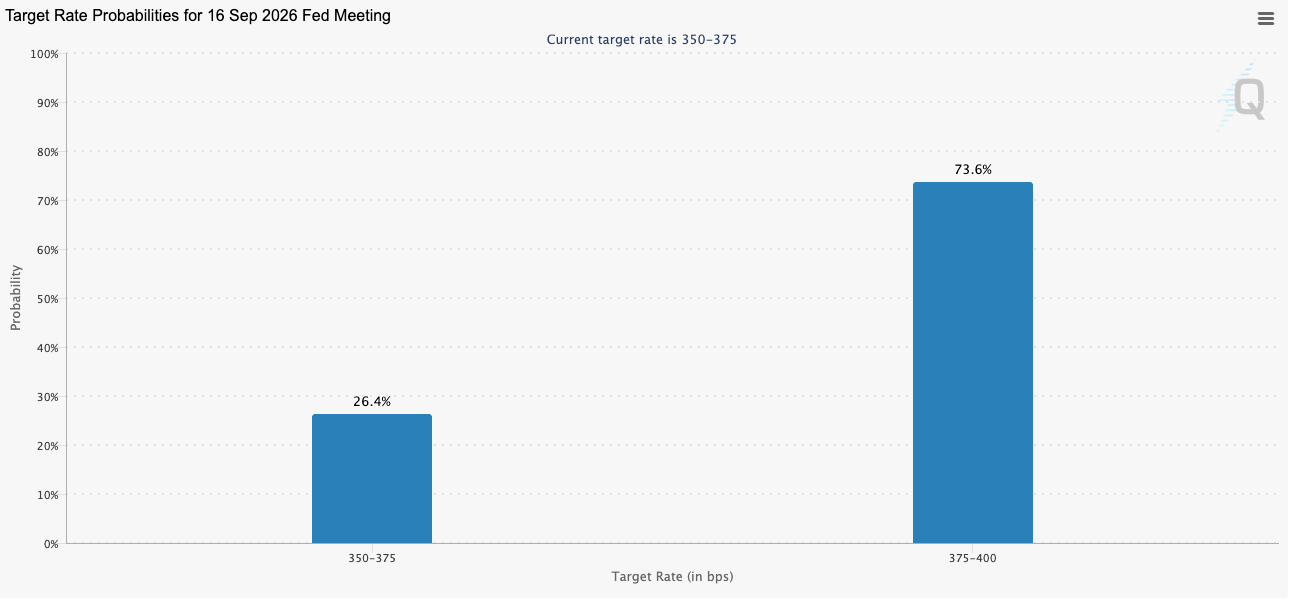
Current probability of a rate hike. Source: CME

However, it's important to note that a clear gap remains between market pricing and the overall expectations of economists. A FactSet survey of economists shows that most still believe rate cuts will resume in 2027, with a cumulative reduction of around 50 basis points. In other words, the pricing in short-term interest rate futures more reflects a sensitive reaction to recent oil price and inflation data.

From a broader perspective, the resurgence of these rate hike expectations follows a relatively clear transmission chain, with the core starting point being geopolitical conflict near the Strait of Hormuz. Since July, escalating conflicts between Iran and relevant parties have repeatedly threatened this key waterway, about 30 miles wide, which handles roughly 20% of global daily seaborne oil trade. WTI crude oil futures rose approximately 20% in July. Note, this is not the first conflict but a second round of US-Iran conflict following an agreement. Energy prices are one of the most directly transmitted components in the Fed's key PCE inflation gauge. Rising oil prices quickly reflect in the next inflation report, which is the direct reason for the market's rapid repricing of hike probability in the past week.

Regarding specific data points, the June CPI report released on July 14 showed a year-on-year increase of 3.5%, the most optimistic reading since the Iran conflict erupted, primarily due to a temporary relief from a 5.7% month-on-month drop in energy prices during a ceasefire. However, this relief appears quite fragile, as July's renewed oil price increases are likely to be reflected in the next data release. The next widely recognized key node is the July CPI report released on August 12th. If the data shows the June moderation is real and sustainable, the probability of a September hike will likely revert towards the economist consensus. However, if the data indicates energy-driven inflation is reaccelerating, especially if the Iran ceasefire remains incomplete and oil prices stay above $80, the probability of a September hike will rise further.

Signals from the Fed itself are also reinforcing this expectation. The dot plot from the June meeting showed that 9 out of 18 officials now expect at least one rate hike this year, higher than in March when the median projection still anticipated rate cuts. The core PCE inflation forecast was raised to 3.3% for 2026. Since taking office, Chair Wash has explicitly simplified policy statements and downplayed forward guidance. He notably did not submit his own economic projections at the June meeting, but his press conference remarks were interpreted as hawkish by the market, directly fueling rate hike bets at the time. Some members hold differing views; for instance, Milan, who was on the committee earlier this year, publicly questioned the logic of hiking when core CPI monthly readings had once turned negative. Overall, besides developments in the geopolitical situation itself over the next month, the July CPI data, the August non-farm payrolls report, and Fed officials' remarks at the Jackson Hole Symposium will be key windows for judging whether a September hike truly materializes, which will also amplify volatility in crypto assets and related US stocks around these data release dates.

Impact on Crypto Assets?

For crypto assets, a rise in rate hike expectations is never good news. Bitcoin is currently oscillating between $64,000 and $65,000 and remains highly sensitive to Fed signals. Bitcoin has repeatedly demonstrated high-beta risk asset characteristics over the past year, with its price movements showing a strengthening correlation with the US dollar liquidity cycle. Since the beginning of the year, impacted by a series of macro shocks like tariff policies and geopolitical risks, Bitcoin once fell below $64,000, while traditional safe-haven assets like gold and silver recorded double-digit gains. This divergence itself indicates the market does not treat Bitcoin as a true safe haven but as a liquidity-sensitive risk asset. If the Fed does pivot to a hike in September, the opportunity cost of holding non-yielding assets like Bitcoin will rise further, and the incentive for funds to flow back from risk assets to money market funds and short-term bonds will correspondingly strengthen, directly putting pressure on short-term sentiment in the crypto market.

However, the impact of rate hikes on Bitcoin is not linear. Entering 2023, despite the Fed still hiking rates twice consecutively, Bitcoin rose 21% against the trend. The actual impact of the last two hikes on price was quite limited, indicating that when a rate hike path is fully digested by the market and inflation data shows marginal improvement, the hike itself may not necessarily continue to suppress prices. What truly determines the move is often the expected change in policy direction, not the single hike action. This historical experience also provides a reference for observing this potential September hike. If a September hike ultimately materializes but is interpreted by the market as the end of the tightening cycle rather than its start, Bitcoin's decline in magnitude and duration could be brief, with the market entering expectations for a rate-cutting cycle faster.

Impact on US Stocks?

Regarding US stocks, the price movements of crypto-related stocks and assets often amplify Bitcoin's own volatility. Stock prices of companies like Coinbase (COIN), Circle (CRCL), and MicroStrategy (MSTR) typically react to rate expectations more sharply than spot Bitcoin: rising rate hike expectations mean a higher risk-free rate, which directly increases the discount rate in equity valuation models, putting particular pressure on growth and high-valuation tech stocks. An important support for the US stock rally in recent years has been valuation expansion driven by rate cut expectations. Once this expectation reverses, the market needs to reprice for higher capital costs, making increased index volatility almost inevitable. Notably, several heavyweight tech stocks in the S&P 500 and Nasdaq have already experienced significant corrections. If expectations for a September hike further solidify, valuation pressure on these core heavyweight stocks could transmit to the broader index level.

Simultaneously, this rise in rate hike expectations coincides with the most capital-intensive earnings season for tech giants. From late July to early August, Google, Microsoft, Meta, Amazon, and Apple sequentially reported Q2 earnings, with market reactions showing clear divergence. The core point of contention is whether capital expenditures can translate into actual revenue. Google Cloud revenue surged 82% year-on-year to a record growth rate, but its full-year capital expenditure guidance was raised to a range of $195-205 billion, causing its stock price to drop 7%. Meta's revenue grew 28% year-on-year, slightly exceeding expectations, but its capital expenditure guidance was raised to $130-145 billion, sending its stock tumbling nearly 9%. Apple's stock fell significantly due to weaker-than-expected revenue guidance for Q4 and supply chain constraint concerns. Only Microsoft delivered results satisfying the market, with annual cloud revenue surpassing $100 billion for the first time and its FY2027 capital expenditure guidance lowered from $190 billion to $175 billion, causing its stock to surge over 15% in a single day, its biggest gain in nearly 18 years. The combined capital expenditure of these four companies approaches $750 billion, and the market's evaluation criteria have shifted from "willingness to spend on AI" to "whether this money can convert into visible revenue and cash flow."

This divergence implies higher sensitivity heading into September. These giants primarily rely on debt and equity issuance to fill cash flow gaps for their capital expenditures. If a September hike indeed occurs, rising corporate financing costs will directly compress the marginal return space for their capital spending. At that point, market tolerance for the narrative of "spending heavily on AI for growth" may further narrow. For companies already experiencing negative cash flow and lacking compelling growth stories, stock price volatility could be more intense than in the July round.

Regarding the September policy meeting, a more accurate description for now is that a rate hike has transformed from a low-probability event nearly ruled out at the beginning of the year into a mainstream scenario with over 50% probability in market pricing. For crypto asset and related US stock investors, oil price trends, monthly CPI data, and Fed officials' remarks at events like the Jackson Hole Symposium will be key windows over the next month for observing whether the probability of a hike further solidifies.


Related Questions

QWhat key data point and event have the most immediate impact on the likelihood of a September Fed rate hike according to the article?

AThe key data point is the upcoming July CPI report scheduled for release on August 12th. The most immediate external event is the geopolitical conflict near the Strait of Hormuz, which impacts global oil prices and, consequently, inflation expectations. Rising oil prices are the core driver behind the recent sharp increase in market pricing for a September hike.

QHow did the voting pattern of the July 29-30 FOMC meeting influence market expectations?

AThe July FOMC meeting resulted in a 9-3 vote to keep rates unchanged. The fact that three members voted for an immediate 25 basis point rate hike signaled a significant expansion of hawkish sentiment within the committee. This shift was interpreted by the market as a strong indication that a rate hike in September is now a much more realistic possibility, leading to a sharp jump in market pricing.

QAccording to the article, what are the two different characteristics of Bitcoin's price action in relation to monetary policy, and what is the key determinant of its impact?

AFirst, Bitcoin has repeatedly shown characteristics of a high-beta risk asset, sensitive to the US dollar liquidity cycle. Second, historically, even during a hiking cycle, Bitcoin's price can rise if the path is well-anticipated and inflation shows marginal improvement. The key determinant of the impact is not the rate hike action itself, but the shift in market expectations regarding the overall policy cycle (e.g., whether it's seen as the end or the continuation of tightening).

QWhy are crypto-related stocks like Coinbase and MicroStrategy potentially more vulnerable to rate hike expectations than Bitcoin itself?

ACrypto-related stocks are growth-oriented equities. Rising rate expectations increase the discount rate used in their valuation models, which puts direct downward pressure on their stock prices. This sensitivity is often more acute than for the underlying asset (Bitcoin). Higher interest rates also increase corporate financing costs, impacting their capital expenditure plans.

QWhat new market standard is emerging for judging major tech companies' massive AI-related capital expenditures, and how does it relate to interest rate concerns?

AThe market's focus has shifted from judging 'how much money a company is willing to spend on AI' to assessing 'whether that spending can be converted into visible revenue and cash flow.' This is critical in a higher interest rate environment because increased borrowing costs directly compress the marginal return on these massive capital investments, making the market less tolerant of companies that burn cash without showing clear near-term growth results.

Related Reads

With Revenue 3.8 Billion Lower Than CXMT, Net Profit Is 8.6 Billion Higher: What Secrets Are Hidden in YMTC's IPO?

Chinese NAND flash giant Changcun Holdings has submitted its IPO prospectus to the Shanghai Stock Exchange. In Q1 2026, the company reported revenue of 47.042 billion yuan and a net profit attributable to parent company shareholders of 33.379 billion yuan. This presents a striking contrast with its competitor Changxin Technology, which had higher revenue (50.8 billion yuan) but a significantly lower net profit of 24.762 billion yuan. The key to this discrepancy lies in their ownership structures of core assets. Changcun Holdings fully owns its main operating entity, Yangtze Memory Technologies Co., Ltd., allowing nearly all group profits to flow to the parent company. In contrast, Changxin Technology controls but does not fully own its key production subsidiaries, meaning a substantial portion of its consolidated profits (approximately 8.25 billion yuan in Q1 2026) belongs to minority shareholders, reducing its reported net profit. Despite Changcun's higher net profit, its pre-IPO valuation is estimated lower than Changxin's. Analysts attribute this to differing market expectations: Changxin, focused on DRAM and the high-growth HBM market for AI servers, is seen as having greater long-term growth potential. Changcun, while dominant in NAND flash, operates in a market with inherent size constraints, making its future valuation more dependent on successfully upgrading its product mix toward higher-value segments like enterprise SSDs.

marsbit8m ago

With Revenue 3.8 Billion Lower Than CXMT, Net Profit Is 8.6 Billion Higher: What Secrets Are Hidden in YMTC's IPO?

marsbit8m ago

Perpetual Contract Liquidation Wave Resurges, Bitcoin $62k - $67k May Become the 'Disaster Zone'

A wave of liquidations has hit the crypto perpetual futures market, with analysts warning of continued volatility. Following Bitcoin's drop below $76,000 and subsequent rebound, over $84 million in long positions were liquidated in one hour, demonstrating the amplified impact of leverage. The U.S. CFTC's recent approval of a spot Bitcoin perpetual contract on the Kalshi exchange has opened this "previously closed" asset class to American institutions, with the platform reporting $5.5 billion in volume in its first two weeks. However, critics like Better Markets warn that perpetuals are "among the most dangerous crypto products" for retail investors due to a lack of enhanced protections. Recent price action saw a massive $529 million in hourly liquidations, predominantly longs. Analysts note that while a $3.3 billion short squeeze cleared liquidity above $80,000, a significant pool of long liquidations now sits between $62,000 and $67,000, posing a downside risk if key resistance holds. Experts caution new traders against using leverage or options, which can expire worthless, without proper experience and risk management. Despite the dangers, the demand for leveraged products persists, with some institutional players preferring on-chain platforms for their transparency and self-custody. As Kalshi expands its perpetual offerings beyond crypto, the core warning remains: leverage can lead to sudden, severe losses for unprepared investors.

marsbit8m ago

Perpetual Contract Liquidation Wave Resurges, Bitcoin $62k - $67k May Become the 'Disaster Zone'

marsbit8m ago

Japanese Interest Rates Return to 1996 Levels: Can Bitcoin's 'Decoupling Narrative' Withstand the September Rate Hike?

Japan's borrowing costs have hit their highest level since 1996, with 30-year and 10-year government bond yields rising significantly. This marks a major shift for a country long reliant on negative rates. Meanwhile, Bitcoin surged 22% in a week, topping $80,000. The core question is whether crypto's apparent decoupling from traditional market turbulence can withstand potential interest rate hikes by the Bank of Japan (BOJ) in September. For years, the yen carry trade—borrowing cheap yen to invest in higher-yielding assets—has fueled global risk assets. This leverage, estimated at up to $500 billion, relies on near-zero Japanese rates. The BOJ raised its policy rate to 1.0% in June, a 31-year high, with a further hike expected in September. A rapid yen appreciation could quickly wipe out carry trade profits and trigger deleveraging, as seen in August 2024 when Bitcoin and Japanese stocks fell sharply. Currently, however, the yen is weakening, which could temporarily support the carry trade and risk assets. Japan faces a debt dilemma. Its national debt has soared to a record ¥1,346 trillion. Raising rates could stabilize the yen but drastically increase debt servicing costs. The BOJ has signaled a slower pace of policy normalization to ensure market stability. Japan's large-scale selling of US Treasuries to fund currency intervention has also contributed to rising global yields. Bitcoin's recent resilience challenges traditional risk-asset logic. A pessimistic view holds that significant BOJ tightening and a stronger yen would force global deleveraging, pulling Bitcoin down. Higher yields also make interest-bearing assets relatively more attractive than Bitcoin. An optimistic scenario suggests that continued yen weakness could make Bitcoin an appealing hedge for Japanese investors. Japanese institutional interest is growing, with regulatory progress potentially paving the way for spot crypto ETFs by 2027. The key event is the BOJ's September 17-18 meeting. Market focus will be less on the expected rate hike to 1.25% and more on the future policy guidance. A hawkish signal aiming for higher rates could strengthen the yen and unwind carry trades. A dovish stance, constrained by debt concerns, could further weaken the yen, potentially benefiting Bitcoin via a weaker dollar and local demand. The current market prices in a slow evolution of Japan's debt issues. While Bitcoin may be trading on yen weakness and institutional adoption, the 30-year yield near 4% is a significant risk signal. The correlation between the yen's direction and Bitcoin remains crucial and could reverse swiftly if the BOJ alters market expectations in September.

marsbit13m ago

Japanese Interest Rates Return to 1996 Levels: Can Bitcoin's 'Decoupling Narrative' Withstand the September Rate Hike?

marsbit13m ago

Trading

Spot
活动图片