Will Solana Flip Ethereum? Revenue Numbers Show Disturbing Trend

bitcoinistPublished on 2025-12-22Last updated on 2025-12-22

Abstract

Solana is on track to surpass Ethereum in annual revenue for the first time, with $1.4 billion year-to-date compared to Ethereum's $522 million. This represents a significant shift, as Ethereum's revenue has declined by around 90% over five years, while Solana's has surged by approximately 5,000%. Key contributors to Solana's growth include dApps like Pump.fun, Jupiter, and Phantom, along with user base fees. Solana co-founder Anatoly Yakovenko emphasized the importance of providing a superior execution layer for decentralized applications. Despite a recent drop in meme coin trading activity, which previously drove user engagement, analysts suggest growing stablecoin usage and tokenized equities—such as those from Galaxy Digital and Visa's planned USDC settlements—may sustain Solana's momentum. Critics point to reduced monthly traders, but proponents believe new user bases will emerge.

Solana is set to flip Ethereum in revenue numbers for the first time ever. Solana co-founder Anatoly Yakovenko commented on this development, highlighting the gap between both networks while also questioning how they could sustain this trend.

Solana On Course To Flip Ethereum In Yearly Revenue

In an X post, the Solana treasury company DeFi Development Corporation (DFDV) revealed that SOL is on course to surpass ETH in annual revenue for the first time. The company stated that this is not just a milestone but “instead a regime shift.” DFDV added that SOL stands as the revenue chain, where the decentralized applications (dApps) of tomorrow will live, scale, and breathe.

The accompanying chart shows that SOL has recorded annual revenue of $1.4 billion year-to-date (YTD), while the Ethereum network has recorded $522 million. As DFDV noted, this marks a significant shift, given that ETH surpassed SOL in previous years. In 2024, Ethereum recorded an annual revenue of $2.5 billion, while SOL recorded $1.42 billion.
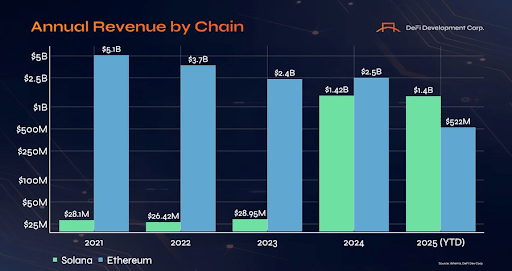
Source: Chart from Defi Dev Corps on X

Notably, Ethereum’s revenue is down around 90% in 5 years, while Solana’s revenue has increased around 5,000% in the same period. DeFiLlama data shows that dApps such as Pump.fun, Axiom, Meteroa, Jupiter, and Phantom have actively contributed to the revenue recorded on SOL. Meanwhile, the network has also generated base fees paid by users.

Commenting on this milestone, Solana’s co-founder stated that it has been a “crazy year” and noted that whether open permissionless protocols can actually grow and maintain revenue remains an open question. Yakovenko further remarked that he believes the entire crypto market cap will continue to grow and, eventually, will have to be split by revenue.

He also stated that Solana and Ethereum’s only shot at this is in the execution layer. Yakovenko explained that providing the best execution layer will mean global decentralized, low-latency, and high-throughput censorship resistance.

“SOL Is Dying”

Amid Solana’s revenue milestone over Ethereum, DeFi maxi Scribbler has declared that Solana is dying. In an X post, he noted that over 30 million people were trading on the network each month between November last year and February this year. However, since then, the network has struggled to average 1 million traders monthly.

This is likely due to the slowdown in meme coin trading on the SOL network, which gained it a lot of traction last year and at the start of this year, when U.S. President Donald Trump launched his meme coin, TRUMP. However, crypto commentator Marty doesn’t believe that this is the end for Solana, stating that equity traders and stablecoin users will replace the meme coin traders.

Notably, Galaxy Digital and Forward Industries have tokenized their stocks on SOL, while the network is also seeing increasing activity in stablecoin transactions. Visa just recently announced plans to begin USDC stablecoin settlements on Solana for U.S. banks.

SOL trading at $126 on the 1D chart | Source: SOLUSDT on Tradingview.com

Related Questions

QAccording to the article, what is the projected annual revenue for Solana (SOL) and Ethereum (ETH) year-to-date (YTD)?

AYear-to-date, Solana has recorded an annual revenue of $1.4 billion, while the Ethereum network has recorded $522 million.

QWhat significant trend does the article highlight regarding the 5-year revenue change for Ethereum and Solana?

AEthereum's revenue is down around 90% in the last 5 years, while Solana's revenue has increased by approximately 5,000% in the same period.

QWhat reason is suggested for the recent decline in the number of monthly traders on the Solana network?

AThe decline is likely due to a slowdown in meme coin trading, which had previously given the network a lot of traction.

QWhat did Solana co-founder Anatoly Yakovenko identify as the 'only shot' for Solana and Ethereum's success?

AHe stated that their only shot is in the execution layer, which means providing a global, decentralized, low-latency, and high-throughput censorship-resistant platform.

QWhat recent development did Visa announce regarding the Solana network?

AVisa announced plans to begin USDC stablecoin settlements on Solana for U.S. banks.

Related Reads

Lowering Expectations for BTC's Next Bull Market

The author, Alex Xu, explains his decision to significantly reduce his Bitcoin holdings (from full to ~30% of his portfolio) during the current bull cycle, citing a lowered long-term outlook for BTC's price appreciation in the next cycle. He outlines six key reasons for this reduced expectation: 1. **Diminished Growth Drivers:** The narrative of exponential user adoption has largely played out with institutional ETF adoption. The next major growth phase—adoption by sovereign national reserves or central banks—seems unlikely in the near future. 2. **Personal Opportunity Cost:** More attractive investment opportunities have emerged in other assets, such as undervalued companies. 3. **Industry-Wide Contraction:** The broader crypto industry is struggling, with most Web3 business models (SocialFi, GameFi, DePIN) failing. This overall萧条 (depression) reduces the fundamental demand and consensus for Bitcoin. 4. **Strain on Major Buyer:** MicroStrategy, a major corporate buyer of BTC, faces rising financing expenses for its debt, which could slow its purchasing rate and create significant marginal pressure on the market. 5. **Increased Competition from Gold:** The emergence of "tokenized gold" has closed the functional gap (portability, divisibility) between physical gold and Bitcoin, offering a strong competitor in the non-sovereign store-of-value space. 6. **Security Budget Concerns:** The block reward halving continues to exacerbate the long-standing issue of funding Bitcoin's network security, with new fee source explorations like Ordinals and L2s largely failing. The author's decision to hold a significant (though reduced) position reflects a cautious, not bearish, outlook. He remains open to increasing his exposure if the fundamental reasons for his skepticism change or if new positive catalysts emerge.

marsbit29m ago

Lowering Expectations for BTC's Next Bull Market

marsbit29m ago

Can Iran 'Control' the Strait of Hormuz?

Iran has announced a comprehensive plan to assert control over the strategic Strait of Hormuz, a critical global oil shipping chokepoint. The proposed measures include requiring all vessels to obtain Iranian permission for passage, imposing fees for security, environmental protection, and navigation management—preferably paid in Iranian rials—and absolutely banning Israeli ships. Vessels from countries deemed hostile by Iran’s top security bodies may also be barred. Analysts suggest Iran’s motives are multifaceted: increasing pressure on the U.S. and Israel by leveraging control over oil transit to influence global prices and inflation; creating a new revenue stream, potentially exceeding $7.7 billion annually, to counter Western sanctions and support postwar reconstruction; and using transit permissions as bargaining chips in future negotiations, notably with the U.S. However, the plan faces significant practical and diplomatic challenges. Enforcing comprehensive interception and fee collection in the busy waterway, patrolled by international military forces, would be difficult. The U.S. has already countering with a blockade of Iranian ports and threats to intercept any ship paying fees, potentially strangling Iran’s oil exports and fee revenue. Broad international opposition, led by European and Gulf states, and legal controversies further complicate implementation. The proposal may ultimately serve more as a negotiating tactic than a feasible policy, with its execution remaining highly uncertain.

marsbit1h ago

Can Iran 'Control' the Strait of Hormuz?

marsbit1h ago

Trading

Spot
Futures

Hot Articles

Discussions

Welcome to the HTX Community. Here, you can stay informed about the latest platform developments and gain access to professional market insights. Users' opinions on the price of ETH (ETH) are presented below.

活动图片














