Why Only Dollar-Cost Averaging Can Capture Bitcoin's Long-Term Dividends?

比推Published on 2026-03-06Last updated on 2026-03-06

Abstract

This article argues that dollar-cost averaging (DCA) is the optimal strategy for capturing Bitcoin's long-term gains, supported by historical backtesting and forward-looking models. The strategy involves investing a fixed amount regularly, regardless of market conditions. A five-year DCA simulation, starting in January 2021 with weekly $250 investments, resulted in a total investment of $67,500, acquiring approximately 1.65 BTC at an average price of $40,884. At a price of $71,000, the portfolio was worth ~$120,500, a 76% gain. Projections show even higher returns at $100,000 and the expected 2025 cycle peak of ~$126,000. A shorter-term DCA example starting in January 2024 showed an initial paper loss at current prices but significant projected profits at higher future price points. A comparison over five years also demonstrated that DCA into Bitcoin outperformed DCA into the S&P 500. Long-term modeling, based on Bitcoin's power-law growth curve, projects a median price of around $430,000 by 2030. A four-year DCA plan starting in 2026 could accumulate roughly 0.30 BTC, leading to substantial returns even under conservative price estimates. The key conclusion is that while entry timing affects the magnitude of gains, the duration of the holding period is the most critical factor for maximizing returns.

Written by: Cointelegraph

Compiled by: AididiaoJP, Foresight News

Original title: Why Only Dollar-Cost Averaging Can Capture Bitcoin's Long-Term Dividends?


Both backtest data and forward-looking models indicate that using a dollar-cost averaging (DCA) strategy to buy Bitcoin is the best way to invest in BTC. Will this method still work in the next bull market?

Bitcoin has experienced a 50% plunge over the past 5 months, and savvy investors adjust their strategies during such bear markets and correction periods. This strategy is called dollar-cost averaging (DCA), which involves investing a fixed amount regularly, regardless of market conditions.

By examining historical market cycle data and BTC price forward simulations, we can more clearly see how this steady investment approach performs across different entry times and investment horizons.

Five Years of DCA in Bitcoin Yields Substantial Net Gains

Starting from January 2021, investing $250 weekly in Bitcoin via DCA, the total investment over five years would be $67,500. According to DCA simulation data, this strategy would have accumulated 1.65097905 BTC, with an average purchase price of $40,884.

At Bitcoin's current price of nearly $71,000, this 1.65097905 BTC is worth approximately $120,500, resulting in a profit of $53,000 (a 76% increase). If Bitcoin rises to $100,000, the holdings would be worth about $165,000; and at the cycle peak of nearly $126,000 in October 2025, the holdings would reach a value of $208,000.
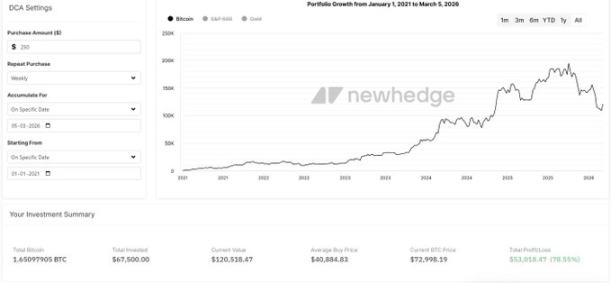
Bitcoin DCA Cycle 2021-2026 Source: Newhedge

Now consider a shorter investment period to see the impact of entry timing on early returns. Starting weekly $250 DCA from January 2024, the total investment is $28,500, accumulating 0.36863166 BTC with an average purchase price of $77,312.

At the current price of $71,000, this Bitcoin is worth approximately $26,909, representing a 6% paper loss. At a price of $100,000, the holdings would be worth $36,863; at the cycle peak of $126,000, the holdings would be worth $46,448.

In February this year, Swan Bitcoin analyst Adam Livingston compared on platform X the returns of DCA into BTC versus the S&P 500 index over the past five years. Investing $100 weekly resulted in $42,508 for BTC and $37,470 for the S&P 500, with returns of 62.9% and 43.6% respectively.

Livingston noted that although Bitcoin is highly volatile, historical data shows that persisting with DCA during downturns leads to higher long-term gains.
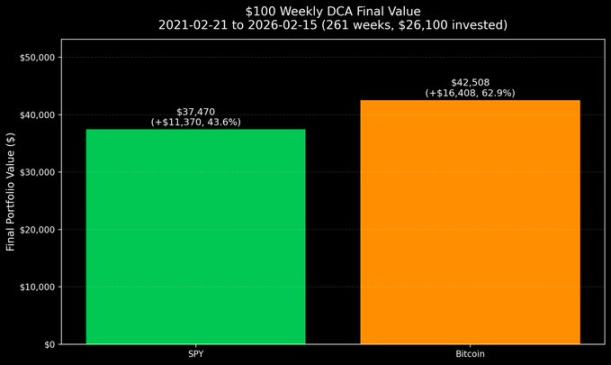
Weekly $100 DCA: BTC vs. S&P 500 Source: Adam Livingston/X

Long-Term Models: Time is the Key

Forward-looking simulation studies have also tested the effectiveness of DCA starting in 2026. Starting a weekly $250 DCA from January 2026 until March 2030 would mean a total investment of approximately $54,250.

The price prediction is based on Bitcoin's long-term power law growth curve (which tracks the historical relationship between Bitcoin's price and time on a logarithmic scale). This model generates a rising support band and a median trendline, largely consistent with previous market cycles.
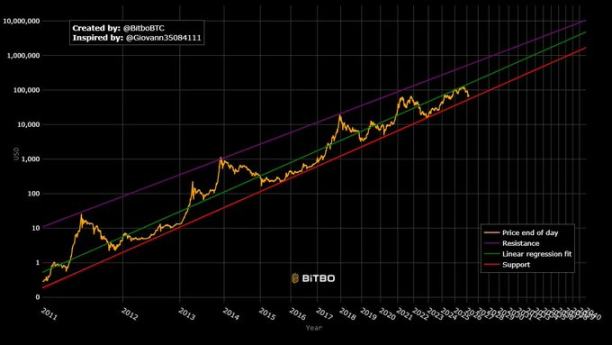
Bitcoin Power Law Growth Curve Source: Bitbo.io

Based on this model, analysts estimate the long-term trend support could break above $100,000 by 2028, which also serves as the foundational assumption for future DCA modeling. Bitcoin Well's simulation shows that by March 2030, the median price projection is approximately $430,000.

Accounting for potential price deviations, the model also considers the upper and lower bounds of the power law channel, providing a lower estimate (approx. $274,000) and a higher estimate (approx. $900,000).

Based on these assumptions, four years of DCA would accumulate roughly 0.30 BTC:

  • If BTC price is $274,000, holdings value ~$82,200.

  • If BTC price is $430,000 (median projection), holdings value ~$129,000.

  • If BTC price is $900,000, holdings value ~$270,000.
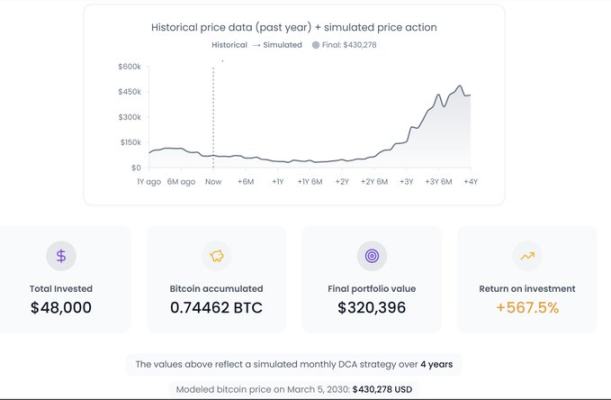
DCA Investment Results as of March 2030 Source: Bitcoin Well

In November 2025, Bitcoin researcher Sminston With conducted a study using a similar predictive model to test the impact of entry time on long-term returns. The findings revealed that even buying at a price 20% higher than the then price of $94,000 and selling at a price 20% lower than the projected 2035 median price, the remaining holdings after ten years would still yield a profit of nearly 300%.

In this simulation, the final total assets were 7.7 times the initial investment.

The study concluded: Entry timing affects the level of returns, but the duration of holding is the key determinant of the magnitude of gains.



Original link:https://www.bitpush.news/articles/7617498

Related Questions

QWhat is the main investment strategy discussed in the article for capturing Bitcoin's long-term gains?

AThe main investment strategy discussed is Dollar-Cost Averaging (DCA), which involves investing a fixed amount of money at regular intervals, regardless of market conditions.

QAccording to the backtest data, how much profit was generated from a 5-year DCA strategy starting in January 2021 with a weekly investment of $250?

AThe 5-year DCA strategy generated a profit of $53,000, a 76% increase, with the total investment of $67,500 growing to approximately $120,500 at a Bitcoin price of $71,000.

QWhat model is used to predict Bitcoin's future price in the long-term simulations mentioned in the article?

AThe long-term price predictions are based on Bitcoin's power-law growth curve model, which tracks the historical relationship between Bitcoin's price and time on a logarithmic scale.

QHow does the performance of a DCA strategy compare to investing in the S&P 500 index over a five-year period, as cited in the article?

AOver a five-year period, a weekly DCA investment of $100 in Bitcoin yielded $42,508 (a 62.9% return), outperforming the S&P 500 index, which yielded $37,470 (a 43.6% return).

QWhat is the key conclusion from the research by Bitcoin researcher Sminston With regarding the timing of entry and long-term holding?

AThe key conclusion is that while the timing of entry affects the magnitude of returns, the duration of holding (long-term holding) is the primary determinant of the overall profit size.

Related Reads

Can a Hair Dryer Earn $34,000? Deciphering the Reflexivity Paradox in Prediction Markets

An individual manipulated a weather sensor at Paris Charles de Gaulle Airport with a portable heat source, causing a Polymarket weather market to settle at 22°C and earning $34,000. This incident highlights a fundamental issue in prediction markets: when a market aims to reflect reality, it also incentivizes participants to influence that reality. Prediction markets operate on two layers: platform rules (what outcome counts as a win) and data sources (what actually happened). While most focus on rules, the real vulnerability lies in the data source. If reality is recorded through a specific source, influencing that source directly affects market settlement. The article categorizes markets by their vulnerability: 1. **Single-point physical data sources** (e.g., weather stations): Easily manipulated through physical interference. 2. **Insider information markets** (e.g., MrBeast video details): Insiders like team members use non-public information to trade. Kalshi fined a剪辑师 $20,000 for insider trading. 3. **Actor-manipulated markets** (e.g., Andrew Tate’s tweet counts): The subject of the market can control the outcome. Evidence suggests Tate’sociated accounts coordinated to profit. 4. **Individual-action markets** (e.g., WNBA disruptions): A single person can execute an event to profit from their pre-placed bets. Kalshi and Polymarket handle these issues differently. Kalshi enforces strict KYC, publicly penalizes insider trading, and reports to regulators. Polymarket, with its anonymous wallet-based system, has historically been more permissive, arguing that insider information improves market accuracy. However, it cooperated with authorities in the "Van Dyke case," where a user traded on classified government information. The core paradox is reflexivity: prediction markets are designed to discover truth, but their financial incentives can distort reality. The more valuable a prediction becomes, the more likely participants are to influence the event itself. The market ceases to be a mirror of reality and instead shapes it.

marsbit12m ago

Can a Hair Dryer Earn $34,000? Deciphering the Reflexivity Paradox in Prediction Markets

marsbit12m ago

First Day Review of "Musk's WeChat" XChat: Even Worse Than Expected

Elon Musk's much-anticipated "WeChat-like" app, XChat, has officially launched after multiple delays. The initial review reveals a product that falls short of expectations, offering an experience largely similar to X Platform's (formerly Twitter) direct messages, despite being marketed as an encrypted communication tool. Key observations from the first-day test include: 1. The app's promoted "end-to-end encryption" and its claimed relation to Bitcoin's architecture were criticized by experts as a superficial attempt to capitalize on crypto buzz, with no real technical connection. 2. Musk's vision of an ad-free "secure communication system" is technically met, but only because the app is currently extremely basic, featuring only a single chat interface. 3. A promised anti-screenshot feature appears inconsistent; it works in X Platform group chats but fails within the XChat app itself, where screenshots still capture avatars. 4. The app supports 45 languages and has a 16+ age rating, indicating a broader tolerance for content compared to WeChat's 13+ rating. 5. A puzzling login process requires users to verify the email associated with their X account. 6. The touted encryption" feels minimal in practice, with its presence only indicated by a simple "Encrypted - Yes" label on messages. 7. Disappearing message timers for groups can be set from 5 minutes to 4 weeks, with the timer starting upon being read by a user. 8. Group invite links are shared with X Platform groups. 9. Group size limits are planned to be increased, aiming for 1000 members, a move that has drawn user criticism. 10. The app offers 8 different colored icons, and its chat bubbles are notably similar to WeChat's. Message deletion options mimic Telegram's. Crucially, many pre-announced features like importing X contacts, integrating Grok AI, X Money payments, and Cashtags are not yet available. The initial release is seen as a bare-bones and underwhelming first step.

Odaily星球日报1h ago

First Day Review of "Musk's WeChat" XChat: Even Worse Than Expected

Odaily星球日报1h ago

Trading

Spot
Futures
活动图片



