Why Only Dollar-Cost Averaging Can Capture Bitcoin's Long-Term Dividends?

比推Published on 2026-03-06Last updated on 2026-03-06

Abstract

This article argues that dollar-cost averaging (DCA) is the optimal strategy for capturing Bitcoin's long-term gains, supported by historical backtesting and forward-looking models. The strategy involves investing a fixed amount regularly, regardless of market conditions. A five-year DCA simulation, starting in January 2021 with weekly $250 investments, resulted in a total investment of $67,500, acquiring approximately 1.65 BTC at an average price of $40,884. At a price of $71,000, the portfolio was worth ~$120,500, a 76% gain. Projections show even higher returns at $100,000 and the expected 2025 cycle peak of ~$126,000. A shorter-term DCA example starting in January 2024 showed an initial paper loss at current prices but significant projected profits at higher future price points. A comparison over five years also demonstrated that DCA into Bitcoin outperformed DCA into the S&P 500. Long-term modeling, based on Bitcoin's power-law growth curve, projects a median price of around $430,000 by 2030. A four-year DCA plan starting in 2026 could accumulate roughly 0.30 BTC, leading to substantial returns even under conservative price estimates. The key conclusion is that while entry timing affects the magnitude of gains, the duration of the holding period is the most critical factor for maximizing returns.

Written by: Cointelegraph

Compiled by: AididiaoJP, Foresight News

Original title: Why Only Dollar-Cost Averaging Can Capture Bitcoin's Long-Term Dividends?


Both backtest data and forward-looking models indicate that using a dollar-cost averaging (DCA) strategy to buy Bitcoin is the best way to invest in BTC. Will this method still work in the next bull market?

Bitcoin has experienced a 50% plunge over the past 5 months, and savvy investors adjust their strategies during such bear markets and correction periods. This strategy is called dollar-cost averaging (DCA), which involves investing a fixed amount regularly, regardless of market conditions.

By examining historical market cycle data and BTC price forward simulations, we can more clearly see how this steady investment approach performs across different entry times and investment horizons.

Five Years of DCA in Bitcoin Yields Substantial Net Gains

Starting from January 2021, investing $250 weekly in Bitcoin via DCA, the total investment over five years would be $67,500. According to DCA simulation data, this strategy would have accumulated 1.65097905 BTC, with an average purchase price of $40,884.

At Bitcoin's current price of nearly $71,000, this 1.65097905 BTC is worth approximately $120,500, resulting in a profit of $53,000 (a 76% increase). If Bitcoin rises to $100,000, the holdings would be worth about $165,000; and at the cycle peak of nearly $126,000 in October 2025, the holdings would reach a value of $208,000.
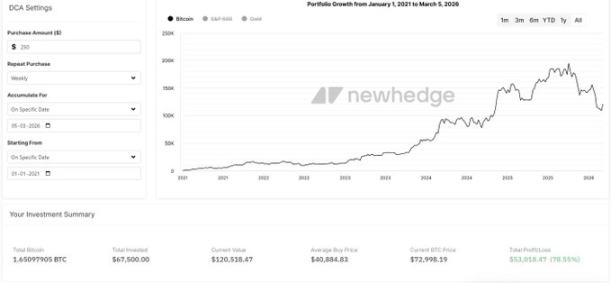
Bitcoin DCA Cycle 2021-2026 Source: Newhedge

Now consider a shorter investment period to see the impact of entry timing on early returns. Starting weekly $250 DCA from January 2024, the total investment is $28,500, accumulating 0.36863166 BTC with an average purchase price of $77,312.

At the current price of $71,000, this Bitcoin is worth approximately $26,909, representing a 6% paper loss. At a price of $100,000, the holdings would be worth $36,863; at the cycle peak of $126,000, the holdings would be worth $46,448.

In February this year, Swan Bitcoin analyst Adam Livingston compared on platform X the returns of DCA into BTC versus the S&P 500 index over the past five years. Investing $100 weekly resulted in $42,508 for BTC and $37,470 for the S&P 500, with returns of 62.9% and 43.6% respectively.

Livingston noted that although Bitcoin is highly volatile, historical data shows that persisting with DCA during downturns leads to higher long-term gains.
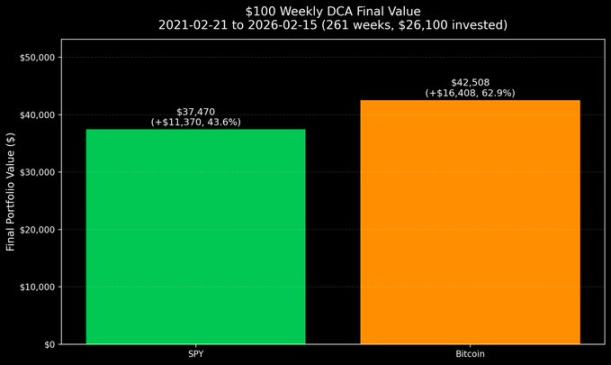
Weekly $100 DCA: BTC vs. S&P 500 Source: Adam Livingston/X

Long-Term Models: Time is the Key

Forward-looking simulation studies have also tested the effectiveness of DCA starting in 2026. Starting a weekly $250 DCA from January 2026 until March 2030 would mean a total investment of approximately $54,250.

The price prediction is based on Bitcoin's long-term power law growth curve (which tracks the historical relationship between Bitcoin's price and time on a logarithmic scale). This model generates a rising support band and a median trendline, largely consistent with previous market cycles.
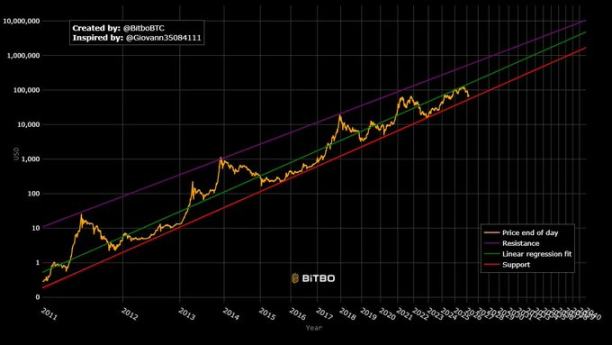
Bitcoin Power Law Growth Curve Source: Bitbo.io

Based on this model, analysts estimate the long-term trend support could break above $100,000 by 2028, which also serves as the foundational assumption for future DCA modeling. Bitcoin Well's simulation shows that by March 2030, the median price projection is approximately $430,000.

Accounting for potential price deviations, the model also considers the upper and lower bounds of the power law channel, providing a lower estimate (approx. $274,000) and a higher estimate (approx. $900,000).

Based on these assumptions, four years of DCA would accumulate roughly 0.30 BTC:

  • If BTC price is $274,000, holdings value ~$82,200.

  • If BTC price is $430,000 (median projection), holdings value ~$129,000.

  • If BTC price is $900,000, holdings value ~$270,000.
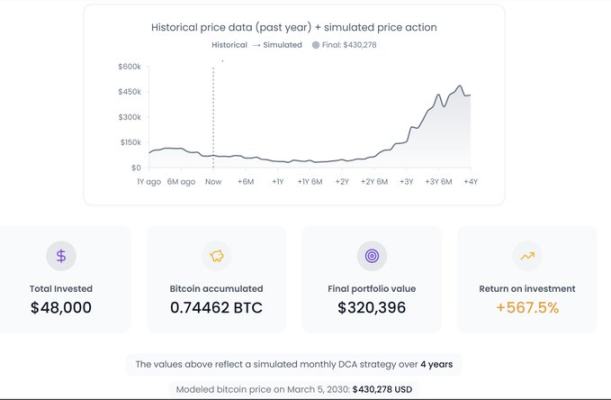
DCA Investment Results as of March 2030 Source: Bitcoin Well

In November 2025, Bitcoin researcher Sminston With conducted a study using a similar predictive model to test the impact of entry time on long-term returns. The findings revealed that even buying at a price 20% higher than the then price of $94,000 and selling at a price 20% lower than the projected 2035 median price, the remaining holdings after ten years would still yield a profit of nearly 300%.

In this simulation, the final total assets were 7.7 times the initial investment.

The study concluded: Entry timing affects the level of returns, but the duration of holding is the key determinant of the magnitude of gains.



Original link:https://www.bitpush.news/articles/7617498

Related Questions

QWhat is the main investment strategy discussed in the article for capturing Bitcoin's long-term gains?

AThe main investment strategy discussed is Dollar-Cost Averaging (DCA), which involves investing a fixed amount of money at regular intervals, regardless of market conditions.

QAccording to the backtest data, how much profit was generated from a 5-year DCA strategy starting in January 2021 with a weekly investment of $250?

AThe 5-year DCA strategy generated a profit of $53,000, a 76% increase, with the total investment of $67,500 growing to approximately $120,500 at a Bitcoin price of $71,000.

QWhat model is used to predict Bitcoin's future price in the long-term simulations mentioned in the article?

AThe long-term price predictions are based on Bitcoin's power-law growth curve model, which tracks the historical relationship between Bitcoin's price and time on a logarithmic scale.

QHow does the performance of a DCA strategy compare to investing in the S&P 500 index over a five-year period, as cited in the article?

AOver a five-year period, a weekly DCA investment of $100 in Bitcoin yielded $42,508 (a 62.9% return), outperforming the S&P 500 index, which yielded $37,470 (a 43.6% return).

QWhat is the key conclusion from the research by Bitcoin researcher Sminston With regarding the timing of entry and long-term holding?

AThe key conclusion is that while the timing of entry affects the magnitude of returns, the duration of holding (long-term holding) is the primary determinant of the overall profit size.

Related Reads

US Stocks Suffer Worst Plunge Since 2025: Three Triggers Ignite Tech Stock Valuation Reset

The US stock market experienced its most severe sell-off since the 2025 tariff crisis on June 5th, 2025. The Nasdaq Composite plummeted 4.18%, the S&P 500 fell 2.64%, and the Dow Jones dropped 695 points. The panic stemmed from three converging factors. First, Broadcom's earnings report ignited fears of a slowdown in AI growth. While its AI chip revenue surged 143% YoY to $10.8B, its Q3 AI revenue guidance of $16B fell short of the $17.2B consensus. This triggered a massive sector-wide sell-off, with the Philadelphia Semiconductor Index crashing 10.26% and semiconductor stocks losing roughly $1.3 trillion in market value in a single day. Second, a shockingly strong May jobs report crushed hopes for Federal Reserve rate cuts. Non-farm payrolls added 172,000 jobs, doubling expectations. This robust data, combined with persistently high oil prices above $92/barrel due to the ongoing Iran war and blockade of the Strait of Hormuz, drastically increased market expectations for a potential Fed rate hike instead of a cut. Higher interest rates compress the valuations of growth-heavy tech stocks. Third, the prolonged Iran conflict continues to fuel inflationary pressures, complicating the Fed's policy decisions and undermining the "inflation is tamed" narrative. Together, these events challenged the twin pillars of the market rally: the "limitless AI growth" story and expectations for imminent monetary easing. The sell-off spread globally, impacting Asian and European markets and cryptocurrencies. The article posits this is likely a severe "valuation repricing" rather than the end of the AI story. The underlying demand for AI remains strong, but investor expectations for growth speed and the prices they are willing to pay are being recalibrated. Key upcoming factors include the June FOMC meeting, future AI company earnings, and developments in the Iran conflict.

marsbit1h ago

US Stocks Suffer Worst Plunge Since 2025: Three Triggers Ignite Tech Stock Valuation Reset

marsbit1h ago

From Madison Square Garden to Kalshi: Prediction Markets Break into the NBA Finals

From Madison Square Garden to Kalshi: Prediction Markets Break into the NBA Finals Prediction markets are playing a significant role in the 2026 NBA Finals, particularly around the New York Knicks' unexpected 2-0 series lead. Platforms like Kalshi and Polymarket have seen massive trading volumes, exceeding hundreds of millions of dollars on championship and related markets. Their influence extends beyond online trading. Kalshi's official partnership with Madison Square Garden has given it prominent physical branding at the arena. Furthermore, local businesses like The Jeffrey bar are using prediction market contracts to hedge the risk of game-result-based promotions, turning potential losses into manageable costs—a concept similar to the famous "Mattress Mack" strategy from traditional sports betting. These markets differentiate themselves by offering a wider, more entertainment-focused range of "event contracts" beyond typical game outcomes, such as predicting celebrity attendance. They also have broader accessibility across the U.S. compared to age- and location-restricted traditional sportsbooks. However, their rapid integration into sports raises regulatory and ethical questions. The NBA is cautiously engaging, discussing integrity frameworks with regulators like the CFTC. While the league permits minor investments like Giannis Antetokounmpo's stake in Kalshi, it advocates for strict rules to prevent insider trading. Many fans express concern on platforms like Reddit, fearing that the close ties between prediction markets, the league, and players could compromise the game's integrity. The NBA Finals has thus become a high-stakes testing ground, showcasing prediction markets' commercial potential while challenging traditional boundaries between financial trading, entertainment, and gambling.

marsbit3h ago

From Madison Square Garden to Kalshi: Prediction Markets Break into the NBA Finals

marsbit3h ago

Recursive Self-Improvement AI Gains Traction, Google Pours Cold Water, While DeepSeek and Others Approach the Fringes

The term "recursive self-improvement" (RSI), where AI improves itself autonomously, is gaining momentum in the AI industry. Startups like Recursive Superintelligence and projects such as Andrej Karpathy's Auto-Research aim to create systems where AI designs, implements, and validates its own research, moving toward superintelligence. While Google CEO Sundar Pichai cautions that such exponential acceleration is not yet a reality, progress is evident. For instance, Anthropic reported its Claude Code writes nearly 100% of the team's code, though it still lacks true self-direction. Analysts frame RSI development in stages: "adequacy" (systems functioning without humans), "parity" (matching human research quality), and "supremacy" (exceeding human-AI collaboration). Reaching parity could trigger rapid, unpredictable advancement due to AI's continuous operation. In China, companies like DeepSeek and Baidu incorporate self-optimization techniques without explicitly branding them as RSI, focusing on algorithmic efficiency and reinforcement learning. However, challenges remain, including "model collapse" from training on AI-generated data and the immense computational and open-collaboration requirements. Ultimately, RSI represents a trend of increasing automation in AI development, potentially reducing human oversight in the creation process itself.

marsbit3h ago

Recursive Self-Improvement AI Gains Traction, Google Pours Cold Water, While DeepSeek and Others Approach the Fringes

marsbit3h ago

Trading

Spot
Futures
活动图片