Why Must Banks Ban Stablecoin Yields?

marsbitPublished on 2026-01-19Last updated on 2026-01-19

Abstract

The article "Why Banks Are Determined to Ban Yield-Bearing Stablecoins?" explores the ongoing debate around the U.S. cryptocurrency market structure bill (CLARITY), particularly the fierce opposition from large banks against interest-bearing stablecoins. Banks argue that such stablecoins could cause deposit outflows, but the author refutes this, explaining that funds used to purchase stablecoins like USDC ultimately flow back into the banking system as reserves held by issuers like Circle. The real concern for banks is not the total volume of deposits but a shift in deposit structure. U.S. major banks (e.g., Bank of America, JPMorgan Chase) rely heavily on "low-interest banking," where transaction deposits (used for payments, transfers) pay near-zero interest, creating a significant spread between deposit rates and the Fed’s benchmark rate. This model generates massive profits—over $360 billion annually from interest differentials and transaction fees. Stablecoins directly compete with transaction deposits by offering similar utility (payments, settlements). If stablecoins can generate yield, users may shift funds from bank transaction accounts to stablecoins to earn higher returns. While the money remains in the banking system (as stablecoin reserves), it moves from low-cost transaction deposits to higher-yield instruments, squeezing bank profit margins and reducing fee income. Thus, banks oppose yield-bearing stablecoins to protect their lucrative low-cost depos...

Original | Odaily Planet Daily (@OdailyChina)

Author | Azuma (@azuma_eth)

With Coinbase's temporary "betrayal" and the Senate Banking Committee's delayed review, the cryptocurrency market structure bill (CLARITY) has once again fallen into a phase of stagnation.

  • Odaily Note: For background, see "The Biggest Variable in the Post-Crypto Market: Can the CLARITY Bill Pass the Senate?" and "CLARITY Review Suddenly Delayed: Why Is the Industry So Divided?".

Based on current market debates, the biggest point of contention surrounding CLARITY has focused on "yield-bearing stablecoins." Specifically, the GENIUS bill passed last year, in order to gain banking industry support, explicitly prohibited yield-bearing stablecoins. However, the bill only stipulated that stablecoin issuers cannot pay holders "any form of interest or yield," but did not restrict third parties from providing yields or rewards. The banking industry is very dissatisfied with this "workaround" and is trying to overturn it in CLARITY, banning all types of yield-bearing paths. This has drawn strong opposition from some cryptocurrency groups, represented by Coinbase.

Why are banks so opposed to yield-bearing stablecoins, insisting on blocking all yield paths? The goal of this article is to answer this question in detail by dissecting the profit model of large U.S. commercial banks.

Bank Deposit Outflows? Pure Nonsense

In statements opposing yield-bearing stablecoins, the most common reason used by banking representatives is "concern that stablecoins will cause bank deposit outflows" — Bank of America CEO Brian Moynihan said in a call last Wednesday: "Up to $6 trillion in deposits (about 30% to 35% of all U.S. commercial bank deposits) could migrate to stablecoins, thereby restricting banks' ability to lend to the overall U.S. economy... and yield-bearing stablecoins could accelerate deposit outflows."

However, anyone with a basic understanding of how stablecoins operate can see that this statement is highly misleading. When $1 flows into a stablecoin system like USDC, that $1 does not disappear into thin air. Instead, it is placed in the reserve treasury of stablecoin issuers like Circle and eventually flows back into the banking system in the form of cash deposits or other short-term liquid assets (such as Treasury bonds).
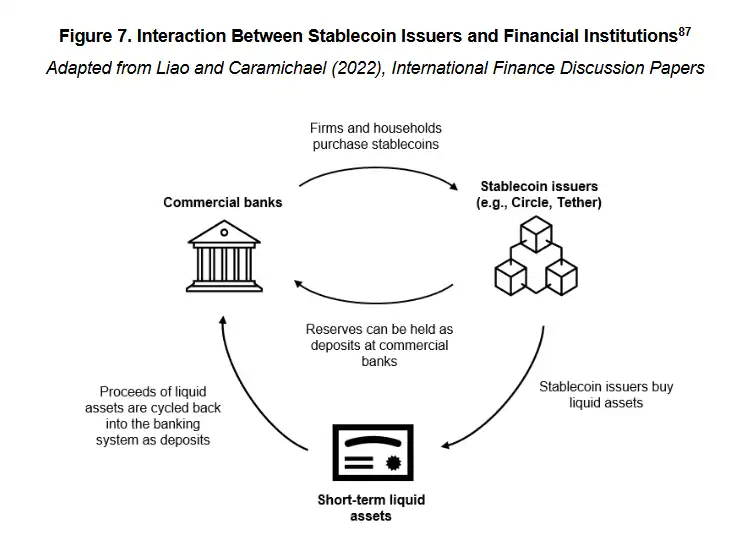
  • Odaily Note: Stablecoins backed by crypto assets, futures hedging, algorithms, or other mechanisms are not considered here. First, because such stablecoins account for a small proportion; second, because these stablecoins do not fall under the discussion scenario for compliant stablecoins under the U.S. regulatory system — last year's GENIUS bill clearly defined reserve requirements for compliant stablecoins, limiting reserve assets to cash, short-term Treasury bonds, or central bank deposits, which must be segregated from operational funds.

So the reality is clear: Stablecoins do not cause bank deposit outflows because the funds always eventually flow back to banks and can be used for credit intermediation. This is determined by the business model of stablecoins and has little to do with whether they yield interest or not.

The real key issue lies in the change in deposit structure after the funds flow back.

The Cash Cow of American Big Banks

Before analyzing this change, we need to briefly introduce the interest-earning practices of large U.S. banks.

Van Buren Capital General Partner Scott Johnsson cited a paper from the University of California, Los Angeles, stating that since the 2008 financial crisis damaged the banking industry's credibility, commercial banks in the U.S. have diverged into two distinct forms in the deposit-taking business — high-interest banks and low-interest banks.
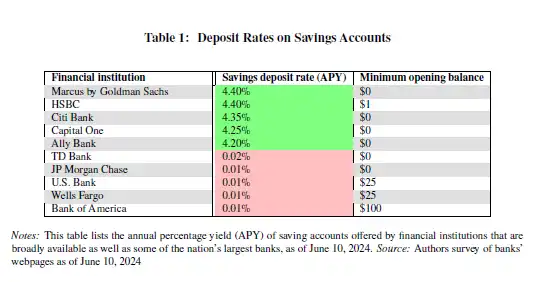
High-interest banks and low-interest banks are not formal classifications in a regulatory sense but are commonly used terms in market context — manifested in the fact that the deposit interest spread between high-interest banks and low-interest banks has reached more than 350 basis points (3.5%).

Why is there such a significant interest spread for the same deposit? The reason is that high-interest banks are mostly digital banks or banks with business structures focused on wealth management and capital market businesses (such as Capital One). They rely on high interest rates to attract deposits to support their credit or investment businesses. Conversely, low-interest banks are mainly national large commercial banks that actually hold the power in the banking industry, such as Bank of America, Chase Bank, and Wells Fargo. They have a vast retail customer base and payment networks, allowing them to maintain extremely low deposit costs through customer stickiness, brand effect, and branch convenience, without needing to compete for deposits with high interest rates.

From the perspective of deposit structure, high-interest banks generally focus on non-transaction deposits, i.e., deposits主要用于储蓄或获取利息回报 — such funds are more sensitive to interest rates and are more costly for banks; low-interest banks generally focus on transaction deposits, i.e., deposits主要用于支付、转账、结算 — the characteristics of such funds are high stickiness, frequent流动性, and extremely low interest rates, making them the most valuable liabilities for banks.
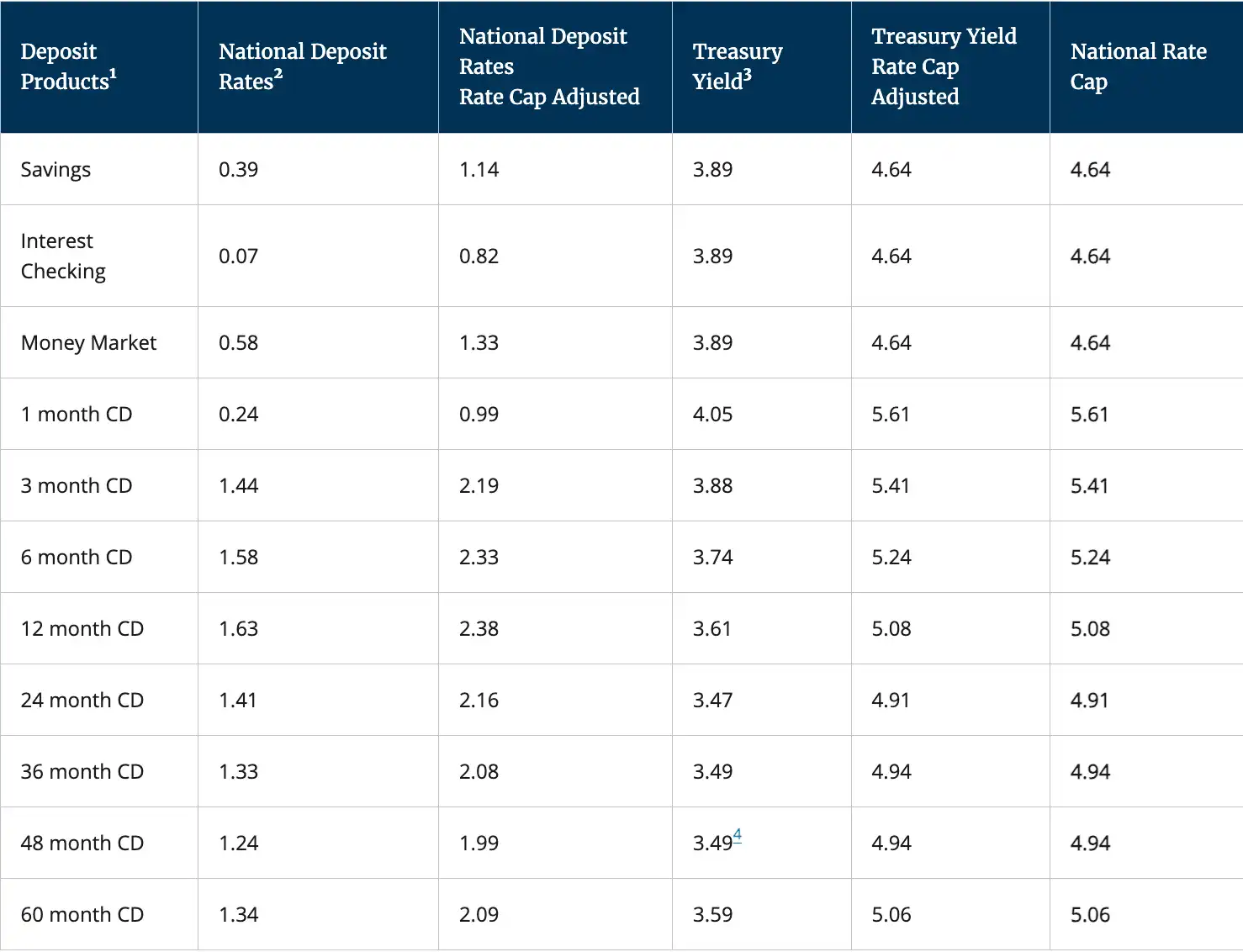
Latest data from the Federal Deposit Insurance Corporation (FDIC) shows that as of mid-December 2025, the average annual interest rate for U.S. savings accounts was only 0.39%.

Note, this is data that already includes the impact of high-interest banks. Since mainstream U.S. banks mostly follow the low-interest model, the actual interest they pay to depositors is far lower than this level — Galaxy founder and CEO Mike Novogratz直言 stated in an interview with CNBC that large banks pay almost zero interest to depositors (about 1 - 11 basis points), while the同期 Federal Reserve benchmark rate was between 3.50% and 3.75%. This spread brings huge profits to banks.
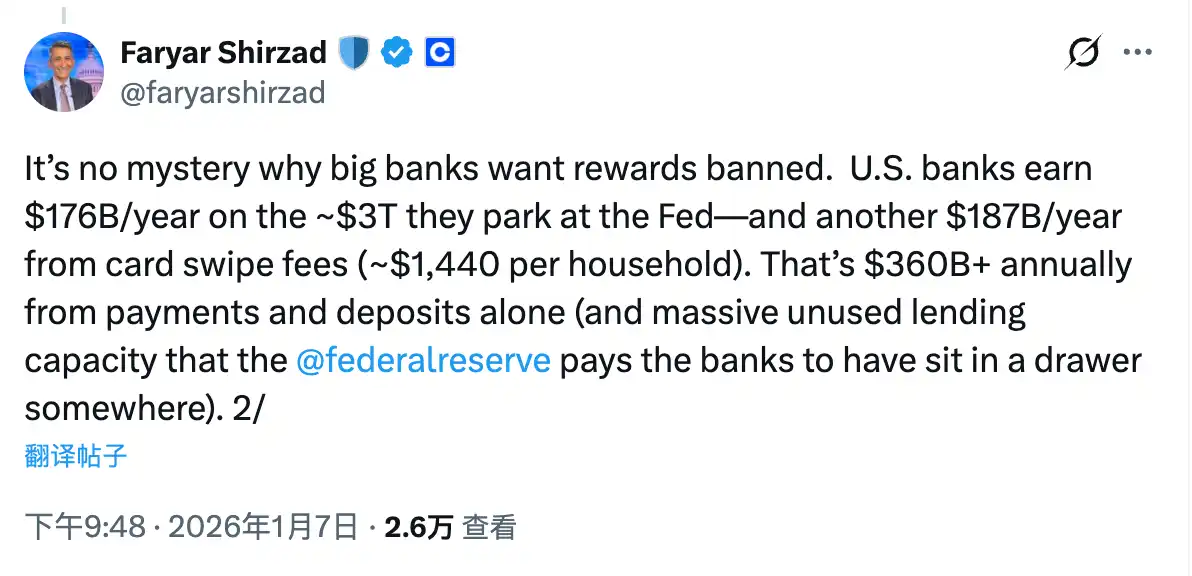
Coinbase Chief Compliance Officer Faryar Shirzad calculated a clearer account — U.S. banks can profit $176 billion annually from approximately $3 trillion in funds deposited at the Federal Reserve, and additionally profit $187 billion annually from transaction fees charged to depositors. Just from deposit spreads and payment transaction环节, this brings in over $360 billion in revenue annually.

The Real Change: Deposit Structure and Profit Distribution

Back to the topic, what changes will the stablecoin system bring to the bank deposit structure? How will yield-bearing stablecoins further助推 this trend? The logic is actually quite simple. What are the use cases for stablecoins? The answers are无非 payment, transfer, settlement... etc. Doesn't this sound familiar!

As mentioned earlier, these functions are the core utilities of transaction deposits, which are both the main type of deposits for large banks and the most valuable liabilities for banks. Therefore, the banking industry's real concern about stablecoins is — stablecoins, as a new transaction medium, can directly compete with transaction deposits in terms of use cases.

If stablecoins did not have yield-bearing functionality, it might be acceptable. Considering the usage barriers and the slight interest advantage of bank deposits (a mosquito's leg is still meat), the actual threat stablecoins pose to this core territory of large banks is not significant. But once stablecoins are given the feasibility of yielding interest, driven by the interest spread, more and more funds may shift from transaction deposits to stablecoins. Although these funds will eventually flow back into the banking system, stablecoin issuers, out of profit consideration, will inevitably invest most of the reserve funds into non-transaction deposits, only needing to retain a certain proportion of cash reserves to handle daily redemptions. This is the so-called change in deposit structure — the money remains in the banking system, but bank costs will increase significantly (the interest spread is compressed), and revenue from transaction fees will also decrease significantly.

At this point, the essence of the problem is very clear. The reason why the banking industry is fiercely opposed to yield-bearing stablecoins has never been about "whether the total amount of deposits within the banking system will decrease," but rather about the possible change in deposit structure and the resulting profit redistribution issue.

In the era without stablecoins, especially without yield-bearing stablecoins, large U.S. commercial banks firmly controlled this source of "zero-cost or even negative-cost" funds known as transaction deposits. They could earn risk-free profits through the spread between deposit rates and benchmark rates, and also continuously charge fees for basic financial services such as payment, settlement, and clearing, thus building an extremely solid closed loop that几乎不需要与储户分享收益.

The emergence of stablecoins essentially dismantles this closed loop. On the one hand, stablecoins highly compete with transaction deposits in terms of functionality, covering core scenarios such as payment, transfer, and settlement; on the other hand, yield-bearing stablecoins further introduce the variable of yield, making transaction funds that were originally not sensitive to interest rates begin to have the possibility of repricing.

In this process, funds do not leave the banking system, but banks may lose control over the profits from these funds — liabilities that were almost zero-cost are forced to transform into liabilities that require paying market-based yields; payment fees that were exclusively enjoyed by banks are also开始被分流 to stablecoin issuers, wallets, and protocol layers.

This is the change that the banking industry truly cannot accept. Understanding this, it is not difficult to understand why yield-bearing stablecoins have become the most intense and最难妥协的争议焦点 in the CLARITY legislative process.


Related Questions

QWhat is the main reason banks are strongly opposed to interest-bearing stablecoins according to the article?

ABanks oppose interest-bearing stablecoins because they fear a shift in deposit structures, where low-cost transactional deposits (their most valuable liabilities) might move to stablecoins, increasing bank funding costs and reducing their profit margins from interest spreads and transaction fees.

QHow do interest-bearing stablecoins potentially impact the profitability of large U.S. commercial banks?

AInterest-bearing stablecoins could compress banks' interest spread profits by forcing them to pay market-based returns on deposits that were previously near-zero cost, and also reduce transaction fee income as stablecoins divert payment and settlement activities away from traditional banking channels.

QWhat is the difference between 'high-interest banks' and 'low-interest banks' in the U.S. banking system as described in the article?

AHigh-interest banks (e.g., digital banks) rely on offering competitive interest rates to attract deposits for lending or investment, while low-interest banks (e.g., large national banks like Bank of America) leverage customer loyalty, brand power, and network convenience to maintain extremely low-cost transactional deposits with minimal interest payments.

QWhy does the article argue that stablecoins do not cause an outflow of bank deposits in the broader sense?

AStablecoins do not cause a deposit outflow because funds used to purchase stablecoins like USDC are held in reserve (e.g., cash or short-term Treasuries) by issuers like Circle, which ultimately flow back into the banking system, remaining available for credit intermediation.

QWhat key legislative bill is currently facing delays and disputes over the issue of interest-bearing stablecoins?

AThe cryptocurrency market structure bill, known as the CLARITY Act, is currently stalled progress in the Senate Banking Committee due to intense debates, particularly around prohibiting all forms of interest-bearing stablecoins.

Related Reads

MSX US Stock Daily Insight: Amazon 2026 Q2 Earnings: AWS Records Fastest Growth in Five Years

**MSX Daily US Stock Observation: Amazon's Q2 2026 Earnings: AWS Achieves Fastest Growth in Five Years** Amazon's latest quarterly results exceeded expectations, driven by a strong performance from its cloud computing unit. The company reported revenue of $200.66 billion, surpassing estimates of approximately $197 billion. The key highlight was Amazon Web Services (AWS), which generated $42.232 billion in revenue, surging 37% year-over-year. This marked the segment's fastest growth pace in 18 quarters, indicating robust demand for cloud services. Reported Earnings Per Share (EPS) of $5.75 significantly exceeded the $1.84 forecast. However, this figure included a substantial one-time, non-operating gain of $53.4 billion, primarily from the revaluation of Amazon's investment in AI company Anthropic. Excluding this item, core operating profit was $27.461 billion, a strong increase of 43% compared to the same period last year. Despite the positive results, Amazon provided guidance for the upcoming third quarter that fell short of market expectations. The company's revenue guidance midpoint is $199.5 billion, below the consensus estimate of around $204 billion. Operating profit guidance of $24.5 billion also slightly missed expectations of approximately $247.9 billion. Furthermore, Amazon raised its forecast for full-year capital expenditures to $220 billion, citing rising memory chip costs, which weighed on investor sentiment regarding future profitability. In summary, Amazon's quarter showcased accelerating momentum in its core AWS business. The underlying operational profit growth remains solid. However, cautious forward guidance and increased investment spending present key areas for monitoring in the coming quarters, as the market assesses whether the current growth phase will translate into sustained profit margin expansion.

Odaily星球日报9m ago

MSX US Stock Daily Insight: Amazon 2026 Q2 Earnings: AWS Records Fastest Growth in Five Years

Odaily星球日报9m ago

Cyclical Stock or Growth Stock? Coinbase's Q2 Earnings Report Reveals 'Valuation Disagreement'

Coinbase's Q2 2026 financial results revealed a mixed performance, reigniting debate over whether the company should be valued as a cyclical stock tied to crypto markets or a growth stock with future potential. Total revenue missed expectations at $1.22 billion, down 19% year-over-year. Transaction revenue fell to $599 million, with retail crypto spot trading revenue dropping 30% to $452 million, back to 2023 levels. The company reported a net loss of $359 million, marking its third consecutive quarterly loss. Despite CEO Brian Armstrong's positive commentary on metrics like a 10.3% overall crypto trading market share and 106% growth in prediction markets, the market reacted negatively, with shares dropping over 5% after-hours. A key issue is the decline in core retail trading. While Coinbase touted record market share, this figure includes derivatives and new products. Its traditional crypto spot trading share is likely shrinking. New ventures like prediction markets, while growing, contributed less than $30 million, insufficient to offset the core revenue decline. The valuation debate hinges on perspective. As a cyclical stock, Coinbase remains deeply tied to the crypto bear market, with user attrition and competitive pressures justifying a lower valuation. The company's strategy appears focused on surviving until the next bull cycle. Viewed as a growth stock, however, Coinbase shows promising diversification. Subscription and service revenue reached $555 million, nearly matching transaction revenue. Stablecoin revenue, its second-largest source at $292 million, remains strong through its partnership with Circle. Critically, Coinbase is positioning itself as a leader in the emerging on-chain "agent economy." Over 90% of agent-based stablecoin transactions occur on its Base network, which it believes could handle trillions in future agent transactions. The recent acquisition of Deribit also aims to boost its international derivatives offering. In summary, Coinbase's present struggles are clear, but its future hinges on whether its investments in revenue diversification, stablecoins, and the agent economy can ultimately transform its business model and justify a growth premium.

Odaily星球日报29m ago

Cyclical Stock or Growth Stock? Coinbase's Q2 Earnings Report Reveals 'Valuation Disagreement'

Odaily星球日报29m ago

Global Market Share Survey: Japanese Firms Lead in Semiconductor Materials

Global Market Share Survey: Japanese Firms Lead in Semiconductor Materials According to the 2025 "Major Goods and Services Market Share Survey" by Nikkei, Japanese companies maintain strong positions in semiconductor-related materials. In silicon wafers, Shin-Etsu Chemical ranks first with a 26.3% share, followed by SUMCO at 17.8%. Together, they hold 44.1% of the market, widening their lead over competitors from Taiwan, Germany, and South Korea. In photoresists, Tokyo Ohka Kogyo, JSR, and Shin-Etsu Chemical occupy the top three spots, with a combined share of 60.5%. Despite their strength in materials, Japanese firms have a weaker presence in core semiconductor segments like DRAM and NAND flash memory, where South Korean and U.S. companies dominate. For instance, SK Hynix and Samsung lead in DRAM, while China’s CXMT doubled its share to 6% in 2025. The semiconductor market is projected to grow rapidly, with WSTS forecasting a 90% increase to $1.5112 trillion by 2026. Major players like Samsung, SK Hynix, and Micron are making massive investments to expand capacity. To maintain their edge in materials, Japanese companies must similarly commit to large-scale, risk-taking investments. In contrast, Japan’s automotive sector shows stagnation. Toyota remains the global leader but with only a slight share increase to 12.3%, while Japanese brands are absent from the top five in the EV market. In shipbuilding, Imabari Shipbuilding rose to third place globally with a 7.2% share, benefiting from large container ship deliveries. However, Chinese and South Korean firms dominate the sector, holding the top two positions. Japan aims to revitalize its shipbuilding industry through government and corporate efforts, targeting a near doubling of output by 2035. Addressing labor shortages and adopting advanced technologies like physical AI will be critical for competitiveness.

marsbit54m ago

Global Market Share Survey: Japanese Firms Lead in Semiconductor Materials

marsbit54m ago

Trading

Spot
活动图片