Why is the RWA Boom Failing to Benefit DeFi?

marsbitPublished on 2026-05-19Last updated on 2026-05-19

Abstract

The rapid growth of the tokenized real-world assets (RWA) market, now nearing $30 billion on-chain, has largely bypassed the DeFi ecosystem. Only about $2.47 billion is actively locked in DeFi protocols, indicating a penetration rate of just 9%. A major barrier is the "permissioned" architecture of most RWA products, like BlackRock's BUIDL fund, which are designed for institutional compliance. They require whitelisting, off-chain settlement, and strict investor accreditation, making them incompatible with open, permissionless DeFi applications like Aave or Uniswap. This is evident in categories like bonds/money market funds ($16.6B on-chain, $920M in DeFi) and tokenized equities ($2.7B on-chain, $78M in DeFi). Notable exceptions are private credit protocols (e.g., Maple Finance, Centrifuge) and assets like Ondo's USDY, which were designed from inception for DeFi composability, allowing them to be used freely as collateral. Morpho and Aave Horizon also demonstrate successful RWA lending integrations. However, industry reports (IOSCO, ECB) warn that growth may remain confined within traditional financial systems due to fragmented regulations, lack of unified standards, and inherent conflicts between DeFi's open logic and compliance requirements like minimum investments and fixed redemption windows. The RWA sector is effectively split into two markets: a compliant, permissioned on-chain finance market and a smaller DeFi-native market focused on composability. For DeFi penetr...

Author: Gino Matos

Compiler: Chopper, Foresight News

Data from DeFiLlama shows that the on-chain tokenized real-world asset (RWA) scale has approached $30 billion. However, only $2.47 billion is shown as the active DeFi Total Value Locked (TVL), which is the actual amount of funds deposited into third-party DeFi platform liquidity pools and participating in the ecosystem's operation.

The vast majority of other RWA assets remain outside of scenarios such as lending markets and collateral vaults, which enable free combination and interaction of crypto assets. Bonds and money market funds are the largest RWA category by scale, with an on-chain total exceeding $16.6 billion. Yet, the effective TVL flowing into the DeFi ecosystem is only $920 million. The on-chain scale of gold and commodity assets is $5.7 billion, with only $183.6 million effectively circulating in DeFi. Equity assets have an on-chain scale of $2.7 billion, but the funds that have entered the DeFi market are a mere $78.27 million.

Only the private credit sector stands out: its on-chain scale is $3.226 billion, with a DeFi effective TVL of $1.257 billion, achieving an ecosystem penetration rate of 39%. The reason behind this is that projects like Maple Finance and Centrifuge were designed from the outset as lending financial instruments, making them naturally suited for DeFi application scenarios.

In contrast, tokenized products like US Treasury bond funds, gold assets, and stock assets are designed by their issuers to cater more to institutional custody needs, with their overall architecture aligning with the operational models of traditional compliant funds.
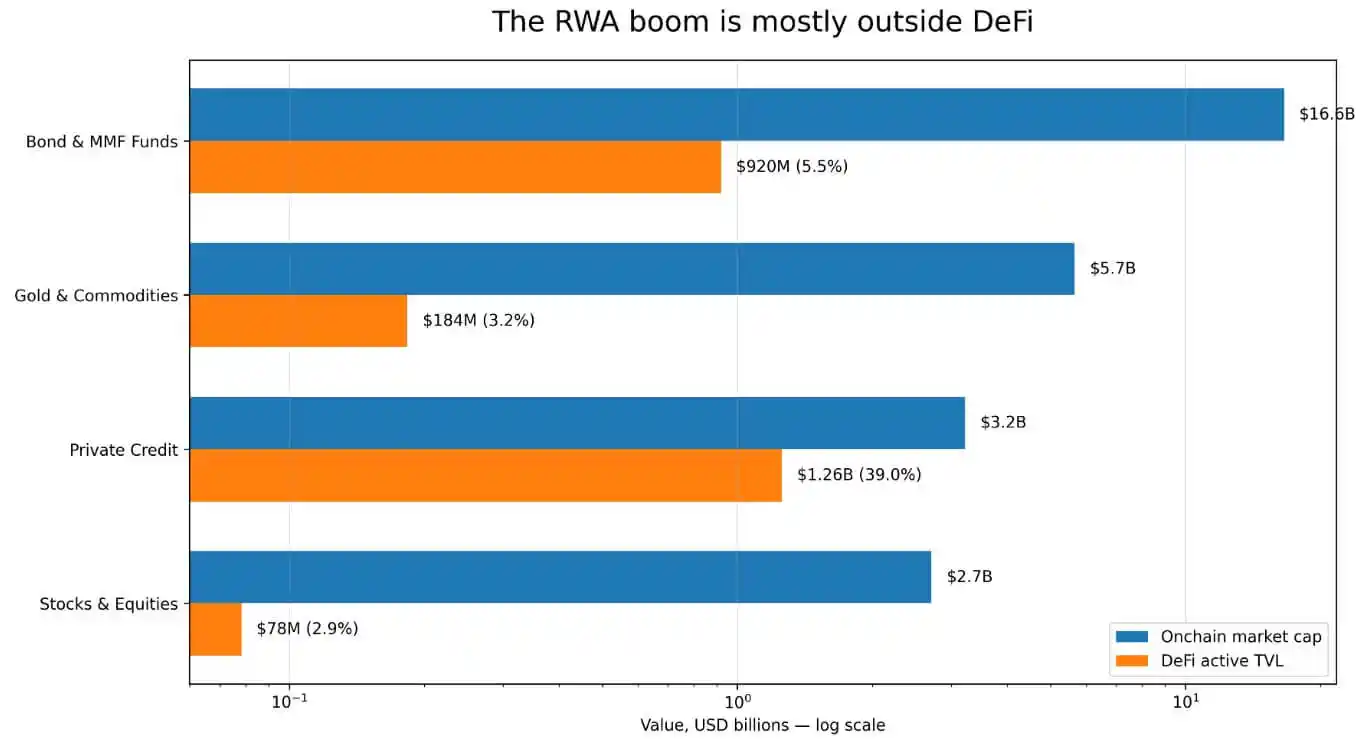
Distribution of On-Chain Market Value and DeFi Active TVL Across Four RWA Categories

Permissioned Architecture Becomes the Biggest Barrier to DeFi Composability

DeFiLlama categorizes the money market fund product BUIDL by BlackRock as a permissioned fund. Its effective TVL within the DeFi ecosystem is only $18.9 million.

The International Organization of Securities Commissions (IOSCO) pointed out in its final report on financial asset tokenization released in November 2025 that BUIDL created a permissioned system on a public blockchain for issuance, custody, secondary trading among qualified investors, dividend distribution, and redemption.

Potential investors must pass the whitelist review on the Securitize platform. Furthermore, on-chain asset transfer actions only attain full legal validity after information verification and confirmation by an offline transfer agent.

This means that BUIDL is essentially a compliant custody infrastructure built atop blockchain channels, primarily serving institutional asset custody and offline account reconciliation needs. Its smart contracts only support interactions from whitelisted addresses. Without using a compliant wrapping layer as an intermediary, they cannot be directly deposited into permissionless, open DeFi protocols like Aave or Uniswap.

In February 2026, BlackRock completed the integration of BUIDL with Uniswap, enabling partial assets to enter trading pools. However, asset access permissions are still controlled by Securitize, limited to qualified investment institutions with a net asset value of no less than $5 million; ordinary market participants still cannot participate.

IOSCO found that the vast majority of tokenized money market funds on the market currently adopt similar operational models. These assets have so far failed to deliver the high secondary market liquidity value previously anticipated by the industry.

RedStone stated bluntly in its tokenization industry report released in March 2026 that the most challenging part of asset tokenization implementation is coordinating a series of complex rules across different jurisdictions and public chain ecosystems, including compliance review, identity verification, trading permission restrictions, risk control sanctions screening, and corporate rights distribution. Looking at the current market, Morpho and Aave Horizon are among the few genuine case studies successfully implementing RWA assets in DeFi applications.

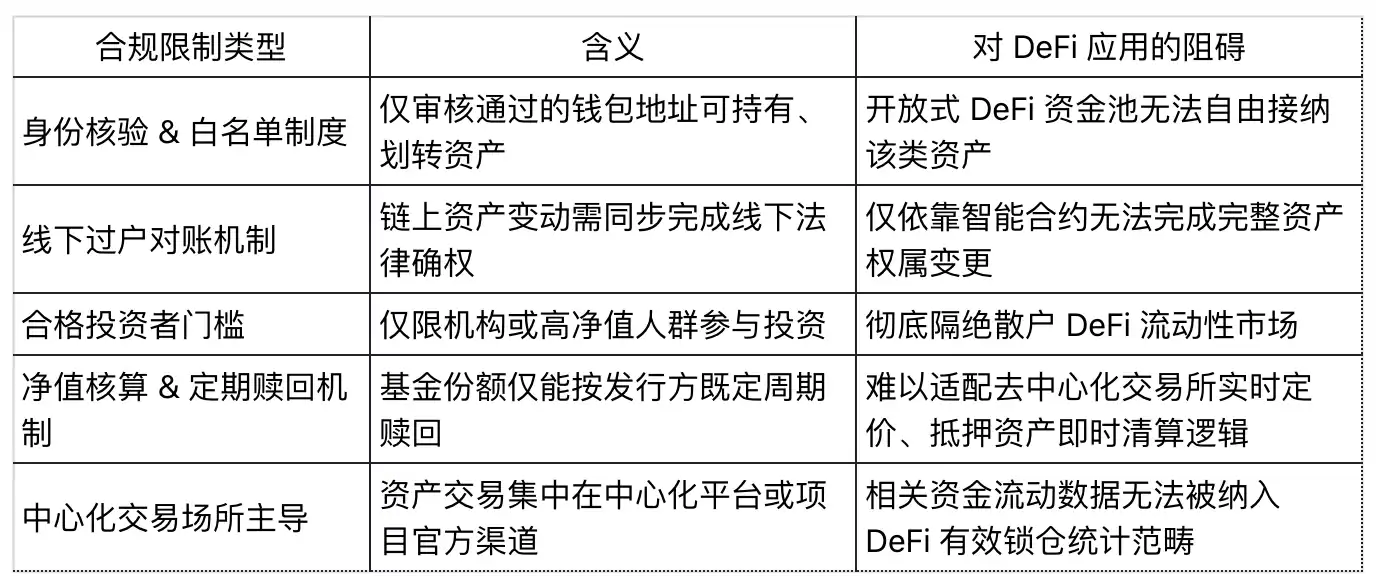
In short, each compliance and access restriction set by project parties further raises the barrier for assets to enter the DeFi ecosystem. Products like US Treasury token bonds and money market funds are themselves designed to meet the regulatory requirements of licensed institutional investors, actively incorporating various permission constraints.
Gold and commodity assets face another practical issue. CoinGecko data shows that in Q1 2026, spot trading volume for tokenized gold reached $90.7 billion, surpassing the total for the entire year of 2025. However, the vast majority of this trading occurs on centralized exchanges. The aforementioned DeFi effective TVL of $183.6 million only represents a tiny fraction circulating within the ecosystem. The enormous trading volume in centralized markets is completely outside the scope of DeFiLlama's data statistics.

Positive Outlook: Highly Compatible Products Have Set Examples

In early 2026, the TVL of Ondo's USDY exceeded $1 billion and has now achieved full coverage across nine public chain ecosystems. The Ondo Global Markets segment, launched in September 2025, focuses on tokenized US stocks and ETF assets for overseas investors. It was designed from the start to support free asset transfer and direct use as DeFi collateral. Currently, the TVL for corresponding assets is $650 million, with cumulative trading volume exceeding $12 billion.

According to RedStone statistics, the RWA deposit scale on the Morpho platform exceeds $620 million, and the total RWA-related asset scale on Aave Horizon is $423.5 million. Both lending protocols have successfully implemented mature RWA collateralized lending models.

These implementation cases fully prove that as long as the design philosophy of permissionless free circulation is upheld from the asset issuance stage, RWA assets can fully achieve composability within the DeFi ecosystem.

During an industry roundtable hosted by DWF Labs in April 2026, projects including Centrifuge, Falcon Finance, and xStocks jointly proposed the view that the RWA sector has now diverged into two major development tracks. The first prioritizes compliance with asset ownership regulations, adhering to a strictly permissioned and controlled path. The second balances compliant issuance standards while enabling secondary market circulation properties, with ecosystem composability as the core design orientation.

Graham Nelson, the person in charge of the Centrifuge project, stated that stringent whitelist access mechanisms mean each participant in a liquidity pool needs to undergo separate qualification reviews, directly blocking the path for assets to enter open DeFi.

The DeRWA solution launched by Centrifuge bypasses this barrier by wrapping the underlying primary issuance assets in a compliant manner while relaxing restrictions on secondary market asset circulation. Artem Tolkachev from Falcon Finance also mentioned that ecosystem composability and flexible exit mechanisms are the key bridges connecting real-world assets with crypto market liquidity.

The industry is optimistic that as the overall on-chain RWA asset scale approaches $50 billion, if most projects within the sector shift towards designs compatible with DeFi, the penetration rate of RWA assets in the DeFi ecosystem is expected to break through the current low level of 9%.

Negative Reality: Industry Growth May Be Confined to the Traditional Financial System

Standard Chartered Bank predicts that the global tokenized asset scale will reach $2 trillion by 2028, but it simultaneously warns that this industry boom is likely to be confined within the traditional banking and financial system, with limited growth benefits for the open crypto market.

IOSCO's research in November 2025 also corroborates this point. Constrained by the inherent access barriers and liquidity shortcomings of distributed ledger technology, the current distribution, circulation, and secondary market trading of tokenized assets still heavily rely on traditional financial infrastructure.

The European Central Bank further pointed out in its tokenization industry research report released in April 2026 that the absence of unified global standards for asset tokenization is highly prone to creating isolated asset silos. Different asset systems have their own compliance rules, settlement layers, and access mechanisms, ultimately leading to high concentration of liquidity within closed circles, making interconnection and circulation difficult.

The DeFi penetration rates of 5.5% for bonds and money funds, 3.2% for gold and commodities, and 2.9% for equities directly reflect this fragmented ecosystem pattern.

Most US Treasury tokens and money fund products on the market commonly set minimum investment thresholds, mandatory identity verification, offline asset reconciliation cycles, and fixed redemption windows tied to net asset value. These underlying rules inherently conflict with the operational logic of decentralized exchanges' real-time pricing and permissionless collateral vaults. These constraints are mandatory requirements from the regulatory level and an inevitable choice for asset issuers to adapt to the compliant environment.

Two Markets, One Industry Label

The total on-chain RWA scale of $30 billion and the effective DeFi circulation scale of $2.47 billion, while seemingly belonging to the same RWA sector, actually correspond to two completely separate markets:

  • Compliant On-Chain Financial Market: Primarily consisting of money market funds, US Treasury funds, and institutionally custodied assets. Asset transfer relies on offline transfer agent reconciliation and confirmation, following traditional financial regulations throughout.
  • DeFi Composability Ecosystem Market: Assets can be freely deposited into lending protocols, used as permissionless collateral, and integrated into various automated yield strategies for free circulation.
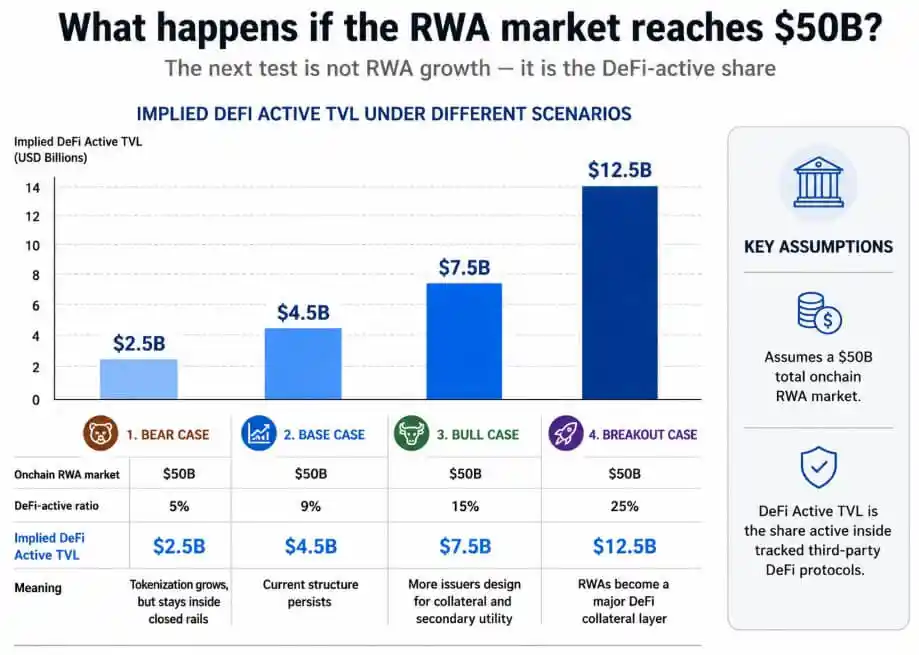
The chart above predicts the implied DeFi Active TVL under four scenarios in a $50 billion RWA market, ranging from 5% to 25%

The achievement of over $620 million in RWA deposits on Morpho and the circulation of USDY across 9 blockchains is sufficient proof that the second type of market possesses genuine development potential.

To drive the DeFi penetration rate of RWA assets beyond 9%, asset issuers must abandon the 'compliance-system-first' design approach exemplified by BlackRock's BUIDL. Instead, they should adopt underlying architectures that natively support permissionless free circulation.

Currently, $28.56 billion of on-chain RWA assets belong to the permissioned control track. This also means that most current tokenized real-world assets are, in essence, more akin to compliant on-chain traditional financial products, rather than general-purpose collateral assets suitable for open DeFi ecosystems.


Related Questions

QAccording to the article, what is the main reason why most tokenized real-world assets (RWA) have not been successfully integrated into DeFi ecosystems?

AThe main reason is that the majority of RWA products, such as bond and money market funds, are designed with a permissioned architecture from the outset to comply with institutional custody and traditional regulatory requirements. This includes whitelisting, mandatory identity verification, and reliance on offline settlement processes, which creates significant barriers for these assets to be used in permissionless DeFi applications like Aave or Uniswap.

QWhich RWA sector, according to the article, has shown a high degree of integration with DeFi, and what is the key factor for its success?

AThe private credit sector has shown high integration, with a 39% penetration rate into DeFi. The key factor for its success is that projects like Maple Finance and Centrifuge were designed from the beginning as lending financial tools, making them inherently compatible with DeFi application scenarios.

QWhat is the fundamental difference between the two distinct markets identified in the article under the common label of "RWA"?

AThe two distinct markets are: 1) A compliant on-chain financial market, consisting of assets like money market funds and treasuries. These assets rely on offline registrars for transfer validation and follow traditional financial regulations. 2) A DeFi-composable ecosystem market, where assets can be freely deposited into lending protocols, used as collateral, and integrated into various automated yield strategies for permissionless circulation.

QWhat solution is mentioned in the article for bridging the gap between compliant primary issuance of RWAs and their potential for secondary market circulation in DeFi?

AThe article mentions Centrifuge's "DeRWA" solution as an example. It involves creating a compliant wrapper for the underlying primary issuance asset while relaxing restrictions on the secondary market circulation of that wrapped asset, thereby enabling it to be used in open DeFi protocols.

QBased on the article's analysis, what must RWA issuers do to significantly increase the current low DeFi penetration rate of their assets?

ATo significantly increase DeFi penetration beyond the current ~9%, RWA issuers must move away from design philosophies centered on a closed, permissioned compliance system (like BlackRock's BUIDL). Instead, they need to adopt a native, permissionless architecture from the ground up that supports free and unrestricted circulation of assets within DeFi ecosystems.

Related Reads

The U.S. Government Blocked the Anthropic Model. It Wasn't About 'Jailbreaking' at All.

Last Friday, the U.S. Commerce Department issued an enforcement letter that forced Anthropic to take its two most advanced AI models, Fable 5 and Mythos 5, offline. The stated reason was unspecified national security concerns, initially linked to potential "jailbreaks" of the models' safeguards. However, new details suggest the action stemmed more from a deteriorating relationship between the Trump administration and Anthropic, rather than a genuine technical threat. According to reports, the government cited a little-known export control regulation, compelling Anthropic to block access for all non-U.S. persons, including its own international employees. The company complied, shutting down the models without a court order or specific technical details from the government. Cybersecurity expert Katie Moussouris revealed she was privately shown a research paper detailing a potential safeguard bypass in Fable 5. She argued the described method was minor and did not warrant an export ban, stating that attempts to "fix" it would only weaken the model's defensive capabilities. Moussouris and other experts have since called for the order to be revoked, warning it dangerously removes advanced cybersecurity tools from U.S. defenders. Analysts like Justin Hendrix suggest the move appears retaliatory and sets a dangerous precedent, signaling that the U.S. government can unilaterally shut down a tech company's products. The incident has raised concerns about the reliability of American AI and the potential for political interference in the tech industry, serving as a warning to the broader sector.

marsbit3m ago

The U.S. Government Blocked the Anthropic Model. It Wasn't About 'Jailbreaking' at All.

marsbit3m ago

Ray Dalio: AI Bull Market Continues to Soar, Should Investors Go All In or Cash Out and Leave the Field?

In his latest notes, Ray Dalio addresses a critical question for investors amid the AI-driven stock market surge: how should one allocate assets during a transformative technological revolution? Dalio emphasizes that technological advancement does not automatically make related stocks attractive. Historical tech cycles—marked by excitement, crowding, volatility, and eventual shakeouts—show that even long-term winners like Microsoft and Apple experienced severe drawdowns. Today's AI sector faces similar uncertainties: overinvestment, intensifying competition, geopolitical tensions (e.g., Taiwan's chip supply), tax policy shifts, anti-AI sentiment, and potential disruption from future technologies like quantum computing. Dalio's core argument focuses on the highly concentrated market structure, where a few tech giants dominate major indices. He warns investors against unknowingly holding concentrated, correlated exposures. Instead of chasing a handful of AI leaders, he advocates for a robust, diversified portfolio of 15 or more high-quality, uncorrelated investments, risk-balanced to match an investor's volatility tolerance. Mathematically, such diversification significantly improves the risk-return ratio—for example, holding 15 uncorrelated assets can boost the ratio by over four times compared to a single concentrated bet. Dalio cautions that future equity returns appear low, with his bubble indicator suggesting real returns could be negative over the next 5-10 years. He stresses that knowing what you don't know is as important as knowing what you do. In an environment of high uncertainty and concentration, avoiding large, concentrated bets on AI stocks is prudent. The optimal strategy is disciplined diversification—the "holy grail" of investing—to navigate this technologically driven cycle with lower risk and comparable or better returns.

marsbit7m ago

Ray Dalio: AI Bull Market Continues to Soar, Should Investors Go All In or Cash Out and Leave the Field?

marsbit7m ago

The World Cup has only been played for a few days, but some AI prediction models have already been crowned as oracles, while others have stumbled badly.

The 2026 FIFA World Cup has sparked significant interest not only on the pitch but also in AI-driven match prediction. Major models like Qwen, Copilot, and ChatGPT are being used to forecast outcomes, scores, upsets, red cards, and key player performances. Qwen gained early attention by accurately predicting Mexico's 2-0 win over South Africa (including a red card risk) and South Korea's 2-1 victory over the Czech Republic in the opening matches. Copilot's pre-tournament predictions had notable successes, such as correctly calling the Mexico 2-0 scoreline, South Korea's 2-1 win, and Brazil's 1-1 draw with Morocco. However, it also had clear misses, failing to predict upsets like Australia's 2-0 win over Turkey or Switzerland's draw with Qatar. ChatGPT provided detailed analytical reasoning, correctly predicting Mexico's 2-0 win, but its full-tournament predictions tended to favor favorites, missing several underdog results and draws. Tests pitting multiple models (ChatGPT, Gemini, Grok, Claude) against the same match, like Mexico vs. South Africa, showed varying predictions, with only some hitting the exact score. In summary, while AI models like Qwen have shown promising early results in specific match details, and others have had isolated successes, they collectively struggle to consistently identify upsets and underdog performances. AI is becoming an additional reference tool for prediction markets but is far from a definitive source.

marsbit7m ago

The World Cup has only been played for a few days, but some AI prediction models have already been crowned as oracles, while others have stumbled badly.

marsbit7m ago

Missed Out on SpaceX's IPO? Take a Look at SpaceX's Complete Supply Chain

SpaceX is now public, but its high valuation and losses may deter some investors. However, the real opportunity, as seen with Apple, Tesla, and Nvidia, may lie in its extensive supply chain. SpaceX, funded primarily by its profitable Starlink service, spends hundreds of billions annually on components for its rockets, satellites, and planned orbital AI data centers, creating significant revenue streams for suppliers. Key suppliers are categorized by their indispensability. The first group includes irreplaceable players like **NVIDIA** (GPUs for AI supercomputers), **Eutelsat (SATS)** (spectrum rights), **Filtronic** (millimeter-wave amplifiers), **Materion (MTRN)** (beryllium alloys), and **STMicroelectronics (STM)** (phased array chips). The second category comprises suppliers costly to replace due to long certification cycles or deep integration, such as **Honeywell (HON)** (flight controls), **Carpenter Technology (CRS)** (specialty steel), **Hexcel (HXL)** (carbon fiber), **Broadcom (AVGO)** (data switching), and **Linde** (industrial gases). The third group involves high-volume, cost-critical manufacturers for mass-produced items like Starlink terminals. Major players here include Taiwanese contract manufacturer **Wistron NeWeb (6285)** and several Chinese-listed firms: **Sunway Communication (300136)**, **Parker Advanced Materials (605123)**, **Western Superconducting (002149)**, and **Yingliu Co., Ltd. (603308)**. Other niche providers include **Tianyin Electromechanical**, **Tongyu Communication**, **Trimble (TRMB)**, **Astronics (ATRO)**, and **CTSH**. The timing is now relevant because: 1) SpaceX's procurement is accelerating with plans for 100 launches in 2026, 30 million Starlink terminals, and orbital data centers. 2) Its IPO has brought unprecedented transparency to its supply chain. 3) This phase mirrors early days of the Tesla supply chain boom. The investment thesis shifts from betting on SpaceX's stock to betting on the steady, order-book-driven revenues of its essential suppliers. Risks remain, such as commodity cycles, geopolitical factors, and technological shifts, but the supply chain offers a potentially less speculative path to participate in SpaceX's growth.

marsbit25m ago

Missed Out on SpaceX's IPO? Take a Look at SpaceX's Complete Supply Chain

marsbit25m ago

Jane Street: The Most Powerful Behind-the-Scenes Operator in the Crypto Industry

Jane Street: Crypto's Most Powerful Behind-the-Scenes Operator A recent 13F filing revealed Jane Street, the secretive Wall Street quant giant, drastically reduced its Bitcoin ETF holdings while increasing stakes in Ethereum ETFs. This move highlights its role not as a directional investor, but as a critical infrastructure player extracting "tolls" from crypto's institutionalization. The firm, founded in 2000 and famously lacking a CEO, has systematically embedded itself across crypto markets. It acts as a key Authorized Participant (AP) and market maker for major Bitcoin and Ethereum ETFs, profiting from arbitrage between ETF shares and underlying assets. Its approach combines quantitative prowess with a willingness to hold positions for structural arbitrage, differing from pure high-frequency traders. Jane Street faces allegations related to the 2022 Terra (LUNA) collapse. A lawsuit claims it used non-public information to withdraw $85 million in UST minutes before a critical withdrawal by Terraform Labs, allegedly exacerbating the crash and avoiding over $200 million in losses. The company denies the claims. Further indicating its reach, a wallet suspected to be operated by Jane Street ("JaneStreetIndia") was identified on the prediction market Polymarket. This bot executed over 11,000 high-frequency trades on short-term crypto price movements with a near-perfect win rate, showcasing a套利 strategy divorced from traditional prediction. Beyond trading, Jane Street holds equity in crypto infrastructure like Kraken, 1inch, and Arbitrum, and mining stocks. Its strategy is clear: avoid betting on winners, but secure a position in the market's essential plumbing. By becoming a ubiquitous part of the liquidity infrastructure—from ETFs to OTC trading and potentially链上 markets—Jane Street operates as a market force itself, raising questions about whether crypto's decentralized,散户-friendly alpha is being permanently eroded by traditional finance's most sophisticated players.

Foresight News28m ago

Jane Street: The Most Powerful Behind-the-Scenes Operator in the Crypto Industry

Foresight News28m ago

Trading

Spot
Futures
活动图片