Why I Am Not Bullish on Ethereum at Its Current State?

marsbitPublished on 2026-01-19Last updated on 2026-01-19

Abstract

Why I'm Not Bullish on Ethereum at Current Prices The author expresses skepticism about Ethereum's current valuation, not its long-term business growth potential (user base and transaction volume are expected to increase). The author believes the price is too high relative to its fundamentals, based on the following analysis: - Active users and transaction counts have reached new highs but are growing slower than some leading e-commerce platforms. - Monthly transaction fees are only 0.6% of the previous cycle's peak, and average fees per transaction are 0.5% of previous highs. This slow growth comes at the cost of drastically reduced service prices, which is unfavorable in any industry. - If Ethereum is viewed as a company selling block space, its price-to-fee (PF) ratio exceeds 2,000x and its price-to-sales (PS) ratio exceeds 10,000x. It has negative net profit, so no P/E ratio exists. In comparison, traditional cloud service companies have P/E ratios of 20-30 and single-digit PS ratios. - If considered a commodity (like digital oil), Ethereum faces competition from other chains and rollups offering similar services. Its value proposition may not justify such a high premium, especially as its narrative as a store of value (like Bitcoin) has faded. - There is a lack of new, product-market-fit crypto native applications this cycle, leading to oversupply of block space and stagnant growth in the public chain sector. - Grand visions of Ethereum becoming a decentralized "Wall S...

Author: Alex Xu

Not being bullish doesn't mean I am pessimistic about Ethereum's business development (referring to long-term growth in user scale and transaction volume, which I believe will continue), but rather that I am unwilling to buy at the current price because it is too expensive relative to its fundamentals.

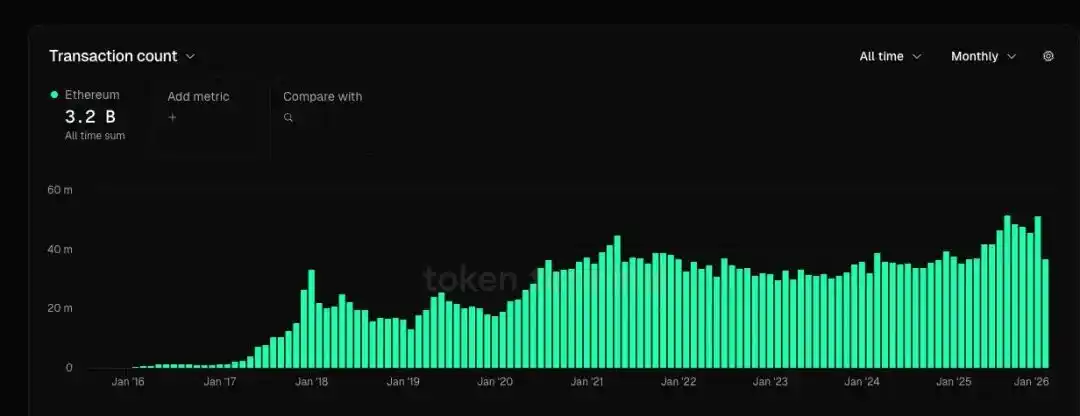
From a few charts, we can paint a picture of Ethereum's current state:
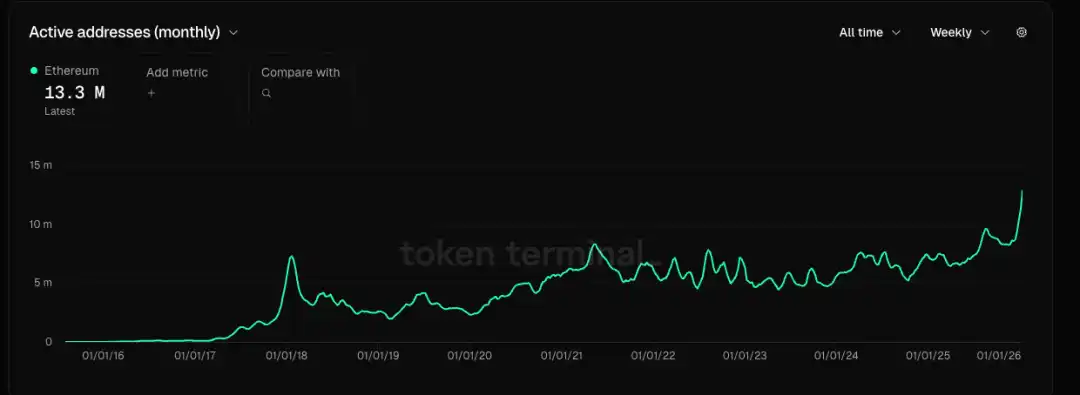
1. The number of active users has risen in waves to new highs (44% higher than the peak of the last cycle), and the number of transactions has also reached new highs (13% higher than the peak of the last cycle). However, the growth rate of these two metrics is still slower than the GMV growth of some leading e-commerce platforms.
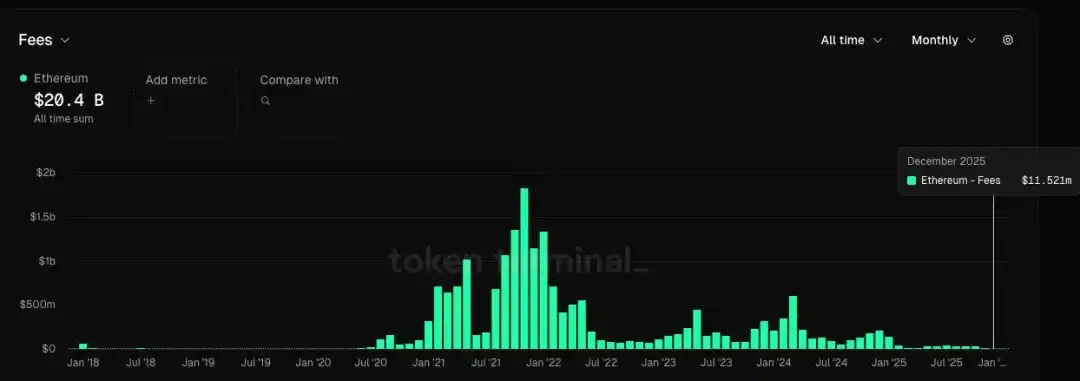
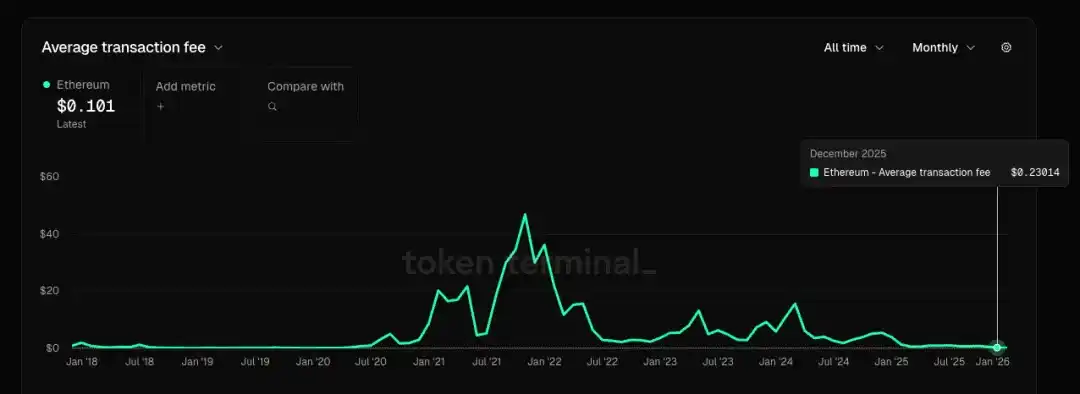
2. The current monthly transaction fees are only 0.6% of the peak of the last cycle, and the average transaction fee per transaction is only 0.5% of the peak of the last cycle. This means that the slow growth in users and transaction volume has been achieved at the cost of a sharp decline in service prices. When growth comes at the expense of drastic price reductions for products and services, it is not a good sign for any company in any industry.
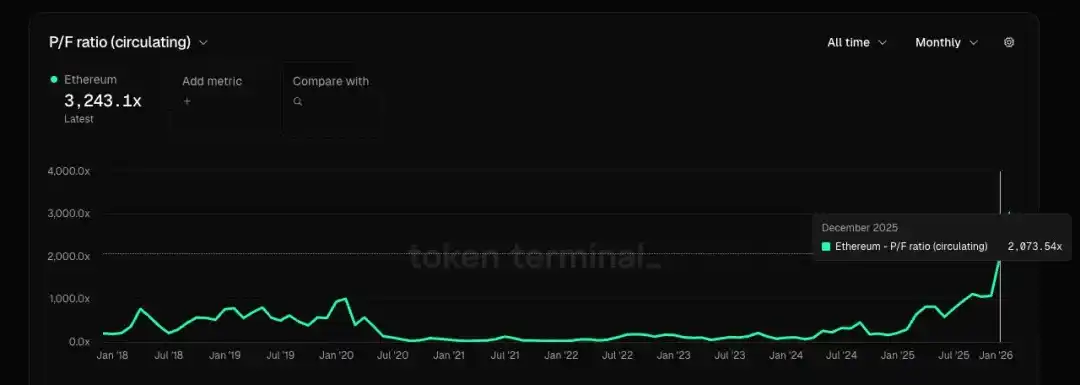
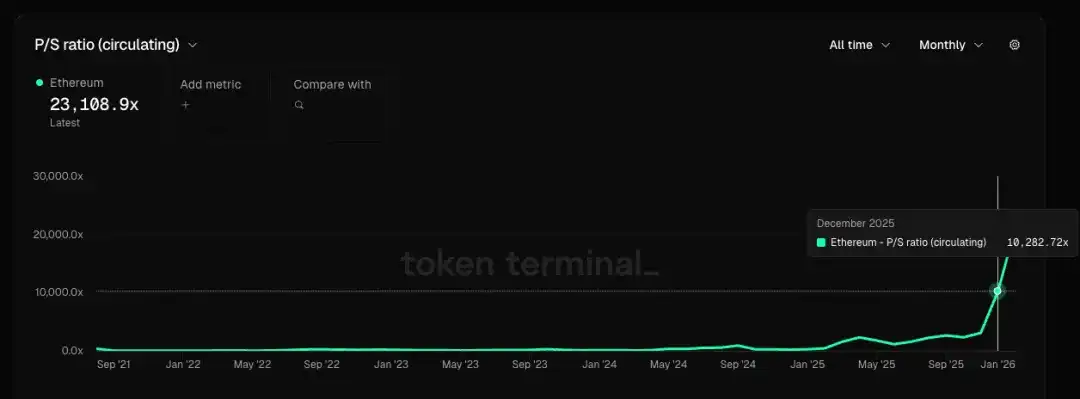
3. If we view Ethereum as a company providing block space services, based on December data, its P/F (Price-to-Fee ratio) exceeds 2,000x, and its P/S (Price-to-Sales ratio) exceeds 10,000x. Its net profit is negative, so there is no P/E ratio. In comparison, traditional cloud service companies typically have P/E ratios between 20-30 and P/S ratios in the single digits.

4. If Ethereum is considered not a company but a commodity (similar to digital oil), its challenge lies in the fact that other public chains and rollups can provide similar block space services (akin to substitutable oil). Some may argue that Ethereum's decentralization and censorship-resistant properties make it more valuable as a commodity resource, but is it really worth that much more? The previous narrative that ETH could replace BTC as a store of value has largely disappeared, as consensus has shifted: compared to BTC's status as digital gold, ETH is more like a tech company + specialized cloud service provider, and its commodity positioning is also highly substitutable.

5. Crypto-native applications with product-market fit (PMF) have almost disappeared in this cycle, with almost no high-value applications emerging. Insufficient demand and increased supply (the continued growth of rollups and public chains) have led to a severe oversupply of block space, and the public chain sector itself is experiencing sluggish growth or even contraction.

6. The grand vision painted by Tom Lee and some domestic VCs—"Ethereum is the Wall Street on-chain, and everything will eventually be on Ethereum"—lacks sufficient data and factual evidence to support this story. There is no concrete logical derivation, and it seems more like a promotional pitch. Our investment decisions should be based on rationality, not faith. I am not ready to buy into their narrative yet. If future data and facts gradually support this story, it will be time to reconsider.


Related Questions

QWhat is the author's main reason for not being optimistic about Ethereum at its current price?

AThe author believes the current price is too expensive relative to its fundamentals, such as its high valuation multiples and declining fee revenue, despite some growth in user base and transaction count.

QHow does the author compare Ethereum's current performance to the previous cycle's peak in terms of transaction fees?

AThe author states that the current monthly transaction fees are only 0.6% of the previous cycle's peak, and the average fee per transaction is only 0.5% of the previous high.

QWhat valuation multiples does the author use to argue that Ethereum is overvalued, and how do they compare to traditional cloud service companies?

AThe author uses a Price-to-Fees (PF) ratio of over 2000x and a Price-to-Sales (PS) ratio of over 10,000x for Ethereum, while noting that traditional cloud service companies typically have a PS ratio in the single digits and a PE ratio between 20-30.

QAccording to the author, what is a key challenge to Ethereum's 'digital oil' commodity narrative?

AThe author argues that other blockchains and rollups can provide similar block space services, making Ethereum's commodity-like resource highly substitutable and questioning if its premium valuation is justified.

QWhy does the author express skepticism about the narrative that Ethereum will become the 'Wall Street of on-chain' activities?

AThe author finds this narrative lacks supporting data and concrete logical derivation, viewing it more as promotional 'shilling' rather than a rational investment thesis based on current evidence.

Related Reads

A 120,000 Yuan Tombstone or 399 Yuan AI Immortality: Which Would You Choose?

"The 'Deathcare Moutai' Fushouyuan, once a highly profitable cemetery operator, has halted trading amid a severe crisis, with its net profit plummeting by 52.8% in 2024. This reflects a broader trend of people rejecting expensive traditional burials, as average grave prices in China have soared to over ¥120,000. In response, the industry is pivoting to digital alternatives, with companies like Fushouyuan offering AI-powered memorial services, such as virtual farewell halls and AI-generated recreations of the deceased. Simultaneously, a low-cost, unregulated AI 'resurrection' industry has emerged online, with services priced as low as ¥399. These often use open-source tools to create crude digital avatars from photos and voice clips, exploiting vulnerable individuals, particularly bereaved parents who have lost their only child. However, these services raise significant ethical and legal concerns, including data privacy risks and potential use in scams. Academic studies warn that such AI companions may exacerbate grief, leading to prolonged mourning disorders and emotional dependency, rather than providing genuine comfort. While regulations are being drafted to manage digital human services, the deep emotional drive to 'reconnect' with loved ones often overshadows rational concerns. Ultimately, the article questions whether digital immortality truly preserves memory or merely offers a commercialized illusion, emphasizing that no technology can replace the real, irreplaceable loss of a human life."

marsbit5m ago

A 120,000 Yuan Tombstone or 399 Yuan AI Immortality: Which Would You Choose?

marsbit5m ago

Anthropic Starts Poaching Scientists? $27K Weekly Onsite Stipend to Fix Claude's Expert-Level Errors

Anthropic has launched a new STEM Fellow program, offering $3,800 per week for a three-month, in-person residency in San Francisco. The role targets experts from science, technology, engineering, and mathematics (STEM) fields—machine learning experience is helpful but not required. Instead, Anthropic values scientific judgment and a willingness to learn quickly. Fellows will work with Claude models and internal tools under the guidance of an Anthropic researcher. Example projects include a materials scientist identifying errors in Claude’s reasoning or a climate scientist integrating atmospheric modeling software with Claude. The goal is to have experts "tell Claude where it's wrong" and improve its scientific capabilities. This initiative is part of Anthropic’s broader strategy to strengthen its scientific ecosystem, following earlier programs like the AI Safety Fellows and AI for Science programs. The company acknowledges that current AI models, while powerful, still produce high-confidence errors and lack end-to-end research autonomy. The program aims to embed domain expertise directly into model development, turning scientists into "high-level reviewers" for AI. Anthropic CEO Dario Amodei has previously emphasized AI’s potential to accelerate scientific breakthroughs, particularly in biology and healthcare. The company believes that the next phase of AI competition will depend not on scaling parameters, but on integrating human expertise to refine model accuracy and reliability.

marsbit55m ago

Anthropic Starts Poaching Scientists? $27K Weekly Onsite Stipend to Fix Claude's Expert-Level Errors

marsbit55m ago

Trading

Spot
Futures

Hot Articles

Discussions

Welcome to the HTX Community. Here, you can stay informed about the latest platform developments and gain access to professional market insights. Users' opinions on the price of ETH (ETH) are presented below.

活动图片