Why Do You Always Lose Money on Polymarket? Because You're Betting on News, While the Pros Read the Rules

marsbitPublished on 2026-04-20Last updated on 2026-04-20

Abstract

Why do you always lose money on Polymarket? Because you bet on news, while the pros study the rules. This article explains how top traders ("che tou") profit by meticulously analyzing market rules, not just predicting events. Polymarket, a prediction market platform, often sees disputes over event outcomes due to ambiguous rule wording. For instance, a market asking "Who will be the leader of Venezuela by the end of 2026?" was misinterpreted by many who bet on Delcy Rodríguez, assuming she held power. However, the rules specified "officially holds" as the formally appointed, sworn-in individual. Since Nicolás Maduro was still recognized as president officially, he won the market—even being in prison. To resolve such disputes, Polymarket uses a decentralized arbitration system via UMA protocol. The process involves: 1. Proposal: Anyone can propose a market outcome by staking 750 USDC, earning 5 USDC if unchallenged. 2. Dispute: A 2-hour window allows challenges with a 750 USDC stake; successful challengers earn 250 USDC. 3. Discussion: A 48-hour period on UMA Discord for evidence and debate. 4. Voting: UMA token holders vote in two 24-hour phases (blind then public). Outcomes require >65% consensus and 5M tokens voted; otherwise, four re-votes occur before Polymarket intervention. 5. Settlement: Results are final and automatic. Unlike traditional courts, Polymarket’s system lacks separation between arbitrators and stakeholders—voters often hold market positions, creating co...

Author: Changan I Biteye Content Team

Do you know why you can't beat the pros on Polymarket? Because they scrutinize the rules, parsing every word like lawyers reviewing a contract.

In April 2026, a controversy over Venezuela's leader erupted in the Polymarket community.

There was a market on Polymarket asking, "Who will be the leader of Venezuela by the end of 2026?" Many traders intuitively thought: Maduro is in a U.S. prison, Delcy is presiding over the cabinet in Caracas, so the de facto ruler is obviously Delcy. They placed their bets on Delcy.

But the rules and supplementary notes were clear: "officially holds" refers to the person formally appointed and sworn in. The UN-recognized Venezuelan government has not formally removed or replaced Maduro; official government information still identifies him as president. The rules specifically added: "Temporarily authorized to exercise presidential powers does not equate to a transfer of the presidential office."

According to these rules, even if Maduro remains in a U.S. prison, he is still the legitimate president of Venezuela.

Similar examples abound:

  • After Polymarket issued a stablecoin, controversy arose over "What is the FDV of the Polymarket token?": Is a stablecoin considered a token? A single word makes all the difference.

  • Iran Uranium: The standard for "agreement"—conditional statements vs. formally signed agreements.

Behind these cases lies the same logic: On Polymarket, the rules are paramount. But when disputes arise over the rules, Polymarket has a complete adjudication process to resolve them. This article will explain how this mechanism operates, and where it resembles and fundamentally differs from traditional courts.

I. Polymarket's Adjudication Mechanism

Ambiguity in the rule text doesn't just cause pricing discrepancies; it becomes a formal dispute at settlement.

Polymarket sees numerous market settlements daily, with markets involving political statements, diplomatic postures, and military actions being particularly prone to controversy.

Disputed events are actually the norm in prediction markets. Ambiguity creates pricing divergence during trading and turns into conflict at settlement—it's the same issue at two different points in time.

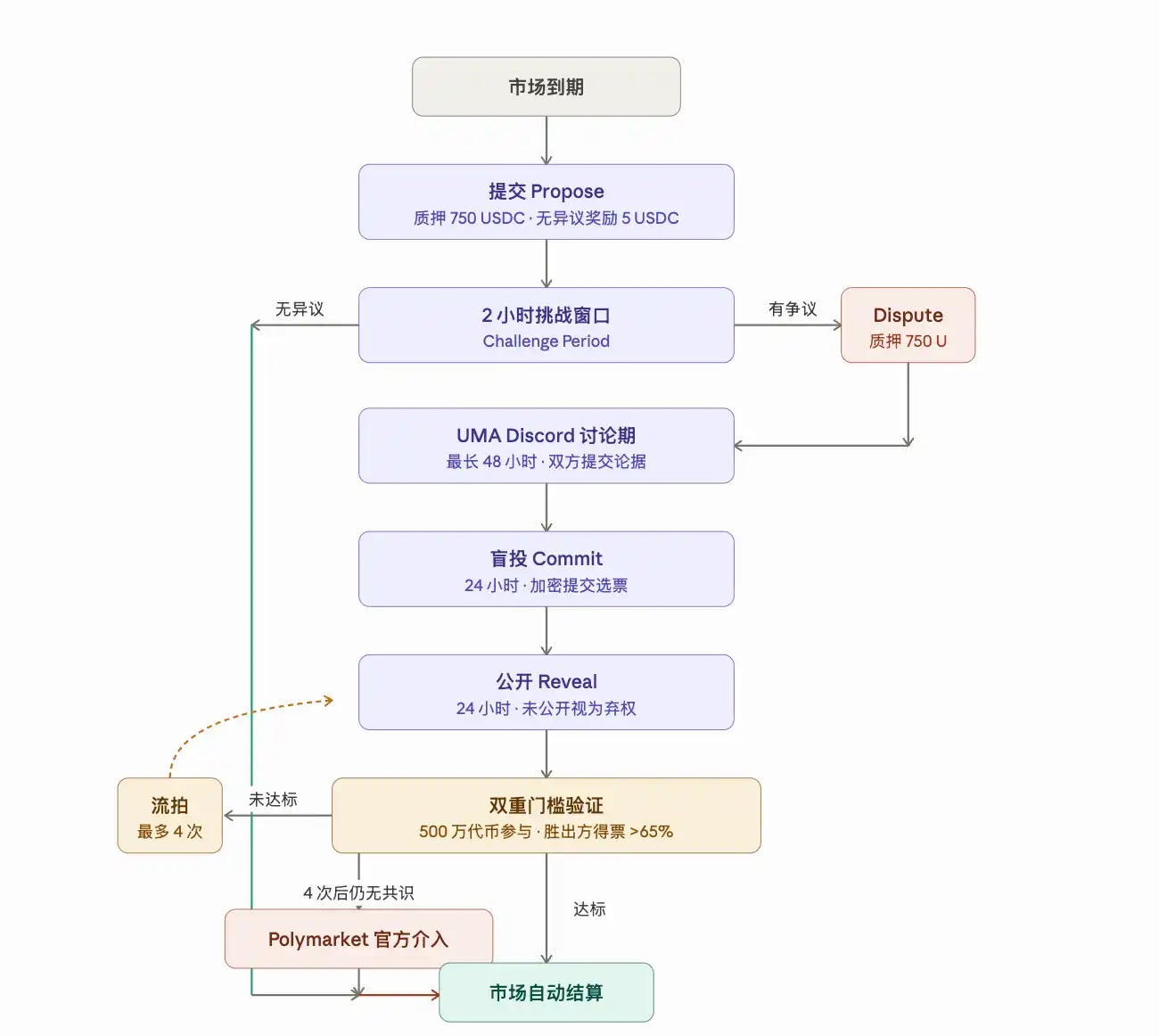
To resolve these disputes, Polymarket has established a complete adjudication process. The settlement process splits into two paths: normal settlement and dispute resolution.

Step 1: Submit a Proposal (Propose)

When a market meets the settlement conditions, anyone can submit a proposed resolution, declaring whether the market should be judged YES or NO. Submitting a proposal requires staking 750 USDC as a bond, which serves as the submitter's endorsement of their judgment. If the market has no objections, the user who submitted the proposal receives a 5 USDC reward.

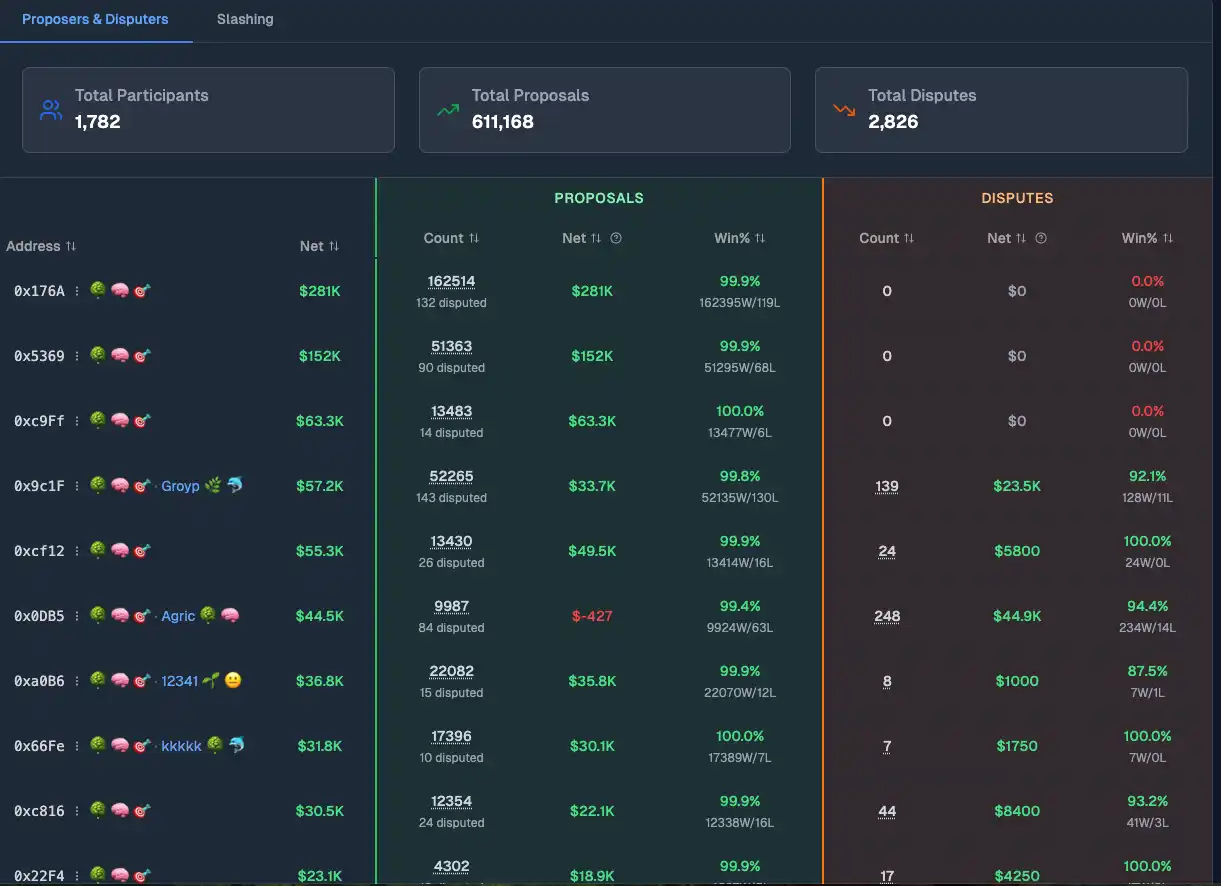
Currently, only 1782 users have submitted Proposals. The top-earning user has accumulated $281K.
Step 2: 2-Hour Challenge Window (Dispute)

After a proposal is submitted, it enters a 2-hour challenge period. This is the first fork in the entire process.

If no objections are raised within 2 hours, the system defaults the proposal as correct, the market settles directly, and the process ends. The vast majority of markets follow this path.

If someone believes the proposal result is incorrect, they can challenge it within this 2-hour window, also requiring a stake of 750 USDC. A successful challenge earns a 250 USDC bonus.

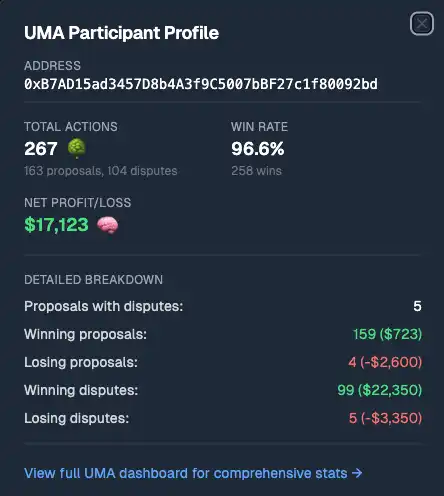
Very few users specialize in Disputes. The user who has earned the most from the Dispute环节 is 0xB7A, with profits of $17,123.
Step 3: Up to 48-Hour Discussion Period

Once entering the dispute track, both parties proceed to the UMA Discord discussion phase. This stage allows各方 to present arguments and evidence: interpretations of the rule text, relevant news reports, historical precedents, official statements—any material supporting their position can be presented at this stage.

The discussion period lasts up to 48 hours and is the only phase where reasons can be fully stated. The quality of this stage很大程度上 determines the direction of the subsequent vote.

Step 4: 48-Hour Voting

After the discussion, it enters the UMA token holder voting phase, divided into two 24-hour stages.

  • The first stage is blind voting. It forces each voter to make an independent judgment based on their understanding of the rules, rather than following big players.

  • The second stage is public. Votes not made public in this stage are considered abstentions and are directly invalidated.

After voting, UMA sets two settlement thresholds that must be met simultaneously for the adjudication to complete:

  • Participation level: At least 5 million tokens must participate in the vote, ensuring the裁决 has sufficient representativeness.

  • Absolute consensus: The winning side must have a vote share exceeding 65%, not a simple 51% majority.

If both thresholds are not met, the vote fails and enters a new round of re-voting, up to a maximum of 4 times. If no consensus is reached after 4 rounds, Polymarket officials have the right to intervene directly in the adjudication.

Step 5: Automatic Settlement

Once the vote result is confirmed, the market settles automatically, and funds are distributed according to the result. There is no appeal, no retrial, no recourse.

The entire dispute process, from challenge submission to final settlement, is typically completed within a week.
II. Polymarket vs. Traditional Courts: The Same Logic, Different Design

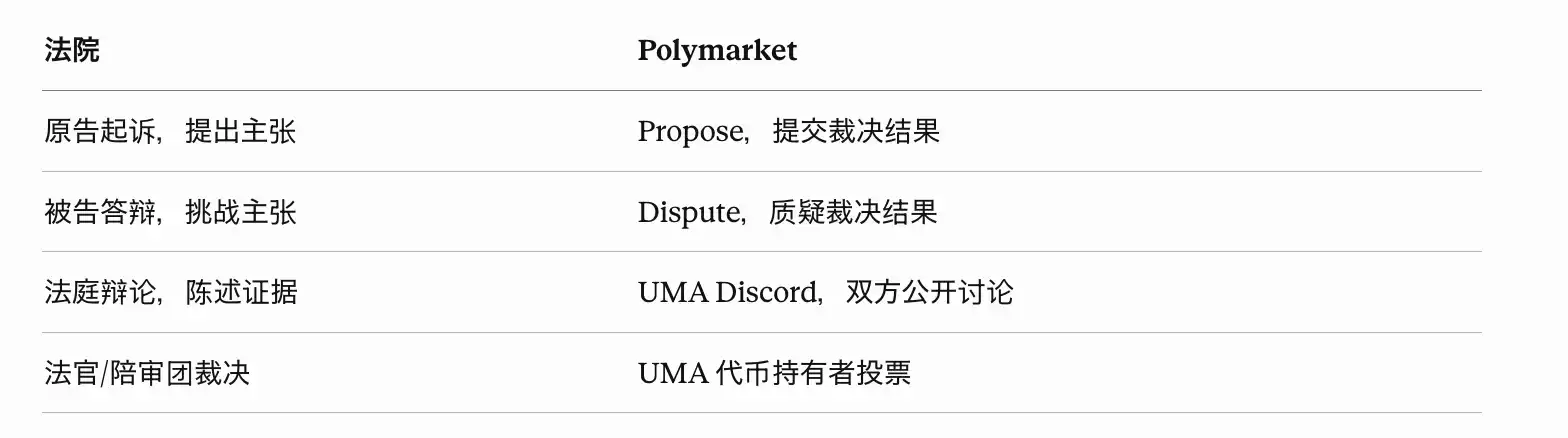
On the surface, Polymarket's adjudication process is highly similar to traditional courts: there is a party making a claim, a party challenging the claim, a discussion phase for statements, and finally an adjudicator who gives the result.

But the two systems differ fundamentally in one key design: separation of powers.
  1. Court power is isolated

In traditional courts, the plaintiff and defendant only have the right to state their case, not to adjudicate. The judge only has adjudication power, without a vested interest. Crucially, the judge must remain independent of the case. If the judge has any interest in the case, they must recuse themselves, and another judge takes over.

The adjudicator and the interested party are never the same person.

  1. Polymarket lacks this isolation

UMA token holders are the adjudicators, but they can simultaneously hold positions in the disputed market. Which direction they adjudicate directly affects their own profits and losses. The裁判者 and the interested party being the same person is called a conflict of interest in traditional courts, requiring mandatory recusal, but in Polymarket, it is legal and normal.

This design flaw is the root cause of the following two problems.

1️⃣ Why the discussion环节 fails

In court, the positions of the plaintiff and defendant are fixed from the moment of filing. Lawyers don't switch sides mid-trial, nor do they withdraw their statements because the other side is more assertive. Positions are clear, roles are defined, and the entire debate is built on this stability.

The UMA Discord discussion faces two problems simultaneously.

  • Herd mentality: The discussion is public and real-name. Once influential KOLs state their position, it's easy for others to follow. Many participants just post "P1" or "P2" without giving any理由.

  • Position switching: Participants also hold positions in the disputed market. When their positions change, their stance naturally changes with it. This is why posts in the UMA Discord are often deleted after being made.

Both problems stem from the same root: the adjudicator and the interested party are not separated. Courts use a mandatory recusal system to separate these two roles, ensuring the stability of positions during discussion. Polymarket lacks this isolation.

2️⃣ Why the adjudication results are opaque

In court, the judge hears the full arguments from both sides before making a ruling. The ruling document states which arguments were adopted, the basis for the decision, and the reasoning behind it. The losing party might disagree, but at least they know why they lost and can strengthen their arguments next time.

These rulings form a system of precedents that can be studied. Future judges, lawyers, and parties can cite them, making the adjudication standards searchable, learnable, and predictable.

After UMA voting concludes, there is only a result: YES or NO. The讨论 parties don't know what the voters saw, what they believed, or why they leaned one way. Winners don't know which argument worked; losers don't know where their persuasion fell short. Because the adjudication logic is never made public, the outcomes of disputes are difficult to learn from and accumulate.

Court rulings form a system of precedent; Polymarket's adjudications leave only a result.

III. Final Thoughts

Therefore, Polymarket is never just a market for "guessing events" correctly. It's more like a system that translates real-world events into legal text and then translates that legal text into settlement results.

Understanding the rules is as important as doing research. The pros' advantage often comes from their depth of understanding of the rules, knowing what this system acknowledges and what adjudications will recognize.

Those who realize earlier that a gap exists between "reality" and "the rules" have a better chance of profiting from the price deviations created by misreading, controversy, and emotion.

Related Questions

QWhat is the main reason why many traders lose money on Polymarket according to the article?

ABecause they bet based on news and intuition, while experienced traders focus on meticulously reading and interpreting the rules of each market.

QDescribe the first step (Propose) in Polymarket's dispute resolution process.

AWhen a market meets settlement conditions, anyone can submit a proposal for a YES or NO outcome. This requires staking 750 USDC as a bond. If the proposal is accepted without dispute, the submitter earns a 5 USDC reward.

QWhat is a fundamental design difference between Polymarket's UMA voting system and a traditional court system?

APolymarket's UMA token holders, who act as the arbitrators, are allowed to hold positions in the markets they are voting on, creating a conflict of interest. Traditional courts enforce strict separation, where judges must recuse themselves if they have any interest in a case.

QWhy does the article claim the discussion phase in the UMA Discord often fails?

AIt fails due to herd mentality, where participants follow influential KOLs without providing their own reasoning, and because participants can change their stated positions as their market positions change, since arbitrators are not isolated from having a financial stake.

QWhat key advantage do 'che tou' (car heads, or experienced traders) have over regular users on Polymarket?

ATheir advantage comes from a deeper understanding of the platform's rules—knowing how the system will interpret events and what evidence it will recognize during a dispute resolution—allowing them to profit from pricing discrepancies created by misreadings and emotions.

Related Reads

Senior Trader's Confession: How to Trade Market's False Expectations?

Veteran trader's case study: trading the market's "wrong expectations". This trade centered on a textbook "expectation error" after a weak CPI report. While the market initially priced in broad monetary easing (sending Nasdaq to 30,060), the crucial 30-year real yield hit a 20-year high. This signaled a fractured transmission mechanism: short-term rates eased, but long-term funding costs (vital for tech valuations) refused to fall. The trader executed five short positions on the Nasdaq (NQ) as it fell from 30,060 to 28,768. The core methodology: don't just trade the data, but analyze the market's implied causal chain and identify where it breaks. In this case, the chain was: Weak CPI → Policy Easing → Lower Long-Term Funding Costs → NQ Valuation Expansion. The break occurred between policy easing and long-term rates. The "veto variable" – long-term real yields – refused to confirm the bullish narrative. Trades were structured around "fast variables" (price) temporarily repairing while "slow variables" (funding conditions) remained broken. The article outlines a repeatable framework: 1) Map the market's implied causal chain. 2) Identify the veto variable. 3) Observe if it rejects the narrative. 4) Enter when price still follows the old script. 5) Choose the cleanest asset expression (e.g., short NQ, not broad S&P). 6) Define both invalidation and fulfillment exit conditions. The key insight: Alpha often comes not from an information edge, but from a "reaction function edge" – recognizing when the market is applying an outdated causal logic to new data. The critical question: What causal chain is the market's first reaction relying on, and is that chain still valid today?

marsbit21m ago

Senior Trader's Confession: How to Trade Market's False Expectations?

marsbit21m ago

Opinion: The Hedging Relationship Between U.S. Treasuries and Stocks Has Broken Down, and BTC, as a Risk Asset, Is Under Dual Pressure

For the past 20 years, U.S. investors relied on a free insurance policy: when stocks fell, bonds rose, cushioning portfolio losses. This reliable inverse correlation underpinned entire financial strategies. However, this mechanism broke down around 2020 and has not recovered. Currently, the two-month rolling correlation between the S&P 500 and 10-year Treasury yields is at -0.69, its lowest level since 1996, indicating stocks and bonds are moving in sync to an unprecedented degree, eliminating the traditional portfolio shock absorber. The失效 of this hedge is not simply due to lost confidence in U.S. debt. The key driver is the shift from growth-dominated to inflation-dominated market narratives. When growth fears prevail, stocks and bonds move inversely. Since 2022, persistent inflation volatility has been the dominant factor, causing both asset classes to suffer simultaneously from higher inflation expectations. Investors now seek safety without duration risk, favoring cash, dollars, and short-term Treasuries while selling long-duration bonds. Record U.S. deficits, rising net interest payments, and waning foreign demand (e.g., from Japan) are pressuring long-term yields, with the 30-year yield surpassing 5%. This environment places Bitcoin, as a risk asset on the far end of the risk curve, under dual pressure. Higher risk-free rates increase the opportunity cost of holding non-yielding assets like Bitcoin, while falling equities reduce overall risk appetite. Bitcoin's performance has become highly sensitive to macro conditions such as real yields, dollar strength, and financial conditions. While its long-term thesis as a fixed-supply asset outside the sovereign credit system is strengthened by these fiscal trends, the same conditions hurt it in the short term. The return of bonds as a effective hedge requires inflation volatility to subside, growth risks to retake dominance, and the Fed to have room to ease policy. Until then, Bitcoin trades in a market where the deepest asset class no longer absorbs shocks, removing the safety floor for all risk assets, especially those that pay nothing to wait.

marsbit21m ago

Opinion: The Hedging Relationship Between U.S. Treasuries and Stocks Has Broken Down, and BTC, as a Risk Asset, Is Under Dual Pressure

marsbit21m ago

Funding Weekly | Crypto.com Secures $400M Investment, CeFi and Stablecoin Sectors Continue to Attract Capital

Crypto Weekly Investment Recap: Funds Converge on CeFi, Stablecoins, and AI Last week's crypto and AI investment landscape saw significant capital concentration, with a few large deals dominating. **Crypto/Web3 Highlights (July 13-19):** Total investment exceeded **$812 million** across 17 deals. Key trends: * **Centralized Finance (CeFi) & Stablecoins** remained a major magnet, led by **Crypto.com**'s massive **$400 million** raise from Citadel Securities, valuing the exchange at $20B. * **Infrastructure & Tools** saw 7 deals, including **Cyclops** ($20M for stablecoin payments) and **ADI Chain** ($50M for stablecoin settlement infrastructure). * **DeFi** had 2 deals, such as AI-native DEX **Quote Trade** ($4M). * Other notable raises: API broker **Alpaca** ($135M), cross-border platform **Flex** ($70M), treasury firm **ORANGE JUICE** ($40M), and prediction market **Pascal** ($9M). * **Acquisitions:** Keyrock bought BlockFills' trading unit, SBI Holdings acquired Singapore exchange Coinhako, and MoonPay bought startup Glide. **AI & Robotics Highlights:** Investment momentum in AI remained very strong. * Nvidia-backed AI cloud service **Fireworks** raised a massive **$1.5 billion** at a $17.5B valuation. * In robotics, **Walden Robotics** (spun out from Toyota) secured **$300 million**, and Chinese humanoid firm ****逐际动力** **(Climax Dynamics) raised nearly **$200 million** in a Pre-IPO round. * Other significant AI raises included Indian programming platform **Emergent** ($130M) and drone company **Brinc** ($125M), backed by Sam Altman. Overall, the trend shows capital flowing heavily into established crypto financial services, stablecoin infrastructure, and large-scale AI/robotics commercialization.

marsbit1h ago

Funding Weekly | Crypto.com Secures $400M Investment, CeFi and Stablecoin Sectors Continue to Attract Capital

marsbit1h ago

The Gentlest Bear Market? BTC Bears Exit, ARK and Bitwise Collectively Bullish

**Title: The Mildest Bear Market? BTC Shorts Exit, ARK and Bitwise Collectively Bullish** Bitcoin continues to consolidate around $75,000 while Ethereum struggles near $1,900. Market data shows $116 million in liquidations over 24 hours, with $62.7 million from short positions, and the Fear & Greed Index remains at 35 (Fear). According to Polymarket, there's a 33% probability BTC falls below $50,000 this year. ARK Invest's Q2 2026 Bitcoin report notes technical weakness but identifies potential bottoming signals, including a record high in long-term holder supply, suggesting selling exhaustion. Bitwise's Juan Leon calls this the "structurally mildest bear market" on record, with a ~50% drawdown from highs, less severe than past cycles. He highlights institutional accumulation and a shift in investor dialogue from survival to entry points. Technical analysis from Bit suggests a potential C-wave low may have formed, with an ideal bottoming range between $50,000-$55,000. However, glassnode's CryptoVizArt warns that failure to break $66,000 could signal a local top, as new buyer accumulation is concentrated there. Analyst Darkfost identifies a critical support band between $59,000-$70,000, where 50% of BTC's circulating supply has changed hands. Notably, trader Doctor Profit announced closing all crypto short positions—including BTC shorts from $115k-$125k and over 100 altcoin shorts—for significant profit. He has begun a phased accumulation of Bitcoin spot starting at $64,000, reversing his previous $40k-$50k target, citing structural positives like regulatory clarity and institutional adoption. He argues the anticipated September/October bottom may arrive earlier than the herd expects.

Foresight News2h ago

The Gentlest Bear Market? BTC Bears Exit, ARK and Bitwise Collectively Bullish

Foresight News2h ago

Trading

Spot
活动图片