Why Are Crypto Project Acquisitions Now Excluding Tokens?

marsbitPublished on 2025-12-18Last updated on 2025-12-18

Abstract

Recent acquisitions in the crypto space, such as Circle’s purchase of Interop Labs (developers of Axelar Network), have sparked controversy by focusing on acquiring teams and intellectual property while excluding the native tokens. In the Axelar case, the AXL token and network remain independent, leading to a 15% price drop and community backlash. Similar patterns emerged in other acquisitions: Kraken’s Ink acquired Vertex Protocol’s team and tech but abandoned the VRTX token, causing a 75% crash. Pump.fun acquired Padre and invalidated its token without compensation, and Coinbase integrated Vector.fun’s tech without involving the TNSR token. These cases reflect a broader “acquihire” trend common in Web2, where companies acquire talent and tech but avoid equity or token obligations. In crypto, however, this often leaves retail token holders with no rights or financial benefits, as tokens are designed to avoid regulatory scrutiny as securities—offering utility or governance instead of ownership or profit-sharing. This has led to growing tension between project teams and token holders, exemplified by Aave’s recent governance proposal to assert DAO control over IP, equity, and revenue—highlighting the misalignment between token-based incentives and traditional equity structures. The trend raises fundamental questions about the value and rights attached to tokens in decentralized ecosystems.

In the early hours of the day before yesterday, the Interop Labs team (the initial developer of Axelar Network) announced its acquisition by Circle to accelerate the development of its multi-chain infrastructure Arc and CCTP.

Normally, being acquired is good news. However, the further detailed explanation provided by the Interop Labs team in the same tweet caused an uproar. They stated that the Axelar network, foundation, and AXL token would continue to operate independently, with development work being taken over by CommonPrefix.
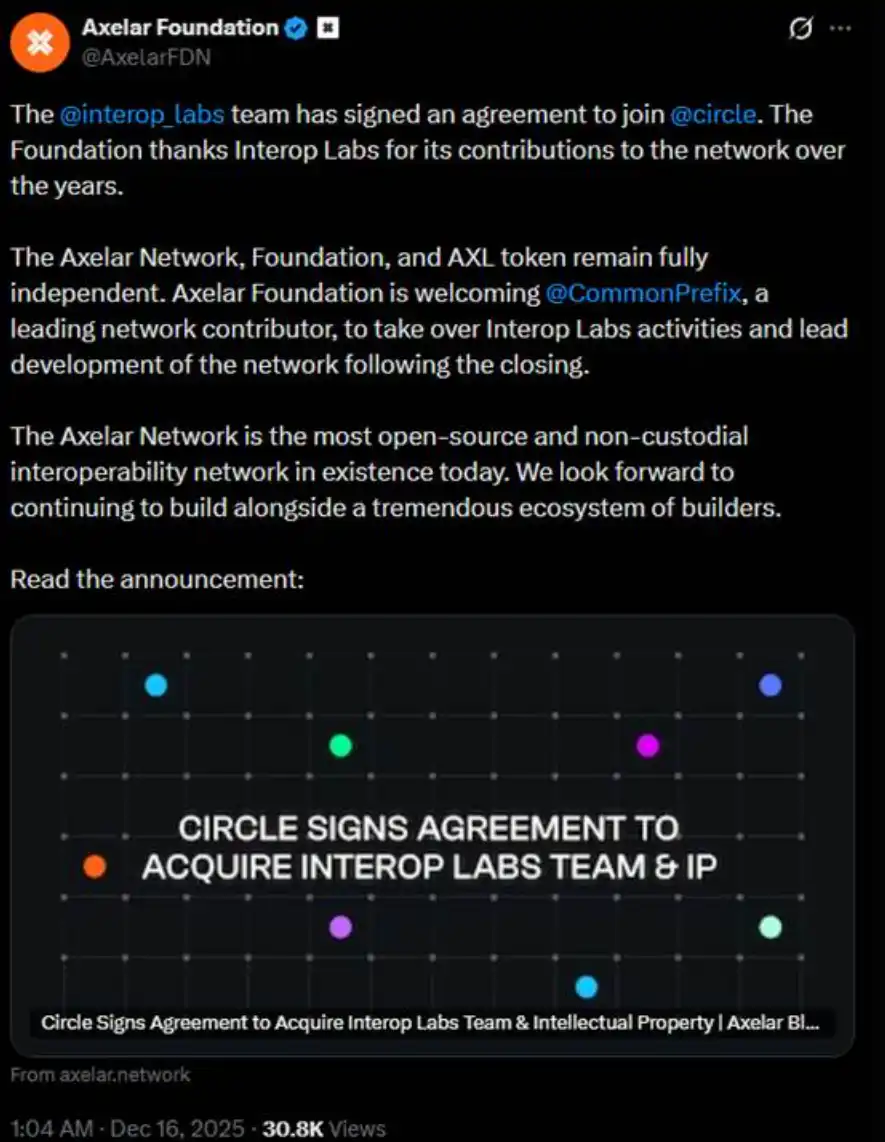
In other words, the core of this transaction is the "team merging into Circle" to promote the application of USDC in the fields of privacy computing and compliant payments, rather than a comprehensive acquisition of the Axelar network or its token system. The team and technology, Circle is taking. The original project, Circle is not managing.

After the acquisition news was announced, the price of Axelar token $AXL first rose slightly and then began to fall, currently down about 15%.
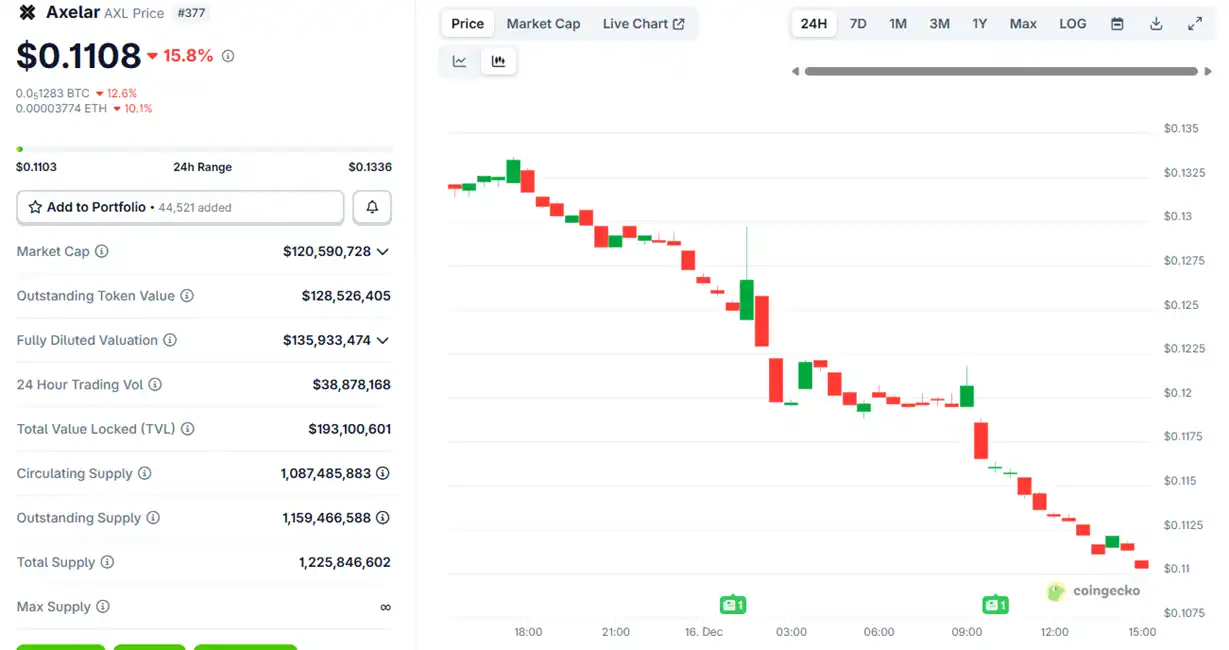
This arrangement quickly sparked intense discussions in the community about "token vs equity." Multiple investors questioned that Circle essentially acquired the core assets through the acquisition of the team and intellectual property, but bypassed the rights of AXL token holders.
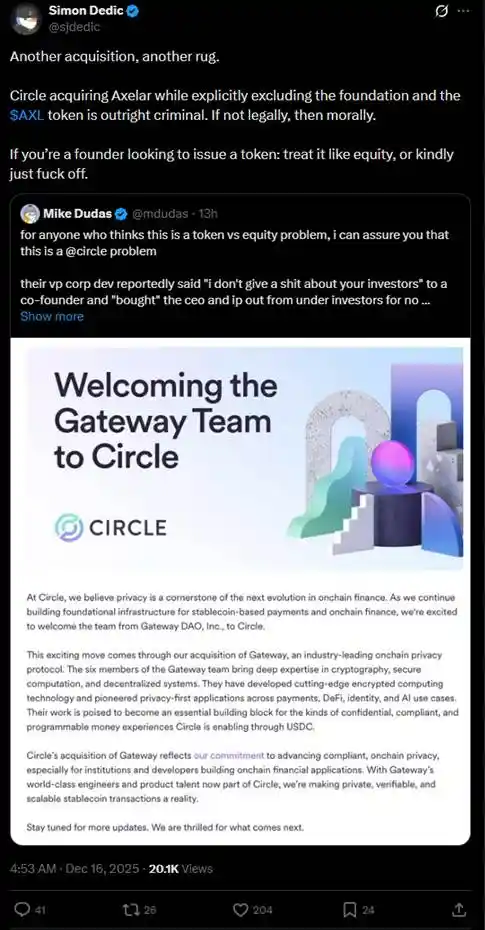
Over the past year, similar cases of "acquiring the team and technology, but not the token" have occurred repeatedly in the crypto space, causing serious harm to retail investors.

In July, Ink, the Layer 2 network under Kraken, acquired the decentralized trading platform Vertex Protocol based on Arbitrum, taking over its engineering team and trading technology architecture, including the synchronous order book, perpetual contract engine, and money market code. After the acquisition, Vertex shut down its services on 9 EVM chains, and the token $VRTX was abandoned. After the news was announced, $VRTX fell more than 75% that day and gradually "went to zero" (current market cap is only $73,000).
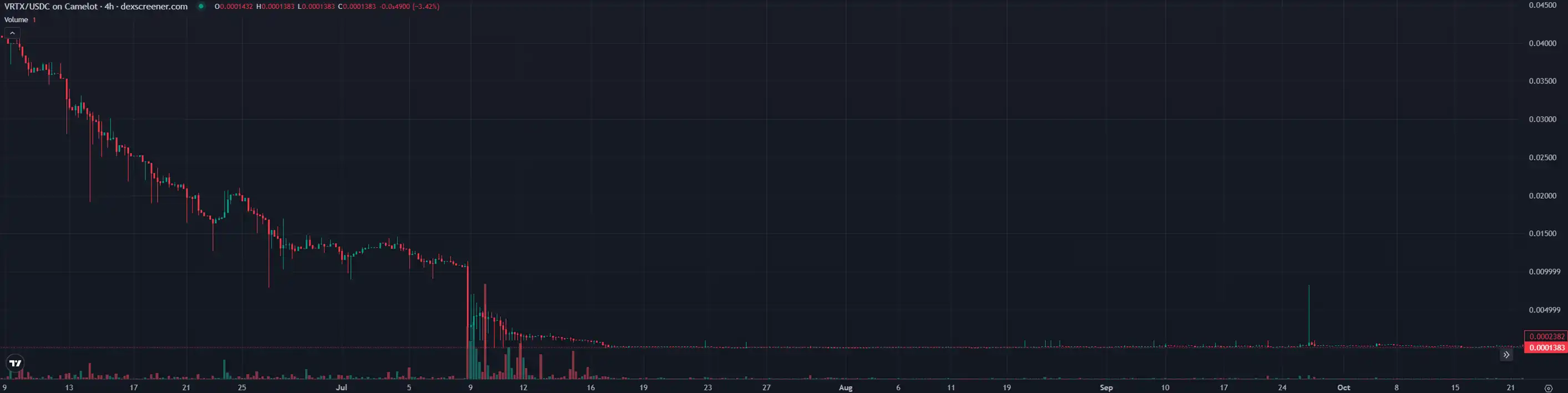
However, $VRTX holders at least had a tiny bit of comfort because they would receive a 1% airdrop during the TGE of Ink (snapshot has ended). Next, there are even worse cases, where the token is directly invalidated without any compensation.

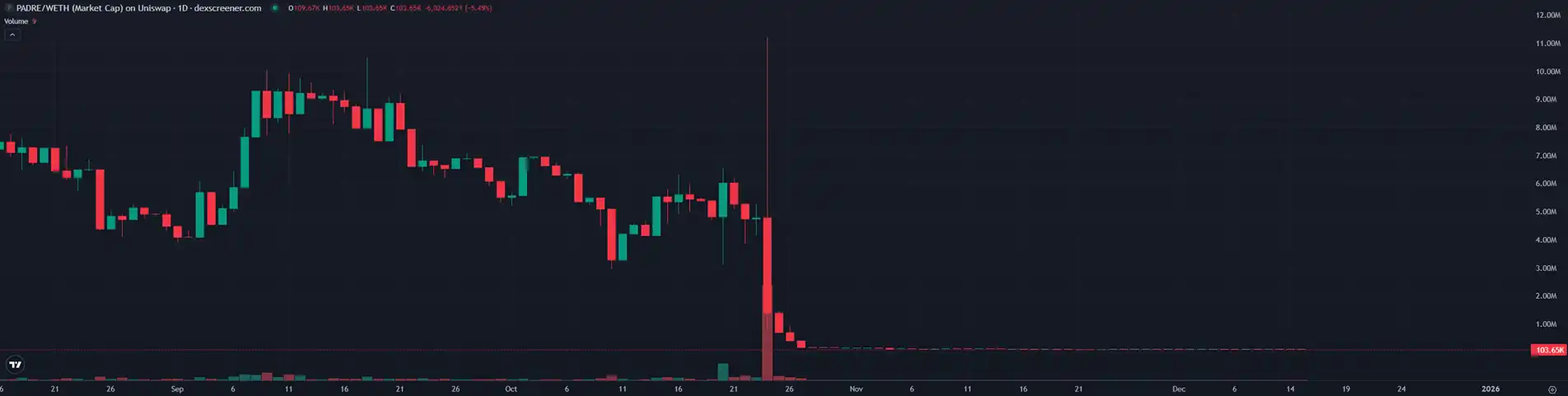
In October, pump.fun announced the acquisition of the trading terminal Padre. When the acquisition of Padre was announced, pump.fun also stated that the Padre token would no longer be used on its platform and directly indicated that there were no future plans for the token. Since the declaration of the token's invalidation was in the last reply of the thread, the token doubled instantly and then plummeted sharply. Currently, $PADRE has a market cap of only $100,000.
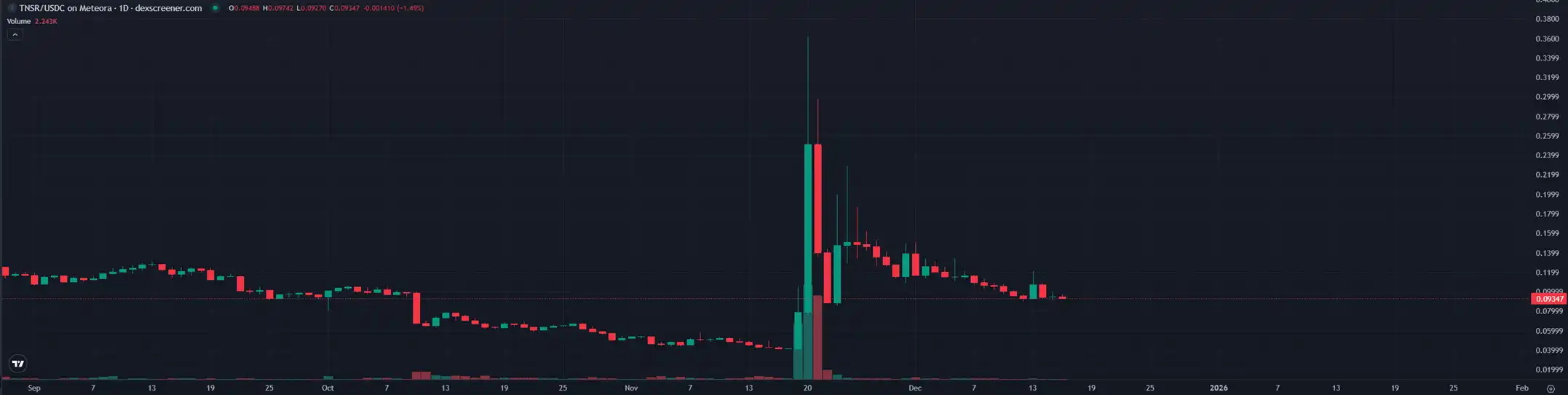
In November, Coinbase announced the acquisition of the Solana trading terminal Vector.fun built by Tensor Labs. Coinbase integrated Vector's technology into its DEX infrastructure, but did not involve the Tensor NFT market itself or the equity of $TNSR. Part of the Tensor Labs team moved to Coinbase or other projects.

The price movement of $TNSR was relatively stable among the examples, rising sharply and then falling back. The current price has returned to a level appropriate for an NFT market token and is still higher than the low before the acquisition news.
In Web2, it is legal for large companies to acquire small companies by "taking the team and intellectual property, but not the equity." This situation is called an "acquihire." Especially in the tech industry, "acquihire" allows large companies to quickly integrate excellent teams and technologies, avoiding the lengthy process of hiring from scratch or internal development, thereby accelerating product development, entering new markets, or enhancing competitiveness. Although it is unfavorable to small shareholders, it stimulates overall economic growth and technological innovation.

Nevertheless, "acquihire" must also satisfy the principle of "acting in the best interests of the company." The reason these examples in the crypto space have made the community so angry is precisely because the "small shareholders," as token holders, completely disagree that the project parties in the crypto space are "acting in the best interests of the company" for the better development of the project through acquisition. Project parties often dream of listing on the US stock market when the project itself can make big money, and then issue tokens to make money when everything is just starting or declining (the most typical example is OpenSea). After these project parties make money from the tokens, they turn around to find their next opportunity, leaving the past projects only in their resumes.

So, can retail investors in the crypto space only swallow their broken teeth? It was also the day before yesterday that Ernesto, former CTO of Aave Labs, published a governance proposal titled "$AAVE Alignment Phase 1: Ownership," firing a shot to defend token rights in the crypto space.

The proposal advocates that Aave DAO and Aave token holders clearly control core rights such as protocol IP, brand, equity, and revenue. Aave service provider representatives such as Marc Zeller publicly endorsed the proposal, calling it "one of the most influential proposals in Aave governance history."

Ernesto mentioned in the proposal, "Due to some past events, there is strong hostility towards Aave Labs in previous posts and comments, but this proposal strives to remain neutral. This proposal does not imply that Aave Labs should not be a contributor to the DAO or lacks the legitimacy or ability to contribute, but the decision should be made by Aave DAO."

According to the interpretation by crypto KOL @cmdefi, the cause of this conflict lies in Aave Labs replacing the front-end integrated ParaSwap with CoW Swap, after which the generated fees flowed to Aave Labs' private address. Accordingly, Aave DAO supporters believe this is a form of plunder because, with the existence of the AAVE governance token, all benefits should优先 flow to AAVE holders or remain in the treasury for DAO voting decisions. Additionally, previously, ParaSwap's revenue would continuously flow into the DAO. The new CoW Swap integration changed this status, further leading the DAO to believe this was a plunder.

This very directly reflects a contradiction similar to that between "shareholders and management," and again highlights the awkward positioning of token rights in the crypto industry. In the early days of the industry, many projects promoted the "value capture" of tokens (such as obtaining rewards through staking or directly sharing profits). But since 2020, SEC enforcement actions (such as lawsuits against Ripple and Telegram) have forced the industry to shift towards "utility tokens" or "governance tokens," which emphasize usage rights rather than economic rights. As a result, token holders often cannot directly share project dividends—project revenue may flow to equity held by the team or VCs, while token holders are like small shareholders contributing for free.

As in the examples mentioned in this article, project parties often sell teams, technological resources, or equity to VCs or large companies, while also selling tokens to retail investors. The final result is that resource and equity holders profit first, while token holders are marginalized or even get nothing. Because tokens do not have legally defined investor rights.

To avoid the regulation that "tokens cannot be securities," tokens are designed to be increasingly "useless." Because regulation is avoided, retail investors are placed in a very passive and unprotected position. The various cases that have occurred this year have, in a sense, reminded us that the current problem of "narrative failure" in the crypto space may not be that people no longer believe in narratives—narratives are still good, profits are still good, but when we buy tokens, what exactly can we expect?


Related Questions

QWhat is the main reason behind the recent trend of acquiring crypto projects without their tokens, as discussed in the article?

AThe main reason is to avoid regulatory risks, as tokens are often designed to be 'utility' or 'governance' tokens to circumvent securities regulations, leaving token holders with no legal investor rights. Acquirers focus on teams and intellectual property to integrate technology without assuming obligations to token holders.

QHow did the community react to Circle's acquisition of Interop Labs, and why?

AThe community reacted with outrage because Circle acquired only the team and intellectual property of Axelar Network, leaving the AXL token and its holders independent and excluded from the benefits of the acquisition, causing the token's price to drop significantly.

QWhat is an 'acquihire' in the context of Web2, and how does it relate to the crypto acquisitions mentioned?

AAn 'acquihire' in Web2 refers to an acquisition where a larger company buys a smaller one primarily for its team and technology intellectual property, rather than its equity or business operations. This relates to crypto acquisitions as it mirrors the pattern where acquirers take teams and IP but discard the tokens, harming散户 investors.

QWhat problem did Ernesto's proposal for $AAVE aim to address, according to the article?

AErnesto's proposal aimed to address the misalignment of interests by advocating for Aave DAO and token holders to explicitly control core assets like IP, brand, equity, and revenue, ensuring that benefits flow to token holders rather than being diverted to private entities like project teams or VCs.

QWhy are token holders in crypto projects often left with limited protection or benefits during acquisitions?

AToken holders have limited protection because tokens are deliberately designed without legal investor rights to avoid being classified as securities under regulations like those enforced by the SEC. This allows project teams and equity holders to prioritize their own interests during acquisitions, marginalizing token holders.

Related Reads

Blockchain Capital Partner: Most People Have a Narrow Understanding of the On-Chain Economy

Author Spencer Bogart, a partner at Blockchain Capital, argues that most people have a narrow view of the on-chain economy, seeing it primarily as a faster, cheaper version of existing financial systems. While this represents a significant opportunity, he believes it's only a small part of the story. Bogart compares the current state of crypto to the early internet, where email was the obvious "faster mail" application. The truly transformative categories—like search, social media, and cloud computing—were entirely new and unimaginable beforehand. Similarly, the most profound innovations in crypto will not be incremental improvements but entirely new categories enabled by the core properties of public blockchains: atomic execution, shared global state, programmable custody, and composability. He cites the "flash loan" as a prime example of a "new verb"—a financial action structurally impossible before programmable assets and atomic settlement. It allows for uncollateralized, trustless borrowing of any size, provided repayment occurs within the same transaction, enabling novel strategies like arbitrage and collateral swaps. Bogart admits the difficulty in precisely predicting these future innovations, as human imagination tends to extrapolate from the past. He posits that the most exciting applications in ten years will be things that don't exist today and have no precedent—products only possible in a global, composable, always-on environment with programmable assets. While the exploration of this vast design space will involve many failures, the potential for transformative, category-defining breakthroughs is what makes the next decade so promising.

链捕手22m ago

Blockchain Capital Partner: Most People Have a Narrow Understanding of the On-Chain Economy

链捕手22m ago

Cloud PC Gets a Second Chance, Google/Alibaba/Microsoft Battle for Cloud AI Dominance

Google unexpectedly announced "Android Computer," a new high-end productivity-focused PC series, positioning cloud AI as its core rather than an add-on. This move signals a potential revival for the "cloud computer" concept in the AI era. The article argues that current "AI PCs" are essentially traditional Windows machines with AI features grafted on, heavily reliant on cloud AI for complex tasks due to limited local consumer-grade hardware capabilities. This reliance raises questions about the value of premium local AI hardware. Cloud computers, which struggled with latency-sensitive applications like cloud gaming, are seen as a natural fit for AI PCs due to AI's higher tolerance for response time. Google's Android Computer deeply integrates AI (powered by its Gemini model) into the OS interface, making it contextually available. Its hardware-agnostic approach (supporting both x86 and ARM chips) further underscores the shift towards cloud-centric AI. Other players are adapting: Cloud service providers like Alibaba are enhancing their AI cloud computer offerings; chipmakers (Intel, AMD) are focusing on data center AI chips; traditional PC brands are adding AI software layers; and Apple is leveraging its ecosystem and affordable hardware. Microsoft is defining AI PC standards, embedding Copilot (powered by GPT and Bing) into Windows, and also relying on cloud AI. In conclusion, Android Computer challenges the traditional PC form factor by proposing a "light local, heavy cloud" model. This approach appears promising amid rising hardware costs and local compute bottlenecks. The future PC market will involve a multifaceted competition around cloud integration, OS-level AI, and cross-device ecosystems, potentially redefining the PC as a screen and network conduit to cloud-based AI productivity.

marsbit43m ago

Cloud PC Gets a Second Chance, Google/Alibaba/Microsoft Battle for Cloud AI Dominance

marsbit43m ago

Encrypted ETF Weekly Report | Last Week, US Bitcoin Spot ETF Net Outflow $9.95 Billion; US Ethereum Spot ETF Net Outflow $255 Million

Last week, U.S. Bitcoin spot ETFs saw significant net outflows totaling $995 million over three days, with a major contribution of $317 million from BlackRock's IBIT. Their total net asset value (NAV) stands at $104.2 billion. U.S. Ethereum spot ETFs also experienced net outflows of $255 million over five days, largely from BlackRock's ETHA ($186 million out), bringing their total NAV to $12.93 billion. In Hong Kong, Bitcoin spot ETFs recorded a net outflow of 24.91 BTC, reducing their NAV to $323 million. Hong Kong's Ethereum spot ETFs saw no inflows, with an NAV of $68.13 million. U.S. Bitcoin spot ETF options showed increased activity, with a total nominal trading volume of $797 million and a put/call trading ratio of 1.63, indicating a bullish market sentiment. The total open interest reached $23.08 billion. Key developments include VanEck and Grayscale simultaneously filing amended proposals for BNB ETFs, signaling potential SEC review progress. Grayscale also filed for the first U.S. privacy coin ETF (Zcash). Avenir Group remains Asia's largest institutional holder of Bitcoin ETFs. 21Shares launched an actively managed crypto ETF (TKNS), and Bitwise's Hyperliquid ETF (BHYP) is set to list on the NYSE. Institutional activity varied: JPMorgan dramatically increased its Bitcoin ETF holdings (IBIT up 174%), while Jane Street significantly reduced its exposure (IBIT down 71%). Dartmouth College disclosed holdings of $7.7M in Bitcoin ETF and $3.4M in a Solana ETF.

链捕手47m ago

Encrypted ETF Weekly Report | Last Week, US Bitcoin Spot ETF Net Outflow $9.95 Billion; US Ethereum Spot ETF Net Outflow $255 Million

链捕手47m ago

Trading

Spot
Futures
活动图片