Encrypted ETF Weekly Report | Last Week, US Bitcoin Spot ETF Net Outflow $9.95 Billion; US Ethereum Spot ETF Net Outflow $255 Million

链捕手Published on 2026-05-18Last updated on 2026-05-18

Abstract

Last week, U.S. Bitcoin spot ETFs saw significant net outflows totaling $995 million over three days, with a major contribution of $317 million from BlackRock's IBIT. Their total net asset value (NAV) stands at $104.2 billion. U.S. Ethereum spot ETFs also experienced net outflows of $255 million over five days, largely from BlackRock's ETHA ($186 million out), bringing their total NAV to $12.93 billion. In Hong Kong, Bitcoin spot ETFs recorded a net outflow of 24.91 BTC, reducing their NAV to $323 million. Hong Kong's Ethereum spot ETFs saw no inflows, with an NAV of $68.13 million. U.S. Bitcoin spot ETF options showed increased activity, with a total nominal trading volume of $797 million and a put/call trading ratio of 1.63, indicating a bullish market sentiment. The total open interest reached $23.08 billion. Key developments include VanEck and Grayscale simultaneously filing amended proposals for BNB ETFs, signaling potential SEC review progress. Grayscale also filed for the first U.S. privacy coin ETF (Zcash). Avenir Group remains Asia's largest institutional holder of Bitcoin ETFs. 21Shares launched an actively managed crypto ETF (TKNS), and Bitwise's Hyperliquid ETF (BHYP) is set to list on the NYSE. Institutional activity varied: JPMorgan dramatically increased its Bitcoin ETF holdings (IBIT up 174%), while Jane Street significantly reduced its exposure (IBIT down 71%). Dartmouth College disclosed holdings of $7.7M in Bitcoin ETF and $3.4M in a Solana ETF.

Compiled by: Jerry, ChainCatcher

Last Week's Performance of Cryptocurrency Spot ETFs

US Bitcoin Spot ETF Net Outflow of $9.95 Billion

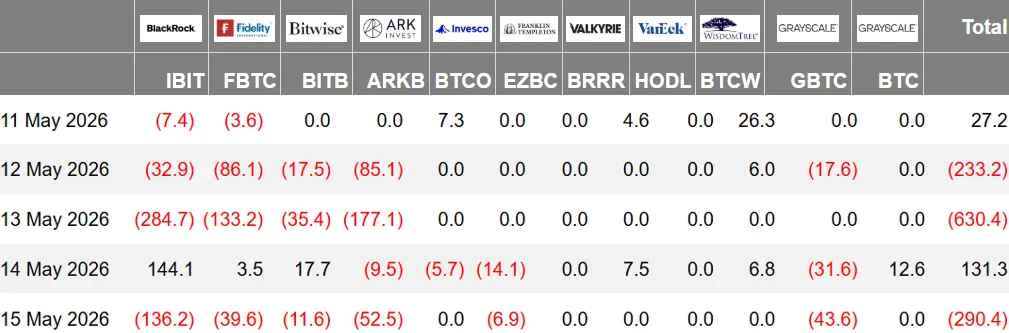
Last week, US Bitcoin Spot ETFs experienced net outflows for three days, with a total net outflow of 9.95 billion dollars, and total assets under management (AUM) reached $104.29 billion.

Six ETFs were in a net outflow state last week, with the main outflow coming from BlackRock's IBIT, which saw a net outflow of $317 million.
Data Source: Farside Investors

US Ethereum Spot ETF Net Outflow of $255 Million

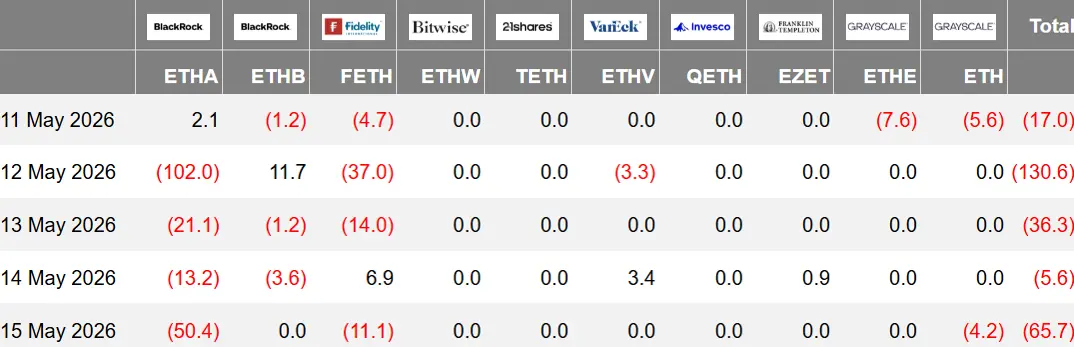
Last week, US Ethereum Spot ETFs experienced net outflows for five days, with a total net outflow of 2.55 billion dollars, and total AUM reached $12.93 billion.

The main outflow last week came from BlackRock's ETHA, with a net outflow of $186 million. Four Ethereum spot ETFs were in a net outflow state.
Data Source: Farside Investors

Hong Kong Bitcoin Spot ETF Net Outflow of 24.91 Bitcoins

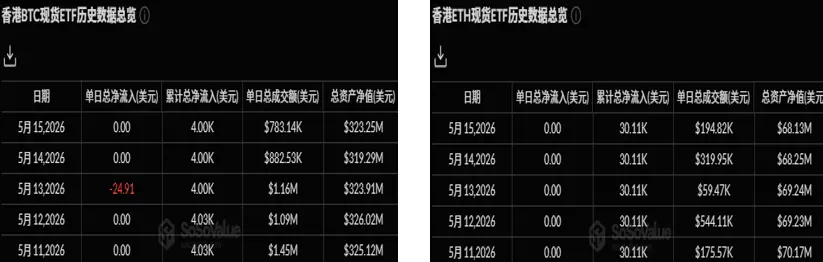
Last week, Hong Kong Bitcoin Spot ETFs had a net outflow of 24.91 Bitcoins, with an AUM of $323 million. Among them, issuer Harvest Bitcoin's holdings dropped to 210.92 coins, and ChinaAMC's holdings dropped to 2,570 coins.

Hong Kong Ethereum Spot ETFs had no fund inflows, with an AUM of $68.13 million.
Data Source: SoSoValue

Performance of Cryptocurrency Spot ETF Options

As of May 14, the total notional trading volume for US Bitcoin Spot ETF options was $797 million, with a notional total long/short trading ratio of 1.63.

As of May 14, the total notional open interest for US Bitcoin Spot ETF options reached $23.08 billion, with a notional total long/short ratio of 1.45.

Market trading activity for Bitcoin Spot ETF options has increased in the short term, with overall sentiment leaning bullish.

Additionally, the implied volatility stands at 41.82%.

Data Source: SoSoValue

Overview of Last Week's Cryptocurrency ETF Dynamics

VanEck and Grayscale File BNB ETF Amendments on Same Day

According to The Block, VanEck submitted the fifth amendment to its BNB ETF registration statement to the US Securities and Exchange Commission on Friday (May 15), while Grayscale also submitted the second amendment to its Grayscale BNB ETF prospectus on the same day.

Bloomberg ETF analyst James Seyffart stated that the synchronized actions suggest both issuers are responding to feedback from the US SEC and may be planning a launch in the near future. James Seyffart speculates that BNB might be the next crypto asset to pass SEC scrutiny and have the potential to list in the US.

Meanwhile, Canary Capital separately filed an amendment to its proposal for a staked TRX ETF, which would bundle Tron's staking rewards into a regulated framework.

Grayscale Submits Revised BNB ETF S-1 Again, Possibly Paving Way for US Spot ETF Advancement

Bloomberg ETF analyst James Seyffart stated on platform X that Grayscale has submitted the second revised version of its S-1 filing for its BNB ETF to the US Securities and Exchange Commission (SEC).

He said this revision is likely based on adjustments in response to SEC feedback, suggesting the product may be accelerating its launch process.

Avenir Group Maintains Position as Asia's Largest Institutional Holder of Bitcoin ETF, Ranking First in Region for Eight Consecutive Quarters

The latest disclosed SEC filings show that as of March 31, 2026, Avenir Group holds 18,276,100 shares of BlackRock's iShares Bitcoin Trust (IBIT). Based on the quarter-end closing price, the position value is approximately $702 million, a slight decrease of about 0.061% compared to Q4 2025. Avenir Group has maintained its position as Asia's largest institutional holder of Bitcoin ETFs for eight consecutive quarters since Q2 2024.

Since 2026, Avenir Group has been advancing the integration of TradFi and Crypto, including strategic investments in CoinRoutes, leading a $20 million seed round for Inference Research, and signing an MOU for cooperation with Tiger Brokers, AMINA Bank, and CoinRoutes during Consensus Hong Kong 2026 to promote next-generation institutional-grade trading infrastructure development.

Data: US Dartmouth College Discloses Holding $7.7 Million in Bitcoin ETF and $3.4 Million in SOL ETF

According to MacroScope monitoring, in its submitted 13F filing, US Dartmouth College disclosed that as of March 31, it holds approximately 201,531 shares of BlackRock's Bitcoin ETF "IBIT," valued at $7.7 million, with no change in holdings from the previous quarter.

The college also reported a new position: holdings of Bitwise Solana Staking ETF valued at $3.4 million (304,803 units).

21Shares Announces Launch of Actively Managed Crypto ETF TKNS

According to an official announcement, 21Shares has announced the launch of an actively managed crypto ETF, ticker TKNS. The fund is managed by a professional team, aiming to capture market opportunities and outperform passive index funds. Portfolio managers will adjust holdings based on market conditions to balance long-term goals with short-term opportunities. The fund operates like a standard stock ETF, with simplified tax reporting, and is currently tradable on select brokerage platforms.

Bitwise Hyperliquid ETF to List on New York Stock Exchange This Friday

The Bitwise Hyperliquid ETF will begin trading on the New York Stock Exchange this Friday under the ticker BHYP. Previously, 21Shares' Hyperliquid ETF (THYP) launched this Tuesday, with a first-day trading volume of approximately $1.8 million. BHYP will be the first US fund to offer Hyperliquid staking rewards, with related staking operations to be conducted through Bitwise's subsidiary, Bitwise Onchain Solutions. 21Shares also stated it plans to stake the majority of its HYPE holdings. Hyperliquid is currently a leading on-chain perpetual contract exchange, gradually expanding into tokenized commodities and spot crypto trading. Its native token HYPE is used for platform fee payments and is consistently among the top 15 crypto assets by trading volume.

JPMorgan Chase Significantly Increased Bitcoin ETF Holdings in Q1, IBIT Position Surges 174%

According to a Cointelegraph report, 13F filings show that JPMorgan Chase significantly increased its Bitcoin ETF holdings in the first quarter. Its holdings in BlackRock iShares Bitcoin Trust (IBIT) grew from approximately 3 million shares to 8.3 million shares, an increase of 174%.

Additionally, JPMorgan Chase also significantly increased holdings of other Bitcoin spot ETFs like Fidelity's FBTC and Bitwise's BITB, and slightly increased its holdings of MicroStrategy (MSTR).

Regarding altcoin ETFs, JPMorgan Chase's actions varied: it initiated a position in Bitwise Solana Staking ETF (BSOL), increased holdings of Ethereum-related ETFs, while completely exiting its position in an XRP ETF.

Jane Street Q1 Significantly Reduced Bitcoin ETF Exposure, IBIT Holdings Down 71% QoQ

The latest 13F filing submitted by quantitative giant Jane Street to the US SEC discloses a significant reduction in its Bitcoin ETF exposure for Q1 2026. Its holdings of IBIT decreased approximately 71% quarter-over-quarter to 5,872,212 shares, valued at approximately $225.6 million. Its holdings of FBTC decreased approximately 60% to 1,954,174 shares, valued at approximately $115 million.

Additionally, its holdings of MSTR also decreased approximately 78% quarter-over-quarter to 209,833 shares, valued at approximately $26.18 million.

Grayscale Files First Privacy Coin Spot ETF Application, Multicoin Capital Discloses It Has Accumulated ZEC

Grayscale has filed an application for a Zcash spot ETF, seeking to convert its existing Zcash trust into a spot product, becoming the first privacy coin ETF seeking to list in the US. Concurrently, Multicoin Capital disclosed it has been accumulating ZEC since February, with co-founder Tushar Jain linking the investment thesis to proposed US wealth tax legislation, suggesting that government expansion of surveillance over private financial holdings will drive structural demand for assets shielded from regulatory scrutiny at a mathematical level.

However, this application also raises institutional custody challenges: approximately 30% of Zcash's supply is in shielded address pools, a historical high, but ETF custody would almost certainly need to use transparent address pools to meet audit and balance proof requirements. Previously, the SEC ended its long-term review of Zcash in January 2026 without enforcement action, significantly reducing regulatory uncertainty.


Related Questions

QWhat was the net outflow for U.S. Bitcoin spot ETFs last week, and which fund was the largest contributor?

ALast week, U.S. Bitcoin spot ETFs had a net outflow of $995 million. The primary contributor to this outflow was BlackRock's IBIT, with a net outflow of $317 million.

QHow did the U.S. Ethereum spot ETFs perform in terms of net flow last week?

AU.S. Ethereum spot ETFs experienced a net outflow of $255 million over five days last week, with the total assets under management reaching $12.93 billion.

QWhat significant ETF filing news was reported involving VanEck and Grayscale?

AVanEck and Grayscale both submitted amended filings for their respective BNB ETF proposals on the same day (May 15). Analysts believe this synchronized action indicates both issuers are responding to SEC feedback and potentially preparing for a near-term launch.

QWhich institution maintains the title of Asia's largest Bitcoin ETF institutional holder, and for how long?

AAvenir Group maintains the title of Asia's largest Bitcoin ETF institutional holder. As of March 31, 2026, it held over 18.2 million shares of BlackRock's IBIT, a position it has held for eight consecutive quarters since Q2 2024.

QWhat is the significance of the new ETF application filed by Grayscale mentioned in the article?

AGrayscale filed an application to convert its existing Zcash Trust into a spot ETF, marking the first application for a privacy-focused cryptocurrency ETF in the United States.

Related Reads

Collateral Dollars: How Does a 'Second-Layer Dollar' Above Stablecoins Form?

Collateral Dollars: How Does a "Second Layer of Dollars" Form on Top of Stablecoins? Most assume stablecoins replicate Eurodollar functions, expanding the offshore dollar system. However, stablecoins primarily replace specific functions like operational dollar balances for settlement. They do not inherently create new dollar credit; they substitute existing claims. The key question is: what happens when financial intermediaries use stablecoins as collateral to create a new layer of dollar-denominated claims? This "collateral dollar" channel operates through secured lending, not direct money creation. A money-like event only occurs when a liability issued against the controlled stablecoin is funded, rolled over, or accepted at near-par value by another balance sheet. The discount (haircut) prices the gap between "effective control over the token" and "reliable convertibility to bank dollars." Elasticity stems not from the stablecoin itself but from the liability issued against it and the willingness of third-party balance sheets to treat that liability as a near-par asset. Compared to the traditional Eurodollar system—where elasticity originates from bank deposit creation—the stablecoin collateral chain is structurally different. Eurodollar deposits are credit-expansive from inception. Stablecoins are initially substitutive; elasticity emerges later if an intermediary's liability against them gains monetary acceptance. Stablecoins disrupt specific tiers of the offshore dollar system, mainly replacing operational settlement balances. They do not replace the need for full dollar balance-sheet capacity (credit lines, hedging, maturity transformation). For systemic impact, the second-layer liability must pass three tests: transferability, funding capacity, and monetary acceptance (being fundable or held at par by others). Pressure transmission also differs. In the Eurodollar system, stress moves up a hierarchy of claims. In a stablecoin collateral chain, the second-layer liability can lose its money-like status well before the underlying stablecoin faces a run, often triggered by haircut increases and margin calls that create a dynamic spiral of falling token prices and rising discounts. In conclusion, the "collateral dollar" is not the stablecoin itself. It is the second-layer liability issued against a controlled token balance that is willing to be funded and maintained at near-par value. Its existence depends on that liability surviving the leap from "token liquidity" to "bank dollar liquidity."

marsbit7m ago

Collateral Dollars: How Does a 'Second-Layer Dollar' Above Stablecoins Form?

marsbit7m ago

Collateral Dollars: How the 'Second-Layer Dollar' Above Stablecoins Takes Shape?

"Collateralized Dollars: How a 'Second Layer of Dollars' Forms on Top of Stablecoins" Most assume stablecoins replicate Eurodollars and expand the offshore dollar system, but this is not accurate. Stablecoins primarily replace certain functions within the existing system, especially operational dollar balances for daily settlement. The critical question is what happens when financial intermediaries create a new layer of dollar claims *on top of* stablecoins. This article explains how this new collateralized funding channel works. Stablecoins introduce tokenized private dollar claims. Even if issuers and reserves are within the US legal perimeter, their circulation and use as collateral can become economically "offshore." Enforceable control over collateral opens a secured credit channel but does not itself create a monetary claim. A true monetary event occurs only when another balance sheet funds, rolls over, or accepts a liability issued against the controlled token at near-par value. The discount prices the gap between "effective control over the token" and "reliable convertibility into bank dollars." Elasticity comes from the balance sheet issuing the liability against the token and from third-party willingness to treat that liability as a near-par asset. Collateralized Dollars are not the stablecoins themselves; they are the second-layer liability that another balance sheet is willing to issue, fund, and maintain at near-par against a controlled token balance. The Eurodollar system is a hierarchy of claims, with elasticity originating in expandable bank liabilities. In contrast, the stablecoin collateral chain starts with a tokenized asset. It gains systemic significance only when an intermediary's liability against that token is treated as money-like by other balance sheets. Key determining factors include: who has effective control, the legal/operational path to bank dollars, and whether the resulting claim can still be financed near-par under stress. Pressure in this new channel manifests differently. The upper-layer (intermediary) claim fails first, losing its money-like status, potentially while the underlying stablecoin remains solvent. Increased haircuts and forced sales can create a destructive feedback loop, widening the very gap the discount measures. In conclusion, the Eurodollar analogy has limits. Reserve quality supports the underlying token's solvency, but the leverage, credit, and liabilities built atop it face a separate test. Collateral eligibility is not monetary acceptance. Only when a claim built on stablecoins survives the leap from "token liquidity" to "bank dollar liquidity" do Collateralized Dollars truly exist.

链捕手13m ago

Collateral Dollars: How the 'Second-Layer Dollar' Above Stablecoins Takes Shape?

链捕手13m ago

Don't Be Misled by the $1.25 Billion Cap: MicroStrategy's Three-Pronged Bitcoin Sale Pools Hide Massive Selling Pressure

Don't Be Misled by the $1.25B Cap: Strategy's Three-Tier Bitcoin Sales Plan Hides Massive Potential Selling Pressure Strategy recently sold 3,588 BTC (~$216M) to fund a dividend and replenish its dollar reserve, while claiming its $1.25B "reserve build" capacity remains fully available. This highlights a key nuance: the widely cited $1.25B limit applies only to sales for "Building" the reserve. Strategy's broader capital framework, however, allows Bitcoin sales for three primary purposes, each with different scales: 1. **Building the Reserve:** Selling BTC to raise up to $1.25B for the reserve. 2. **Covering Priority Share Expenses:** Selling BTC to pay dividends/interest or to replenish the reserve after such payments are made from it (no specified limit). 3. **Share Repurchase Funding:** Selling BTC to fund up to $1B each in convertible note and common stock repurchases (totaling $2B potential). Combined, just the capped "Build" and "Repurchase" channels could facilitate over $3B in Bitcoin sales, excluding the uncapped "Cover Expenses" channel. The accounting distinction between "Building" (adding cash before a payout) and "Replenishing" (adding cash after a payout) is operationally blurry but allows sales like the recent $216M transaction without touching the $1.25B "Build" quota. This gives Strategy significant flexibility. The move signifies a strategic shift: Strategy is transforming from a simple Bitcoin accumulator into an active capital manager, akin to a hedge fund. Bitcoin is now a financial lever to balance pressures between common stock, convertible notes, dollar reserves, and Bitcoin holdings. This creates inherent tensions—actions benefiting one part of the capital structure may harm another. Investors must understand that the potential Bitcoin sales are far greater than the surface-level $1.25B figure. Strategy has become a complex financial entity where every term in its disclosures matters. Betting on it now is a wager on its active capital management skill to navigate these internal contradictions without a systemic failure.

Foresight News20m ago

Don't Be Misled by the $1.25 Billion Cap: MicroStrategy's Three-Pronged Bitcoin Sale Pools Hide Massive Selling Pressure

Foresight News20m ago

When the Largest BTC Buyer Becomes a Seller, Who's Buying After MicroStrategy Sells 3,588 Bitcoin?

MicroStrategy, once the largest corporate buyer of Bitcoin, sold 3,588 BTC for approximately $216 million to fund its preferred stock dividends, marking a significant shift from buyer to seller. This move occurred after its market-to-NAV premium vanished, breaking its "print stock to buy Bitcoin" financial model. A roundtable discussion featuring Austin Campbell, Ram Ahluwalia, and Chris Perkins analyzed the implications. They noted that MicroStrategy's dominance has become a narrative bottleneck for the broader crypto market, with some speculating that Bitcoin's price might only surge significantly after the company's influence wanes. The conversation expanded to examine the capital structure conflict between traditional equity and crypto tokens, arguing that most current tokens will fail as they don't fit neatly into existing debt/equity frameworks. A "stablecoin war" was identified as a major trend, with entities like Tether, Robinhood, and the OUSD alliance competing. Tether's decision to abandon the European MiCA market highlights strategic divergences. The panelists argued that bank-issued stablecoins could revolutionize global finance by allowing US banks to capture net interest margins from international transactions, potentially making JPMorgan the first trillion-dollar bank. They concluded that while capital is currently being siphoned by AI/semiconductors, markets will eventually refocus on fundamentals and cash flow, which could benefit cryptocurrencies with real utility.

marsbit27m ago

When the Largest BTC Buyer Becomes a Seller, Who's Buying After MicroStrategy Sells 3,588 Bitcoin?

marsbit27m ago

Bitcoin’s path to $80K may hinge on THIS hidden trend

Bitcoin's potential path toward $80,000 is influenced by conflicting market signals. Data shows the Coinbase Bitcoin Premium Index has recorded its longest-ever streak of consecutive negative premiums, indicating muted institutional demand or net selling from U.S. institutions. While such a trend often signals short-term weakness, it doesn't necessarily forecast a long-term bear market. Additionally, a bearish crossover occurred in Bitcoin's Net Unrealized Profit/Loss (NUPL), with its short-term average falling below the longer-term average, suggesting declining investor profitability and waning market momentum. Historically, major bear market bottoms saw the 100-day NUPL drop below zero, but this cycle it remains positive, implying either an unprecedented bottom or a further decline is needed. Currently trading around $63,148, Bitcoin has seen weekly gains but remains below its May peak. Technical indicators present a mixed picture: the MACD shows bullish momentum, while the RSI signals bearish pressure. A positive development is the return of inflows to Bitcoin ETFs after eight weeks of outflows. Analysts hold divergent views; some highlight a key liquidity zone between $48,000-$50,000 where a market bottom could form, while others maintain a more optimistic long-term outlook. Ultimately, while some bullish signs exist, a strong push from institutional investors appears crucial for Bitcoin to challenge the $80,000 level.

ambcrypto1h ago

Bitcoin’s path to $80K may hinge on THIS hidden trend

ambcrypto1h ago

Trading

Spot
活动图片