Why Are Crypto Cards Struggling to Replace Visa?

marsbitPublished on 2026-08-13Last updated on 2026-08-13

Abstract

Encrypted bank cards struggle to replace Visa due to fundamental differences in payment economics. Analysis reveals Visa’s fee is only about 7-9% of the total merchant discount rate (MDR), with the largest share (70-80%) going to issuing banks as interchange fees. Most crypto debit cards, operating on prepaid stablecoins like USDC, lack the credit-based revenue model of traditional reward credit cards. This results in significantly lower interchange income. Even with higher exempt rates for small banks, the total fee pool for a $100 stablecoin debit transaction is only about $0.62, leaving minimal room for profit sharing after covering network, processor, and bank costs. Stablecoins primarily innovate in the back-end settlement layer, enabling near real-time T+0 settlements on networks like Visa and Mastercard instead of the traditional T+2 cycle. This optimizes working capital for issuers but doesn't lower costs for merchants or improve the consumer checkout experience. Card networks are actively integrating stablecoins for settlement, seeing them as a system enhancement, not a threat. While stablecoins can reduce costs in cross-border payments by eliminating intermediaries and forex layers, this logic doesn't translate to domestic card payments where the cost structure is dominated by interchange fees. The core promise of bypassing card networks to save merchants money is flawed, as removing Visa only cuts the smallest fee component.

Written by: Vaidik Mandloi

Compiled by: Luffy, Foresight News

Did you know? In July, spending on cryptocurrency credit cards exceeded $759 million, with over 9 million transactions. That's nearly two and a half times the volume from the same period last year. And yet, over 90% of that transaction value is still processed via Visa cards.

Almost all crypto card projects tell the same story: using stablecoin payment rails to bypass card network fees and pass the savings back to merchants. We previously explored this logic when analyzing Stripe's cross-border payment infrastructure built on stablecoins.

I delved deep into a core question: what actually happens when you try to cut out the traditional card networks? Can bypassing Visa and Mastercard truly save merchants money? Which layer of the payment infrastructure can stablecoins actually replace?

The conclusion I reached was completely unexpected.

How the Payment System Works

To find the answer, we must first understand where fees go when a consumer swipes a card to pay. My first realization was a common misconception: many, including practitioners in the crypto industry, believe card networks like Visa take the largest cut of the fees.

That's not the case. When a merchant accepts a $100 premium credit card payment, they pay a Merchant Discount Rate of about 2.2%, totaling $2.2. The key point is that this $2.2 is not pocketed by Visa but is distributed among three parties, and not equally.
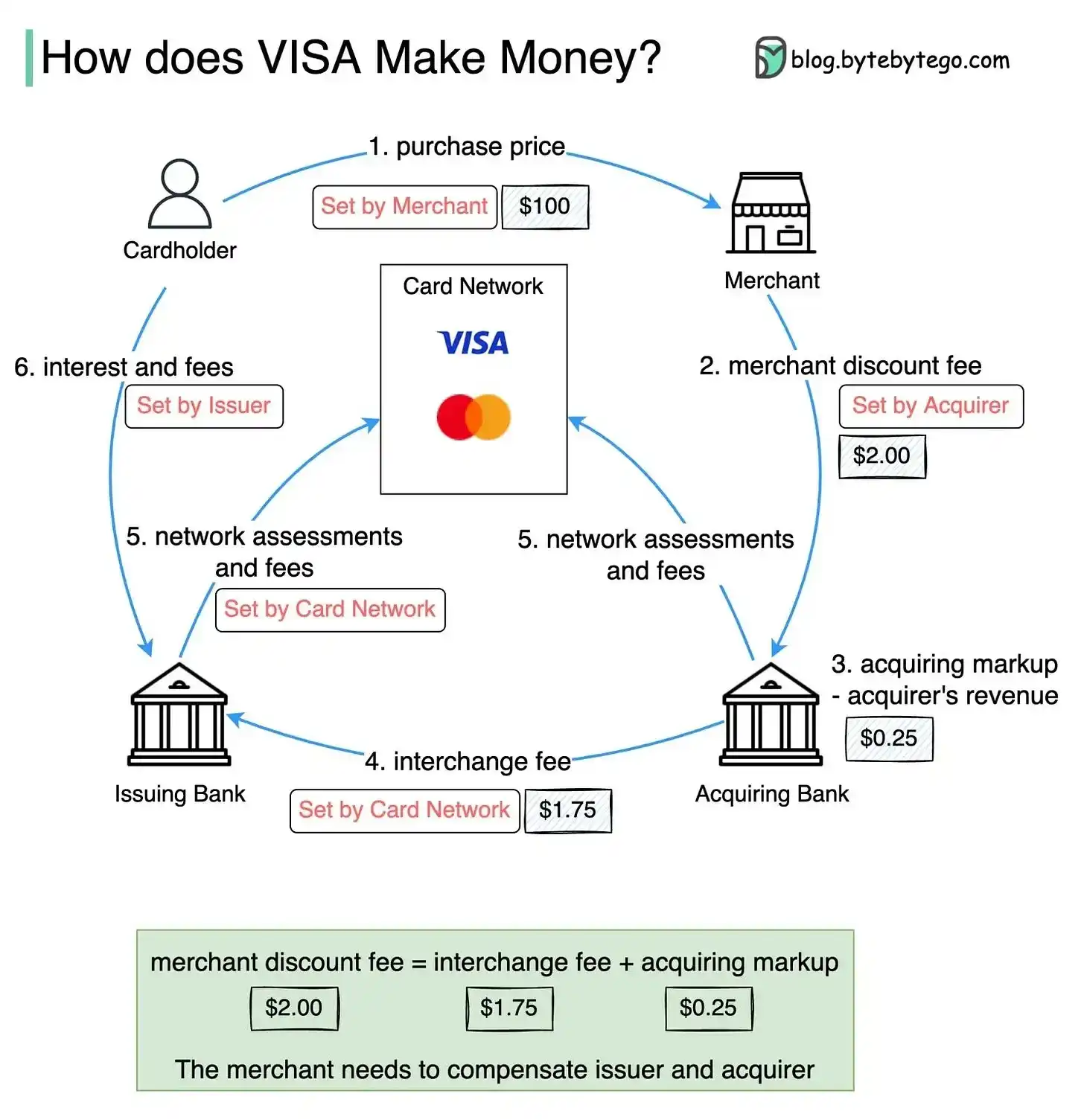
  • The largest share, about $1.75, goes to the issuing bank—the institution that issued the credit card to the consumer. This fee is called the Interchange Fee and accounts for 70%–80% of the merchant's total cost.
  • Next, the merchant's payment processor (acquirer) takes a service fee of $0.30–$0.70.
  • Lastly, the card networks—Visa/Mastercard—which everyone aims to disrupt, collect only a $0.13–$0.18 Assessment Fee, roughly 7%–9% of the merchant's total outlay.

This means that merely removing Visa only eliminates the smallest fee in the entire chain. There's a fundamental reason why Visa's fee is so low.

Visa does not issue credit to anyone, does not bear credit risk, chargeback disputes, or fraud losses. In fact, Visa doesn't even move money. It's simply an information transmission network that activates when a user swipes at a merchant terminal. Visa's job is to relay authorization messages between the merchant terminal and the issuer and set the rules for the entire system. The heaviest responsibilities fall on the issuer.

The issuer extends credit to consumers, bears bad debt risk, carries the cost of funds between the purchase date and the bill payment date, and uses interchange fees to subsidize reward programs to attract card usage.

This creates Visa's highly attractive business model. In 2025, Visa processed $14.2 trillion in payment volume across 257.5 billion transactions, generating $40 billion in net revenue with a net profit margin close to 50%. It makes about $0.13 per transaction on average—that's the entirety of its profit. Visa ranks among the world's highest market cap companies not because it charges high fees per swipe, but because it processes hundreds of billions of transactions annually with near-zero marginal cost and absolutely no credit risk.

Now, let's address the most challenging reality for stablecoin cards.

All stablecoin cards on the market are debit products. Funds—USDC, USDT—are already held in the user's wallet before a purchase occurs. There is no funding period and no revolving credit generating interest income. This places these cards in a completely different economic model.

Furthermore, the U.S. Congress's Durbin Amendment in 2010 capped interchange fees for debit cards issued by banks with assets over $100 billion at $0.21 + 0.05% per transaction. Most stablecoin card solutions partner with small banks (digital banks) with assets below the $100 billion threshold, exempt from the Durbin Amendment—a common FinTech partner bank model.
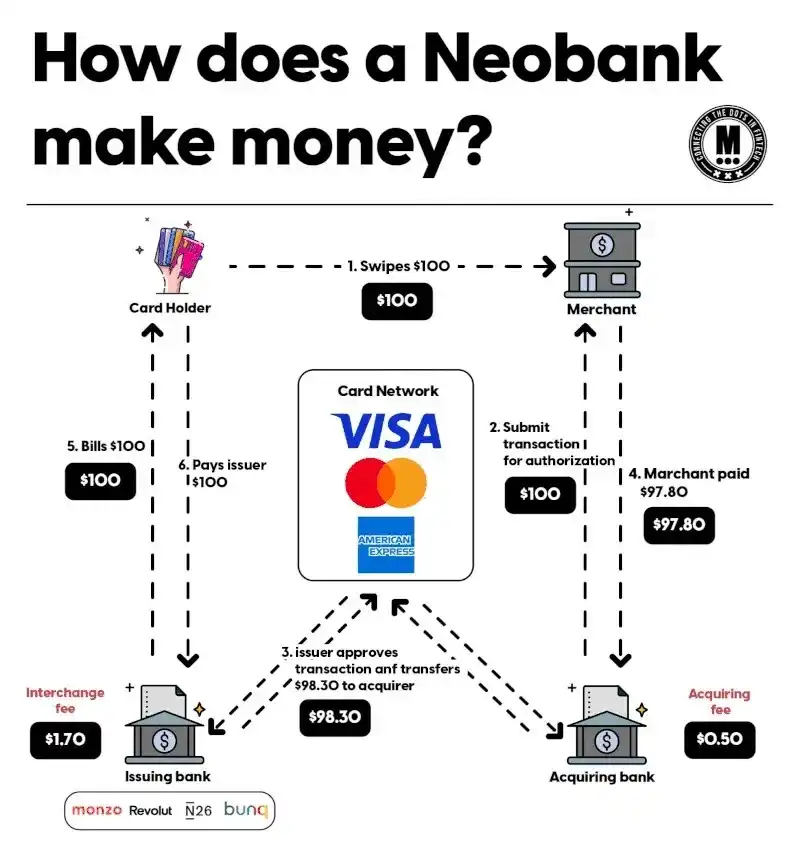
The average interchange fee for an unrestricted, dual-message network debit card is currently about $0.62 per transaction. A clear comparison: a $100 premium credit card transaction generates $2.20 in total revenue; a stablecoin debit card, even applying the higher, exempt rate, yields only $0.62 in total revenue. The project must then pay card network fees, processor fees, partner bank costs from these 62 cents, cover fraud losses and operational expenses, and only the remaining sliver can be considered for merchant rebates.

What Can Stablecoins Actually Replace?

As seen above, the savings from removing Visa are minimal, and the profit margin for operating a stablecoin card based on debit interchange fees is extremely narrow. However, the value of stablecoin payments might not lie in saving negligible card network fees but in potentially replacing more core parts of the payment stack.

To investigate, I revisited our previous article "Stripe Building Its Own Blockchain," which broke down a cross-border payment into seven fee layers: Acceptance, Orchestration, License/Compliance, Custody, FX, Issuance, and Settlement/Clearing. I mapped an in-country card transaction against these seven layers to see which ones actually change.
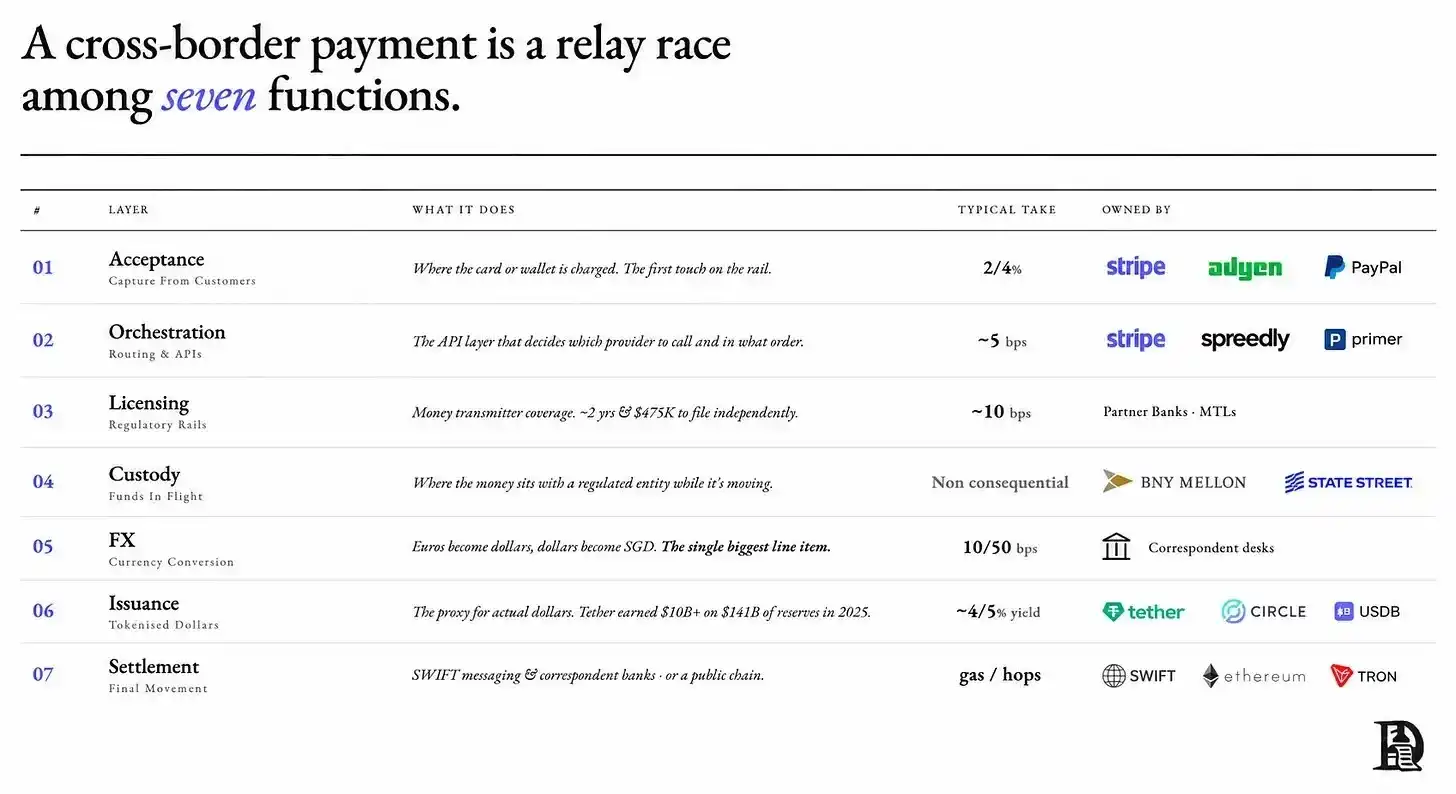
From the merchant's perspective, the Acceptance layer remains completely unchanged. The process stays the same: the merchant has a terminal, the user swipes, and the merchant still pays the Merchant Discount Rate to the acquirer. The merchant may not even be aware the funding source is USDC. On the merchant's statement, this transaction is identical to any other Visa transaction. Similarly, the Orchestration layer still goes through Visa or Mastercard, and the Issuance layer still relies on a partner bank and the card network's BIN. FinTechs were already using this model long before stablecoins—no fundamental innovation.

The real change happens in the backend layers, the ones most easily overlooked.

The Settlement/Clearing layer is the only area where stablecoins can bring fundamental change. In the traditional model, settlement between the issuer and card network operates on a T+2 cycle, further delayed by weekends and batch processing. To address this pain point, service providers like Rain support end-of-day stablecoin settlement with Visa; Mastercard has also begun accepting USDC, PYUSD, RLUSD, etc., for intraday settlement. This significantly compresses the traditional T+2 settlement, approaching real-time clearing and freeing up working capital previously tied up at the issuer.

However, the benefits from optimized working capital flow entirely to the issuing bank. The merchant's discount rate does not drop due to faster settlement, and the consumer's checkout experience feels no difference.

The sole beneficiary of T+0 stablecoin settlement is the card operator, who no longer needs to float funds for the two-day settlement period. The innovation from stablecoins essentially helps issuers optimize treasury management. The gains can be substantial at scale but offer no direct benefit to merchants or consumers. Meanwhile, Visa has no incentive to lower its fees—the cost of settlement float was never borne by Visa; the pressure was always on the issuer. Even if stablecoin settlement lowers the issuer's funding cost, Visa's own costs haven't changed, so merchant fees naturally remain the same.

Notably, Visa and Mastercard are not resisting stablecoin settlement; they are actively integrating it into their networks. Visa has supported USDC settlement on Ethereum and Solana since 2021, with annualized settlement volume reaching $7 billion. Mastercard acquired BVNK months ago to expand its stablecoin infrastructure. Both networks have even stated: "Stablecoins won't disrupt the existing payment landscape; instead, they will entrench this system."

The major card networks aren't being disrupted or replaced by stablecoins; on the contrary, they are absorbing stablecoins as an upgrade to their own settlement layer. Every stablecoin card running on Visa, while proclaiming to disrupt it, contributes to its transaction volume and continues to pay its fees.

As an additional note, in our Stripe article, we mentioned that stablecoins can indeed reduce cross-border payment costs by removing multiple correspondent banks—that argument holds. But the context matters. The core pain point of cross-border payments is FX and multiple intermediaries, while in-country consumer spending has a completely different fee structure. The industry is applying a logic proven for cross-border payments directly to in-country spending scenarios, which doesn't match the real cost structure.

The logic of stablecoins empowering cross-border payments is solid, but once applied to in-country spending, analyzing the fee flow reveals this narrative struggles to hold up.

So, what can stablecoins ultimately replace? Objectively, the answer is the clearing/settlement layer and cross-border FX conversion. They transform the underlying funds movement channel behind a transaction. However, the largest cost drivers in an in-country card transaction were never in the settlement infrastructure.


Related Questions

QWhat is the biggest misconception about who receives the majority of the credit card processing fee?

AThe biggest misconception, including among many in the cryptocurrency industry, is that card networks like Visa take the largest share of the merchant discount fee. In reality, the issuer bank receives the largest portion (around 70-80%, called the interchange fee), while Visa/Mastercard only takes a small assessment fee (about 7-9%).

QWhy is the business model of Visa so attractive according to the article?

AVisa's business model is attractive because it has extremely low marginal costs, processes hundreds of billions of transactions annually, and carries no credit risk. It makes a small fee per transaction (around $0.13 on average) but due to massive scale and minimal costs, it achieves high net income and nearly 50% net profit margins.

QWhat are the two main economic challenges for stablecoin debit cards compared to traditional credit cards?

AFirst, stablecoin debit cards operate on a different economic model as they are prepaid, offering no interest income from credit or float. Second, the total revenue per transaction is much lower (around $0.62 for a $100 transaction for a debit card) compared to rewards credit cards (around $2.20 for a $100 transaction), leaving very little profit margin after covering costs.

QAccording to the article, which specific layer of the payment system can stablecoins fundamentally transform?

AStablecoins can fundamentally transform the clearing and settlement layer. They enable near real-time settlement (T+0) compared to the traditional T+2 cycle, which optimizes working capital for the issuer banks.

QWhat is the article's conclusion about the role of card networks like Visa in the context of stablecoin cards?

AThe article concludes that card networks are not being disrupted or replaced by stablecoins. Instead, they are actively integrating stablecoins as an upgrade to their own settlement infrastructure. Every stablecoin card running on Visa contributes transaction volume and fees to Visa while claiming to disrupt it.

Related Reads

Explosion in Deep Sea Robots, the Hardest Series A Round Emerges

Deep-sea robotics startup Deepsea Zhiren has secured over 5 billion yuan in its Series A funding, a landmark deal backed by prominent investors including GGV Capital, Dachen Capital, Genesis Capital, Everbright Capital, China Life Insurance Investment, CETC Investment, and the energy tech fund managed by Cathay Capital with TotalEnergies as the cornerstone LP. Existing investors also participated significantly. The company, founded by industry veteran Ma Yiming, specializes in developing heavy-duty work-class ROVs for extreme deep-sea environments up to 6,000 meters, used in oil and gas, offshore wind, and subsea cable operations. Its product line includes models like "Taurus" (1,000m), "Phoenix 600" (3,000m), and "Singularity" (6,000m). A key achievement is securing multi-million dollar orders from UAE's telecom giant Etisalat, marking a breakthrough for Chinese-made deep-sea robotics in the international market. Deepsea Zhiren differentiates itself through full-stack in-house R&D—from pressure-resistant structures to control systems and AI—and a modular hardware approach. It has built a comprehensive internal standard system aligned with top global offshore specifications. The company is now advancing its "Deep Matrix" initiative, an unmanned, AI-powered, multi-robot cluster system designed for permanent seabed operations. This system aims to drastically reduce reliance on support vessels and human operators, potentially cutting costs in offshore oil field operations by billions over their lifecycle. The funding round signals strong market confidence in the deep-sea tech sector, recently highlighted in China's national policy. With the global subsea services market valued at around 1.5 trillion yuan and growing over 20% annually, Deepsea Zhiren aims to redefine deep-sea development through integrated hardware and embodied AI systems, positioning itself as a global pioneer in ocean robotics.

marsbit18m ago

Explosion in Deep Sea Robots, the Hardest Series A Round Emerges

marsbit18m ago

1confirmation: 5 Consumer Crypto Sectors Worth Revisiting

In the article "1confirmation: 5 Consumer Crypto Sectors Worth Revisiting," the author argues that the next breakthrough consumer crypto application may emerge from ideas that previously failed but are now ripe due to better infrastructure and timing. The five revisited sectors are: 1. **Internet-Native Assets**: Instead of tokenizing real-world assets (RWA), the bigger opportunity lies in creating unique crypto-native assets that don’t exist offline, moving beyond memecoins and NFTs to capture cultural moments or attention meaningfully. 2. **X-to-Earn**: Projects like STEPN and Axie Infinity introduced earning crypto without an initial purchase. The lesson is not that earning models are flawed, but that unsustainable token emissions failed. Future models need a compelling reason for users to earn and hold the assets. 3. **The Metaverse**: Past attempts focused on digitally replicating the real world (e.g., Decentraland). The core mistake was assuming virtual worlds must resemble physical ones. The real opportunity is reimagining next-generation online social experiences. 4. **DAOs**: While still existing, DAOs fell short of their potential by overemphasizing governance. The simpler, powerful use case demonstrated by ConstitutionDAO is collective funding for shared goals (e.g., buying artifacts, funding projects) by internet communities. 5. **People as Markets**: Past SocialFi/creator economy projects (Friend.tech, BitClout) tried to build markets around individuals but often made the person the product. The concept isn't wrong, but implementations failed. The challenge is creating markets around people without requiring them to be tradable assets. The conclusion emphasizes that successful consumer crypto apps will likely come from old ideas revisited, as timing and infrastructure finally align.

marsbit23m ago

1confirmation: 5 Consumer Crypto Sectors Worth Revisiting

marsbit23m ago

Popular Interactions Compilation | predict.fun Launches Dota 2 Special Event; Soar Early Whitelist Application (August 13th)

Here is a summary of key information from today's crypto and Web3 ecosystem: **predict.fun Launches Dota 2 Prediction Event** The BNB Chain-based prediction market platform predict.fun has launched a special event for The International Dota 2 Championship. Users can predict outcomes for matches starting from the group stages on August 13th. The total prize pool is $100,000 USD and 5 million platform points (PP). The event is split into two phases with separate rewards. To participate, users must lock a minimum of 20 shares on their chosen team before a match begins. **CheomaYield: Stablecoin Yield Protocol on GIWA Chain** CheomaYield is a new stablecoin yield protocol built on the GIWA Chain, an Ethereum L2 by Korean exchange Upbit. It has released its tokenomics for the fixed 1 billion CHEOMA token supply, with 30% allocated for airdrops. The protocol is currently on testnet. Users can interact by first claiming GIWA testnet tokens and then test USDC on the CheomaYield platform to earn points. **Soar: Pre-IPO Trading Platform Waitlist** Soar is a platform that allows users to gain exposure to pre-IPO companies like OpenAI and SpaceX by taking long or short positions on their valuations, without requiring accredited investor status. The platform has opened early access, and users can join a waitlist by registering their email on the official website.

Odaily星球日报24m ago

Popular Interactions Compilation | predict.fun Launches Dota 2 Special Event; Soar Early Whitelist Application (August 13th)

Odaily星球日报24m ago

Trading

Spot
活动图片