Who Can Catch Ma Huateng's Red Envelope?

marsbitPublished on 2026-01-27Last updated on 2026-01-27

Abstract

The article discusses the intensifying competition among Chinese tech giants in the AI sector, triggered by Tencent’s announcement of a 10 billion yuan cash giveaway through its AI app, Yuanbao, during the Spring Festival. Pony Ma’s move is reminiscent of WeChat’s 2015 “Pearl Harbor-style” disruption of the digital payment market, which helped it compete fiercely with Alipay. Major players like Baidu, ByteDance (with Doubao), and Alibaba (with Qianwen) have also launched large-scale marketing campaigns and春晚 (Spring Festival Gala) partnerships, with billions in subsidies and promotions. The competition has expanded beyond pure AI model performance to include applications, ecosystem integration, and hardware. The AI landscape is described as a “Warring States” era, with ByteDance (compared to Chu), Tencent (Qi), and Alibaba (Wei) leading through distinct strategies: ByteDance leverages short-video content, Tencent focuses on social integration, and Alibaba builds a super-app ecosystem. Other significant players include Baidu and DeepSeek, while smaller firms pivot to niche markets. Despite massive investments—with companies like ByteDance and Alibaba spending hundreds of billions—the industry has yet to find a sustainable business model. Profitability remains elusive, relying on subsidies and user acquisition rather than stable revenue streams like subscriptions or enterprise solutions. Experts suggest 2026 may be a decisive year for AI commercialization, with intensified ...

Author: Ba Xiaoling, Wu Xiaobo Channel

"Hoping to recreate the grand scene of WeChat red envelopes back in the day." With one sentence from Ma Huateng, the atmosphere in the entire domestic large model industry became tense and confrontational again.

The day before, Tencent Yuanbao announced that starting February 1st, it would distribute 1 billion CNY in Spring Festival cash red envelopes through the Yuanbao APP.
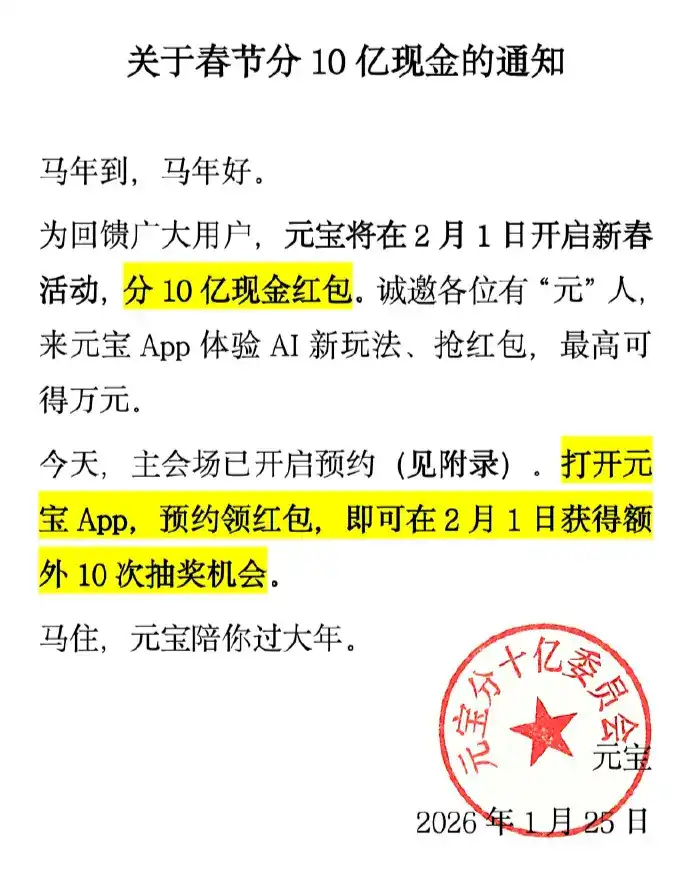
Image source: Internet

Competitors had to be on guard. That legendary red envelope shower from WeChat, which was recorded in the history of Chinese internet business wars, was described by Jack Ma as a "sneak attack on Pearl Harbor." In 2015, WeChat Pay partnered exclusively with the Spring Festival Gala, giving out 500 million CNY in WeChat red envelopes. That single night, WeChat garnered 11 billion "shake" interactions, bound over 100 million bank cards, and in just this one battle, forcefully seized half of the online payment market share from Alipay.

Also starting from this year, "Big Tech Red Envelope Wars" began to become part of the Chinese Spring Festival Gala memory. From Alipay to Douyin and Kuaishou, then to Taobao, JD.com, and Pinduoduo, it seems any internet giant worth its salt must have made an appearance at the Spring Festival Gala. The red envelope shower during the Gala also grew from the initial 500 million CNY to last year's 3 billion CNY.

Thus, this became the most anticipated segment of the Spring Festival Gala: which big tech company will give out red envelopes this year.

This year, the giants are once again standing at the same starting line, splashing cash and flying all sorts of marketing activities. When Ma Huateng steps up to "give red envelopes," can other big tech companies catch them?

Internet Giants Launch AI Red Envelope War

On the same day Yuanbao announced its lavish 1 billion CNY giveaway, Baidu also officially announced it would scatter 500 million CNY in Year of the Horse red envelopes and would cooperate with Beijing Television for the Spring Festival Gala.

ByteDance had already tied up with CCTV's Spring Festival Gala a month earlier, using its B2B AI cloud service platform, Volcano Engine, as the exclusive AI cloud partner for the 2026 Spring Festival Gala, while Doubao will配合上线各种互动玩法 (cooperate to launch various interactive features).

Although the official sponsorship amount was not disclosed, there are some reference figures: In 2020, Kuaishou's exclusive cooperation price with CCTV's Spring Festival Gala was 1.3-1.4 billion CNY, with an overall marketing package of about 2 billion CNY. In 2021, Douyin's exclusive cooperation price with CCTV's Spring Festival Gala was around 1 billion CNY, and additionally, on New Year's Eve, it distributed a total of 1.2 billion CNY in cash red envelopes.

Throughout 2025, compared to Tencent and Alibaba, ByteDance's marketing investment in Doubao could be considered "frugal." Some media analysis suggests this Spring Festival Gala sponsorship is likely ByteDance's largest AI brand marketing investment for the entire year.

Alibaba's response posture is to integrate the Alibaba ecosystem of applications, turning the Qianwen APP into a super traffic入口 (entry point) fully connected to shopping, navigation, travel, and a series of other functions, using incentives like food delivery red envelopes for user acquisition. Prior to this, Qianwen also secured the exclusive总冠名 (title sponsorship) of the Bilibili New Year's Eve Gala.

In the view of资深科技自媒体人 (veteran tech we-media personality) Zhuang Minghao, this year's red envelope war also sends an important signal: AI competition is expanding from pure model capability to application and入口 (entry point) competition.

And even before this, the smoke of battle had already filled手机屏幕 (mobile phone screens).

Throughout 2025, the big tech AI arms race was fought from every angle. For example, the talent war: Tencent high-profile hired 27-year-old former OpenAI researcher Yao Shunyu, concurrently serving as head of both the AI Infra department and the large language model department.

Another example is the hardware offense and defense war. Last December, ByteDance suddenly launched a "Doubao Phone," an action that directly切入 (cut into) the underlying mobile phone operating system, triggering joint boycotts from major software manufacturers. After the cold reception, ByteDance turned around and launched AI earphones and an AI "Recording Bean" equipped with Doubao.

On the other side, Alibaba launched the Quark AI glasses equipped with Qianwen, once承包 (monopolizing) the advertising space on the large screens in the passages of Hangzhou's highest traffic subway stations.

2025 World Artificial Intelligence Conference, Quark Smart AI Glasses

The most direct is the marketing war. According to a DataEye Research Institute report, in December 2025, in the native AI market, the top five in terms of投放素材量 (volume of advertising materials投放) were依次 (in order) Alibaba Qianwen, Yuanbao, Ant Afu, Doubao, and AI Douyin, accounting for 96% of the monthly投放素材量 in the mainland market.

Perhaps because the budgets were too large and the tasks too heavy, the最终出圈的姿态 (final姿态 that broke through the circle) were also varied and strange. For example, Yuanbao, wanting to conquer the下沉市场 (lower-tier market), went to rural areas to paint slogans on walls, "Difficult postpartum care for sows? Ask Tencent Yuanbao."

Image source: Internet

The most震撼 (stunning) is still the capital war. ByteDance's estimated capital expenditure for 2025 was nearly 160 billion CNY. Recently, overseas institutions reported that ByteDance has raised its 2026 capital expenditure target from 160-180 billion CNY to 300 billion CNY.

Alibaba announced at the beginning of 2025 a plan to invest 380 billion CNY in AI construction over the next three years,刷新 (refreshing) the AI spending record for domestic companies. At the end of the year, it又表示 (further stated), "this number might be conservative."

Ma Huateng, who did not disclose specific figures, also said at Tencent's annual meeting: "In 2025, Tencent played it safe and steady, the only area where we spent relatively more on investment was AI." According to institutional predictions, Tencent's AI capital expenditure in 2025 was close to 100 billion CNY.

"In a word, 2025 was a year of 'certainty.' The value and capability of AI were fully confirmed. Giants saw the situation clearly and went 'ALL IN' with full force; AI became usable, while疯狂基建 (frantic infrastructure building) occurred." Hu Yanping, a specially appointed professor at Shanghai University of Finance and Economics, summarized it this way.

And 2026 is the year of "decisiveness."

The Warring States Era of AI

AI industry investor Gao Zhendong compares the current landscape of large model competition to the Warring States era. Each company has its own strengths, and it's hard to distinguish superiority.

Hu Yanping believes that in terms of the overall commercialization picture, domestic AI currently presents a "(3+1)+5+N" pattern.

Among them, "3+1" refers to ByteDance, Alibaba, Tencent, plus Baidu; "5" refers to DeepSeek and the former "Six Little Tigers of Large Models" – Kimi, Zhipu, MiniMax, Step星辰 (Step Star), etc.; "N" refers to other AI enterprises focusing on vertical models and specialized markets.

But with the giants entering with heavy investments, under the spotlight, three "states" stand out in this Warring States struggle.

Gao Zhendong believes ByteDance is similar to the State of Chu:拥有最广的疆域 (having the vastest territory), the thickest foundation, vast land and abundant resources, a latecomer who arrived first, possessing流量母矿 (traffic motherlodes) like Douyin and TikTok.

Tencent is like the State of Qi:富甲天下 (the wealthiest under heaven), sitting on the profits of fishing and salt. It possesses the WeChat "social moat" and ample cash flow. It only needs to guard the social入口 (entry point) and can influence the entire situation with capital and traffic.

Alibaba is more like the State of Wei:率先变法 (the first to enact reforms), profound底蕴 (heritage), talent济济 (abundant talent), possessing强大的组织能力 (strong organizational capabilities). As the pioneer of Chinese cloud computing, Alibaba has打通 (opened up) the entire AI industry chain from chips to the cloud, from models to applications, top to bottom.

The three giants have thus extended their respective strategies.

Alibaba fights an生态战 (ecosystem war). Relying on its application ecosystem, the Qianwen APP is advancing towards becoming a "super app" covering all scenarios of eating, drinking, living, and traveling. It can now achieve ordering takeout, booking flights and hotels, and checking navigation in one stop.

ByteDance relies on short video scenarios, excelling more in AI creation and entertainment-oriented content. Besides the general product Doubao, ByteDance also has the AI creation tool Jimeng AI, which can generate videos, comic dramas, e-commerce pages, advertisements, etc.

Tencent continues to tightly grasp the social入口 (entry point). In the second half of 2025, Tencent Yuanbao successively integrated with Tencent Meeting and QQ, and recently launched the AI social-focused "Yuanbao Pai," which is essentially adding Yuanbao to group chats and supports inviting WeChat friends to join.

Image source: Internet

Beyond the giants displaying their prowess, the market cake left for other competitors seems to be getting smaller.

In Gao Zhendong's view, those that can still be called hegemons alongside the three giants are Baidu and DeepSeek. Baidu is like the State of Zhao in the Warring States, making massive investments in autonomous driving and base large models, with a solid technical foundation—a military power; DeepSeek, although its data and computing power scale cannot match the big factories, its computing efficiency is already on par with the latest models from Google and OpenAI, resembling the State of Han in the Warring States era, with sophisticated weaponry and good at "术"治 (governance by tactics/methods).

More small and medium-sized enterprises are seeking new paths of differentiation. For example, among the "Six Little Tigers of Large Models" that were hugely popular in 2024, Baichuan Intelligence, founded by Sogou founder Wang Xiaochuan, and 01.AI, founded by Kai-Fu Lee, have先后放弃 (successively abandoned) training base large models, turning to industry-level AI applications in healthcare and law; Zhipu AI and MiniMax landed on the Hong Kong stock market in early 2026, pinning their hopes on capital market funds to support subsequent R&D and market investment.

In the view of digital economy scholar Liu Xingliang, second and third-tier models still have space for deep application in细分场景 (segmented scenarios) like education, healthcare, and enterprises, but in the competition for mass入口 (entry points) and traffic, it may already be difficult to compete head-on with the giants.

Zhuang Minghao values "全栈能力" (full-stack capability): The AI competition at the current point is no longer单纯 (purely) model competition, but extends from the cloud to the model to the application, and even needs to expand to chips and hardware.

Hu Yanping uses four dimensions to observe the subsequent competitive situation:

◎ First, technical progress, where coding ability becomes an important central capability.

◎ Second, capital investment. Big factories are multiplying their AI capital expenditures, while slightly smaller leading startups, if they do not have cash reserves and investments of more than 5 billion CNY in 2026, will find it difficult to remain in the second tier.

◎ Third, user base. Either possess a traffic大盘 (large traffic pool) of billions of users, or form alliance cooperation with生态企业 (ecosystem companies) with hundreds of millions of users, otherwise market expansion costs (市场拓展成本) will be extremely high, affecting monetization capabilities.

◎ Fourth, expand monetization channels, quickly forming revenue sources of tens of billions of CNY from AI e-commerce, advertising marketing, enterprise application solutions, API Token, etc., because the Chinese market is an ecosystem where services are often free, and relying solely on subscriptions can hardly support sustainable development.

Therefore, also as Liu Xingliang's view, although the tripod鼎立 (tripod standing stable) seems stable in the short term, the competitive landscape is still full of variables in the future, influenced by technological innovation, outbreaks in vertical细分赛道 (segmented tracks), policy guidance, etc.
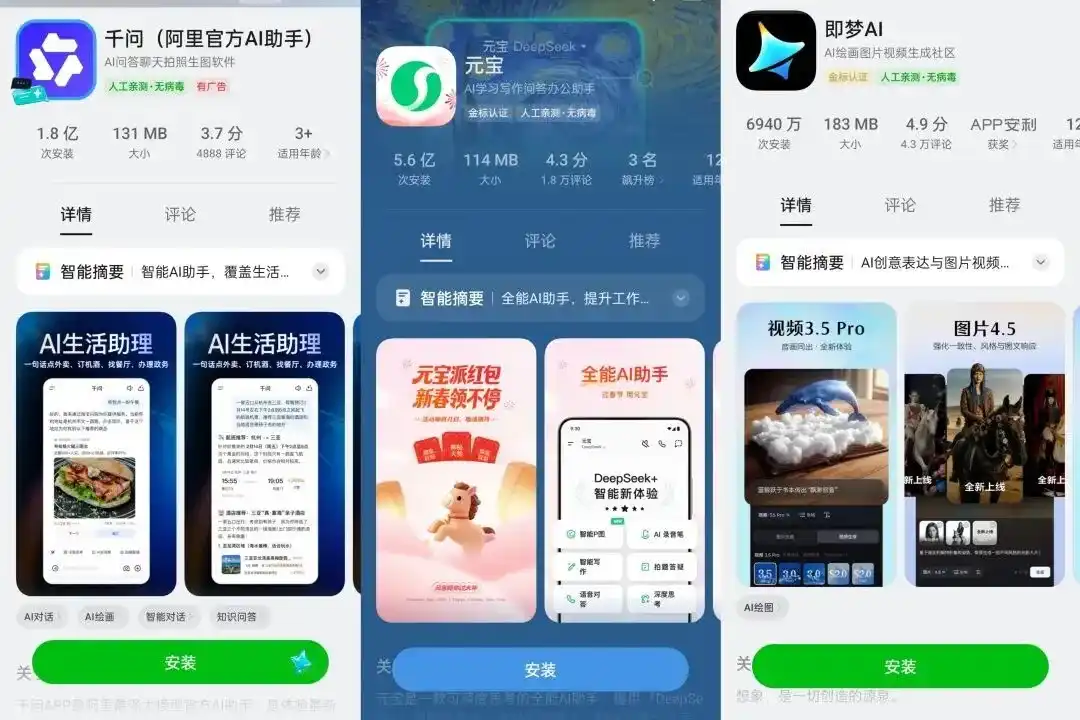
App download page in手机应用商店 (mobile app store)

Winner Undecided

The internet industry is no stranger to giant wars.

From the "Group Buying Wars," "Online Payment Wars," "Hundred-Model Wars" to the "Food Delivery Wars," every round of technological or business model innovation is a money-burning war, but these wars ultimately have more losses than wins, and the winners often change unpredictably.

The current battlefield is like the mid-Warring States period, with诸侯并起 (vassals rising together),霸权更替 (hegemony changing hands),改制与变法不断 (reforms and transformations constant), but a new order has yet to be established.

In other words, whether giants or small factories, although their tactics and situations differ, one point is格外一致 (particularly consistent): they have not yet found effective business models and are all operating at huge losses.

In Liu Xingliang's view, the current large model war still relies on the打法 (playbook) of "subsidies + traffic入口" to seize users, which helps educate the market in the early stages but is difficult to profit from in the long run. Real profitability still requires forming stable revenue sources such as paid subscriptions, AI solutions for enterprise customers, and industry定制服务 (customized services).

Also, as Zhuang Minghao said: "The current competition容不得 (does not allow for) consideration of the so-called sustainability of the money-burning model; it's a prisoner's dilemma."

However, the fact that the new order has not yet been established also means that the real winner is still悬念 (in suspense) and perhaps has not even appeared yet.

Hu Yanping believes that in the next stage, whether big factories, mid-stream enterprises, or "little dragons" and "little tigers," all have opportunities. In the short to medium term, having multiple enterprises participate in competition is a good thing, beneficial for industry development and able to provide consumers with diverse choices.

He also judges that the inflection point for AI monetization is即将到来 (approaching). From the close combat of technology and products to the stalemate of marketing competition, it all means that 2026 will become the "first year of AI value harvest." This year, domestic AI will welcome three major changes: big technical investment, big competitive differentiation, and big market分流 (diversion/shift).

It can be predicted that before the outcome of the battle is settled, red envelope showers will continue to fall in various forms. And the answer to this great war might be hidden in your hand: whose red envelope did you catch?


Related Questions

QWhat is the significance of the 10 billion yuan red envelope campaign launched by Tencent's Yuanbao app, according to the article?

AIt is an attempt by Tencent to replicate the success of the 2015 WeChat red envelope campaign, which dramatically increased WeChat Pay's market share, and signifies the intensifying competition in the domestic AI industry, shifting from pure model capability to application and entry point competition.

QWhich three major companies are highlighted as the leading contenders in the current AI 'Warring States' era, and what are their respective strengths compared to ancient states?

AByteDance is compared to Chu for its vast territory and massive traffic from apps like Douyin/TikTok; Tencent is compared to Qi for its immense wealth and strong social moat with WeChat; Alibaba is compared to Wei for being a first mover with deep底蕴, strong organizational capability, and a full AI industry chain from chips to the cloud.

QWhat are the four key dimensions mentioned by Hu Yanping to observe the future AI competitive landscape?

AThe four dimensions are: 1. Technological progress, with coding capability as a key central ability. 2. Capital investment, requiring massive spending to stay competitive. 3. User base, needing a huge traffic pool or strategic alliances. 4. Diversified monetization channels, requiring rapid formation of multi-billion RMB revenue streams from various sources beyond just subscriptions.

QWhat is the current state of profitability for companies in the large model competition, as described in the article?

ANone of the companies, whether giants or smaller firms, have found an effective business model and are all operating at a significant loss, currently relying on subsidies and traffic入口 strategies to capture users.

QWhat major marketing and partnership moves did ByteDance and Alibaba make in response to the competitive AI landscape around the Chinese New Year period?

AByteDance partnered with China Central Television's Spring Festival Gala as the exclusive AI cloud partner through its Volcano Engine platform, with its Doubao AI participating in interactive activities. Alibaba integrated its Qianwen app across its ecosystem to create a super traffic入口 and secured the exclusive title sponsorship of the Bilibili New Year's Eve Gala.

Related Reads

Will the Fed Still Cut Interest Rates? Tonight's Data Is Crucial

The core debate surrounding the Federal Reserve's potential interest rate cuts is intensifying amid geopolitical conflict and rebounding inflation. The key question is whether high energy prices will cause persistent inflation or weaken consumer demand enough to force the Fed to cut rates. Citigroup presents a bullish case for cuts, arguing that oil supply disruptions from the Strait of Hormuz are temporary and will not lead to lasting inflationary pressure. They point to receding bond yields and oil prices as evidence the market is pricing in a short-lived shock. Citi's data also shows tightening financial conditions, a stabilizing labor market, and healthy tax returns, supporting their view that the path to lower rates remains open. Conversely, Deutsche Bank offers a starkly contrasting, more hawkish outlook. They argue the Fed's current policy is already neutral and expect rates to remain unchanged indefinitely. Their view is based on stalled disinflation progress and a shift toward more hawkish rhetoric from key Fed officials like Waller, who cited risks from prolonged Middle East conflict and tariffs. Other officials, including Williams and Hammack, signaled rates would likely stay on hold for a "considerable time." The market pricing has shifted dramatically, now forecasting zero cuts in 2026. The imminent release of the March retail sales "control group" data is highlighted as a critical test. This metric, which excludes gas station sales, will reveal if high gasoline prices are eroding consumer spending in other areas. A weak reading could support the case for imminent rate cuts, while a strong one would bolster the argument for the Fed to hold steady. This data is pivotal for determining the near-term policy path.

marsbit17m ago

Will the Fed Still Cut Interest Rates? Tonight's Data Is Crucial

marsbit17m ago

The Second Half of Macro Influencer Fu Peng's Career

Fu Peng, a prominent Chinese macroeconomist and former chief economist of Northeast Securities, has joined Hong Kong-based digital asset management firm Bitfire Group (formerly New Huo Group) as its chief economist. This move, announced in April 2026, triggered an 11% surge in Bitfire's stock price. Fu, known for his accessible macroeconomic commentary and large social media following, will focus on integrating digital assets into global asset allocation frameworks, particularly combining FICC (fixed income, currencies, and commodities) with cryptocurrencies for institutional clients. His career includes roles at Lehman Brothers and Solomon International, with significant influence gained through public communication. However, in late 2024, Fu faced temporary social media bans after a controversial private speech at HSBC on China's economic challenges, though he denied regulatory sanctions. He later left Northeast Securities citing health reasons. Bitfire, a licensed virtual asset manager serving high-net-worth clients, seeks to build trust and attract traditional capital through Fu’s expertise and credibility. The partnership represents a strategic shift for both: Fu enters the crypto sector after a traditional finance peak, while Bitfire aims to leverage his macro framework for institutional adoption. Outcomes remain uncertain regarding capital inflows and compatibility within corporate structure.

marsbit1h ago

The Second Half of Macro Influencer Fu Peng's Career

marsbit1h ago

Trading

Spot
Futures

Hot Articles

What is SONIC

Sonic: Pioneering the Future of Gaming in Web3 Introduction to Sonic In the ever-evolving landscape of Web3, the gaming industry stands out as one of the most dynamic and promising sectors. At the forefront of this revolution is Sonic, a project designed to amplify the gaming ecosystem on the Solana blockchain. Leveraging cutting-edge technology, Sonic aims to deliver an unparalleled gaming experience by efficiently processing millions of requests per second, ensuring that players enjoy seamless gameplay while maintaining low transaction costs. This article delves into the intricate details of Sonic, exploring its creators, funding sources, operational mechanics, and the timeline of significant events that have shaped its journey. What is Sonic? Sonic is an innovative layer-2 network that operates atop the Solana blockchain, specifically tailored to enhance the existing Solana gaming ecosystem. It accomplishes this through a customised, VM-agnostic game engine paired with a HyperGrid interpreter, facilitating sovereign game economies that roll up back to the Solana platform. The primary goals of Sonic include: Enhanced Gaming Experiences: Sonic is committed to offering lightning-fast on-chain gameplay, allowing players and developers to engage with games at previously unattainable speeds. Atomic Interoperability: This feature enables transactions to be executed within Sonic without the need to redeploy Solana programmes and accounts. This makes the process more efficient and directly benefits from Solana Layer1 services and liquidity. Seamless Deployment: Sonic allows developers to write for Ethereum Virtual Machine (EVM) based systems and execute them on Solana’s SVM infrastructure. This interoperability is crucial for attracting a broader range of dApps and decentralised applications to the platform. Support for Developers: By offering native composable gaming primitives and extensible data types - dining within the Entity-Component-System (ECS) framework - game creators can craft intricate business logic with ease. Overall, Sonic's unique approach not only caters to players but also provides an accessible and low-cost environment for developers to innovate and thrive. Creator of Sonic The information regarding the creator of Sonic is somewhat ambiguous. However, it is known that Sonic's SVM is owned by the company Mirror World. The absence of detailed information about the individuals behind Sonic reflects a common trend in several Web3 projects, where collective efforts and partnerships often overshadow individual contributions. Investors of Sonic Sonic has garnered considerable attention and support from various investors within the crypto and gaming sectors. Notably, the project raised an impressive $12 million during its Series A funding round. The round was led by BITKRAFT Ventures, with other notable investors including Galaxy, Okx Ventures, Interactive, Big Brain Holdings, and Mirana. This financial backing signifies the confidence that investment foundations have in Sonic’s potential to revolutionise the Web3 gaming landscape, further validating its innovative approaches and technologies. How Does Sonic Work? Sonic utilises the HyperGrid framework, a sophisticated parallel processing mechanism that enhances its scalability and customisability. Here are the core features that set Sonic apart: Lightning Speed at Low Costs: Sonic offers one of the fastest on-chain gaming experiences compared to other Layer-1 solutions, powered by the scalability of Solana’s virtual machine (SVM). Atomic Interoperability: Sonic enables transaction execution without redeployment of Solana programmes and accounts, effectively streamlining the interaction between users and the blockchain. EVM Compatibility: Developers can effortlessly migrate decentralised applications from EVM chains to the Solana environment using Sonic’s HyperGrid interpreter, increasing the accessibility and integration of various dApps. Ecosystem Support for Developers: By exposing native composable gaming primitives, Sonic facilitates a sandbox-like environment where developers can experiment and implement business logic, greatly enhancing the overall development experience. Monetisation Infrastructure: Sonic natively supports growth and monetisation efforts, providing frameworks for traffic generation, payments, and settlements, thereby ensuring that gaming projects are not only viable but also sustainable financially. Timeline of Sonic The evolution of Sonic has been marked by several key milestones. Below is a brief timeline highlighting critical events in the project's history: 2022: The Sonic cryptocurrency was officially launched, marking the beginning of its journey in the Web3 gaming arena. 2024: June: Sonic SVM successfully raised $12 million in a Series A funding round. This investment allowed Sonic to further develop its platform and expand its offerings. August: The launch of the Sonic Odyssey testnet provided users with the first opportunity to engage with the platform, offering interactive activities such as collecting rings—a nod to gaming nostalgia. October: SonicX, an innovative crypto game integrated with Solana, made its debut on TikTok, capturing the attention of over 120,000 users within a short span. This integration illustrated Sonic’s commitment to reaching a broader, global audience and showcased the potential of blockchain gaming. Key Points Sonic SVM is a revolutionary layer-2 network on Solana explicitly designed to enhance the GameFi landscape, demonstrating great potential for future development. HyperGrid Framework empowers Sonic by introducing horizontal scaling capabilities, ensuring that the network can handle the demands of Web3 gaming. Integration with Social Platforms: The successful launch of SonicX on TikTok displays Sonic’s strategy to leverage social media platforms to engage users, exponentially increasing the exposure and reach of its projects. Investment Confidence: The substantial funding from BITKRAFT Ventures, among others, emphasizes the robust backing Sonic has, paving the way for its ambitious future. In conclusion, Sonic encapsulates the essence of Web3 gaming innovation, striking a balance between cutting-edge technology, developer-centric tools, and community engagement. As the project continues to evolve, it is poised to redefine the gaming landscape, making it a notable entity for gamers and developers alike. As Sonic moves forward, it will undoubtedly attract greater interest and participation, solidifying its place within the broader narrative of blockchain gaming.

1.1k Total ViewsPublished 2024.04.04Updated 2024.12.03

What is SONIC

What is $S$

Understanding SPERO: A Comprehensive Overview Introduction to SPERO As the landscape of innovation continues to evolve, the emergence of web3 technologies and cryptocurrency projects plays a pivotal role in shaping the digital future. One project that has garnered attention in this dynamic field is SPERO, denoted as SPERO,$$s$. This article aims to gather and present detailed information about SPERO, to help enthusiasts and investors understand its foundations, objectives, and innovations within the web3 and crypto domains. What is SPERO,$$s$? SPERO,$$s$ is a unique project within the crypto space that seeks to leverage the principles of decentralisation and blockchain technology to create an ecosystem that promotes engagement, utility, and financial inclusion. The project is tailored to facilitate peer-to-peer interactions in new ways, providing users with innovative financial solutions and services. At its core, SPERO,$$s$ aims to empower individuals by providing tools and platforms that enhance user experience in the cryptocurrency space. This includes enabling more flexible transaction methods, fostering community-driven initiatives, and creating pathways for financial opportunities through decentralised applications (dApps). The underlying vision of SPERO,$$s$ revolves around inclusiveness, aiming to bridge gaps within traditional finance while harnessing the benefits of blockchain technology. Who is the Creator of SPERO,$$s$? The identity of the creator of SPERO,$$s$ remains somewhat obscure, as there are limited publicly available resources providing detailed background information on its founder(s). This lack of transparency can stem from the project's commitment to decentralisation—an ethos that many web3 projects share, prioritising collective contributions over individual recognition. By centring discussions around the community and its collective goals, SPERO,$$s$ embodies the essence of empowerment without singling out specific individuals. As such, understanding the ethos and mission of SPERO remains more important than identifying a singular creator. Who are the Investors of SPERO,$$s$? SPERO,$$s$ is supported by a diverse array of investors ranging from venture capitalists to angel investors dedicated to fostering innovation in the crypto sector. The focus of these investors generally aligns with SPERO's mission—prioritising projects that promise societal technological advancement, financial inclusivity, and decentralised governance. These investor foundations are typically interested in projects that not only offer innovative products but also contribute positively to the blockchain community and its ecosystems. The backing from these investors reinforces SPERO,$$s$ as a noteworthy contender in the rapidly evolving domain of crypto projects. How Does SPERO,$$s$ Work? SPERO,$$s$ employs a multi-faceted framework that distinguishes it from conventional cryptocurrency projects. Here are some of the key features that underline its uniqueness and innovation: Decentralised Governance: SPERO,$$s$ integrates decentralised governance models, empowering users to participate actively in decision-making processes regarding the project’s future. This approach fosters a sense of ownership and accountability among community members. Token Utility: SPERO,$$s$ utilises its own cryptocurrency token, designed to serve various functions within the ecosystem. These tokens enable transactions, rewards, and the facilitation of services offered on the platform, enhancing overall engagement and utility. Layered Architecture: The technical architecture of SPERO,$$s$ supports modularity and scalability, allowing for seamless integration of additional features and applications as the project evolves. This adaptability is paramount for sustaining relevance in the ever-changing crypto landscape. Community Engagement: The project emphasises community-driven initiatives, employing mechanisms that incentivise collaboration and feedback. By nurturing a strong community, SPERO,$$s$ can better address user needs and adapt to market trends. Focus on Inclusion: By offering low transaction fees and user-friendly interfaces, SPERO,$$s$ aims to attract a diverse user base, including individuals who may not previously have engaged in the crypto space. This commitment to inclusion aligns with its overarching mission of empowerment through accessibility. Timeline of SPERO,$$s$ Understanding a project's history provides crucial insights into its development trajectory and milestones. Below is a suggested timeline mapping significant events in the evolution of SPERO,$$s$: Conceptualisation and Ideation Phase: The initial ideas forming the basis of SPERO,$$s$ were conceived, aligning closely with the principles of decentralisation and community focus within the blockchain industry. Launch of Project Whitepaper: Following the conceptual phase, a comprehensive whitepaper detailing the vision, goals, and technological infrastructure of SPERO,$$s$ was released to garner community interest and feedback. Community Building and Early Engagements: Active outreach efforts were made to build a community of early adopters and potential investors, facilitating discussions around the project’s goals and garnering support. Token Generation Event: SPERO,$$s$ conducted a token generation event (TGE) to distribute its native tokens to early supporters and establish initial liquidity within the ecosystem. Launch of Initial dApp: The first decentralised application (dApp) associated with SPERO,$$s$ went live, allowing users to engage with the platform's core functionalities. Ongoing Development and Partnerships: Continuous updates and enhancements to the project's offerings, including strategic partnerships with other players in the blockchain space, have shaped SPERO,$$s$ into a competitive and evolving player in the crypto market. Conclusion SPERO,$$s$ stands as a testament to the potential of web3 and cryptocurrency to revolutionise financial systems and empower individuals. With a commitment to decentralised governance, community engagement, and innovatively designed functionalities, it paves the way toward a more inclusive financial landscape. As with any investment in the rapidly evolving crypto space, potential investors and users are encouraged to research thoroughly and engage thoughtfully with the ongoing developments within SPERO,$$s$. The project showcases the innovative spirit of the crypto industry, inviting further exploration into its myriad possibilities. While the journey of SPERO,$$s$ is still unfolding, its foundational principles may indeed influence the future of how we interact with technology, finance, and each other in interconnected digital ecosystems.

54 Total ViewsPublished 2024.12.17Updated 2024.12.17

What is $S$

What is AGENT S

Agent S: The Future of Autonomous Interaction in Web3 Introduction In the ever-evolving landscape of Web3 and cryptocurrency, innovations are constantly redefining how individuals interact with digital platforms. One such pioneering project, Agent S, promises to revolutionise human-computer interaction through its open agentic framework. By paving the way for autonomous interactions, Agent S aims to simplify complex tasks, offering transformative applications in artificial intelligence (AI). This detailed exploration will delve into the project's intricacies, its unique features, and the implications for the cryptocurrency domain. What is Agent S? Agent S stands as a groundbreaking open agentic framework, specifically designed to tackle three fundamental challenges in the automation of computer tasks: Acquiring Domain-Specific Knowledge: The framework intelligently learns from various external knowledge sources and internal experiences. This dual approach empowers it to build a rich repository of domain-specific knowledge, enhancing its performance in task execution. Planning Over Long Task Horizons: Agent S employs experience-augmented hierarchical planning, a strategic approach that facilitates efficient breakdown and execution of intricate tasks. This feature significantly enhances its ability to manage multiple subtasks efficiently and effectively. Handling Dynamic, Non-Uniform Interfaces: The project introduces the Agent-Computer Interface (ACI), an innovative solution that enhances the interaction between agents and users. Utilizing Multimodal Large Language Models (MLLMs), Agent S can navigate and manipulate diverse graphical user interfaces seamlessly. Through these pioneering features, Agent S provides a robust framework that addresses the complexities involved in automating human interaction with machines, setting the stage for myriad applications in AI and beyond. Who is the Creator of Agent S? While the concept of Agent S is fundamentally innovative, specific information about its creator remains elusive. The creator is currently unknown, which highlights either the nascent stage of the project or the strategic choice to keep founding members under wraps. Regardless of anonymity, the focus remains on the framework's capabilities and potential. Who are the Investors of Agent S? As Agent S is relatively new in the cryptographic ecosystem, detailed information regarding its investors and financial backers is not explicitly documented. The lack of publicly available insights into the investment foundations or organisations supporting the project raises questions about its funding structure and development roadmap. Understanding the backing is crucial for gauging the project's sustainability and potential market impact. How Does Agent S Work? At the core of Agent S lies cutting-edge technology that enables it to function effectively in diverse settings. Its operational model is built around several key features: Human-like Computer Interaction: The framework offers advanced AI planning, striving to make interactions with computers more intuitive. By mimicking human behaviour in tasks execution, it promises to elevate user experiences. Narrative Memory: Employed to leverage high-level experiences, Agent S utilises narrative memory to keep track of task histories, thereby enhancing its decision-making processes. Episodic Memory: This feature provides users with step-by-step guidance, allowing the framework to offer contextual support as tasks unfold. Support for OpenACI: With the ability to run locally, Agent S allows users to maintain control over their interactions and workflows, aligning with the decentralised ethos of Web3. Easy Integration with External APIs: Its versatility and compatibility with various AI platforms ensure that Agent S can fit seamlessly into existing technological ecosystems, making it an appealing choice for developers and organisations. These functionalities collectively contribute to Agent S's unique position within the crypto space, as it automates complex, multi-step tasks with minimal human intervention. As the project evolves, its potential applications in Web3 could redefine how digital interactions unfold. Timeline of Agent S The development and milestones of Agent S can be encapsulated in a timeline that highlights its significant events: September 27, 2024: The concept of Agent S was launched in a comprehensive research paper titled “An Open Agentic Framework that Uses Computers Like a Human,” showcasing the groundwork for the project. October 10, 2024: The research paper was made publicly available on arXiv, offering an in-depth exploration of the framework and its performance evaluation based on the OSWorld benchmark. October 12, 2024: A video presentation was released, providing a visual insight into the capabilities and features of Agent S, further engaging potential users and investors. These markers in the timeline not only illustrate the progress of Agent S but also indicate its commitment to transparency and community engagement. Key Points About Agent S As the Agent S framework continues to evolve, several key attributes stand out, underscoring its innovative nature and potential: Innovative Framework: Designed to provide an intuitive use of computers akin to human interaction, Agent S brings a novel approach to task automation. Autonomous Interaction: The ability to interact autonomously with computers through GUI signifies a leap towards more intelligent and efficient computing solutions. Complex Task Automation: With its robust methodology, it can automate complex, multi-step tasks, making processes faster and less error-prone. Continuous Improvement: The learning mechanisms enable Agent S to improve from past experiences, continually enhancing its performance and efficacy. Versatility: Its adaptability across different operating environments like OSWorld and WindowsAgentArena ensures that it can serve a broad range of applications. As Agent S positions itself in the Web3 and crypto landscape, its potential to enhance interaction capabilities and automate processes signifies a significant advancement in AI technologies. Through its innovative framework, Agent S exemplifies the future of digital interactions, promising a more seamless and efficient experience for users across various industries. Conclusion Agent S represents a bold leap forward in the marriage of AI and Web3, with the capacity to redefine how we interact with technology. While still in its early stages, the possibilities for its application are vast and compelling. Through its comprehensive framework addressing critical challenges, Agent S aims to bring autonomous interactions to the forefront of the digital experience. As we move deeper into the realms of cryptocurrency and decentralisation, projects like Agent S will undoubtedly play a crucial role in shaping the future of technology and human-computer collaboration.

539 Total ViewsPublished 2025.01.14Updated 2025.01.14

What is AGENT S

Discussions

Welcome to the HTX Community. Here, you can stay informed about the latest platform developments and gain access to professional market insights. Users' opinions on the price of S (S) are presented below.

活动图片