White House Ignites, BSC Spreads Like Wildfire: A Meme Carnival Bidding Farewell to the 'Imperial Decree Model'

Odaily星球日报Published on 2026-01-21Last updated on 2026-01-21

Abstract

White House Ignites, BSC Rallies: A Meme Carnival Moving Beyond the "Imperial Decree" Model The meme market witnessed another sensational surge when the White House official account on X posted about "victory, eviction operations, and memes" on January 21. Within minutes, meme tokens named "memes" were launched on both Solana and BSC chains, sparking a race between the two ecosystems. Contrary to expectations that Solana’s earlier launch and active ecosystem would dominate, the BSC version outperformed in market cap and holder engagement. At its peak, the BSC meme reached a market cap of $28 million with 7,300 holders, while Solana’s version capped at $3.6 million with 3,900 holders. Real-time user data from GMGN also showed significantly higher engagement on BSC. This outcome challenges the long-standing perception that BSC memes rely heavily on endorsements from figures like CZ and He Yi—a pattern often mocked as "crypto Shandong style." In fact, both CZ and He Yi have recently expressed caution against "wordplay memes" created by parsing their social posts. CZ explicitly warned users against buying tokens based on his tweets, while He Yi discouraged the community from treating such meme creation as meaningful contribution. The success of the BSC-based "memes" token—inspired by the White House rather than internal figures—suggests a possible shift in BSC’s meme culture. He Yi’s now-deleted retweet of the White House post may have contributed to its visibility, though th...

Original | Odaily Planet Daily (@OdailyChina)

Author | Golem (@web 3_golem)
The meme market today once again witnessed a "golden dog" legend.

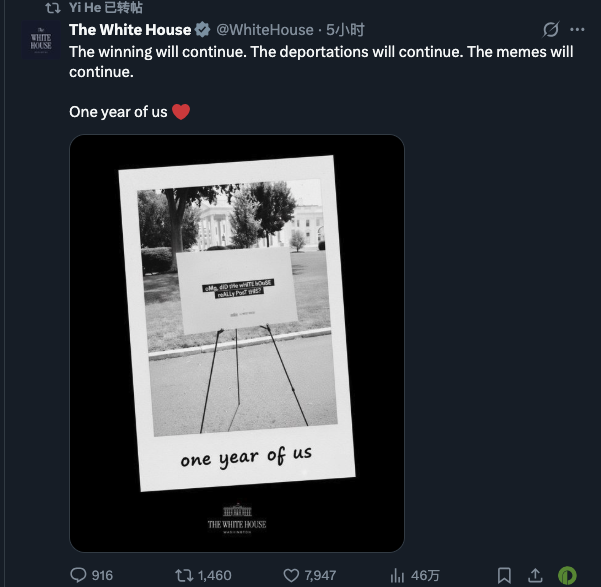
On January 21 at 11:10, the official White House account posted on X platform mentioning "victory, eviction operations, and memes". One minute later, a Meme coin named memes quickly appeared on the Solana chain; 20 minutes later, the BSC chain version was also born. A Meme race between the two chains officially began.

According to empiricism, the Solana version should have the advantage—not only is the ecosystem active, but it also conforms to the consensus of "First is first". However, the result was unexpected: the BSC chain's memes surpassed in market capitalization. According to GMGN data, the BSC version's market cap reached a high of $28 million, with 7,300 holding addresses; while the Solana version's peak was only $3.6 million, with 3,900 holding addresses.

The new feature of GMGN also reveals where players' attention lies: 3 hours after the token's birth, the number of simultaneous online users for the Solana version remained below 1,000, while the BSC version once approached 3,000.

Although some questioned whether the BSC version's market cap was due to "whales pumping, aiming to harvest", the real market attention does not lie—this time, BSC indeed won.

The community often joked that BSC's Meme model was "Shandong Study in the crypto circle", where only projects related to CZ and He Yi had a way out, which once raised concerns about the ecosystem's sustainability. However, BSC's victory in this Meme race not only caused a wave of "slapping thighs" regret for missing out but also prompted the community to rethink the evolution of its Meme model. As GMGN founder Haze said: "The BSC 3.0 era has arrived." (Odaily Note: Haze holds 1.93% of BSC chain memes, ranking second on the holdings list.)

CZ and He Yi Publicly State They Do Not Support "Word-Picking Memes"

I once expressed my thoughts on the BSC Meme model at an Odaily editorial tea party, believing that CZ and He Yi were actually already "kidnapped" by the community. The current BSC Meme model, which relies on "imperial decrees" for cold start, deceives continuous interaction, gets listed on Binance Alpha, and finally gets "poured out", is actually a consensus of the BSC community. Although this model started with CZ's unintentional actions in early 2025, they actually don't like it. However,发展到如今, CZ and He Yi are also powerless to reverse the situation.

When I published this view, it was merely a conjecture, but recent public statements from CZ and He Yi have proven this to be a fact. On January 13, CZ posted saying that although he likes Meme coins, if players blindly follow the trend and buy Meme coins "picked" from his tweets, they are almost destined to lose money.

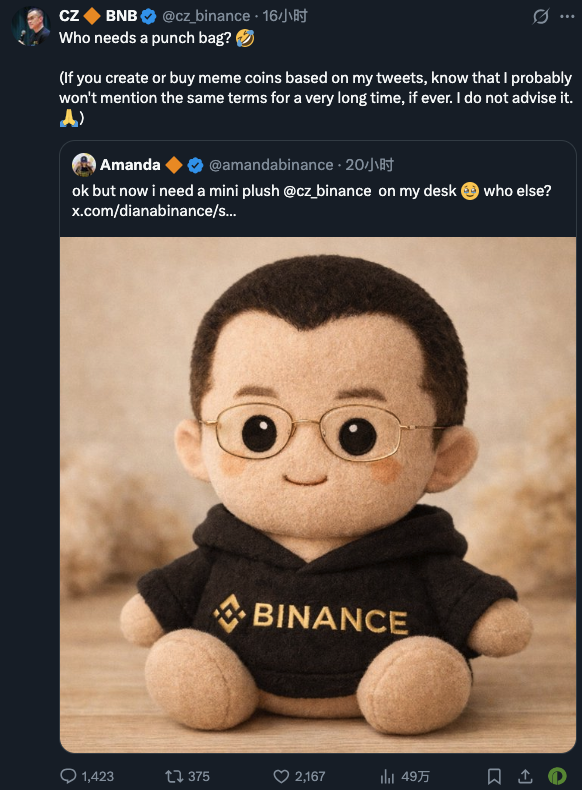
To prevent everyone from blindly chasing these "word-picking Memes", CZ's tweets have started to become cautious. Yesterday, CZ reposted a plush toy created by a user based on his image, which was an ordinary matter, but CZ still specifically noted: If you create or buy Meme coins based on my tweets, please note that I may not mention the same words again for a long time, maybe never. I do not recommend you do this. He even added a 🙏 icon at the end, showing CZ's concern for the community.
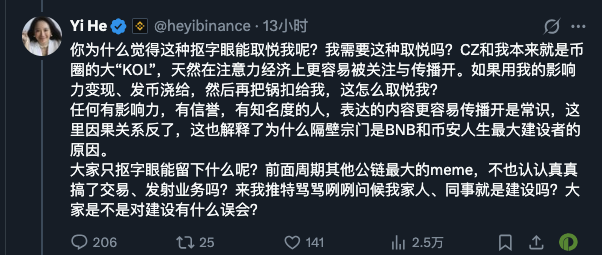
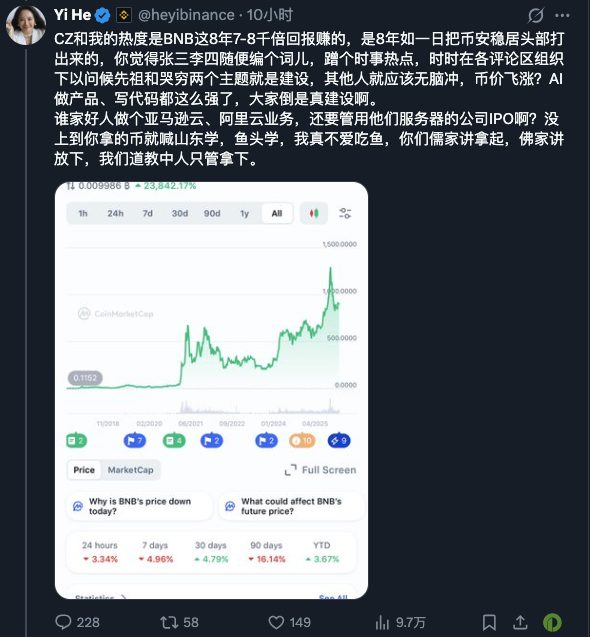
Compared to CZ's euphemism, He Yi's attitude towards the community's "word-picking Memes" is more straightforward. In the early morning of January 21, under a user's post, He Yi not only said that she would severely punish all internal Binance insider trading and bribery, but also "domineeringly" stated that she does not need to rely on Binance Alpha listing Memes that pick words from her tweets to gain pleasure, and also advised the community to focus on real building, not to regard "word-picking and flattery" as real building and be moved by themselves. He Yi also stated that she does not like eating fish, and players should not call it Shandong Study just because Binance Alpha did not list the tokens she supported.
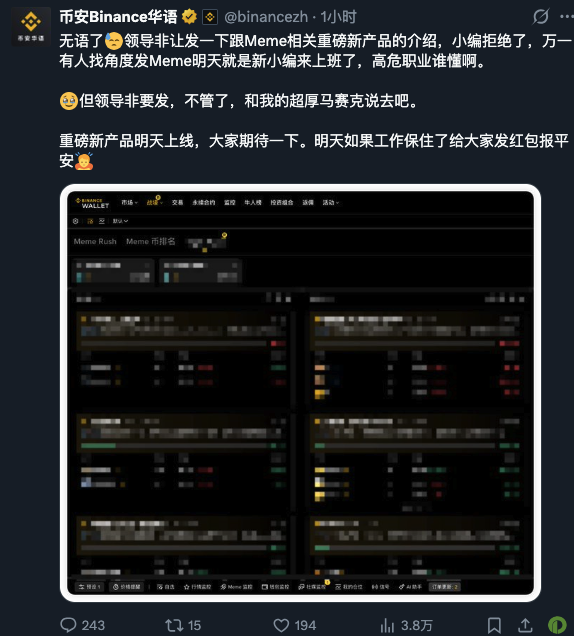
Under the influence of CZ and He Yi's public statements not supporting "word-picking Memes", Binance's official announcements about Memes have also started to become cautious. On January 21, Binance's Chinese account posted that it will launch a new Meme product feature, but to prevent the community from finding angles to issue Meme coins, the editor特意打了超厚马赛克 (specifically applied a very thick mosaic). Although somewhat戏谑 (mockingly), it is enough to see the cautious attitude of the entire Binance team, whether towards Meme coins that pick words from CZ and He Yi's tweets, or those that pick words from Binance's official announcements.
Is BSC Meme Finally Going to Be Different?

Outsiders watch the热闹 (excitement), insiders watch the门道 (tricks). He Yi's remarks not only feel very "alive", but experienced Meme players have realized that the previous BSC Meme model is collapsing from the top down. The successfully outperforming BSC chain memes on the morning of January 21 might be an appetizer. Ironically, memes was also born from the art of "word-picking", but this time it was the White House.

Additionally, after the White House posted, He Yi reposted it (now deleted). This repost, which was unrelated to Binance and He Yi, seemed slightly突兀 (abrupt) in her homepage timeline, and the community was also confused about the reason for He Yi's repost. How much credit He Yi's repost deserves for the BSC's memes, launched 20 minutes later, outperforming Solana's memes is also worth a question mark.
Finally, we might still have to ask that unchanging question, will BSC really be different this time?


Related Questions

QWhat was the unexpected outcome in the meme coin race between Solana and BSC following the White House's post?

AContrary to the expectation that the Solana version would dominate due to its active ecosystem and the 'first is first' consensus, the BSC version of the 'memes' token surpassed it in market capitalization, reaching a high of $28 million compared to Solana's $3.6 million.

QHow did the founders of Binance, CZ and He Yi, publicly express their stance on 'wordplay Meme' coins?

ACZ stated that while he likes meme coins, he warned that blindly buying coins created from words in his tweets would almost certainly lead to losses and explicitly advised against it. He Yi was more direct, stating she does not need to rely on such coins for pleasure and advised the community to focus on real development instead of 'wordplay and flattery'.

QWhat new cautious behavior did the official Binance account demonstrate regarding meme-related announcements?

AThe official Binance Chinese account posted about launching a new meme product feature but added very thick mosaics to the announcement to prevent the community from finding angles to create new meme coins, showing a cautious attitude towards both coins based on CZ/He Yi's words and those based on official Binance announcements.

QWhat does the article suggest the success of the BSC 'memes' token might indicate about the future of BSC's meme model?

AThe article suggests that the success of the BSC 'memes' token, which was sparked by an external source (the White House) rather than internal figures like CZ or He Yi, might signal a shift away from the top-down 'edict model' and the beginning of a new, more sustainable 'BSC 3.0' for meme coins on the chain.

QWhat metric from GMGN highlighted the difference in user attention between the Solana and BSC versions of the 'memes' token?

AGMGN data showed that the number of simultaneous online users for the Solana version remained below 1,000 three hours after launch, while the BSC version一度接近 (once approached) nearly 3,000, indicating significantly higher market attention on the BSC chain.

Related Reads

a16z: AI's 'Amnesia', Can Continuous Learning Cure It?

The article "a16z: AI's 'Amnesia' – Can Continual Learning Cure It?" explores the limitations of current large language models (LLMs), which, like the protagonist in the film *Memento*, are trapped in a perpetual present—unable to form new memories after training. While methods like in-context learning (ICL), retrieval-augmented generation (RAG), and external scaffolding (e.g., chat history, prompts) provide temporary solutions, they fail to enable true internalization of new knowledge. The authors argue that compression—the core of learning during training—is halted at deployment, preventing models from generalizing, discovering novel solutions (e.g., mathematical proofs), or handling adversarial scenarios. The piece introduces *continual learning* as a critical research direction to address this, categorizing approaches into three paths: 1. **Context**: Scaling external memory via longer context windows, multi-agent systems, and smarter retrieval. 2. **Modules**: Using pluggable adapters or external memory layers for specialization without full retraining. 3. **Weights**: Enabling parameter updates through sparse training, test-time training, meta-learning, distillation, and reinforcement learning from feedback. Challenges include catastrophic forgetting, safety risks, and auditability, but overcoming these could unlock models that learn iteratively from experience. The conclusion emphasizes that while context-based methods are effective, true breakthroughs require models to compress new information into weights post-deployment, moving from mere retrieval to genuine learning.

marsbit2h ago

a16z: AI's 'Amnesia', Can Continuous Learning Cure It?

marsbit2h ago

Can a Hair Dryer Earn $34,000? Deciphering the Reflexivity Paradox in Prediction Markets

An individual manipulated a weather sensor at Paris Charles de Gaulle Airport with a portable heat source, causing a Polymarket weather market to settle at 22°C and earning $34,000. This incident highlights a fundamental issue in prediction markets: when a market aims to reflect reality, it also incentivizes participants to influence that reality. Prediction markets operate on two layers: platform rules (what outcome counts as a win) and data sources (what actually happened). While most focus on rules, the real vulnerability lies in the data source. If reality is recorded through a specific source, influencing that source directly affects market settlement. The article categorizes markets by their vulnerability: 1. **Single-point physical data sources** (e.g., weather stations): Easily manipulated through physical interference. 2. **Insider information markets** (e.g., MrBeast video details): Insiders like team members use non-public information to trade. Kalshi fined a剪辑师 $20,000 for insider trading. 3. **Actor-manipulated markets** (e.g., Andrew Tate’s tweet counts): The subject of the market can control the outcome. Evidence suggests Tate’sociated accounts coordinated to profit. 4. **Individual-action markets** (e.g., WNBA disruptions): A single person can execute an event to profit from their pre-placed bets. Kalshi and Polymarket handle these issues differently. Kalshi enforces strict KYC, publicly penalizes insider trading, and reports to regulators. Polymarket, with its anonymous wallet-based system, has historically been more permissive, arguing that insider information improves market accuracy. However, it cooperated with authorities in the "Van Dyke case," where a user traded on classified government information. The core paradox is reflexivity: prediction markets are designed to discover truth, but their financial incentives can distort reality. The more valuable a prediction becomes, the more likely participants are to influence the event itself. The market ceases to be a mirror of reality and instead shapes it.

marsbit3h ago

Can a Hair Dryer Earn $34,000? Deciphering the Reflexivity Paradox in Prediction Markets

marsbit3h ago

Trading

Spot
Futures

Hot Articles

Discussions

Welcome to the HTX Community. Here, you can stay informed about the latest platform developments and gain access to professional market insights. Users' opinions on the price of MEME (MEME) are presented below.

活动图片