Which Way the Fish Head Points, There's Also Shandong-Style Learning in the Crypto World

marsbitPublished on 2026-01-08Last updated on 2026-01-08

Abstract

The article "Where the Fish Head Points: The 'Shandong Rule' in Crypto" uses the metaphor of a Shandong dining custom — where the fish head is oriented towards the guest of honor — to critique the culture of influence and favor-seeking in the crypto industry, particularly around Binance. It highlights how a casual New Year’s tweet by Binance co-founder He Yi, saying “我踏马来了” (I’ve arrived), quickly led to the creation and listing of a meme token with the same name on Binance Alpha — without any direct instruction from her. The author argues that this reflects a deeper cultural issue: instead of transparent, rule-based processes, success increasingly depends on anticipating and pleasing key decision-makers. The piece contrasts this with sectors like AI, where technical merit drives advancement, and suggests that crypto’s reliance on insider access and social signaling — rather than innovation — may signal industry decline. While He Yi may not be directly involved, the system incentivizes sycophancy and information asymmetry, making “reading the room” more valuable than building value.

Written by: Curry, Deep Tide TechFlow

There's a rule at Shandong banquet tables: when the fish is served, the head must point toward the seat of honor.

Whoever it points to is the main guest and must drink first. This isn't written down anywhere, but everyone in Shandong knows it. No one teaches it; you just pick it up.

Recently, someone drew a picture called "Crypto Circle Shandong-Style Learning." A group of people sit around a table eating fish, with Yi He in the seat of honor, and KOLs, the listing team, and editors gathered on either side.

The caption: When Binance lists a coin, the fish head must point toward Yi He.

On January 1, Yi He posted a New Year's tweet. Riding a white horse by the sea, with a caption:

I'm fucking coming.

A fine New Year's greeting—"fucking coming," the Year of the Horse, with a bit of homophonic wit.

Today, Binance Alpha listed a new coin called "I'm Fucking Coming." It was community-made, with no direct connection to Yi He.

But look at this chain: Sister Yi posts a tweet, the community creates a coin, Alpha lists it.

No one needs to give any orders in between.

Last year, Binance was chased and criticized over "girlfriend coins," accused of shady listing practices and利益输送 (interest transfer). Yi He responded several times, saying they were reflecting, adjusting, and even created Alpha as a screening pool.

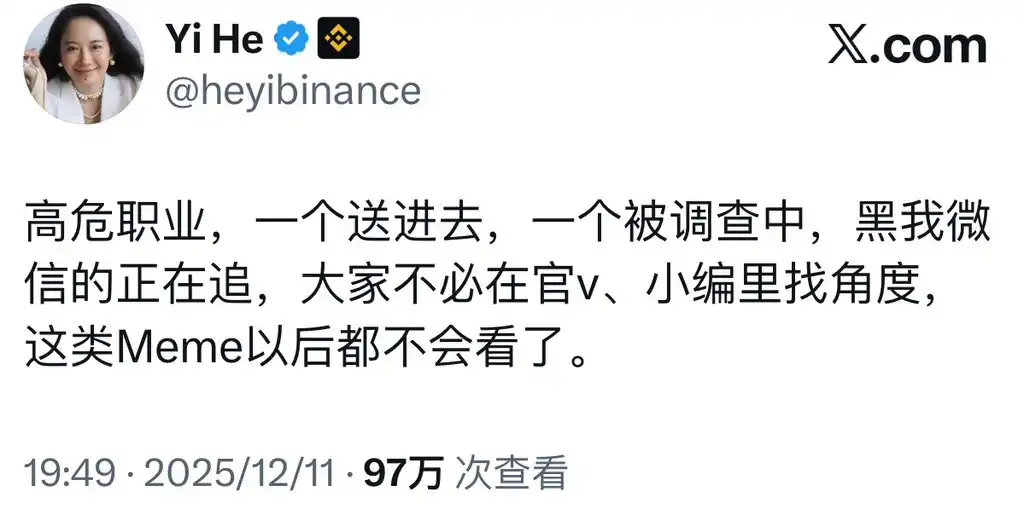
In December, she also tweeted saying, don't try to find angles in our official tweets, we won't pay attention to these kinds of Memes anymore.

Twenty-eight days later, her New Year's tweet became a new coin on Alpha.
What was the problem with girlfriend coins? It was about backdoor deals, favoritism,利益输送 (interest transfer).

These require evidence, a trail, a specific "girlfriend."

But "I'm Fucking Coming" doesn't need any of that.

No backdoor, no favoritism, no利益输送. Sister Yi posted a picture, and the people below just started moving on their own.

This perhaps touches on the essence of Shandong-style learning: The leader doesn't need to say anything; you have to figure it out yourself.

Some in the community commented that Alpha is now just a tool for currying favor, its purpose is to make Sister Yi happy.

Crude wording, but it describes an atmosphere.

When a platform's direction starts revolving around someone's social media, when "which coin to list" becomes "guess what she likes," rules cease to matter.

What matters is揣摩 (speculation/figuring out).

Some put it more harshly: If you want to know if an industry has a future, ask one question—In this industry, do people who are good at flattery succeed more easily than people who are good at doing things?

If the answer is "yes," then this industry is on the decline.

In the crypto world, this trick really works. And the most successful ones, everyone knows who the flattery should be directed toward.
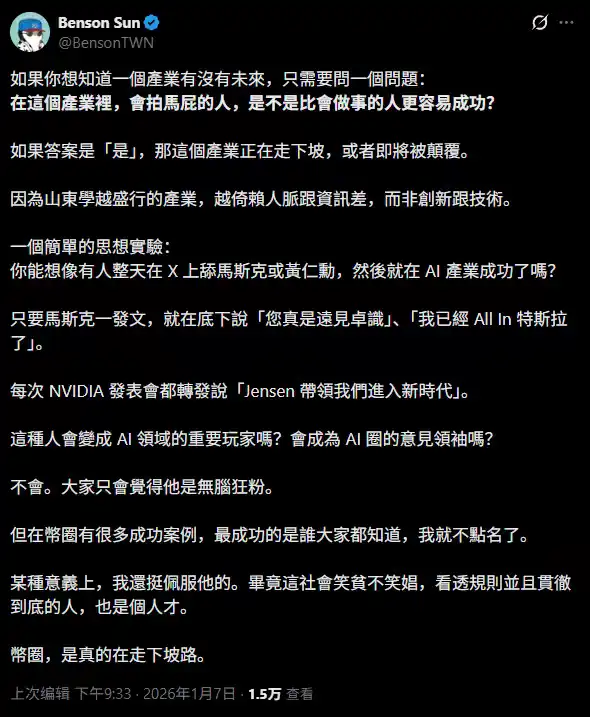
The core resources in the AI circle are technology and products; you have to deliver. Jensen Huang won't give you GPUs just because you call him daddy every day.

The core resources in the crypto circle are listing rights, traffic, who knows the news first. These things aren't in the code; they're in people's hands.

Things in people's hands must be obtained through human methods.

The more prevalent Shandong-style learning is, the more it relies on connections and information asymmetry, not innovation and technology.

Yi He might not even know about this. A small MEME worth a few million market cap isn't enough to bother the Co-CEO.

But that's precisely the problem.

She doesn't need to know. The fish head will turn by itself.

This is really much more efficient than girlfriend coins.

Girlfriend coins at least required a girlfriend. Shandong-style learning only requires an atmosphere.

And those who see through this set of rules and implement them thoroughly are, in a sense, also talented.

After all, in this society, people laugh at the poor, not the prostitute.

Related Questions

QWhat is the core concept of 'Shandong Study' in the crypto world as described in the article?

AThe core concept of 'Shandong Study' in the crypto world refers to an unwritten rule where individuals or groups instinctively align their actions to please key figures in power, such as Binance's He Yi, without explicit instructions. It emphasizes intuition and揣摩 (speculation) over formal rules, particularly in contexts like token approvals on platforms.

QHow did the meme token '我踏马来了' (I'm Coming on Horseback) get listed on Binance Alpha according to the article?

AThe meme token '我踏马来了' was created by the community after He Yi, Binance's co-CEO, posted a New Year's tweet with the phrase '我踏马来了' and an image of herself on a horse. The community independently developed and listed the token on Binance Alpha, without direct involvement or instructions from He Yi, demonstrating the 'Shandong Study' phenomenon.

QWhat criticism does the article level against the crypto industry's reliance on 'Shandong Study' dynamics?

AThe article criticizes that such dynamics prioritize flattery and connections over innovation and technology, suggesting that an industry where 'bootlicking' is more rewarded than actual work is in decline. It highlights how resources like token listing privileges and information asymmetry are controlled by people rather than code, leading to a culture of揣摩 (speculation) rather than merit-based success.

QHow does the 'Shandong Study' approach differ from the previous '闺蜜币' (close-friend coin) issue at Binance?

AThe '闺蜜币' issue involved alleged backdoor dealings and explicit利益输送 (benefit transfers) through personal relationships, requiring evidence of specific connections. In contrast, 'Shandong Study' operates implicitly—no direct orders or relationships are needed; instead, participants intuitively act to align with the preferences of powerful figures like He Yi, creating a self-driven culture of compliance without formal corruption.

QWhat broader implication does the article suggest about power and decision-making in crypto platforms like Binance?

AThe article implies that decision-making in crypto platforms can become overly centralized around key individuals, where informal influence and social media activity shape outcomes like token listings. This shifts focus from transparent, rule-based systems to a culture of揣摩 (speculation) and alignment with personal whims, potentially undermining innovation and fairness in the industry.

Related Reads

OpenAI's Largest Internal Wealth Creation: 600 People Cash Out a Total of $6.6 Billion, 75 Take Home the Maximum $30 Million Each

A Wall Street Journal report reveals OpenAI's unprecedented pre-IPO wealth creation. In a single employee stock sale last October, over 600 current and former employees sold shares, collectively cashing out approximately $6.6 billion. Due to high investor demand, the company tripled the individual sale cap to $30 million, with about 75 employees selling the maximum amount. This event represents the largest such transaction in tech industry history for a private company. OpenAI's valuation was $500 billion for this tender offer. Employees with over two years of tenure were eligible, allowing many post-ChatGPT hires their first liquidity event. The company's stock has reportedly grown over 100-fold in seven years. Following a restructuring, employees collectively hold about 26% of OpenAI. The scale of executive wealth is also staggering. In court testimony related to Elon Musk's lawsuit, President and co-founder Greg Brockman confirmed his OpenAI stake is worth around $30 billion. Analysis indicates about 165 current and former employees hold a combined ~$164.9 billion in equity, averaging nearly $1 billion per person in paper wealth. OpenAI's per-employee stock-based compensation is estimated to be 34 times the average of major tech firms before their IPOs. OpenAI continues its rapid ascent, closing a $122 billion funding round at an $852 billion valuation in March. With monthly revenue hitting $2 billion, over 900 million weekly ChatGPT users, and plans for a potential trillion-dollar IPO in late 2026, this wealth-creation engine shows no signs of stopping.

链捕手16m ago

OpenAI's Largest Internal Wealth Creation: 600 People Cash Out a Total of $6.6 Billion, 75 Take Home the Maximum $30 Million Each

链捕手16m ago

Understanding CPO (Co-Packaged Optics) in One Article: Why Nvidia Is Willing to Spend $3.2 Billion on a Fiber?

NVIDIA and Corning announced a multi-year strategic partnership on May 6, 2026, with NVIDIA committing up to $3.2 billion to support Corning's U.S. expansion. This investment will triple Corning's manufacturing plants and significantly boost its optical fiber and communications production capacity. The core driver behind this massive investment is the fundamental shift from copper to optical interconnect technology within AI data centers. As GPU clusters scale, copper wires face critical limitations: severe signal attenuation over distance, high energy consumption for signal integrity, and excessive heat generation. Optical fiber, transmitting light instead of electrical signals, solves these issues with minimal loss, near-light speed, and lower power needs. The article outlines a three-stage evolution of data center interconnect: 1. **Traditional Copper Interconnects:** The mainstream solution of the 2010s, now being phased out due to scaling bottlenecks. 2. **Pluggable Optical Modules:** The current mainstream, where modules convert electrical signals to light externally. This process still introduces energy loss and latency. 3. **CPO (Co-Packaged Optics):** The next-generation technology where the optical engine is integrated directly with the GPU chip package. This drastically reduces the electrical signal travel distance to mere millimeters, slashing power consumption and latency while boosting data density. NVIDIA CEO Jensen Huang has identified CPO as an essential core technology for AI infrastructure. NVIDIA's investment signifies a strategic shift from being a buyer to actively controlling its supply chain for critical components. With demand for specialized optical fiber far outstripping supply—evidenced by soaring prices—securing long-term manufacturing capacity has become a competitive necessity. While Corning's expansion may pressure some suppliers, a projected global fiber supply gap of 5-15% over the next few years creates a significant opportunity window, particularly for Chinese manufacturers competitive in optical preforms, chips, and modules. Ultimately, NVIDIA's move is not about chasing a trend but an engineering imperative. The transition to light-based interconnects like CPO is driven by the physical limits of copper, marking a definitive step in the ongoing AI computing revolution.

marsbit41m ago

Understanding CPO (Co-Packaged Optics) in One Article: Why Nvidia Is Willing to Spend $3.2 Billion on a Fiber?

marsbit41m ago

KOL's Perspective: Why Is SOL Set to Rise from This Point?

**Summary: Why SOL is Positioned for Growth at This Level** The article argues that SOL is poised for an upward move from its current price point, citing several key factors. Primarily, SOL has just broken out of a 4-month consolidation phase. This breakout signals a return of risk appetite to the broader crypto market, as SOL is seen as a key indicator of overall crypto health. The token's ownership has reportedly shifted from short-term traders and tourists to long-term accumulators, leading to low volume. Any meaningful increase in trading activity could thus trigger significant upward momentum. Fundamental strengths include strong institutional adoption, integration with DeFi and RWAs (Real-World Assets), and the potential benefits from the Clarity Act. Despite its high volatility—having dropped 70% from its all-time high but still up 12x from its bear market low—SOL is highlighted as one of the few tokens from the last cycle to reach new highs. It boasts a robust ecosystem of applications, users, and protocols. Future catalysts include the expected influx of AI developers following the Miami Accelerate conference, which focused on AI on Solana. Furthermore, Solana is positioned as the premier chain for memecoin activity, a trend expected to continue and drive network usage and fees. The article concludes that recent price action reflects a healthy transfer to long-term holders, setting the stage for growth.

marsbit1h ago

KOL's Perspective: Why Is SOL Set to Rise from This Point?

marsbit1h ago

Trading

Spot
Futures
活动图片





