When the Spreads Reach 50%: The Rise of Pre-Market Crypto-Stock Arbitrage

比推Published on 2026-03-16Last updated on 2026-03-16

Abstract

In the context of the crypto bear market, a new arbitrage opportunity is gaining traction: pre-IPO stock tokenization trading across different platforms. The article highlights significant price discrepancies—sometimes exceeding 50%—for high-profile companies like Kalshi, Polymarket, and SpaceX (xAI) on platforms such as PreStocks, Jarsy, and Tessera. These gaps, driven by varying trading mechanisms and liquidity conditions, reveal a strong market demand for a unified platform that bridges traditional and crypto pre-market trading. The piece argues that building such an intermediary could capitalize on these arbitrage opportunities, especially with a wave of major IPOs expected in 2026, while generating revenue through trading fees and liquidity provision.

Author: Wenser, Odaily Planet Daily

Editor: Hao Fangzhou

Original Title: Spreads Exceeding 50%, The Pre-Market Crypto-Stock Arbitrage Market to Become a New Business in the Crypto Bear Market


Not long ago, Mysten Labs CEO evan.sui shared his views on the "bear market." He mentioned that he does not agree with the so-called "the bear market is great, keep building" argument. In fact, the bear market is not "great"; packaging it as good for everyone overlooks the real costs (such as discouraging builders and users). Many retail investors and excellent teams will face cash flow breaks and have to exit, ultimately harming the long-term development of the crypto industry.

However, data evidence is inconsistent with this view. A report released by Lattice VC in October 2024 showed that at that time, over 80% of crypto startups that announced seed round financing during the 2022 bear market were still building. In other words, if project parties can ensure relative stability in personnel and funds, the bear market is indeed more conducive to project construction and development. As for the reasons, perhaps it's because project parties focus more on product development and experience optimization during a bear market; or perhaps the bear market trains project parties in various abilities to survive. In short, being in a crypto bear market, project parties determined to start a business might instead find a way out of desperation and carve their own path of development.

In view of this, we will explore the potential employment tracks and project directions in this cycle through a series of articles titled "Crypto Bear Market Startup Guide." If crypto projects are born and grow rapidly in the future as a result, Odaily Planet Daily also welcomes project parties to discuss cooperation.

Today, let's first talk about the hottest potential entrepreneurial direction at the moment besides prediction markets—the pre-market price difference market for crypto and stocks.

The Real Demand of the Pre-Market Crypto-Stock Market: Platform Differentiation and Liquidity Bridge

As an intermediate bridge connecting the crypto market and the traditional financial market, crypto-stock trading platforms have not only received high attention and active participation from crypto project parties, but global leading securities platforms including Nasdaq and the New York Stock Exchange have also ventured into it, aiming to capture the incremental market while further activating liquidity in the traditional financial market.

Furthermore, not only have listed cryptocurrency concept stocks undergone tokenization and on-chain contract transformation, but many hot concept stocks that have not yet IPOed have also been highly sought after by both the crypto market and the traditional financial market, thus giving rise to several pre-market stock tokenization trading platforms.

Considering that the capital market is about to welcome a wave of US listings this year, including OpenAI, Anthropic, SpaceX (xAI), Kalshi, Polymarket, OKX, Kraken, and a series of AI model companies, commercial aerospace companies, prediction market platforms, and crypto exchanges, 2026 is undoubtedly a "big year for IPOs."

Against the backdrop of the crypto market falling intermittently with occasional rebounds and the stock market rising everywhere节节攀升, the heat of the pre-market stock trading market further corroborates the above view—there is strong demand for pre-market trading of hot concept stocks in both the crypto market and the traditional financial market.

This is the main reason for the emergence of pre-market stock trading platforms such as PreStocks, Jarsy, and Tessera. Additionally, compared to pre-market stock trading markets in the traditional financial market such as Hiive and Nasdaq Private Market, the trading methods, purchase quotas, and entry barriers of the crypto pre-market trading market are more flexible, and the premiums are relatively higher, so many users participate enthusiastically.

But just as the same token can have different degrees of price differences on different exchanges, before the pre-market stock market temporarily introduces a mechanism similar to an oracle, whatever the reason, we can clearly see that the pricing of the same underlying stock on the different platforms mentioned above has certain price differences.

Based on the above information, we can make a judgment—the crypto market still lacks one or more "bridge platforms between pre-market stock trading markets."

This is probably a necessary step to push stock tokenization and pre-market stock tokenization further forward—a unified comprehensive platform covering pre-market trading in both traditional financial markets and crypto markets.

Below, we will take the 2 leading prediction market platforms Kalshi and Polymarket, which are recently seeking $20 billion in financing, and SpaceX (xAI), valued at $1.25 trillion, as examples to discuss the feasibility and real demand of this "entrepreneurial direction."

Comparing Pre-Market Spreads of PreStocks, Jarsy, Tessera 3 Major Platforms: Maximum Spread Rate Exceeds 50%, Price Difference Up to Nearly $150

Kalshi Pre-Market Spread: Up to $148, Spread Rate About 37%

Taking the Kalshi pre-market trading market as an example, its prices on different platforms are as follows—

PreStocks platform, the pre-market price of the stock token is about $397; (Compared to the $369 we mentioned one month ago in the article "Kalshi Trading Volume Continues to Break New Highs, What is a Reasonable Pre-Market Stock Price?" (https://www.odaily.news/zh-CN/post/5209330), it has increased by nearly $30, a increase of 7.6%)
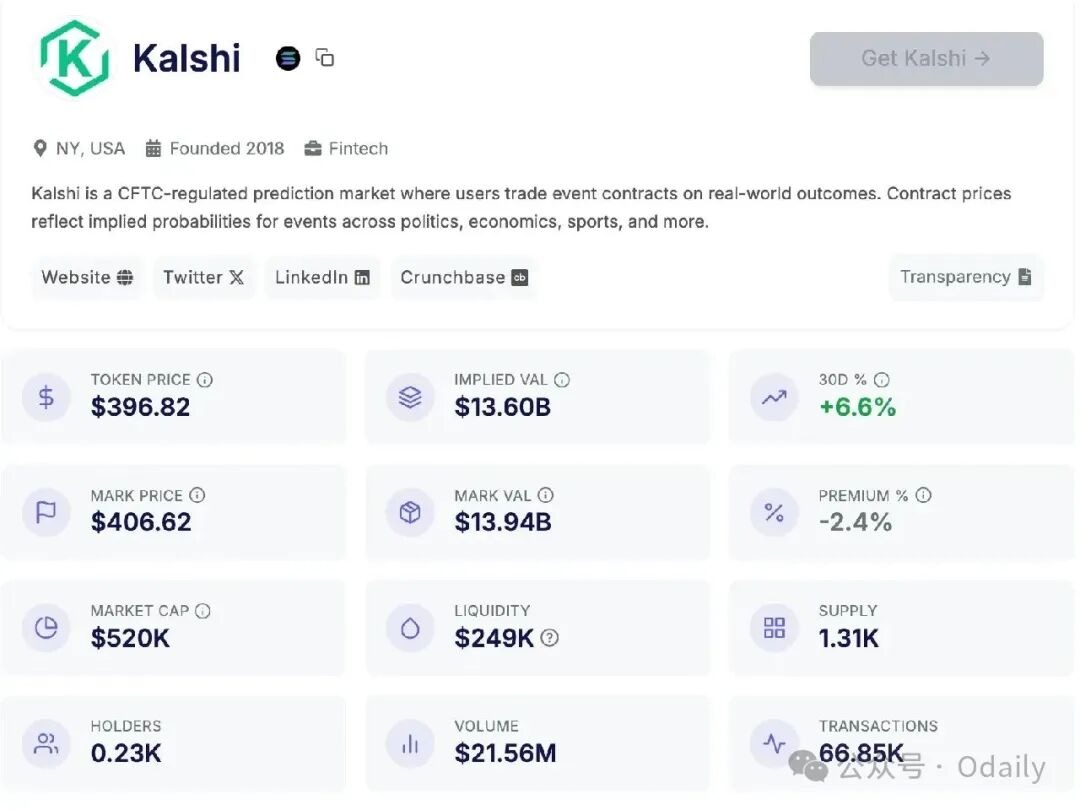
Jarsy platform, the pre-market stock price is quoted at about $545. (Compared to the $504 we mentioned one month ago in the article "Kalshi Trading Volume Continues to Break New Highs, What is a Reasonable Pre-Market Stock Price?" (https://www.odaily.news/zh-CN/post/5209330), it has increased by over $40, a increase of 8.1%)

In other words, the pre-market stock price of Kalshi has a spread of up to $148 between the two major trading platforms (Odaily Planet Daily Note: Considering that the two platforms adopt an order book trading mechanism and an on-chain liquidity token trading mechanism respectively, we are only making an abstract comparison here, temporarily not involving specific asset delivery forms, the same below). If calculated based on the $360 price of the traditional financial market pre-market trading platform Hiive, the pre-market spread is even as high as $185.

Polymarket Pre-Market Spread: Up to $94, Spread Rate Over 50%

Taking the Polymarket pre-market trading market as an example, its prices on different platforms are as follows—

PreStocks platform, the pre-market price of the stock token is about $186 (Odaily Planet Daily Note: up 23% in the past 30 days);
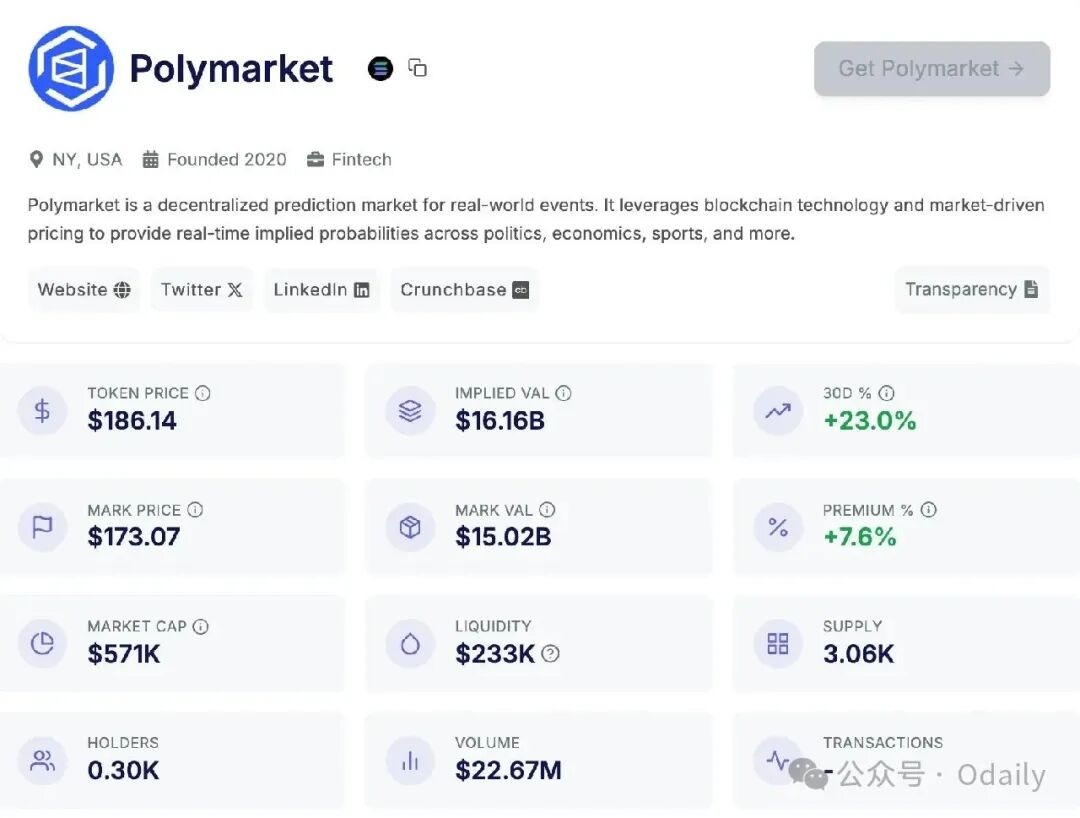
Jarsy platform, the pre-market stock price is quoted at about $280.

In other words, the pre-market stock price of Polymarket has a spread of about $94 between the 2 major platforms, with a spread rate of about 50.5%.

SpaceX(xAI) Pre-Market Spread: About $75, Spread Rate 12.7%

Taking SpaceX(xAI) as an example, its prices on different platforms are as follows—

PreStocks platform, the pre-market price of the stock token is about $666 (Odaily Planet Daily Note: up 4.1% in the past 30 days);
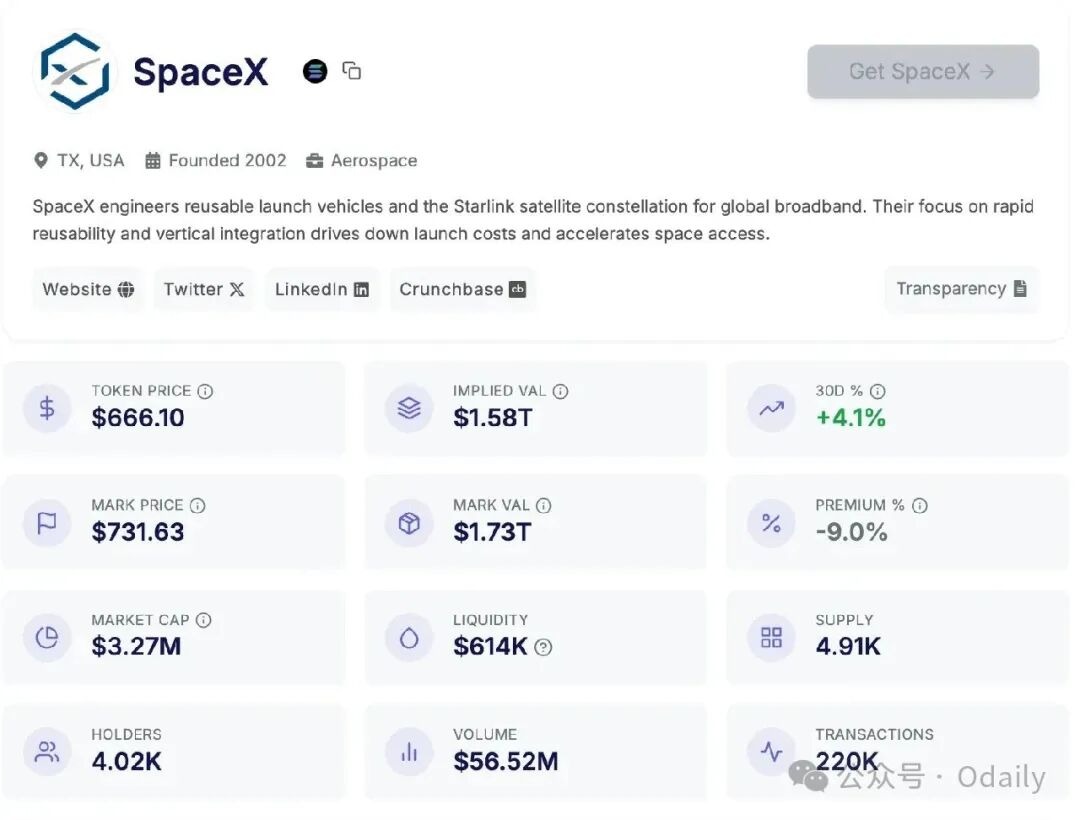
Tessera platform, the pre-market price of the stock token is temporarily reported at about $591 (Odaily Planet Daily Note: up about 14.5% in the past 30 days).
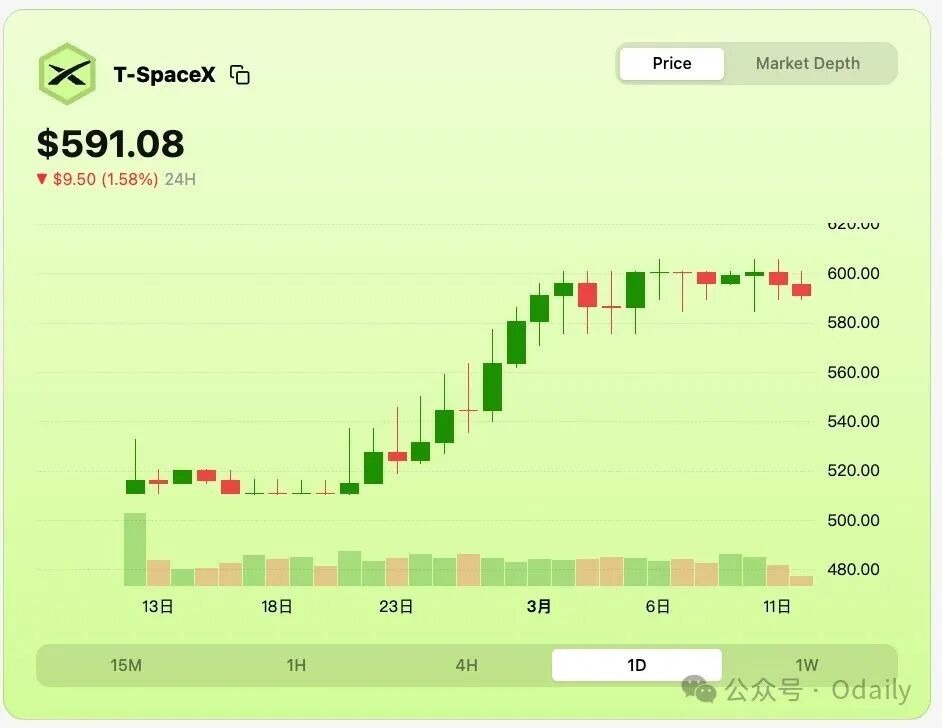
In other words, the pre-market stock price of SpaceX has a spread of about $75 between the 2 major platforms, with a spread rate of about 12.7%.

In summary, based on existing pre-market trading platforms, it might be possible to build a crypto-stock pre-market spread market to meet the trading demand and speculation demand of the market after having sufficient pre-market tokens or pre-market equity capital.

Of course, considering that the current market liquidity remains within the million-dollar level, the main business model of this platform may lie in transaction fees or LP fees, as well as the realization of price differences from the platform's own investment quotas.


Twitter:https://twitter.com/BitpushNewsCN

Bitpush TG Communication Group:https://t.me/BitPushCommunity

Bitpush TG Subscription: https://t.me/bitpush

Original link:https://www.bitpush.news/articles/7619997

Related Questions

QWhat is the main topic of the article regarding the crypto bear market?

AThe article discusses the emergence of a new potential business opportunity in the crypto bear market: the pre-market price arbitrage market for tokenized stocks, where significant price differences (spreads) exist across different trading platforms.

QWhich companies are mentioned as examples to illustrate the price differences in the pre-market stock trading platforms?

AThe article mentions Kalshi, Polymarket, and SpaceX (xAI) as examples to illustrate the price differences on platforms like PreStocks, Jarsy, and Tessera.

QWhat was the largest price difference (spread) mentioned for Polymarket's pre-market stock, and what was the spread rate?

AFor Polymarket, the largest price difference mentioned was $94, with a spread rate of approximately 50.5%.

QAccording to the article, what is the proposed solution to address the price differences across various pre-market trading platforms?

AThe article suggests building a bridge platform or a unified comprehensive platform that connects pre-market trading in both traditional financial markets and crypto markets to arbitrage the price differences.

QWhat reason does the article give for the emergence of platforms like PreStocks, Jarsy, and Tessera?

AThese platforms emerged due to the high demand from both crypto and traditional financial markets for pre-market trading of hot concept stocks, especially with the upcoming IPO boom in 2026 involving companies like OpenAI, Anthropic, SpaceX, and others.

Related Reads

Gensyn AI: Don't Let AI Repeat the Mistakes of the Internet

In recent months, the rapid growth of the AI industry has attracted significant talent from the crypto sector. A persistent question among researchers intersecting both fields is whether blockchain can become a foundational part of AI infrastructure. While many previous AI and Crypto projects focused on application layers (like AI Agents, on-chain reasoning, data markets, and compute rentals), few achieved viable commercial models. Gensyn differentiates itself by targeting the most critical and expensive layer of AI: model training. Gensyn aims to organize globally distributed GPU resources into an open AI training network. Developers can submit training tasks, nodes provide computational power, and the network verifies results while distributing incentives. The core issue addressed is not decentralization for its own sake, but the increasing centralization of compute power among tech giants. In the era of large models, access to GPUs (like the H100) has become a decisive bottleneck, dictating the pace of AI development. Major AI companies are heavily dependent on large cloud providers for compute resources. Gensyn's approach is significant for several reasons: 1) It operates at the core infrastructure layer (model training), the most resource-intensive and technically demanding part of the AI value chain. 2) It proposes a more open, collaborative model for compute, potentially increasing resource utilization by dynamically pooling idle GPUs, similar to early cloud computing logic. 3) Its technical moat lies in solving complex challenges like verifying training results, ensuring node honesty, and maintaining reliability in a distributed environment—making it more of a deep-tech infrastructure company. 4) It targets a validated, high-growth market with genuine demand, rather than pursuing blockchain integration without purpose. Ultimately, the boundaries between Crypto and AI are blurring. AI requires global resource coordination, incentive mechanisms, and collaborative systems—areas where crypto-native solutions excel. Gensyn represents a step toward making advanced training capabilities more accessible and collaborative, moving beyond a niche controlled by a few giants. If successful, it could evolve into a fundamental piece of AI infrastructure, where the most enduring value in the AI era is often created.

marsbit10h ago

Gensyn AI: Don't Let AI Repeat the Mistakes of the Internet

marsbit10h ago

Why is China's AI Developing So Fast? The Answer Lies Inside the Labs

A US researcher's visit to China's top AI labs reveals distinct cultural and organizational factors driving China's rapid AI development. While talent, data, and compute are similar to the West, Chinese labs excel through a pragmatic, execution-focused culture: less emphasis on individual stardom and conceptual debate, and more on teamwork, engineering optimization, and mastering the full tech stack. A key advantage is the integration of young students and researchers who approach model-building with fresh perspectives and low ego, prioritizing collective progress over personal credit. This contrasts with the US culture of self-promotion and "star scientist" narratives. Chinese labs also exhibit a strong "build, don't buy" mentality, preferring to develop core capabilities—like data pipelines and environments—in-house rather than relying on external services. The ecosystem feels more collaborative than tribal, with mutual respect among labs. While government support exists, its scale is unclear, and technical decisions appear driven by labs, not state mandates. Chinese companies across sectors, from platforms to consumer tech, are building their own foundational models to control their tech destiny, reflecting a broader cultural drive for technological sovereignty. Demand for AI is emerging, with spending patterns potentially mirroring cloud infrastructure more than traditional SaaS. Despite challenges like a less mature data industry and GPU shortages, Chinese labs are propelled by vast talent, rapid iteration, and deep integration with the open-source community. The competition is evolving beyond a pure model race into a contest of organizational execution, developer ecosystems, and industrial pragmatism.

marsbit12h ago

Why is China's AI Developing So Fast? The Answer Lies Inside the Labs

marsbit12h ago

3 Years, 5 Times: The Rebirth of a Century-Old Glass Factory

Corning, a 175-year-old glass company, is experiencing a dramatic revival as a key player in AI infrastructure, driven by surging demand for high-performance optical fiber in data centers. AI data centers require vastly more fiber than traditional ones—5 to 10 times as much per rack—to handle high-speed data transmission between GPUs. This structural demand shift, coupled with supply constraints from the lengthy expansion cycle for fiber preforms, has created a significant supply-demand gap. Nvidia has invested in Corning, along with Lumentum and Coherent, in a $4.5 billion total commitment to secure the optical supply chain for AI. Corning's competitive edge lies in its expertise in producing ultra-low-loss, high-density, and bend-resistant specialty fiber, which is critical for 800G+ and future 1.6T data rates. Its deep involvement in co-packaged optics (CPO) with partners like Nvidia further solidifies its position. While not the largest fiber manufacturer globally, Corning's revenue from enterprise/data center clients now exceeds 40% of its optical communications sales, and it has secured multi-year supply agreements with major hyperscalers including Meta and Nvidia. Financially, Corning's optical communications revenue has surged, doubling from $1.3 billion in 2023 to over $3 billion in 2025. Its stock price has risen nearly 6-fold since late 2023. Key future catalysts include the rollout of Nvidia's CPO products and the scale of undisclosed customer agreements. However, risks include high current valuations and potential disruption from next-generation technologies like hollow-core fiber. The company's long-term bet on light over electricity, maintained even through the telecom bubble crash, is now being validated by the AI boom.

marsbit12h ago

3 Years, 5 Times: The Rebirth of a Century-Old Glass Factory

marsbit12h ago

Trading

Spot
Futures
活动图片