When Tether No Longer Clings to the Dollar...

比推Published on 2025-12-09Last updated on 2025-12-09

Abstract

Tether, the issuer of the world's largest stablecoin USDT, is shifting its reserve strategy in anticipation of lower interest rates. While its business model thrived during high-rate periods—earning billions from U.S. Treasury holdings—future Fed rate cuts could reduce its interest income significantly. To adapt, Tether has diversified into gold (over 100 tons) and Bitcoin (over 90,000 BTC), which together make up 12-13% of its reserves. These assets historically perform well in low-rate, high-liquidity environments, potentially offsetting lost Treasury yield. However, rating agencies like S&P have expressed concern, downgrading Tether’s stability rating due to increased exposure to volatile assets like Bitcoin and reduced transparency. The key challenge remains maintaining USDT’s dollar peg while navigating this new macroeconomic phase.

Author: Prathik Desai

Original Title: Gold, Bills, Thrills

Compiled and Edited by: BitpushNews


When I think of stablecoins, I often see them merely as a bridge between the US dollar and the blockchain, nothing more. They can be powerful infrastructure components, silently supporting the operation of on-chain products in ways that are often easily overlooked.

As a business model, stablecoin issuers have direct revenue, which is tied to the interest rates published by the US Federal Reserve. The higher the interest rates, the more income the US Treasury bonds backing their stablecoin circulation bring to the issuers.

However, in recent years, the world's largest stablecoin issuer by circulation has adjusted its reserve strategy to better adapt to the macroeconomic environment.

In this quantitative analysis, I will explore why and how Tether (Tether) is partially replacing its massive interest-earning engine with gold and Bitcoin to cope with the upcoming shift in the interest rate cycle.

Let's begin.
The US Treasury Machine

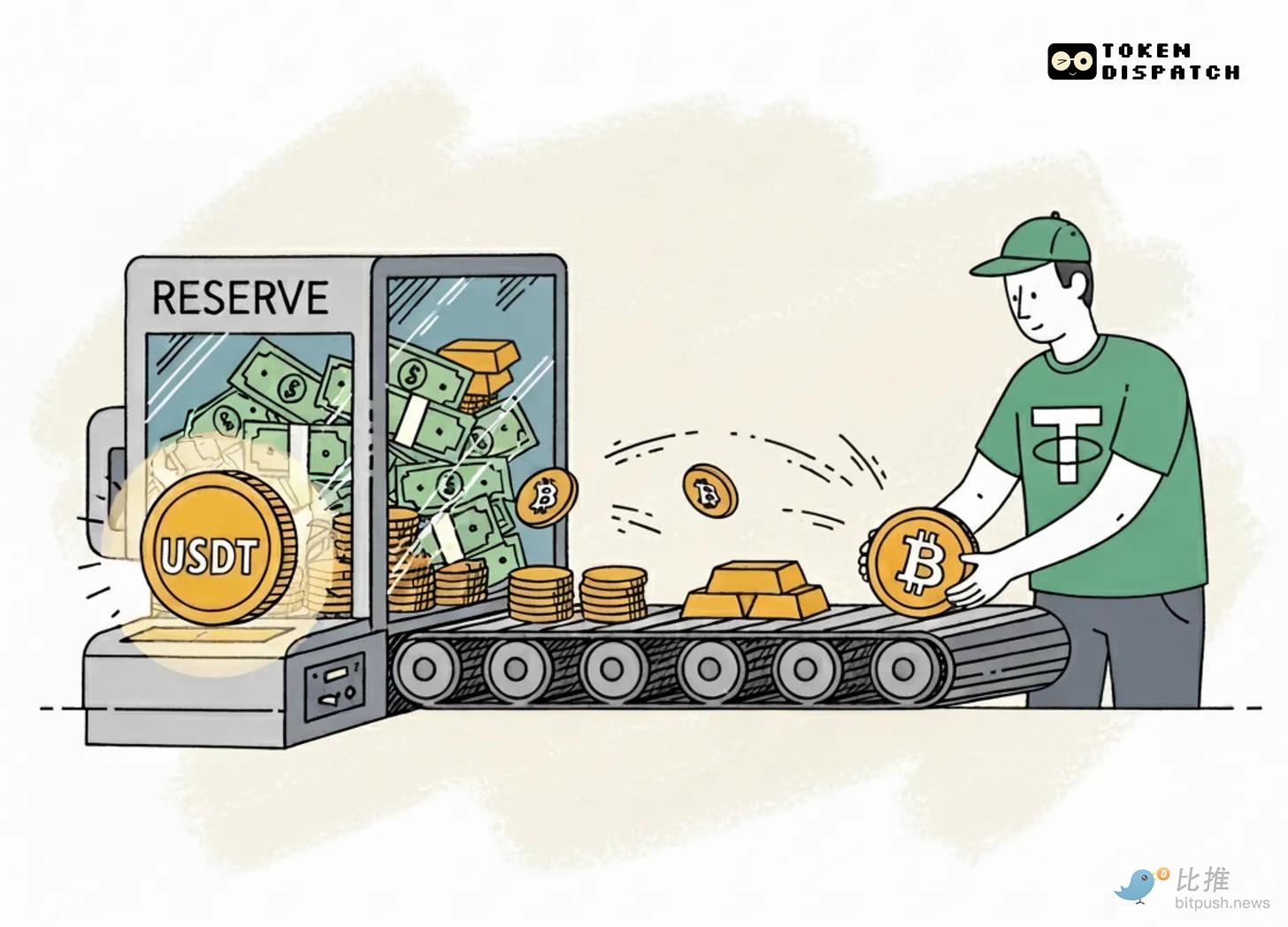
A glance at Tether's US Treasury reserves reveals how it became a profit machine during periods of high interest rates.

Over the past few years, USDT holders earned 0%, while Tether earned about 5% on approximately $1 trillion in US Treasury bonds.

Even with average interest rates relatively low for most of 2025, around 4.25%, as of September 30, 2025, Tether reported a net profit of over $10 billion for the year. In contrast, the second-largest stablecoin issuer, Circle, reported a net loss of $202 million for the same period.

For most of the past three years, Tether's business model perfectly aligned with the macroeconomic backdrop. The Federal Reserve maintained interest rates between 4.5% and 5.5%, and Tether held over $1 trillion in US bonds, with each percentage point of yield bringing in approximately $1 billion in annual revenue.

While most cryptocurrency companies struggled with operational losses, Tether accumulated tens of billions in surplus simply by going long on short-term government debt.

But what happens when the interest rate cycle turns, and rate cuts are expected in the coming years?

The Interest Rate Cycle Problem

CME FedWatch data shows that by December 2026, there is over a 75% probability that the federal funds rate will drop from the current 3.75-4% range to between 2.75-3% and 3.25-3.50%. This is already a significant drop from the 5% level that Tether relied on for profits in 2024.
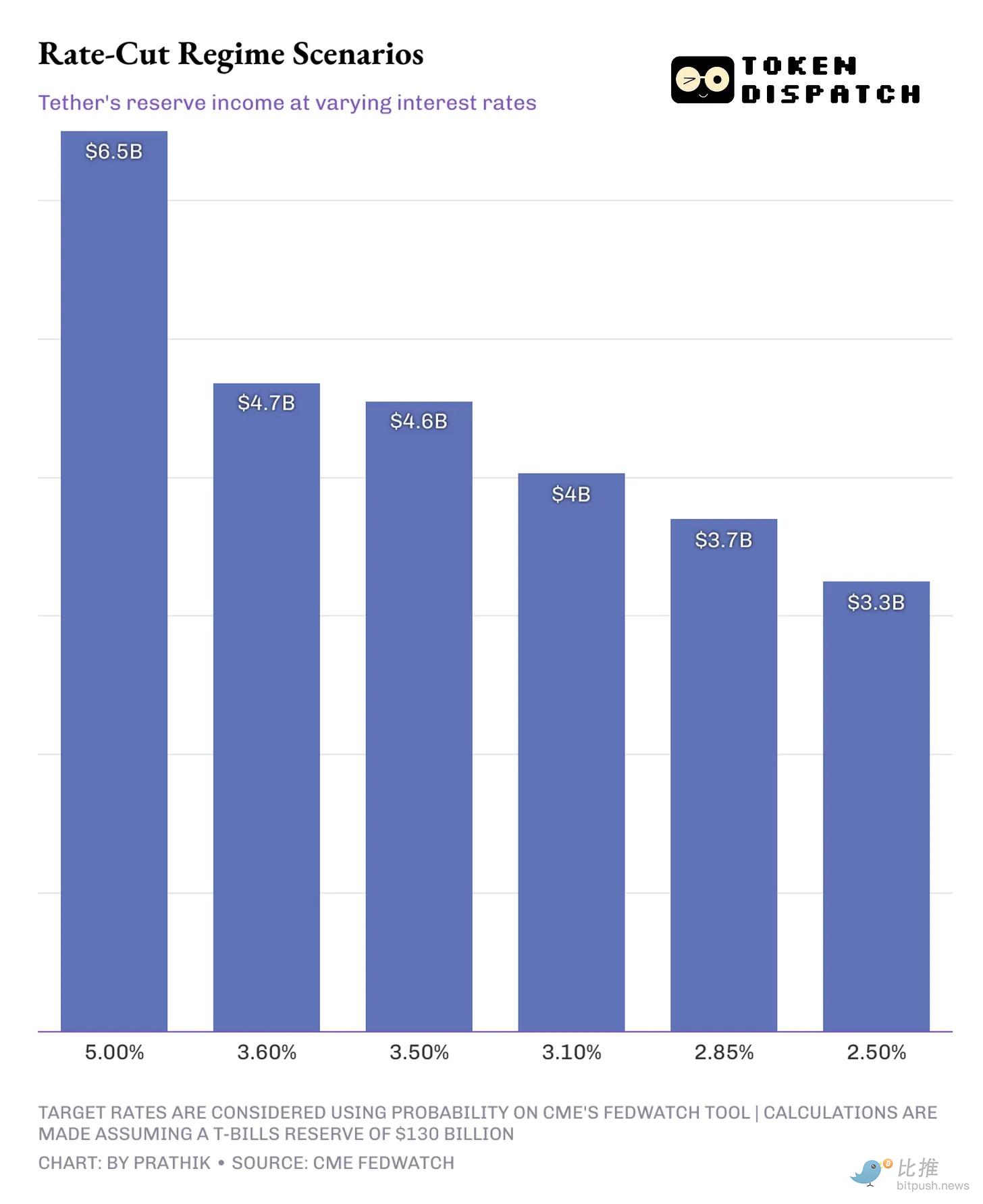
Lower interest rates could compress the interest income Tether earns from its US Treasury holdings.

A one-percentage-point drop in overall US economic liquidity could reduce Tether's annual income by at least $15 billion. This exceeds 10% of its annualized net profit for 2025.

So, how will Tether protect its profitability in this world? After Jerome Powell's term ends in 2026, a new Fed Chair is more likely to follow the expectations of US President Donald Trump for more significant and faster rate cuts.

It is at this point that Tether's reserve strategy diverges most significantly from any other stablecoin issuer.

Diversification Strategy

Between September 2021 and October 2022, Tether reduced its reliance on commercial paper (unsecured short-term debt instruments issued by large corporations) by over 99%. From over $30 billion in September 2021, it was cut to almost zero.

It replaced these assets with US-backed Treasury bonds to increase transparency for investors.
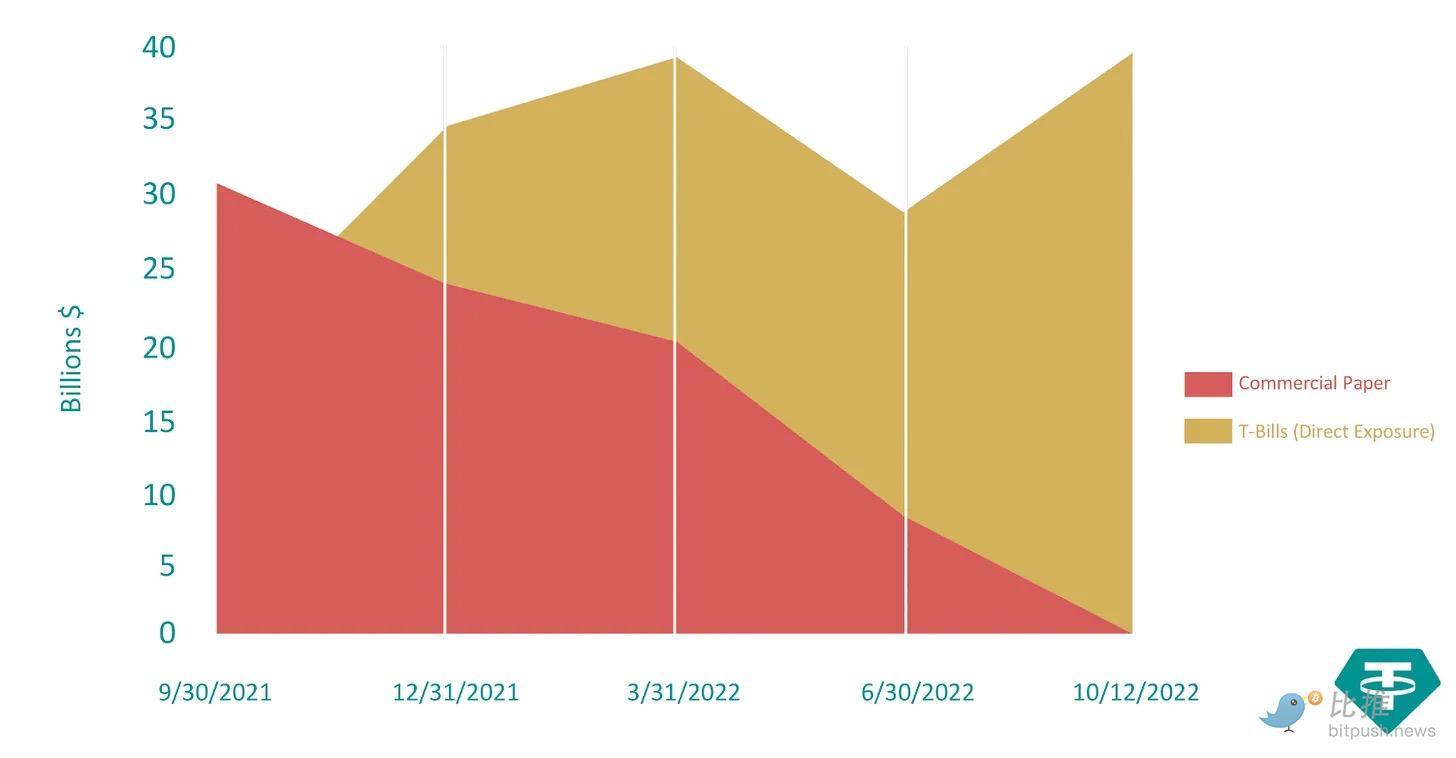
During the same period, Tether's US Treasury reserves grew from less than $25 billion to $40 billion.

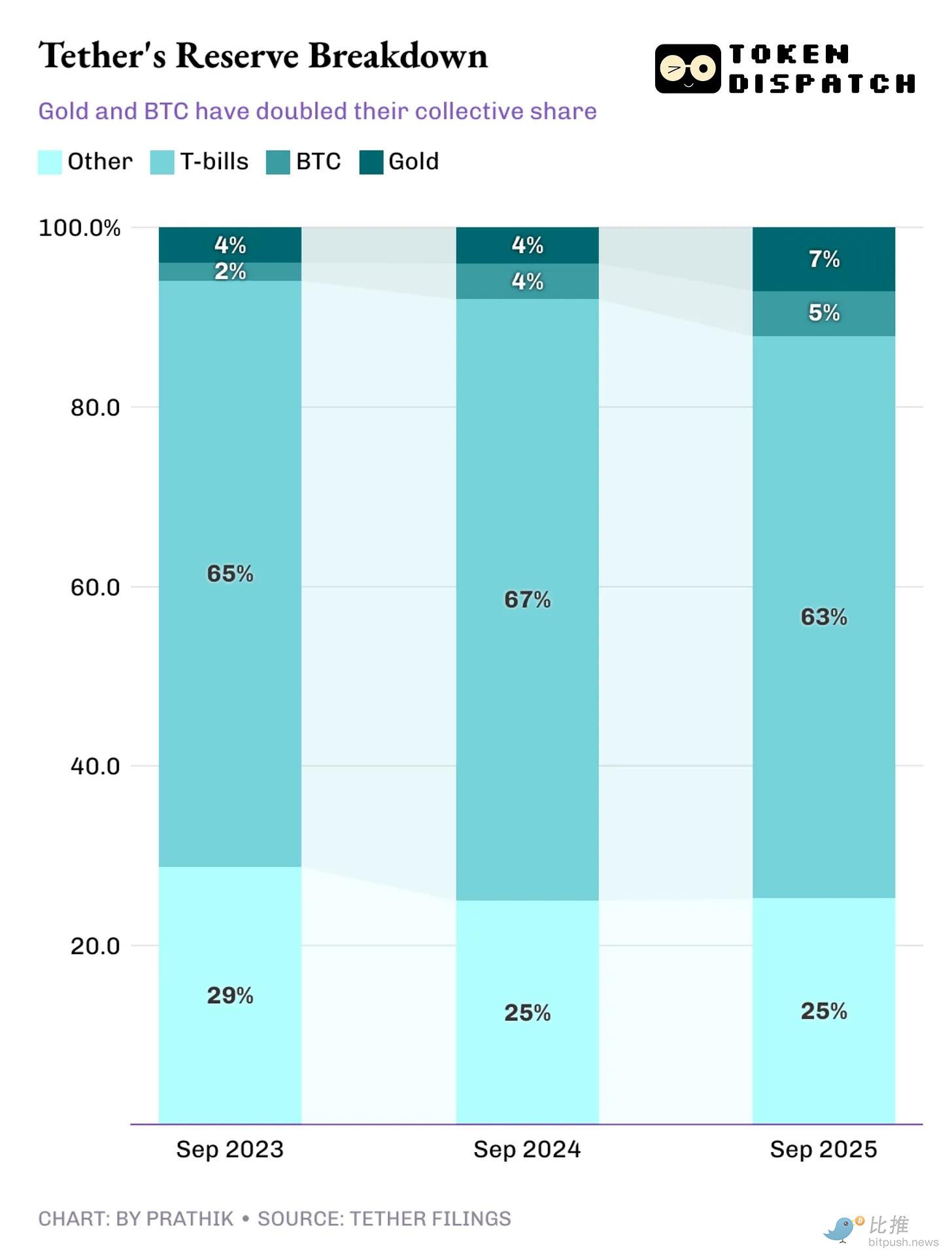
Between Q3 2023 and Q3 2025, the composition of Tether's reserve assets changed, incorporating asset classes rarely seen on the balance sheets of other stablecoin issuers.

As of September 2025, Tether had accumulated approximately over 100 tons of gold, valued at around $13 billion. It also held over 90,000 BTC, worth nearly $10 billion. Together, these account for about 12-13% of its reserves.

In contrast, its competitor Circle held only 74 Bitcoin, worth about $8 million.
Why the Shift Now?

The increase in gold and Bitcoin allocations coincided with the period when the forward rate curve no longer predicted rate hikes.

In response to rising inflation, interest rates jumped from less than 1% to over 5% between May 2022 and August 2023. During this time, maximizing income by investing in US Treasuries made economic sense. But once interest rates peaked in 2023 and no further hikes were expected, Tether saw it as the right moment to start preparing for the turn in the interest rate cycle.

Why Choose Gold and Bitcoin When Yields Fall?

Gold tends to perform well when US Treasury yields fall. This is driven by expectations of rising inflation and the reduced opportunity cost of holding gold instead of low-yielding US Treasuries.
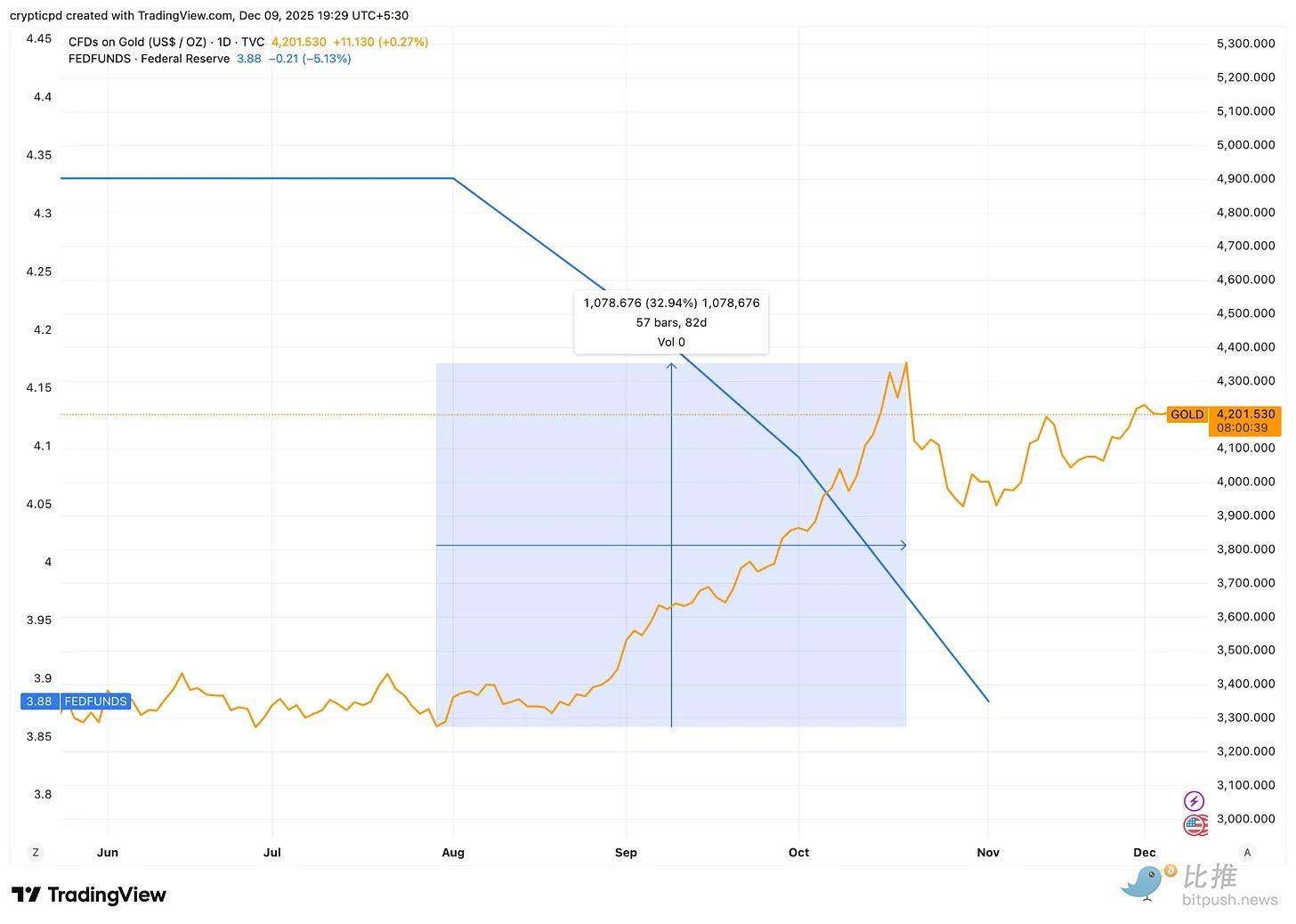
We saw this happen this year; when the Fed cut rates by 50 basis points, gold prices rose over 30% between August and November.

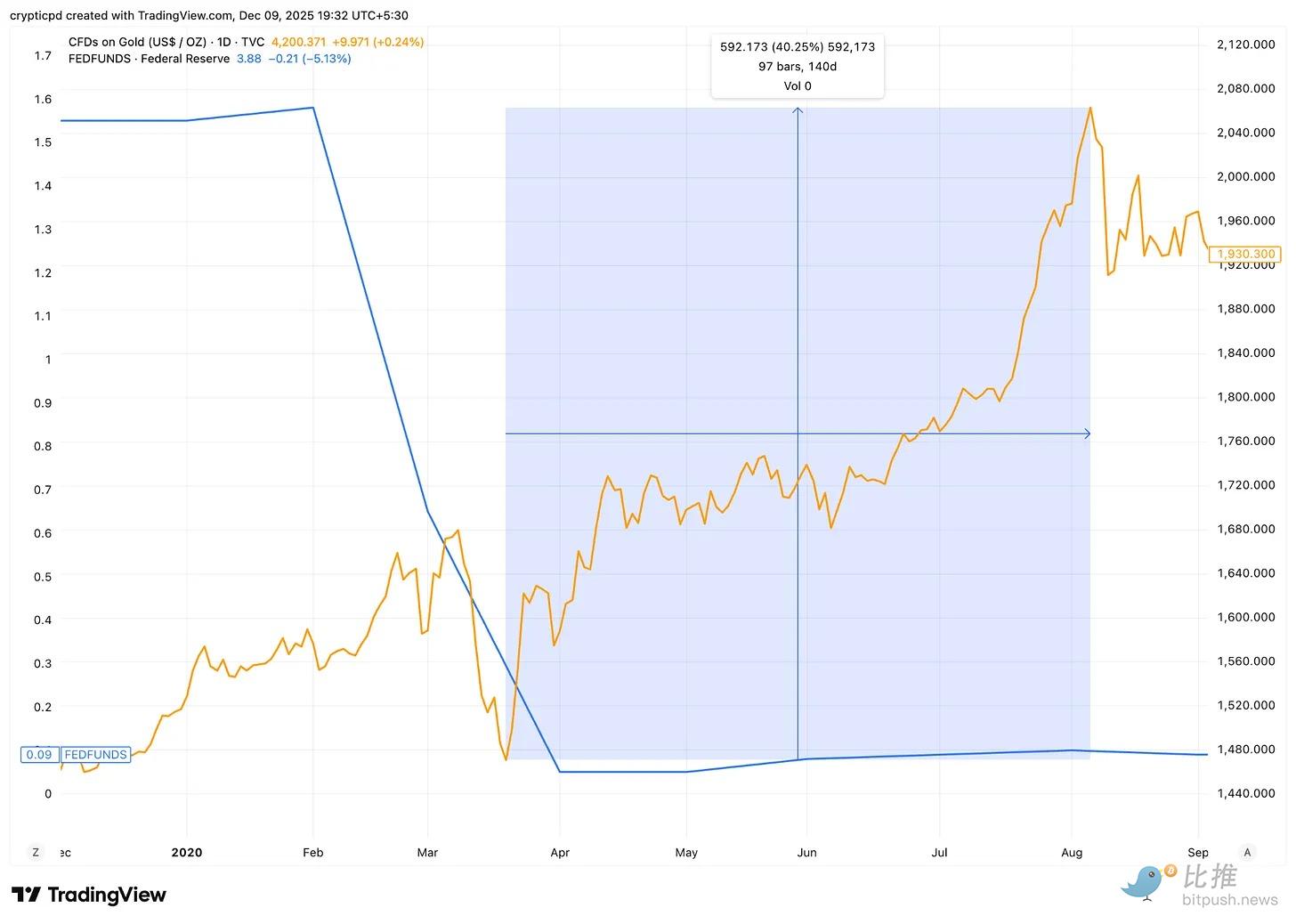
Even during the COVID-19 pandemic, when the Fed cut rates by 1.5 percentage points to inject liquidity into the economy, gold prices rose 40% in the subsequent five months.

Bitcoin has recently exhibited similar macro behavior. As monetary policy eases and liquidity expands, Bitcoin typically reacts like a high-beta asset.
Therefore, while a high-interest-rate environment allows for income through US Treasuries, allocating to Bitcoin and gold can provide potential upside in a low-interest-rate environment.

This allows Tether to book unrealized gains and even realize some profits by selling gold or Bitcoin from its vault, particularly during phases when interest rates are low and income is squeezed.

However, not everyone approves of the increased exposure to gold and Bitcoin on Tether's balance sheet.

The Peg Problem

Although US Treasuries still account for 63% of Tether's reserves, the increased exposure to riskier assets like Bitcoin and unsecured loans has raised concerns among rating agencies.

Two weeks ago, S&P Global Ratings reassessed Tether's ability to maintain the USDT peg to the US dollar from Tier 4 (Constrained) to Tier 5 (Weak). It noted the increased exposure to corporate bonds, precious metals, Bitcoin, and secured loans in its reserves.

The agency pointed out that these assets account for almost 24% of the total reserves. More troubling for the agency is that, although US Treasuries still back most of the reserves, the USDT issuer provides limited transparency and disclosure regarding the composition of these riskier asset classes.

Furthermore, there are concerns about undermining the peg of the USDT token to the US dollar.

S&P stated in its report: "Bitcoin now accounts for about 5.6% of USDT's circulation, exceeding the 3.9% over-collateralization margin, indicating that the reserves can no longer fully absorb the impact of its value decline. Therefore, a decline in Bitcoin's value combined with a decline in the value of other high-risk assets could reduce reserve coverage and lead to USDT being undercollateralized."

On one hand, Tether's shift in reserve strategy seems a reasonable measure to cope with the upcoming low-interest-rate environment. When rate cuts come—and they will—this $13 billion profit engine will struggle to sustain itself. The upside potential of the held gold and Bitcoin could help offset some of the income loss.

On the other hand, this shift has also rightly made rating agencies nervous. The primary task of a stablecoin issuer is to protect its peg to the underlying currency (in this case, the US dollar). Everything else, including the revenue it generates, its reserve diversification strategy, and the unrealized gains it can obtain, becomes secondary. If the peg fails, the business collapses.

When circulating tokens are backed by volatile assets, the risk profile of the peg changes. A sufficiently large impairment of Bitcoin—which we have been experiencing over the past two months—would not necessarily break the USDT peg but would narrow the buffer between the two.

Tether's story will unfold with the upcoming monetary policy easing. This week's rate cut decision will be the first indicator to measure this stablecoin giant's ability to defend its peg and signal its future trajectory.

Let's wait and see.


Twitter:https://twitter.com/BitpushNewsCN

Bitpush TG Discussion Group:https://t.me/BitPushCommunity

Bitpush TG Subscription: https://t.me/bitpush

Original article link:https://www.bitpush.news/articles/7594373

Related Questions

QWhy has Tether started diversifying its reserves to include assets like gold and Bitcoin?

ATether is diversifying its reserves to prepare for the upcoming shift in the interest rate cycle. As the Federal Reserve is expected to lower interest rates, the yield on U.S. Treasuries will decrease, compressing Tether's interest income. Gold and Bitcoin have historically performed well in low-rate environments, offering potential upside to offset this income loss.

QWhat is the current composition of Tether's reserves, and how does it differ from its competitor Circle?

AAs of September 2025, Tether's reserves consist of approximately 63% U.S. Treasuries, over 100 tons of gold (worth ~$13B), and over 90,000 BTC (worth ~$10B). In contrast, its competitor Circle holds only 74 Bitcoin, worth $8 million, showing a vastly different and more conservative strategy.

QWhat concerns have rating agencies like S&P Global raised about Tether's new reserve strategy?

AS&P Global Ratings downgraded its assessment of Tether's ability to maintain the USDT peg from 'constrained' to 'weak.' The agency is concerned about the increased exposure to higher-risk asset classes like corporate bonds, precious metals, Bitcoin, and secured loans, which now make up nearly 24% of its reserves. It also cited limited transparency and the risk that a drop in Bitcoin's value could reduce reserve coverage and lead to USDT being undercollateralized.

QHow did Tether's business model perform during the period of high interest rates?

ADuring the high-interest-rate period, Tether's business model was extremely profitable. It held over $1 trillion in U.S. Treasuries and earned a yield of around 5%. Even with lower average rates of about 4.25% for much of 2025, Tether reported a net profit exceeding $10 billion for the first nine months of the year, far outperforming competitors like Circle, which reported a net loss.

QHow do gold and Bitcoin typically behave in a low interest rate environment, and why is this beneficial for Tether?

AGold tends to perform well when U.S. Treasury yields fall, as it is driven by expectations of rising inflation and a lower opportunity cost of holding non-yielding assets. Bitcoin often acts as a high-beta asset, reacting positively to expansionary monetary policy and increased liquidity. This potential for price appreciation allows Tether to book unrealized gains or realize profits by selling these assets, helping to offset the squeezed income from lower-yielding Treasuries.

Related Reads

Sharplink CEO: One Million Ethereum Developers, Who Can Compete?

Etherean Ecosystem: One Million Developers and a Formidable Moat The Ethereum network has surpassed a significant milestone: over one million unique lifetime developers, with approximately 232,000 active in the past year. This vast and growing talent pool is Ethereum's core advantage, far more critical than transient metrics like speed or transaction fees. The central question is not which blockchain is fastest, but where the best builders choose to build long-term. Ethereum's answer lies in a decade-long accumulation of infrastructure, standards, tools, liquidity, and collaborative culture that is exceptionally difficult to replicate. It has become the default operating system for programmable finance. This massive developer base is actively working on complex, high-risk challenges that deepen Ethereum's strategic moat: * **Glamsterdam Upgrade (2026):** Focused on core protocol scalability (ePBS, parallel execution) while preserving core values like credible neutrality. * **Synchronous Composability:** Aims to make numerous Rollups interoperate like a single chain, directly addressing fragmentation concerns. * **Quantum Resistance:** Ethereum leads mainstream ecosystems in coordinated preparation for post-quantum cryptography, with a targeted migration plan around 2029. This developer advantage is self-reinforcing, fueled by: * **Deep Composability:** Applications interact like interoperable financial Lego bricks via shared standards (e.g., EVM, Solidity). * **Credible Neutrality:** Secured by over 900,000 validators, making it trusted by major institutions. * **Modularity:** Rollups (Base, Arbitrium, etc.) expand, rather than fracture, the ecosystem into a tightly connected modular internet economy. * **Culture:** Attracts top-tier researchers and standard-setters who guide the entire industry. In essence, while other chains generate activity, Ethereum is consolidating as the trusted, long-term coordination layer for internet-native finance. Its future is being built now by the architects of the next-generation financial infrastructure.

Odaily星球日报13m ago

Sharplink CEO: One Million Ethereum Developers, Who Can Compete?

Odaily星球日报13m ago

Ethereum Reaches the Milestone of One Million Developers, Sharplink CEO Delves Deep into Ethereum's Future Possibilities

Ethereum Surpasses One Million Developers Milestone: A Look at Its Unshakeable Dominance and Future Joseph Chalom, CEO of Sharplink, reflects on his recent Asia trip where he engaged deeply with Ethereum developers and ecosystem leaders. The most striking takeaway was not just the industry's vibrancy, but the rigorous, long-term vision of local builders. This context brings to life a pivotal statistic: Ethereum has now surpassed one million cumulative developers (1,012,824), with approximately 232,000 remaining active in the past year—a talent pool unmatched by any other crypto ecosystem. The critical question isn't which blockchain is fastest, but where top developers choose to build long-term. Ethereum's answer is unequivocal. Its decade-long lead stems from a unique convergence of technology, institutional culture, economic systems, and composability, cementing its role as the foundational operating system for programmable finance. This massive developer base is tackling the industry's hardest problems, continuously strengthening Ethereum's moat. Key initiatives include: * **The Glamsterdam Upgrade (planned 2026):** Introducing ePBS and Block-level Access Lists for parallel execution and higher throughput while preserving core values like credible neutrality and fair MEV distribution. * **Synchronous Composability:** Projects are working to enable atomic transactions across dozens of Rollups, making them function as one unified chain and eliminating ecosystem fragmentation. * **Post-Quantum Security:** Ethereum is far ahead in preparing for quantum computing threats, with a dedicated foundation working group and testnets targeting a full migration by ~2029—a crucial factor for institutional adoption. Beyond developers, Ethereum's core network effects are its unparalleled composability and unified standards (like EVM and Solidity), which create a powerful flywheel: more developers → better tools → greater liquidity → more institutional participation. Its other decisive advantages include credible neutrality (over 900k validators), a secure modular architecture with interconnected Rollups, and a deeply entrenched culture shaped by top-tier researchers. Ultimately, there's a vast difference between generating short-term activity and becoming the trusted, long-term coordination layer for global native finance. Major institutions prioritize security, trust, and liquidity—areas where Ethereum holds dominant mindshare. The industry's trajectory shows resources consolidating around unified standards, deep liquidity, and developer consensus. After meeting the builders in Seoul and Hong Kong, Chalom is more convinced than ever: Ethereum's unshakeable future is being built right now.

Foresight News25m ago

Ethereum Reaches the Milestone of One Million Developers, Sharplink CEO Delves Deep into Ethereum's Future Possibilities

Foresight News25m ago

Saylor's Latest Long Read: Bitcoin is Not Money, It's Digital Capital, and Money is Built Upon It

Michael Saylor presents his "Digital Asset Stack" theory, positioning Bitcoin as the foundational layer of digital capital. He argues Bitcoin itself should remain unchanged—no staking, inflation, or protocol alterations. Instead, a five-layer financial architecture should be built atop it: Digital Capital (BTC), Digital Credit (e.g., yield instruments like STRC), Digital Currency (stable, yield-bearing instruments pegged to fiat), Digital Yield (leveraged/structured products), and Digital Equity (e.g., MSTR stock, absorbing residual volatility). Saylor asserts this stack transforms Bitcoin's high-volatility, high-energy capital into tailored products: stable currencies for payments/savings, yield instruments for income seekers, and equity for growth investors. This approach meets diverse needs—corporate treasuries, banks, retirees, emerging market users—without compromising Bitcoin's core properties (scarcity, decentralization). The "killer use case" is rebuilding global money, credit, and capital markets on Bitcoin, bridging the fiat world with a superior digital asset foundation. The system leverages traditional finance principles (risk layering, structured products) while using Bitcoin as the ultimate collateral. This expands Bitcoin's utility, drives adoption, and offers a better monetary experience: digital, yield-bearing, stable-value tools for everyday use.

marsbit37m ago

Saylor's Latest Long Read: Bitcoin is Not Money, It's Digital Capital, and Money is Built Upon It

marsbit37m ago

Can SK Hynix's Stock Double Again in This Rally?

The article discusses the highly optimistic price target of approximately $3,500 for SK Hynix stock, set by Aletheia Capital. This target is significantly above the consensus range of $2,000-$2,520 from major brokerages. The core debate is whether SK Hynix deserves a fundamental re-rating beyond its traditional cyclical discount, based on the long-term impact of AI-driven demand. The $3,500 target hinges on three key assumptions holding simultaneously until at least 2027: 1) Continued shortage and high pricing for HBM (High Bandwidth Memory), a critical component for AI chips; 2) Sustained high prices for standard DRAM, as HBM production consumes capacity and constrains general supply; and 3) Strong AI server demand generating substantial, above-expectation free cash flow. SK Hynix's leading ~58% market share in HBM and its early certification with key clients like Nvidia provide a competitive advantage, allowing it to capture significant supply chain premiums. The HBM shortage is seen not just as a niche growth driver but as a catalyst that amplifies profitability across the entire memory business by tightening overall DRAM supply. However, the article cautions that this target represents an optimistic "tail scenario." Key risks include potential supply increases from competitors (Samsung, Micron) by 2027, a possible slowdown in HBM price growth, and high capital expenditures that could erode the projected free cash flow. The divergence in analyst targets reflects the market's uncertainty over whether the current AI-driven boom will temporarily elevate earnings or permanently raise the memory industry's profit baseline.

marsbit40m ago

Can SK Hynix's Stock Double Again in This Rally?

marsbit40m ago

Trading

Spot
Futures
活动图片