When Hyperliquid Steals Solana's 'Internet Capital Markets' Playbook

链捕手Published on 2026-05-19Last updated on 2026-05-19

Abstract

The article discusses how Solana's grand vision of becoming an "Internet Capital Markets" platform is facing significant challenges in 2026, primarily from the unexpected rise of Hyperliquid. Solana's performance has weakened, with its token SOL experiencing the largest price decline among major cryptocurrencies. Its core narrative of building a global, chain-based marketplace for all assets is under pressure both internally and externally. Hyperliquid, originally a perpetual futures exchange, has evolved into a dedicated Layer 1 financial infrastructure network. Its focused, trading-centric approach is attracting capital and challenging the assumption that a "general-purpose" ecosystem like Solana is necessary for a capital market. Hyperliquid's success suggests that for high-frequency trading, superior performance, liquidity, and user experience may be more critical than a broad application ecosystem. Internally, Solana's strategy suffered a blow from a major hack on the Drift Protocol in April, resulting in over $200 million in losses. In response, Solana founder Anatoly Yakovenko has heavily promoted Phoenix as a new decentralized perpetual futures platform on Solana. While this boosted Phoenix's visibility, its trading volume remains far behind leading platforms. Solana's community has launched a rhetorical attack against Hyperliquid, questioning its decentralization due to its limited validator set and closed-source code. Critics, however, point out Solana's own dec...

Author: Hu Tao

In the cyclical waves of the cryptocurrency market, Solana once returned to its peak with the "Ethereum killer" narrative and extreme performance. However, as we enter 2026, this once high-performance machine is facing unprecedented deceleration pressure, first evident in its price.

In the past year, SOL's price has fallen by up to 73.5% from its high, the largest decline among all mainstream cryptocurrencies. In the recent month's market pullback, SOL's gains have also been very weak, significantly lagging behind other major cryptocurrencies like BTC and ETH.

Furthermore, Solana's core vision of "Internet Capital Markets" has suffered a major blow amidst internal and external challenges, forcing the Solana Foundation's senior team to speak out frequently recently, promoting their ecosystem on the public opinion front.

Solana's Core Narrative Hits a Wall

Over the past few years, Solana has been trying to tell a story far grander than just a "high-performance public chain."

In the definition of the Solana Foundation, Solana's endgame has transformed into "Internet Capital Markets"—a global trading network that brings stocks, commodities, futures, perpetual contracts, and all real-world assets on-chain.

Now, upon opening the official Solana website homepage, the most prominent slogan immediately greeting you is still: "Capital markets for every asset on Earth."
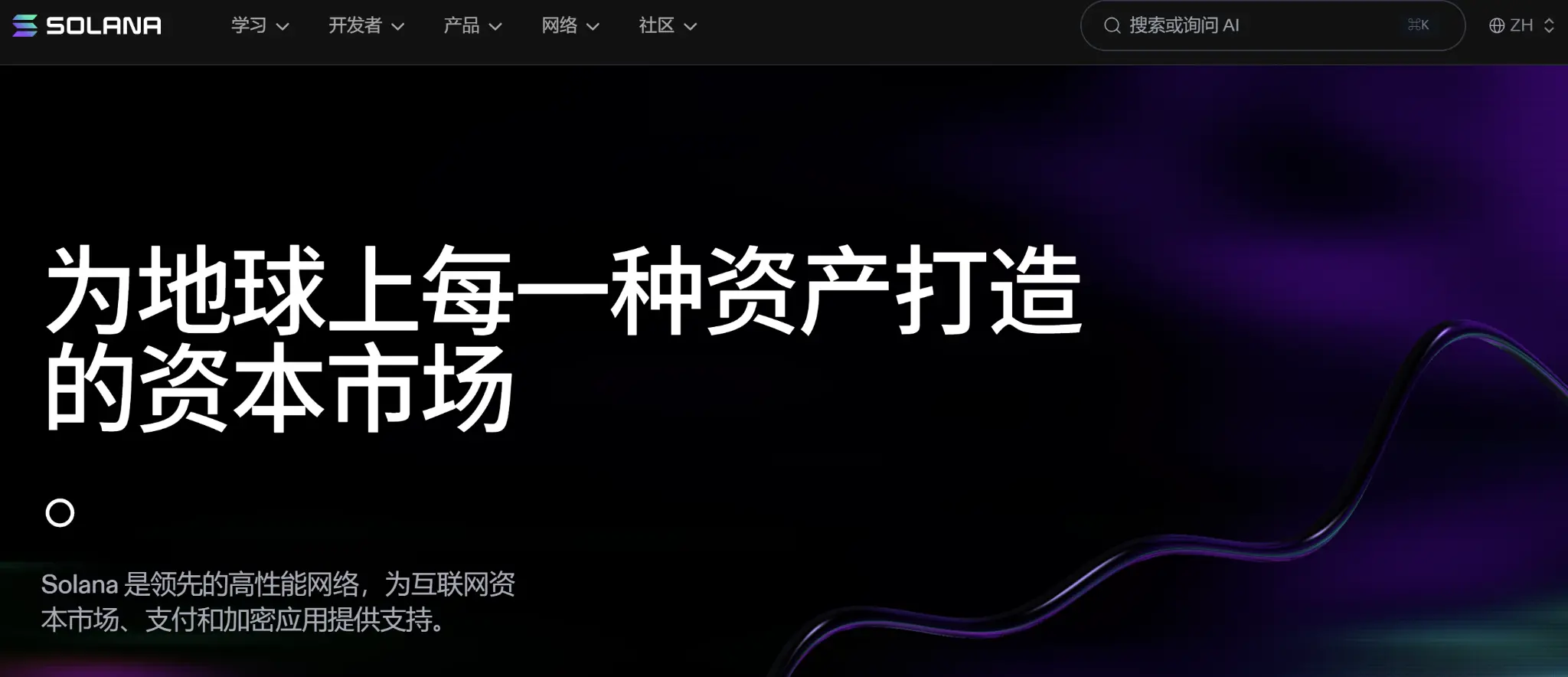
This means Solana aims not only to challenge Ethereum but also to replace traditional exchanges, brokers, and clearing systems, becoming the on-chain version of Nasdaq. High speed, low fees, high throughput, relatively mature user experience, and the strong backing of Wall Street capital once positioned Solana as the public chain closest to achieving this goal.

However, the problem is that as the "Internet Capital Markets" truly begin to take shape, the market is finding that Solana may not necessarily be at its core.

The Unexpected Impact of Hyperliquid

One of the biggest structural changes in the crypto industry over the past year has been the migration of the perpetual futures market away from traditional CEXs to on-chain platforms.

The biggest beneficiary of this trend is not Solana, nor Ethereum, Sui, or other networks, but Hyperliquid.

Initially, Hyperliquid was just an on-chain perpetual futures trading platform, but with the advancement of its Layer1 strategy, it has gradually evolved into a complete financial infrastructure network. Compared to Solana's broad and abstract "capital markets" vision, Hyperliquid has chosen a more focused, transaction-driven path.

For a long time, although the Solana ecosystem has hosted numerous DeFi projects, its core liquidity has always leaned more towards spot trading, Meme Coins, and on-chain speculation. The infrastructure truly capable of supporting institutional-grade trading depth, risk management, and high-frequency trading needs has never matured.

More critically, Hyperliquid has gradually proven something many previously overlooked: an "Internet Capital Markets" may not necessarily require a general-purpose ecosystem.

For high-frequency financial transactions, performance, matching, liquidity, and trading experience are far more important than "richness of on-chain applications." This means a vertical Layer1 specifically designed for financial transactions might be more suitable as the core of on-chain capital markets than a general-purpose public chain like Solana.

This is also why an increasing amount of capital, traders, and attention is converging on Hyperliquid.

After the Drift Incident, Solana Forced to Adjust Perpetual Futures Market Strategy

If Hyperliquid's rise externally squeezes the strategic space for Solana's "capital markets," then the Drift Protocol exploit incident tore open a massive gap from within.

In early April of this year, the Solana DeFi protocol Drift suffered a governance and oracle attack, resulting in over $200 million in losses.

As one of the most important perpetual futures protocols on Solana, Drift had been playing a central liquidity role in Solana DeFi. After the hack, the protocol's functions were directly paralyzed, a large number of assets, vaults, and associated protocols within the Solana ecosystem were affected, and market confidence rapidly deteriorated.

Perpetual futures are a fiercely contested territory in the DeFi space. Faced with the market vacuum left by Drift and the strategic gap in Solana's on-chain derivatives field, the Solana official team must vigorously promote a new alternative product to capture users and market share in this frontline battle for the "Internet Capital Markets" strategy.

At this point, the choices before Solana officials included a series of products like Pacifica, Phoenix, Jupiter, GMTrade, Bullet, and Blink. However, Solana founder Anatoly Yakovenko firmly chose Phoenix.

Over the past five days, Toly has posted at least twenty tweets or retweets related to Phoenix, either forwarding other industry figures' test experiences with Phoenix, directly recommending its use, or discussing his views on Phoenix.

Regarding such "favoritism," Toly has also explained multiple times that Pacifica does not execute trades on the Solana chain; its compatibility with Solana is as good as Hyperliquid's, while Jup is already mature, and he is more focused on early-stage teams building from 0 to 1. Meanwhile, Phoenix is decentralized and can be atomically composable with all other applications on Solana.

Driven by Toly's promotion, Phoenix's popularity has ranked among the top three on RootData's trending projects list for consecutive days, reaching its historical peak in the heat index.

However, in terms of trading volume, Phoenix still lags far behind other established perpetual futures platforms. According to DeFillama data, Phoenix's daily trading volume had long been less than $4 million, and recently, riding the market hype, it surpassed $80 million for the first time. Yet, it still ranks outside the top 20 among all perpetual platforms, with at least a 20-fold gap from the top 5 platforms (minimum $1.6 billion).

Solana's Public Relations Offensive and Internal Rifts

Faced with Hyperliquid's strong rise and the wounds within its own ecosystem, Solana supporters have chosen a seemingly "using the opponent's own spear as a shield" path—wielding decentralization as a weapon to launch a public opinion attack against Hyperliquid.

Solana Foundation member @harkl_ tweeted that Hyperliquid markets itself as a decentralized exchange, but the reality is 24 validator nodes, closed-source node code, a single bridge handling tens of billions of dollars, and a record of forced settlements during market volatility.

"Can you participate in any part of the protocol stack with your own resources without approval from a trusted third party? If not, then it's not permissionless. No matter what you do, you cannot run a Hyperliquid sequencer," Toly further stated.

This argument sparked heated debate in the crypto community. Supporters believe Toly hit Hyperliquid's core weakness—if there are fewer than 30 validator nodes, node code is not open-source, and the bridge is highly centralized, what is the fundamental difference between this so-called "on-chain capital market" and the custodial model of CEXs?

Opponents point out that Solana's own validator count has sharply dropped from 2560 to about 756, its Nakamoto Coefficient has fallen from 31 to 20, and the top twenty validators control over one-third of the staked share—in this context, discussing "decentralization" seems somewhat like "the pot calling the kettle black."

An even thornier issue comes from within the Solana ecosystem. The consistent "favoritism" shown by many Solana Foundation executives has caused discontent among developers of other protocols.

"They will promote what they think is best for themselves. Pushing others away just because a team meets a certain criterion is turning friends into enemies," said kdotcrypto, co-founder of Bulk.

The comment from Pacifica founder Constance was more restrained yet equally damaging: "We chose Solana in 2025, didn't take any funding from the Foundation, didn't raise from investors, just wanted to build the product first and let the market decide." This phrase "let the market decide" carries a veiled protest against the Solana Foundation's role as both "referee and player."

The most brutal truth of the crypto market is this: users don't care about grand narratives; they only care about depth, liquidity, and safety. Hyperliquid's rise is not just a technical victory but a dimensional strike against the "general-purpose public chain" narrative—it proves that the core of building capital markets may not be a sprawling ecosystem, but an ultimate matching engine.

Now, Solana is mired in a quagmire of competing with rivals over "decentralization metrics," and its championed Phoenix still faces a 20-fold trading volume chasm compared to mainstream derivatives platforms.

In this battle for the endgame of "Internet Capital Markets," if Solana cannot regain its dominance in the derivatives field in the second half of 2026, it may remain an excellent Meme playground, but its dream of "hosting global assets" will only drift further away.


Related Questions

QWhat is the core narrative that Solana has been trying to build, and how is it currently being challenged according to the article?

ASolana's core narrative has evolved from being a 'high-performance blockchain' to becoming an 'Internet Capital Markets'—a global trading network for all assets. However, this vision is being challenged externally by Hyperliquid's rise as a vertical Layer1 for financial trading, and internally by the fallout from the Drift Protocol hack and strategic friction within its ecosystem.

QHow does Hyperliquid's approach to becoming a 'capital market' differ from Solana's, and why is it considered a threat?

AHyperliquid takes a more focused, transaction-driven path as a vertical Layer1 specifically designed for high-frequency financial trading, prioritizing performance, matching, liquidity, and trading experience. It is considered a threat because it proves that a specialized financial infrastructure may be more suitable for a capital market core than a general-purpose ecosystem like Solana, drawing away funds, traders, and attention.

QWhat internal event significantly damaged Solana's position in the perpetual futures market, and what was Solana's strategic response?

AThe significant internal event was the governance and oracle attack on the Drift Protocol in April, causing over $200 million in losses and paralyzing a core Solana DeFi protocol. In response, Solana founder Anatoly Yakovenko strongly endorsed and promoted Phoenix as a new decentralized perpetual futures platform to fill the strategic gap and regain market share.

QWhat criticism did Solana's leadership level against Hyperliquid, and what was the counter-argument from critics?

ASolana's leadership criticized Hyperliquid's decentralization, pointing to its limited number of validators (24), closed-source node code, and a single centralized bridge. Critics countered that Solana itself has seen a sharp decline in validators and an increase in stake concentration among top validators, making its focus on Hyperliquid's decentralization seem hypocritical, like 'the pot calling the kettle black.'

QWhat key challenge does the article suggest Solana must overcome to achieve its 'Internet Capital Markets' vision?

AThe article suggests that to achieve its 'Internet Capital Markets' vision, Solana must overcome its significant gap in the derivatives market. It needs to regain dominance in perpetual futures, as its promoted platform, Phoenix, still lags far behind leading platforms in trading volume. Without this, Solana risks remaining just a 'Meme paradise' rather than the global asset network it aims to be.

Related Reads

When Hyperliquid Steals Solana's 'Internet Capital Market' Script

The article "When Hyperliquid Steals Solana's 'Internet Capital Markets' Playbook" discusses Solana's struggles to maintain its "internet capital markets" narrative by 2026. Despite its initial success as a high-performance "Ethereum killer," SOL's price has underperformed, dropping significantly compared to other major cryptocurrencies. Solana's vision of a global, on-chain trading network for all assets is being challenged not primarily by Ethereum, but by Hyperliquid. Hyperliquid, evolving from a perpetual contracts platform into a dedicated financial infrastructure Layer 1, has become a major beneficiary of the shift of derivatives trading from centralized exchanges to on-chain. The article argues that for high-frequency financial trading, a specialized, performance-focused chain like Hyperliquid may be more suitable than a general-purpose ecosystem like Solana. Further compounding Solana's issues was a major $200+ million exploit on its key perpetual protocol, Drift, in April, which damaged market confidence. In response, Solana founder Anatoly Yakovenko heavily promoted the protocol Phoenix as a replacement, boosting its visibility but not its trading volume, which remains far behind leading platforms. Solana supporters have launched a public critique of Hyperliquid's decentralization, pointing to its limited validators and closed-source code. Critics, however, note Solana's own declining validator count and centralization metrics. This strategy has also caused internal friction, with developers of other Solana protocols expressing discontent over the foundation's perceived favoritism towards Phoenix. The conclusion is that Hyperliquid's rise represents a challenge to the "general-purpose blockchain" narrative, proving that the core of a capital market might be a specialized trading engine rather than a broad ecosystem. If Solana cannot regain dominance in derivatives, it risks remaining a "meme coin paradise" while its grand "internet capital markets" ambition slips away.

marsbit21m ago

When Hyperliquid Steals Solana's 'Internet Capital Market' Script

marsbit21m ago

Samsung Bets on Mobile HBM: AI Moves from Cloud to Palm, a New Frontier in Semiconductor Investment?

Samsung is betting on bringing high-bandwidth memory (HBM) technology from servers to mobile devices, aiming to enable powerful on-device AI features in smartphones and tablets. This move is driven by the booming AI market, where HBM demand from data centers has fueled Samsung's record profits, with HBM4 already in mass production. By integrating mobile HBM, Samsung seeks to transform user AI experiences—making tasks like image generation and real-time translation faster, seamless, and more private by processing data locally. Strategically, this allows Samsung to leverage its vertical integration in memory, advanced packaging, and Exynos processors to differentiate its Galaxy devices against competitors like Apple and Qualcomm. It also opens a new consumer growth avenue, reducing reliance on volatile server HBM demand alone. The initiative is expected to benefit the broader supply chain, boosting demand for advanced packaging materials, thermal solutions, and other components. While promising, risks include potential delays in mobile HBM mass production beyond 2027, high initial costs, and the cyclical nature of the memory market. Nonetheless, Samsung's push signals a broader industry shift toward hybrid cloud-edge AI computing, positioning it as a key player in defining the future of AI-powered devices and presenting a potential long-term investment theme in semiconductors.

marsbit39m ago

Samsung Bets on Mobile HBM: AI Moves from Cloud to Palm, a New Frontier in Semiconductor Investment?

marsbit39m ago

Trillion-Dollar Banking Giant Adjusts Portfolio: Buys XRP Heavily, Clears Out Solana

In a significant portfolio rebalancing move, Italian banking giant Intesa Sanpaolo, with $1.1 trillion in assets, has made a notable shift in its cryptocurrency holdings. According to disclosures from Q4 2025 to Q1 2026, the bank's total crypto exposure surged from $100 million to approximately $235 million. The most striking action was its first-time establishment of an XRP position, investing around $18 million through the Grayscale XRP Trust. This marks a milestone as one of the first major European banks to adopt XRP via a regulated investment vehicle. This move is part of a broader, systematic digital asset strategy. The bank also substantially increased its Bitcoin exposure via ETFs and initiated its first Ethereum investment through a staking trust. In a contrasting strategic pivot, Intesa Sanpaolo drastically reduced its Solana holdings by over 99%, nearly exiting its position in a Bitwise Solana staking ETF. This shift is interpreted as reflecting a institutional preference for assets perceived with lower regulatory and operational risk, especially following Solana's network stability issues and improved clarity for XRP after its legal settlements. The bank's actions highlight key drivers for institutional adoption: clearer regulations, the availability of compliant ETF products, and the search for portfolio diversification. This trend signifies crypto's evolving status from a niche experiment to a recognized component of mainstream asset allocation, with institutions favoring gradual, regulated entry points over direct token ownership.

marsbit1h ago

Trillion-Dollar Banking Giant Adjusts Portfolio: Buys XRP Heavily, Clears Out Solana

marsbit1h ago

Base Native Leveraged Prediction Market OmenX Officially Launches on Mainnet

Base-native leveraged prediction market platform OmenX has officially launched on mainnet. It currently supports up to 5x leverage, with plans to increase to 10x based on platform liquidity and market conditions. Unlike traditional prediction markets where users fully collateralize YES/NO positions and wait for settlement, OmenX aims to create a trading platform-like experience. Users can open leveraged positions on event outcomes, and actively trade, adjust, or hedge these positions before the event concludes for greater capital efficiency. Alongside the mainnet launch, OmenX introduced a "Hedge-to-Earn" campaign targeting existing users of other prediction markets (initially Polymarket). This initiative allows users to claim incentives or hedging benefits on OmenX based on their existing positions, aiming to introduce them to leveraged trading and active risk management. OmenX positions itself as a derivatives trading platform for prediction market assets. The team believes that as platforms like Polymarket mainstream prediction markets, event outcomes are becoming a new tradable asset class. The next phase of demand will focus on leverage, liquidity, and advanced trading tools. Post-launch, OmenX plans to expand supported market types, optimize liquidity, and develop APIs and additional trading tools. The team is also in discussions with investors and partners to secure resources for further development.

链捕手1h ago

Base Native Leveraged Prediction Market OmenX Officially Launches on Mainnet

链捕手1h ago

Trading

Spot
Futures

Hot Articles

How to Buy WAVES

Welcome to HTX.com! We've made purchasing Waves (WAVES) simple and convenient. Follow our step-by-step guide to embark on your crypto journey.Step 1: Create Your HTX AccountUse your email or phone number to sign up for a free account on HTX. Experience a hassle-free registration journey and unlock all features.Get My AccountStep 2: Go to Buy Crypto and Choose Your Payment MethodCredit/Debit Card: Use your Visa or Mastercard to buy Waves (WAVES) instantly.Balance: Use funds from your HTX account balance to trade seamlessly.Third Parties: We've added popular payment methods such as Google Pay and Apple Pay to enhance convenience.P2P: Trade directly with other users on HTX.Over-the-Counter (OTC): We offer tailor-made services and competitive exchange rates for traders.Step 3: Store Your Waves (WAVES)After purchasing your Waves (WAVES), store it in your HTX account. Alternatively, you can send it elsewhere via blockchain transfer or use it to trade other cryptocurrencies.Step 4: Trade Waves (WAVES)Easily trade Waves (WAVES) on HTX's spot market. Simply access your account, select your trading pair, execute your trades, and monitor in real-time. We offer a user-friendly experience for both beginners and seasoned traders.

3.8k Total ViewsPublished 2024.03.29Updated 2025.07.02

How to Buy WAVES

Discussions

Welcome to the HTX Community. Here, you can stay informed about the latest platform developments and gain access to professional market insights. Users' opinions on the price of WAVES (WAVES) are presented below.

活动图片