Weekly Token Unlocks: STRK Unlocks 4% of Circulating Supply but Price Surges

marsbitPublished on 2026-05-10Last updated on 2026-05-10

Abstract

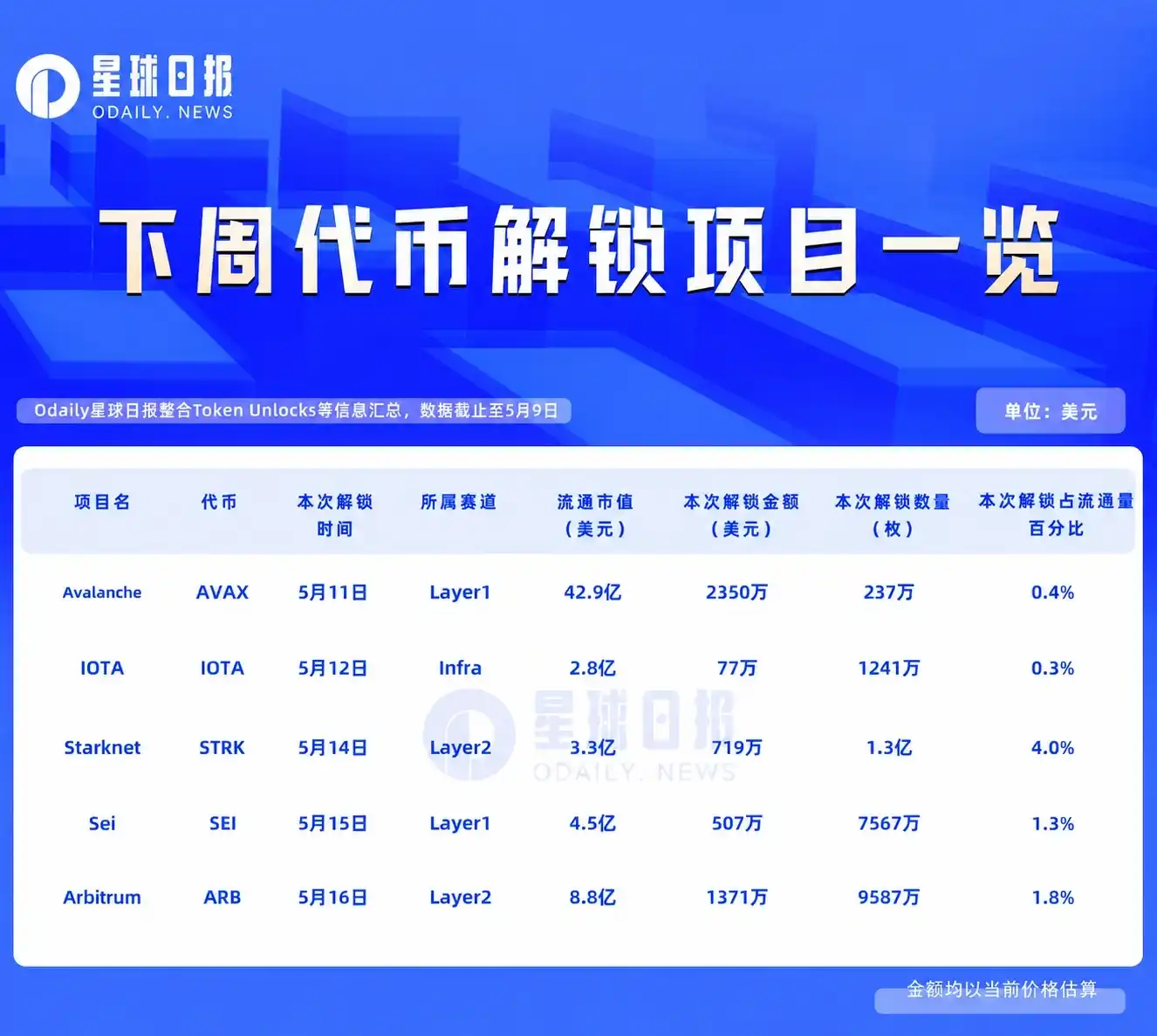
Weekly Token Unlock Recap: STRK's 4% Supply Release Sees Price Rally This week's major token unlocks featured two prominent Ethereum scaling solutions: **Starknet (STRK):** Approximately 130 million STRK tokens (4% of circulating supply), valued at roughly $7.19 million, were unlocked. Starknet is an Ethereum Layer 2 network utilizing zk-STARKs technology to enable faster and cheaper transactions. Despite the significant supply increase, the token's price experienced an upward movement. **Arbitrum (ARB):** Around 95.87 million ARB tokens, worth approximately $13.71 million, were released. Arbitrum is another leading Ethereum Layer 2 solution that processes transactions off-chain before bundling them for Ethereum mainnet settlement, offering improved scalability and lower costs. The ARB token grants holders governance rights within the ecosystem. Both projects continue to play significant roles in scaling the Ethereum network.

Starknet

Project Twitter: https://twitter.com/Starknet

Project Website: https://starknet.io/

Tokens Unlocked This Round: 130 million

Value of Unlocked Tokens: Approximately $7.19 million USD

Starknet is a Layer 2 for Ethereum, utilizing zk-STARKs technology to make Ethereum transactions faster and cheaper. Its parent company, StarkWare, was founded in 2018 and is headquartered in Israel. StarkWare's main products include Starknet and StarkEx. By using STARKs, Starknet verifies transactions and computations without requiring every network node to validate each operation. This significantly reduces the computational load and increases the throughput of the blockchain network.

Arbitrum

Project Twitter: https://twitter.com/arbitrum

Project Website: https://arbitrum.io/

Tokens Unlocked This Round: 95.87 million

Value of Unlocked Tokens: Approximately $13.71 million USD

Arbitrum is an Ethereum Rollup designed to enhance Ethereum's scalability. It aggregates and processes transactions off-chain before submitting a single transaction to the Ethereum mainnet. This means users can enjoy faster and cheaper transactions while still benefiting from the security and decentralization of the Ethereum network. The native token of Arbitrum is ARB. ARB holders can participate in the decision-making process, such as proposing and voting on protocol upgrades or changes.

Related Questions

QAccording to the article, which project will unlock 1.3 billion tokens this week?

AAccording to the article, Starknet (STRK) will unlock 1.3 billion tokens this week.

QWhat is the approximate USD value of Arbitrum's (ARB) token unlock mentioned in the article?

AThe approximate USD value of Arbitrum's token unlock mentioned in the article is $13.71 million.

QWhat core technology does Starknet use to scale Ethereum transactions?

AStarknet uses zk-STARKs technology to scale Ethereum transactions, making them faster and cheaper.

QWhat is the primary purpose of the Arbitrum network as described in the text?

AThe primary purpose of the Arbitrum network is to increase Ethereum's scalability by aggregating and processing transactions off-chain before submitting them to the Ethereum mainnet.

QWhat role do ARB token holders have within the Arbitrum ecosystem?

AARB token holders can participate in governance, such as proposing and voting on protocol upgrades or changes within the Arbitrum ecosystem.

Related Reads

Fei-Fei Li's Team Clarifies the Concept of 'World Models', Sora Merely a Renderer

"World Models" has become a widely used yet confusing term in AI. To address this, a team led by Fei-Fei Li and World Labs proposed a functional taxonomy based on the Partially Observable Markov Decision Process framework. This taxonomy categorizes systems called "world models" into three distinct projections: Renderers, Simulators, and Planners. Renderers, like OpenAI's Sora and other video generation models, focus on producing photorealistic visual outputs for human perception. They prioritize visual fidelity over physical accuracy. Simulators, such as NVIDIA Omniverse, aim to compute precise future environmental states for computational tasks like engineering analysis or digital twins. Planners, like Vision-Language-Action models, take in observations and goals to output executable actions for robots or agents. The article clarifies that most current "world models," including Sora, are primarily Renderers. They generate convincing visuals but lack the core ability to simulate state transitions based on actions, a key requirement for a true world model in classic reinforcement learning definitions. This conceptual confusion has practical implications, leading to potential misalignment in technology selection, investment, and public understanding of AI capabilities. Clear categorization is crucial. It helps enterprises avoid costly mistakes (e.g., using a renderer for robot training), allows investors to accurately assess markets, and enables researchers to build comparable benchmarks. While future systems may integrate these functions, recognizing current boundaries is essential for honest assessment and progress.

marsbit1h ago

Fei-Fei Li's Team Clarifies the Concept of 'World Models', Sora Merely a Renderer

marsbit1h ago

Bloomberg Uncovered: How Do China's Wealthy Circumvent the Annual $50,000 Limit to Transfer Assets?

**Summary: How Wealthy Chinese Circumvent $50,000 Annual Foreign Exchange Limits** Despite China's strict capital controls, including an annual $50,000 per person foreign exchange quota, an estimated $150 billion in funds still leaves the country annually via various gray and underground channels. This report outlines the evolution of China's "capital wall" and the methods used to bypass it. **The Evolving Capital Controls:** * **Foundation (1994):** The system of "current account convertibility with strict capital account controls" was established. * **Quota Set (2007):** The $50,000 individual annual forex purchase limit was formalized. * **Crackdown Begins (2015-2017):** Following market volatility, enforcement tightened. Banks were required to scrutinize transactions, and channels like using UnionPay cards for Hong Kong insurance premiums or buying overseas property were blocked. * **Digital & Legal Upgrades (2024-2026):** Enhanced algorithms now flag suspicious patterns (e.g., "smurfing"). The Common Reporting Standard (CRS) provides Chinese tax authorities with data on citizens' offshore accounts. Unlicensed cross-border brokers have been targeted. **Five Primary Methods for Moving Capital:** 1. **Underground Banking / "Hawala" (Duiqiao):** The largest-scale method. No money crosses borders. Clients pay RMB to a domestic account; an overseas associate deposits equivalent foreign currency into the client's offshore account. Risks include high fees, account freezes, and legal penalties. 2. **"Smurfing" or "Ant Moving":** Using multiple individuals' $50,000 quotas to pool funds for one offshore recipient. Increasingly detected by anti-money laundering algorithms. 3. **Trade Invoice Manipulation:** Businesses over-invoice imports or under-invoice exports via offshore shell companies, creating a pretext to transfer excess funds abroad under the guise of trade. 4. **Channel Migration:** After a crackdown on internet brokers, funds flow toward more compliant but costly channels like major banks' cross-border wealth management services or Qualified Domestic Institutional Investor (QDII) quotas. 5. **Structural Arrangements:** High-net-worth individuals use complex, high-cost legal structures involving offshore trusts, insurance, and investment migration programs to transfer asset ownership. **Regulatory Response: Focusing on People, Not Just Money** The current strategy extends oversight from enterprises to **individual residents**. Tools like CRS allow retroactive visibility into offshore assets. Cryptocurrencies, once seen as a potential loophole, are now actively monitored and prosecuted as an illegal channel. The underlying driver remains: with significant wealth concentrated among millions of affluent households seeking diversification amid domestic economic shifts, the incentive to move assets offshore persists despite regulatory barriers.

marsbit1h ago

Bloomberg Uncovered: How Do China's Wealthy Circumvent the Annual $50,000 Limit to Transfer Assets?

marsbit1h ago

Trading

Spot
Futures

Hot Articles

How to Buy 4

Welcome to HTX.com! We've made purchasing 4 (4) simple and convenient. Follow our step-by-step guide to embark on your crypto journey.Step 1: Create Your HTX AccountUse your email or phone number to sign up for a free account on HTX. Experience a hassle-free registration journey and unlock all features.Get My AccountStep 2: Go to Buy Crypto and Choose Your Payment MethodCredit/Debit Card: Use your Visa or Mastercard to buy 4 (4) instantly.Balance: Use funds from your HTX account balance to trade seamlessly.Third Parties: We've added popular payment methods such as Google Pay and Apple Pay to enhance convenience.P2P: Trade directly with other users on HTX.Over-the-Counter (OTC): We offer tailor-made services and competitive exchange rates for traders.Step 3: Store Your 4 (4)After purchasing your 4 (4), store it in your HTX account. Alternatively, you can send it elsewhere via blockchain transfer or use it to trade other cryptocurrencies.Step 4: Trade 4 (4)Easily trade 4 (4) on HTX's spot market. Simply access your account, select your trading pair, execute your trades, and monitor in real-time. We offer a user-friendly experience for both beginners and seasoned traders.

4.2k Total ViewsPublished 2025.10.20Updated 2026.06.02

How to Buy 4

Discussions

Welcome to the HTX Community. Here, you can stay informed about the latest platform developments and gain access to professional market insights. Users' opinions on the price of 4 (4) are presented below.

活动图片