Web3 Inside and Outside the Great Wall: The Triple Impact and Solutions for Chinese Entrepreneurs

marsbitPublished on 2025-12-17Last updated on 2025-12-17

Abstract

Chinese Web3 entrepreneurs, once dominant in the crypto industry with leading exchanges and mining ventures, have seen their global influence decline significantly since the DeFi Summer of 2020. This shift stems from three major challenges: stringent regulatory crackdowns in China, which dismantled local ecosystems and forced migration overseas; a structural bias in venture capital favoring Western projects due to compliance advantages and better exit opportunities; and a mismatch in skill sets, as many Chinese developers excel in B2C applications rather than the infrastructure-focused B2B nature of recent Web3 development. While culturally diverse founders like Hyperliquid’s Jeff Yan show that Chinese-background innovators can still succeed, they often do so by integrating into Western cultural and operational frameworks. The future of crypto entrepreneurship will depend less on geographic origin and more on cross-cultural collaboration, long-term technical commitment, and adaptive resilience in a rapidly evolving regulatory landscape.

Original Author: Hu Tao, ChainCatcher

As the encryption industry becomes increasingly mainstream, Chinese entrepreneurs seem to be moving further away from the center stage.

There was a time when projects founded by Chinese people accounted for half of the industry, including well-known cryptocurrency exchanges such as Binance, OKX, Bybit, Bitget, Gate, HTX, and Bitmart. This was even more true in the mining sector, where projects like Bitmain, Canaan, and Spark Pool held significant positions in the industry. Their commonality is that they were all established in 2017-2018 or even earlier.

Although Changpeng Zhao, Mingxing Xu, Jihan Wu, and Justin Sun are still actively working on the front lines of the industry, after the DeFi Summer boom in 2020, a general consensus has gradually formed: the visibility and influence of the new generation of Chinese entrepreneurs in the global encryption industry have declined, and so far, no leaders comparable to the previous generation of industry figures have emerged. Given this gap, what has happened to the ecosystem of Chinese entrepreneurs? Where are the future opportunities?

Regulatory and Geopolitical Reshaping: The First Impact of Ecological Disruption

The most significant factor over the past five years has been the drastic changes in regulatory and geopolitical environments.

Starting in 2021, China significantly increased its governance efforts on cryptocurrency-related activities, swiftly shutting down previously gray-area scenarios such as trading and mining. In recent market hotspots, almost any popular concept has been flagged by regulators, from earlier ICOs, NFTs, and digital collectibles to recent payment and real-world asset topics. This undoubtedly limits the inflow and support of high-quality resources into the Chinese encryption ecosystem to some extent.

These crackdowns not only accelerated the relocation of mining and exchange businesses but, more importantly, deprived Chinese entrepreneurs of a native market with natural network effects, high talent density, and capital concentration, forcing them to develop in unfamiliar overseas environments.

In the early encryption ecosystem, many explosively growing Chinese projects rapidly accumulated users through the mobilization mechanisms of Chinese internet communities: WeChat group fission, KOL networks, media matrices, offline gatherings... These channels were once one of the most efficient systems for spreading encryption narratives. However, changes in regulatory policies have largely invalidated this system.

What followed was the rapid shift of the industry's power center to Europe and America—the dominance of U.S. compliance, the influx of institutional capital, and the increasing maturity of regulatory frameworks began to shape an industry order vastly different from that of 2017–2018. New narratives, new regulatory landscapes, and new capital structures naturally favor English-speaking markets and compliance-oriented entrepreneurial teams. For example, prediction markets, which have a certain gambling nature, are unlikely to emerge in the Chinese-speaking market environment where gambling is strictly regulated.

In such an industry environment, the new generation of Chinese entrepreneurs also finds it harder to gain "default trust" from global media, regulators, capital, and users, requiring more trial and error costs in areas like marketing and compliance compared to similar European and American projects.

Shift in Capital Preferences: The Second Impact of Ecological Disruption

If the institutional barriers created by regulatory and geopolitical environments are the first impact, then the "structural shift in preferences" from the capital market side further exacerbates the marginalization trend of Chinese entrepreneurs in the new cycle.

In today's industry environment, without strong VC funding and resource support, projects are at a disadvantage in user acquisition, token listings, and narrative building. Chinese entrepreneurs are already at a disadvantage on the funding front.

Due to the poor performance of altcoins and a significant decline in investment returns, Chinese-background VCs have largely reduced their investment frequency or even stopped entirely over the past 2-3 years. Chinese entrepreneurs face significant constraints in both financing and exit paths. When dealing with VCs dominated by Europe and America, Chinese projects struggle to gain an advantage due to language and cultural differences. As a result, the amount and number of financings secured by Chinese projects have been declining in recent years.
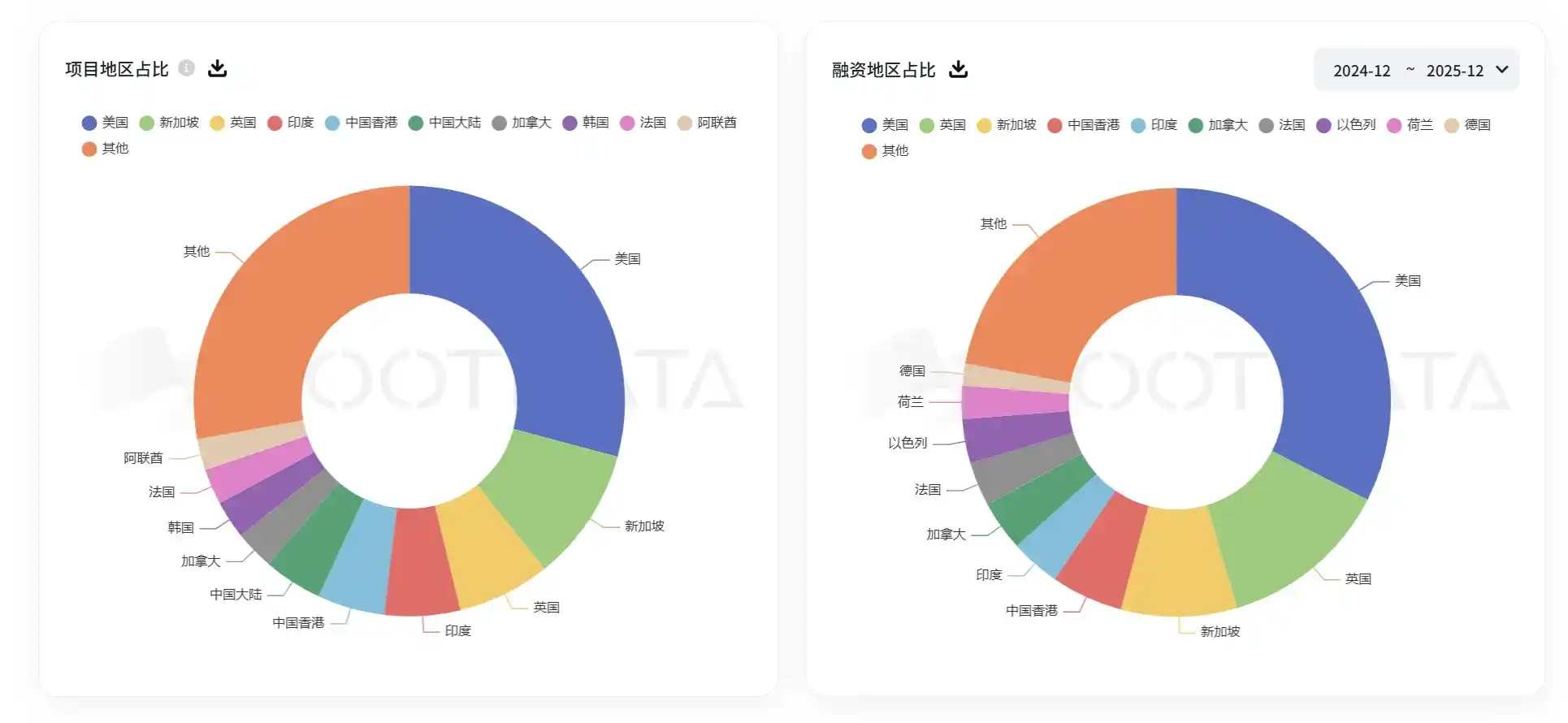
Industry share of the number and financing amount of projects from mainland China Source: RootData

This year, the encryption industry has seen a wave of IPOs and mergers and acquisitions, with companies like Circle and Gemini successfully listing on U.S. stock exchanges, and Coinbase and Ripple frequently making acquisitions. This has significantly boosted confidence among entrepreneurs and VCs, but these developments have largely bypassed Chinese projects. It can be said that European and American projects are enjoying the institutional dividends of the mainstreaming of the encryption industry.

In the eyes of mainstream capital, European and American projects have inherent advantages in compliance, cultural recognition, and exits. Unless Chinese projects have exceptional team composition and technical background, they are unlikely to win the favor of European and American capital.

Mismatch Between Capability Structure and Industry Maturity: The Third Impact of Ecological Disruption

Over the past decade, the main theme of the encryption industry has been in the infrastructure and tool sectors. Although new concepts like DeFi, NFTs, gaming, and inscriptions have emerged, most have failed to become mainstream projects.

In a previous interview with ChainCatcher, Jason Kam, founder of Folius Ventures, stated that over the past 5 to 10 years, Web3 development has been about laying the foundation, focusing more on product categories and states. This has been a decade biased towards ecology, infrastructure, tools, and consensus-building. In other words, it has been a decade of B2B products.

Europe and America have three generations of extremely talented engineers who are very good at building this B2B ecosystem. In contrast, the Asia-Pacific region mainly has young engineers from the 80s and 90s generations, whose career paths developed alongside the boom of China's B2C industry starting in 2005. In other words, their engineering experience lies in B2C and applications, which is at odds with the development trajectory of blockchain. Therefore, they may not excel in public chains and infrastructure.

"If Asia-Pacific entrepreneurs compete with European and American entrepreneurs on the To C level, I believe Asia-Pacific entrepreneurs have no disadvantages; in fact, they may have advantages. Their advantages lie in their rich product experience and their highly aggressive tactics for capturing market share."

Although Chinese entrepreneurs have proven this in the more Web2-like exchange sector, and in on-chain C-end products, the fleeting success of Stepn demonstrated the talent of Chinese entrepreneurs in C-end products. However, the overall market explosion for consumer-grade products has been slow to arrive, which is closely related to the maturity of industry infrastructure. The market has not yet reached the "comfort zone" of Chinese entrepreneurs.

Entrepreneurs with Multicultural Backgrounds Are Becoming Industry Leaders

Strictly speaking, there have been no new cases of representative Chinese entrepreneurs in recent years. Jeff Yan, the founder of Hyperliquid, is of Chinese descent. His parents are Chinese immigrants, and he was born and raised in Palo Alto, California. He later attended Harvard University, majoring in mathematics and computer science. After graduation, Jeff joined the high-frequency trading giant Hudson River Trading as a quantitative trader. In 2022, Jeff founded Hyperliquid and, with the philosophy of "small but refined," no VC, and user-driven growth, built it into one of the fastest-growing giants in the encryption industry in recent years.

However, although Hyperliquid is one of the most successful projects in this cycle with "Chinese bloodline" participation, it is difficult to see it as a continuation of the influence of Chinese entrepreneurs. Jeff is almost never active in the Chinese ecosystem, projects almost entirely European and American values in the outside world, and has never expressed himself in Chinese. The rise of Jeff and Hyperliquid highlights a fact: in the new cycle, Chinese ancestry can still produce global influence, but it must integrate into the mainstream cultural system rather than rely on the old path of Chinese entrepreneurship. If you rely solely on one cultural system, you can only become a regional leader and cannot achieve excellent results in the globalization process.

In fact, the founders of many well-known Chinese projects that have become sector leaders in this cycle mostly have multicultural backgrounds, having studied in Europe or America at least during their university years. Examples include Sean Ren, founder of Sahara; Yu Hu, founder of Kaito; and Erick Zhang, founder of BuidlPad. Their long-term experiences in Europe and America play an important role in their development paths.

In fact, entrepreneurs with multicultural backgrounds are indeed more popular in the encryption industry. For example, the founders of Ethereum, Solana, and Binance's Changpeng Zhao all immigrated from China and Russia to North American countries during their childhood. The collision of different political systems and cultures allowed these entrepreneurs to recognize the value of blockchain in empowering individual sovereignty earlier and quickly take action. They prioritize cultural inclusivity in team building, resource对接, and daily operations, ultimately making it easier to gain the favor of users from different regional cultural backgrounds.

The inherently borderless nature of encryption and the regulatory and interest demands of various countries will dominate the development trends of the encryption industry for a long time through conflict and磨合. Against the backdrop of multiple conflicts between China and the U.S. and the mainstreaming of the encryption industry, Chinese entrepreneurs indeed face increasing challenges. However, as the encryption industry recently faces skepticism about gambling tendencies, nihilism, and the disproval of more and more project concepts, the development trend of Chinese entrepreneurs may no longer be an important industry question. What truly deserves attention is: as speculative growth and narrative泡沫 gradually recede, who can continue to invest in the long-term value of decentralized technology and redefine the industry's direction through real products and verifiable innovation.

The core competitiveness of the future industry landscape will depend more on whether founding teams possess cross-cultural collaboration capabilities, long-term technological investment capabilities, and institutional understanding and organizational resilience in the face of regulatory uncertainty. Regardless of cultural or national background, those who can persistently excel in these dimensions may become the true beneficiaries of the next cycle. In other words, the path to success in the encryption industry has never depended on "where they come from" but on "what they can achieve."

Related Questions

QWhat are the three major challenges faced by Chinese entrepreneurs in the Web3 industry according to the article?

AThe three major challenges are: 1. Reshaped regulatory and geopolitical environment, 2. Shift in capital preferences, and 3. Mismatch between capability structure and industry maturity.

QHow did the change in China's regulatory policy around 2021 impact the Chinese crypto entrepreneurial ecosystem?

AIt led to the rapid shutdown of previously gray-area scenarios like trading and mining, causing an accelerated migration of mining and exchange businesses overseas. Crucially, it deprived Chinese entrepreneurs of their native market, which had natural network effects, talent density, and capital aggregation advantages, forcing them to develop in unfamiliar overseas environments.

QWhy does the article suggest that capital markets' 'structural preference shift' has marginalized Chinese entrepreneurs?

ABecause powerful VC support is crucial for user acquisition, exchange listings, and narrative building. Chinese-background VCs significantly reduced investment frequency due to poor altcoin performance and low ROI. Facing language and cultural barriers, Chinese projects find it difficult to gain favor with dominant Western VCs, leading to a continued decline in the amount and number of financings they secure.

QWhat is the 'mismatch' between the capability structure of Chinese engineers and the maturity of the Web3 industry?

AThe past decade of Web3 focused on infrastructure and tools (B2B products), which aligns with the strengths of Western engineers. However, primarily '80s and '90s generation Chinese engineers developed their skills during China's B2C industry boom post-2005, giving them more experience in consumer applications, creating a mismatch with the industry's earlier infrastructure-building phase.

QAccording to the article, what is a key characteristic of successful founders in the current cycle, as exemplified by Hyperliquid's Jeff Yan?

AA key characteristic is having a multicultural background and integrating into the mainstream cultural system, rather than relying on old Chinese entrepreneurial paths. Founders with long-term experience in the West (e.g., studying there from university) show greater cultural inclusivity in team building, resource对接, and operations, making it easier to gain favor with users from different cultural backgrounds.

Related Reads

ETH Bull and Bear Views Compilation: Can Ethereum's Value Flow Back to ETH?

Titled "ETH Bull and Bear Views: Can Ethereum's Value Flow Back to ETH?", this article synthesizes the current heated debate around Ethereum's native token, ETH, following Bankless co-founder David Hoffman's decision to sell his entire ETH holdings. The **bullish case**, represented by figures like Tom Lee (BitMine CEO) and Raoul Pal, argues that ETH's core thesis remains intact. They contend Ethereum is the essential, secure, and neutral foundational layer for future finance—encompassing stablecoins, RWA, DeFi, L2s, and Agentic AI. Bulls bet on ETH's long-term revaluation as institutional adoption of on-chain finance grows, with significant buying activity from entities like BitMine and Consensys cited as evidence. Conversely, the **bearish perspective**, led by Hoffman and analysts like Markus Thielen, questions ETH's value capture mechanism. They acknowledge Ethereum's network success but argue that the value created by L2s, DeFi, and applications does not sufficiently accrue to the ETH token itself. Bears point to ETH's prolonged underperformance versus the broader crypto market, lack of traditional cash flows, weakening "ultrasound money" narrative, and apparent institutional retreat (e.g., Harvard Management Company exiting its ETH ETF position) as key concerns. The debate highlights a pivotal shift: ETH is no longer just a community belief asset. The central question is whether ETH can transition from being a "**used infrastructure**" to a "**continuously bought and held core asset**" as more value enters the Ethereum ecosystem. The market is now critically examining the direct link between network growth and ETH's value.

marsbit41m ago

ETH Bull and Bear Views Compilation: Can Ethereum's Value Flow Back to ETH?

marsbit41m ago

Crypto is dead, Perps are forever

The crypto industry is shifting from a focus on creating native assets (like altcoins and protocol tokens) to becoming a "global asset pipeline." Native cryptocurrencies, except for Bitcoin, are seen as failing in their value storage and utility promises, with demand driven largely by speculation. Attention and liquidity are now moving toward real-world assets (RWAs) like U.S. stocks, bonds, gold, and oil traded on-chain via perpetual contracts (Perps). Stablecoins like USDT and USDC set the precedent, proving blockchain's core strength is efficient global settlement and transfer, not inventing new monetary systems. Meanwhile, assets like Ethereum and many DeFi tokens struggle as their narratives weaken against tangible traditional assets and the rapid real-world progress of AI. Perpetual contracts have emerged as a pivotal innovation. They simplify trading by offering pure price exposure to any asset, bypassing complexities of ownership, custody, and traditional market hours. Projects like Hyperliquid gained traction by combining CEX-like efficiency with on-chain transparency, capitalizing on post-FTX distrust, macroeconomic volatility, and the surge in demand for 24/7 stock trading. In conclusion, while the era of speculative native "crypto assets" may be over, perpetual contracts persist as the industry's most potent financial instrument—transforming all assets into globally accessible, constantly tradable instruments centered on price speculation.

marsbit47m ago

Crypto is dead, Perps are forever

marsbit47m ago

Tencent, Alibaba, ByteDance in a Battle for the Skill Store

Skill is becoming a key concept in the AI field, essentially serving as a structured "instruction manual" for AI Agents that specifies tool calls, decision logic, and output standards. This allows Agents to execute predefined tasks. As the number of Skills grows, distribution platforms have emerged. Major tech companies are swiftly entering this space. In March, Tencent, Alibaba, and ByteDance launched Skill stores within their respective Agent platforms. Subsequently, players like Zhipu AI, Meituan, and Xiaohongshu joined the fray. This competition for the "Skill store" is fundamentally a battle for the AI-era user entry point; whoever controls distribution controls the users. While ByteDance's Coze has experimented with paid Skills, most platforms offer them for free. The real value lies not in the stores themselves but in using them to attract and retain users within an ecosystem, driving revenue from services like cloud computing, model calls, or advertising. The landscape features three main player types: 1) **Internet giants** (e.g., Alibaba, ByteDance, Tencent, Meituan), leveraging Skills to drive traffic and monetize through their broader ecosystems (cloud services, transactions, ads). 2) **Large model companies** (e.g., Zhipu AI, Moonshot AI), using Skill stores to increase user engagement and monetize model API calls. 3) **Content platforms** (e.g., Xiaohongshu), treating Skills as a new content format to generate traffic and ad revenue. However, transforming Skill stores into a sustainable business faces significant hurdles. Key challenges include: the **difficulty in pricing Skills** due to inconsistent outputs across different models and contexts; **lack of cost transparency** (varying token consumption); **security risks** like Skill poisoning; and the **absence of standardized protocols** for development and evaluation. Unlike standardized mobile apps, Skills are often personalized workflows resistant to uniformity, which hinders the establishment of a reliable review and monetization system akin to the App Store. While there is genuine user demand for paid Skills—particularly in enterprise (e.g., contract review) and certain personal productivity scenarios—current platforms offer developers limited and unpredictable distribution. The future of Skill stores depends on overcoming these standardization, evaluation, and safety challenges to make acquiring a Skill as straightforward as downloading an app. For now, the stores function more as display shelves than robust marketplaces.

marsbit47m ago

Tencent, Alibaba, ByteDance in a Battle for the Skill Store

marsbit47m ago

The Crypto Scene Is Dead, Perpetual Swaps Are Eternal

The crypto industry is undergoing a fundamental shift. The era defined by minting novel, native digital assets (altcoins) is fading. These assets, lacking real-world cash flows or clear value, are losing relevance as attention and capital flow elsewhere. Two powerful external forces are reshaping the space. First, traditional assets like U.S. stocks, bonds, gold, and oil are being tokenized and traded on-chain. Second, the explosive growth of AI, with its tangible products, has overshadowed crypto's once-dominant "future narrative." This marks a critical pivot: crypto is transitioning from being a "factory for new assets" to becoming a "global conduit for existing assets." Its validated utility is not complex financial reinvention but efficient global settlement, transfer, and trading—the original promise of blockchain. Stablecoins like USDT and USDC exemplify this, offering faster dollar movement rather than replacing it. Consequently, native ecosystems like Ethereum face profound challenges. While still crucial infrastructure, ETH struggles to capture value as users interact with Layer 2s or trade traditional assets without needing to hold it. DeFi's grand narrative of rebuilding finance has narrowed to core needs like cheap transfers and deep liquidity. The true breakout innovation is the perpetual contract (Perp). It brilliantly bypasses the complexities of direct asset ownership (custody, compliance, dividends) by creating pure price exposure. Users can speculate on the price movement of *any* asset—NVIDIA, gold, oil—24/7, globally, and with leverage. This "price casino" model, while risky and ethically fraught, delivers unmatched liquidity and accessibility. Projects like Hyperliquid succeeded not by inventing new mechanics but by perfecting the timing and execution of this model. Key drivers included making on-chain Perps feel like centralized exchanges, post-FTX trust migration towards transparency, and rising demand to trade macro assets and equities round-the-clock. In conclusion, the crypto world's most enduring successes are the dollar (via stablecoins), Bitcoin, and trading. Its new frontier is not creating alternative assets but providing a seamless, perpetual trading layer—a new API—for the world's existing financial system. The age of native altcoins is over; the age of perpetual synthetic exposure has begun.

Odaily星球日报56m ago

The Crypto Scene Is Dead, Perpetual Swaps Are Eternal

Odaily星球日报56m ago

Trading

Spot
Futures
活动图片

