Web3 Fund Global Expansion Guide: Deconstructing the Compliance Frameworks of Six Major Global Crypto Funds

marsbitPublished on 2026-03-20Last updated on 2026-03-20

Abstract

A Guide to Web3 Fund Structures: Analyzing Six Major Global Crypto Fund Compliance Frameworks As crypto assets evolve from simple trading to professional asset management, Web3 projects, quantitative teams, and high-net-worth individuals increasingly adopt fund structures. The choice of legal framework is a foundational decision impacting risk isolation, tax treatment, and long-term compliance. This article analyzes six major fund structures suited for different strategies and investor profiles: - **Cayman SPC**: An umbrella company structure allowing multiple segregated portfolios under one entity. Ideal for multi-strategy teams seeking risk isolation and rapid product iteration. - **Cayman ELP**: A limited partnership form common in VC/PE, offering flexible profit distribution, tax transparency, and investor privacy. - **BVI Approved Fund**: A low-cost, fast-setup solution for early-stage teams managing under $100M, with simplified compliance and up to 20 investors. - **Singapore VCC**: An onshore structure with regulatory credibility, umbrella fund options, and potential tax exemptions (13O/13U), suitable for family offices and teams establishing a local presence. - **Hong Kong LPF**: A localized limited partnership offering convenience for Asian-based operations, banking, and legal services, with potential profit tax exemption. - **Hong Kong OFC**: An open-ended corporate structure ideal for liquid strategies, ETFs, or public offerings, supported by government subsidie...

Original Authors: Zhang Qianwen, Cheng Chuying

Introduction

As crypto assets evolve from simple trading activities to professional asset management, an increasing number of Web3 project teams, quantitative teams, and high-net-worth individuals are adopting fund structures to manage crypto assets. In this process, the choice of a fund's legal structure is no longer a matter of formality; it is a fundamental decision directly impacting risk isolation, tax treatment, and long-term compliant operations.

From a regulatory practice perspective, differences in fund establishment systems, regulatory requirements, and tax arrangements across various jurisdictions determine the investment strategies and fundraising targets they are suited for. Whether it's multi-strategy quantitative trading, primary market investments, or family office asset allocation, there is no "optimal structure," only a "suitable structure" that matches the business model.

This article deconstructs six major global crypto fund structures, analyzing their core mechanisms and applicable scenarios to provide reference for managers' compliance planning.

Cayman SPC: The "Umbrella Company" Suitable for Multi-Strategy Operations

The SPC (Segregated Portfolio Company) is a corporate form in the Cayman Islands. Its key feature is the ability to establish multiple, legally independent investment portfolios (SPs) under a single legal entity.

  • Core Mechanism: Risk Segregation

The assets and liabilities of each SP are legally separate. For example, if Strategy A loses money, its creditors can only claim against A's assets and cannot touch the funds of Strategy B. This is crucial in the highly volatile crypto market, effectively preventing one strategy's "meltdown" from dragging down the entire operation.

  • Applicable Scenarios:

When a manager simultaneously runs both high-risk and low-risk strategies, an SPC ensures that accounts are kept separate and do not interfere with each other. Additionally, launching a new product simply involves creating a new sub-fund under the existing SPC, eliminating the need to register a new company. This offers low cost and high speed, making it suitable for teams looking to quickly incubate new strategies.

Cayman ELP: The "Partnership Structure" Suitable for Primary Market Investments

Unlike the corporate structure of an SPC, the ELP (Exempted Limited Partnership) is a partnership structure established under the Exempted Limited Partnership Law. It does not have independent legal personality but is a contractual relationship between a General Partner (GP) and Limited Partners (LPs). ELPs are widely used in venture capital (VC) and private equity (PE).

  • Core Mechanism: Clear Division of Roles

The GP (General Partner) is responsible for managing the money and making investments, bearing unlimited liability (in practice, a limited company is often used as the GP to isolate risk). The LP (Limited Partner) provides capital, does not participate in management, and their liability is limited to their contribution.

  • Applicable Scenarios:

Primary market investments involve complex profit distribution. The Partnership Agreement allows for flexible terms on how and when profits are shared. Furthermore, ELPs are tax-transparent, meaning the fund itself does not pay tax, and the list of LPs does not need to be publicly disclosed, balancing tax efficiency and privacy protection.

BVI Approved Fund: The "Entry-Level Compliance Solution" for Small Teams

For smaller, early-stage teams, the BVI (British Virgin Islands) Approved Fund offers a compliant option with low barriers to entry and controllable costs.

  • Core Mechanism: Filing-Based, Simplified Regulation

Establishment is fast, typically approved within two to three days of submitting materials. It is not mandatory to hire an auditor or a local custodian, significantly reducing operational costs.

  • Applicable Scenarios

Suitable for teams with assets under management below $10 million who are still in the strategy validation phase. It allows for establishing a compliant entity at a lower cost to build a track record. The investor cap is 20 persons, and the asset size cap is $100 million, making it suitable for fundraising within a familiar circle or community.

Singapore VCC: The "Onshore Fund Structure" Balancing Compliance and Practicality

The VCC (Variable Capital Company) is a fund vehicle introduced by Singapore that retains the flexibility of offshore funds while having the regulatory backing of the Monetary Authority of Singapore (MAS).

  • Core Mechanism: Umbrella Structure + Tax Incentives

The VCC also supports the establishment of multiple sub-funds with asset segregation. Most importantly, it can apply for the 13O/13U tax exemption scheme, where qualifying investment income is tax-exempt, and dividends are not subject to withholding tax.

  • Applicable Scenarios

Suitable for teams looking to set up an office in Singapore, obtain work visas, or establish a family office. It offers an internationally recognized compliant identity while protecting investor privacy (the shareholder register is not public), making it attractive to capital seeking long-term stability.

Hong Kong LPF: The "Cross-Border Fund Channel" Connecting Asian Markets

The LPF (Limited Partnership Fund) is a localized fund structure launched by Hong Kong, modeled on the Cayman ELP. It is registered and managed in Hong Kong and governed by Hong Kong law.

  • Core Mechanism: Localized Limited Partnership

Structurally similar to the Cayman ELP, but all legal matters and bank communication are handled locally in Hong Kong, with no time zone or language barriers.

  • Applicable Scenarios

If the team is primarily based in Asia, the LPF offers convenience in lawyer liaison, bank account opening, and daily maintenance. Coupled with Hong Kong's Unified Fund Exemption (UFE) regime, qualifying funds can enjoy profits tax exemption, offering a friendly tax environment.

Hong Kong OFC: The "Open-Ended Fund Structure" Suitable for Public Offerings or ETF Issuance

The OFC (Open-ended Fund Company) is a corporate-type open-ended fund with independent legal personality, allowing flexibility in handling investor subscriptions and redemptions.

  • Core Mechanism: Variable Capital, Flexible Structure

An OFC can increase or decrease shares based on subscription and redemption demands, bypassing the restrictions of capital reduction in traditional companies. It can be used for private placements or apply for public offerings (requires SFC authorization).

  • Applicable Scenarios:

To encourage OFC development, the Hong Kong government offers a subsidy covering up to 70% of the establishment costs (capped at HKD 1 million per company), effectively reducing startup costs. Additionally, the OFC is currently one of the mainstream structures in Hong Kong for issuing virtual asset ETFs and fundraising from the public, making it suitable for highly liquid trading strategies.

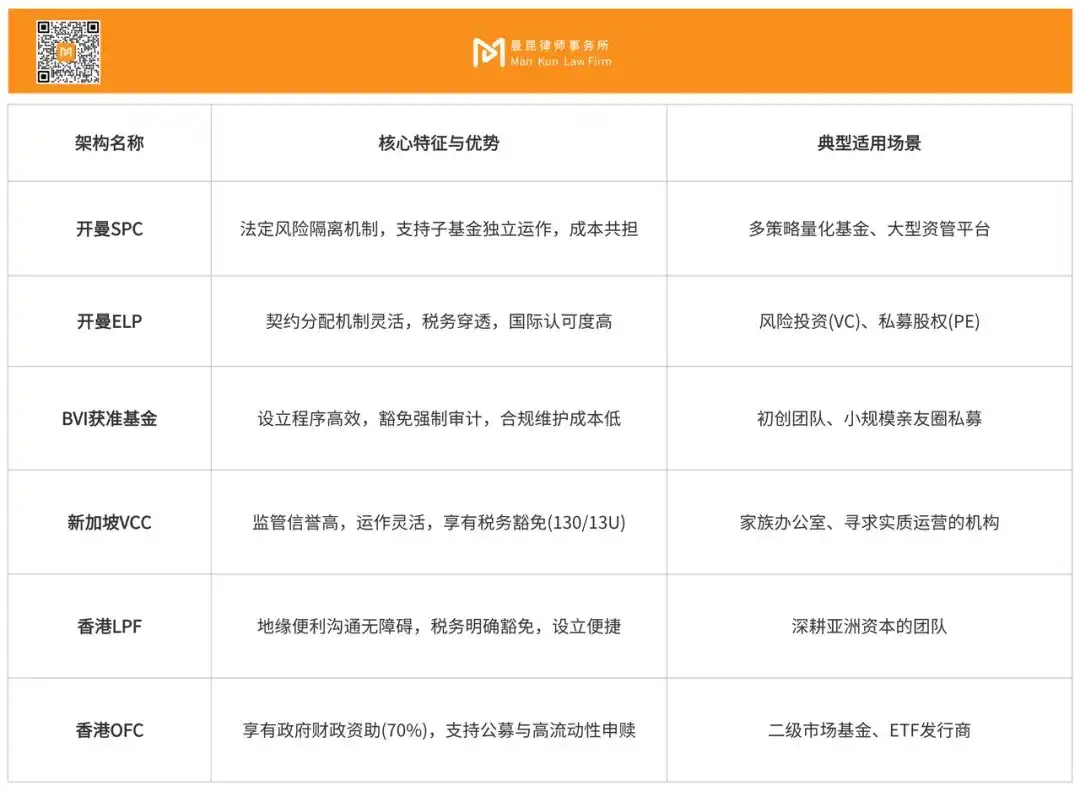
Overview of Core Characteristics of the Six Structures

Based on the above analysis, the legal characteristics and applicable scenarios of the six mainstream fund structures are summarized below:
Conclusion

In the field of crypto assets, the question regarding fund structures is never "whether to establish one," but rather "when to establish it and in what form." Different legal structures correspond not only to how taxes are paid and how regulations are applied but also to how risks are borne, how investors participate, and how the future operational model will succeed.

The fund structures introduced in this article are neither good nor bad in themselves; the key is whether they match your business model, investment strategy, and target investors. For managers who are already operating or plan to operate crypto assets in a fund format, thinking through and finalizing the structure early is itself an important form of risk control.


Related Questions

QWhat is the main advantage of using a Cayman Islands SPC structure for a crypto fund?

AThe main advantage is its ability to provide risk isolation through multiple segregated portfolios (SPs) within a single legal entity, ensuring that the assets and debts of one strategy do not affect others.

QWhich fund structure is most suitable for early-stage teams with smaller assets under management (AUM) and why?

AThe BVI Approved Fund is most suitable because it has a low compliance threshold, fast setup (approved in 2-3 days), reduced operational costs (no mandatory auditor or local custodian), and is designed for teams with AUM below $100 million and up to 20 investors.

QHow does the Singapore VCC structure benefit teams looking to establish a presence in Singapore?

AThe Singapore VCC offers regulatory backing from the Monetary Authority of Singapore (MAS), allows for multiple sub-funds with asset segregation, and provides tax exemptions (e.g., under 13O/13U schemes) on qualifying investment income, making it attractive for setting up offices, obtaining work visas, or establishing family offices.

QWhat makes the Hong LPF a convenient option for teams primarily based in Asia?

AThe Hong Kong LPF is convenient because all legal matters, banking communication, and daily maintenance are handled locally in Hong Kong, eliminating language and time zone barriers, and it benefits from tax exemptions under the Unified Fund Exemption (UFE) regime.

QWhich fund structure is ideal for issuing public offerings or virtual asset ETFs, and what support does it receive?

AThe Hong Kong OFC (Open-ended Fund Company) is ideal for public offerings or ETF issuance due to its flexible capital structure that allows for share redemptions and subscriptions. It also receives government support, including up to 70% subsidy on setup costs (capped at HKD 1 million per company).

Related Reads

Must-Watch Events Next Week|CLARITY Act Could Face Senate Vote; SpaceX, Circle to Report Earnings (8.3-8.9)

**Summary: Key Events and Developments to Watch (August 3-9)** The upcoming week is marked by significant financial disclosures, key legislative deadlines, and notable product updates. **Major Financial Events:** Several companies are scheduled to release their Q2 2026 earnings. American Bitcoin (ABTC) will report on August 3, followed by SpaceX and Hut 8 Mining Corp. on August 4, and Circle on August 5. Notably, a significant portion of SpaceX shares (up to 12% of total shares) will be unlocked on August 6 following their earnings release. **Key Legislative Deadline:** The U.S. Senate faces an August 7 deadline to secure 60 votes for the CLARITY Act, a bipartisan bill aiming to establish a federal regulatory framework for cryptocurrencies. The Senate may hold a full vote on the bill during the week. **Economic Data:** The U.S. July Non-Farm Payrolls report will be released on August 7, providing crucial labor market data. **Technology & Product Updates:** * **Shutdowns:** DeFi portfolio tracker Zapper and wallet app Ctrl Wallet will cease operations on August 3. * **Upgrades:** LayerZero will deprecate its v1 relayers on August 3. XRP Ledger's new version 3.3.0, featuring five new functions, is expected next week. * **AI:** Elon Musk announced that the advanced Grok 4.6 AI model is set for release around August 7. * **Bitcoin:** The BIP-110 forced signaling for a potential Bitcoin network change is scheduled to begin around August 8. **Other Notable Events:** Chinese robotics firm Unitree Tech has set its preliminary price inquiry for its IPO for August 5. South Korean exchange Upbit will delist AQT and AERGO tokens on August 3.

marsbit40m ago

Must-Watch Events Next Week|CLARITY Act Could Face Senate Vote; SpaceX, Circle to Report Earnings (8.3-8.9)

marsbit40m ago

Stocks Are Plummeting More Sharply Than Cryptocurrencies. Where Has the Money Gone?

Stock Markets Plunge Deeper Than Cryptocurrencies: Where Did the Money Go? In late July, Seoul's Kospi index triggered circuit breakers for two consecutive days, plummeting over 40% from its June high. The collapse was led by heavyweight stocks like SK Hynix, whose record profits still disappointed investors, and devastating leveraged ETFs, with one major product losing over 83% of its value. This signaled a global, forced deleveraging targeting the most crowded trades. Interestingly, while stocks exhibited extreme volatility akin to crypto markets, Bitcoin rose nearly 15% in July after a prior steep drop. Analysis shows the money fleeing equities did not flow into Bitcoin. Instead, Bitcoin had already absorbed its sell-off in May-June, when U.S. spot Bitcoin ETFs saw historic outflows. The true safe-haven beneficiary was gold, whose price rose over 20% year-on-year, highlighting a decoupling between Bitcoin and gold as "digital gold." The sell-off was a targeted unwinding of leveraged positions in tech and semiconductors, accelerated by broker-dealer risk management and shifts in the AI narrative, including new competition from Chinese memory chipmakers. The retreat path was clear: from high-valuation tech stocks to cash and U.S. Treasuries, then to gold. For Bitcoin to attract sustained institutional inflows, conditions like eased global liquidity pressure, a "soft-landing" Fed rate cut, and U.S. regulatory clarity via legislation like the stalled CLARITY Act are needed. Currently, Bitcoin is not a safe haven but an already-cleared asset. Its low correlation with tech stocks, however, makes it a potential diversification play for institutional portfolios once the storm passes. The money isn't here yet, but the positioning is underway.

marsbit40m ago

Stocks Are Plummeting More Sharply Than Cryptocurrencies. Where Has the Money Gone?

marsbit40m ago

In Conversation with Ray Dalio: We Are Currently in an AI Bubble, with 1% of My Portfolio in Bitcoin

Ray Dalio, founder of Bridgewater Associates, warns in an interview that the current AI boom shows classic bubble characteristics, which could lead to significant economic downturns as seen in past cycles like 1929 or 2000. He explains that speculative enthusiasm, fueled by debt and overvaluation, often precedes a crash when rising rates or taxation force asset sales, causing widespread losses and recession. Dalio also outlines his "Big Cycle" theory, describing an approximate 80-year pattern where widening wealth gaps, massive government deficits, and shifting geopolitical power (like China's rise) create internal conflict and global instability. He emphasizes that we are in a late-cycle, transitional phase where traditional powers like the US and UK face decline. For personal wealth protection, Dalio advises diversification beyond cash into assets like stocks, bonds, real estate, and particularly gold, which he prefers over Bitcoin. While he holds about 1% of his portfolio in Bitcoin as a non-printable hard asset, he views gold as more secure from technological or governmental threats. Regarding AI's impact, Dalio believes it will disproportionately benefit capital owners, worsening inequality by replacing both physical and cognitive labor. He suggests that human intuition and emotional intelligence, combined with AI, will be key for future workers. On taxation, Dalio argues that wealth taxes are impractical and risk triggering asset sell-offs, reducing productive investment. He points to the UK as a cautionary example of debt, low productivity, and political strife. Geopolitically, Dalio foresees a more regionalized world, with the US showing weakness in prolonged conflicts like with Iran, akin to past imperial declines. The ideal outcome, he suggests, is coexisting powerful blocs (e.g., Americas, China-Asia Pacific) without major war.

marsbit4h ago

In Conversation with Ray Dalio: We Are Currently in an AI Bubble, with 1% of My Portfolio in Bitcoin

marsbit4h ago

Daily 7.2 Trillion KRW: Foreign Capital's Record Net Buying on Friday! Wall Street Says Headwinds for Korean Stock Fund Flows Have Subsided

South Korean stock market sees a dramatic shift in fund flows. On July 31, foreign investors made a record net purchase of approximately KRW 7.2 trillion in KOSPI stocks, marking a fundamental reversal from the persistent large-scale net outflows seen in previous months. This contributed to a significant narrowing of foreign net selling in July to KRW 9.8 trillion, down sharply from KRW 48.4 trillion in June and KRW 44.5 trillion in May. Simultaneously, domestic institutional pressure eased. South Korean pension funds and asset managers turned to a net buying position in July, purchasing KRW 1.0 trillion worth of KOSPI shares, contrasting with net sales in May and June. Market volatility is expected to be dampened by new financial regulations. Effective July 31, the Financial Services Commission tightened access for retail investors to single-stock leveraged ETFs by raising the minimum cash deposit requirement. Trading volumes for these products subsequently dropped to about 50% of their monthly average. Citigroup Research maintains its year-end KOSPI target of 10,000 points. The firm cites several supportive factors: the substantial easing of headwinds from capital outflows, a robust fundamental outlook for the semiconductor sector, historically low market valuations, strong economic fundamentals, and the potential for policy support from financial authorities if needed.

marsbit4h ago

Daily 7.2 Trillion KRW: Foreign Capital's Record Net Buying on Friday! Wall Street Says Headwinds for Korean Stock Fund Flows Have Subsided

marsbit4h ago

Trading

Spot
活动图片




