Warmonger Trump Has Forgotten the Americans Waiting in Airport Lines for Hours

marsbitPublished on 2026-04-03Last updated on 2026-04-03

Abstract

A government shutdown at the Department of Homeland Security (DHS), which began on February 14, 2025, continues to cause severe disruptions across the United States. Over 100,000 DHS employees are unpaid, and nearly 11% of TSA workers are absent, leading to massive airport delays—some lines stretching into parking lots. Elon Musk offered to pay TSA salaries but was declined by the White House due to legal and conflict-of-interest concerns. In response, President Trump deployed Immigration and Customs Enforcement (ICE) agents to assist at airports. However, these agents lacked proper TSA skills, instead focusing on immigration enforcement, and delays persisted. Prediction markets like Polymarket indicate a 44% chance the shutdown ends between April 5–8, after Congress reconvenes. If missed, the stalemate may prolong. Another market suggests a 31% probability Republicans use the "nuclear option"—a procedural maneuver to bypass the 60-vote Senate threshold—to pass funding, though it carries political risks. Amid ongoing Iran tensions, the shutdown highlights domestic dysfunction, with essential services strained and political resolution uncertain.

Recently, international news has been dominated by the Iran situation and Trump's erratic stance on the war's direction.

Yet one event, which dominated headlines in 2025, is now rarely mentioned by mainstream media—on February 14, due to a deadlock between Democrats and Republicans over the Department of Homeland Security (DHS) funding bill, a partial shutdown of the DHS officially began.

As of now, the shutdown has not ended.

During this nearly two-month shutdown, over 100,000 DHS employees have been unable to receive their salaries, and nearly 11% of Transportation Security Administration (TSA) employees have been absent. In New Orleans, passengers waiting for security checks have formed lines winding from inside the terminal to the outdoors, even looping seven times in the parking lot before reaching the entrance.
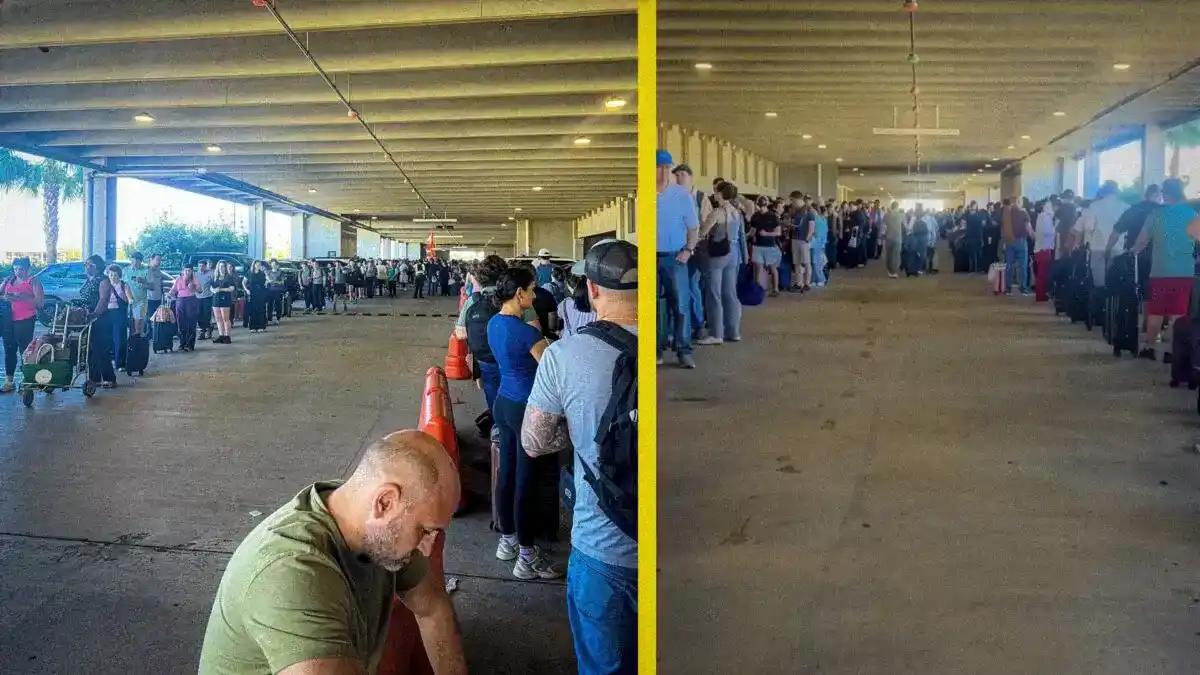
For the United States, which has almost no high-speed rail network and relies heavily on air travel, disruptions to the civil aviation system are crippling. Even Elon Musk publicly offered to pay the salaries of affected TSA employees out of his own pocket.

Also starting in March, the prediction market Polymarket launched a weekly updated prediction event for "number of U.S. flight delays this week"—traders can bet on how many flights will be delayed each week; predicting correctly earns money, while predicting wrong results in a total loss.
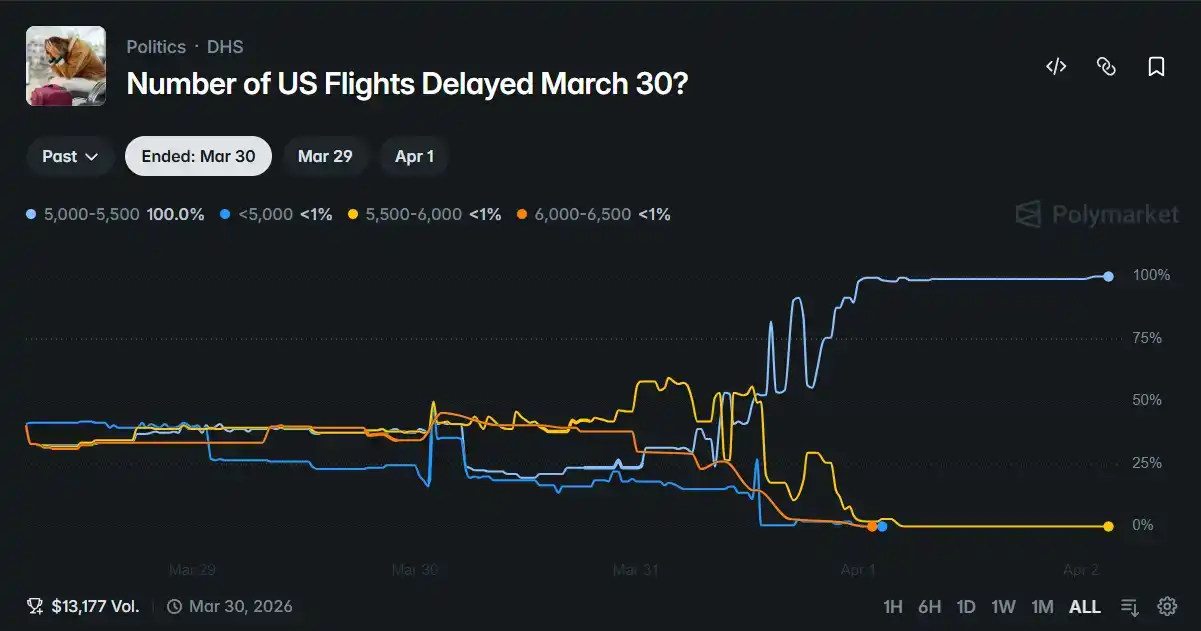
Beyond such purely entertainment-focused events, Polymarket has also listed several topics with considerable reference value. Through the probabilities reflected by these topics, we can attempt to interpret the true current state of the government shutdown and even U.S. domestic affairs.

The Shutdown Game Between the Two Parties

The duration of this shutdown has already broken the previous record of 35 days set by Trump. Amid the widespread flight delays and the near-collapse of the security screening system, when the shutdown will end is the most pressing question for those affected within the United States.

Polymarket currently has a related event: "DHS shutdown will end by ___." As of the time of writing, the probability of the shutdown ending between April 5 and 8 is 44%, while the probability that it will not end in April is 14%.
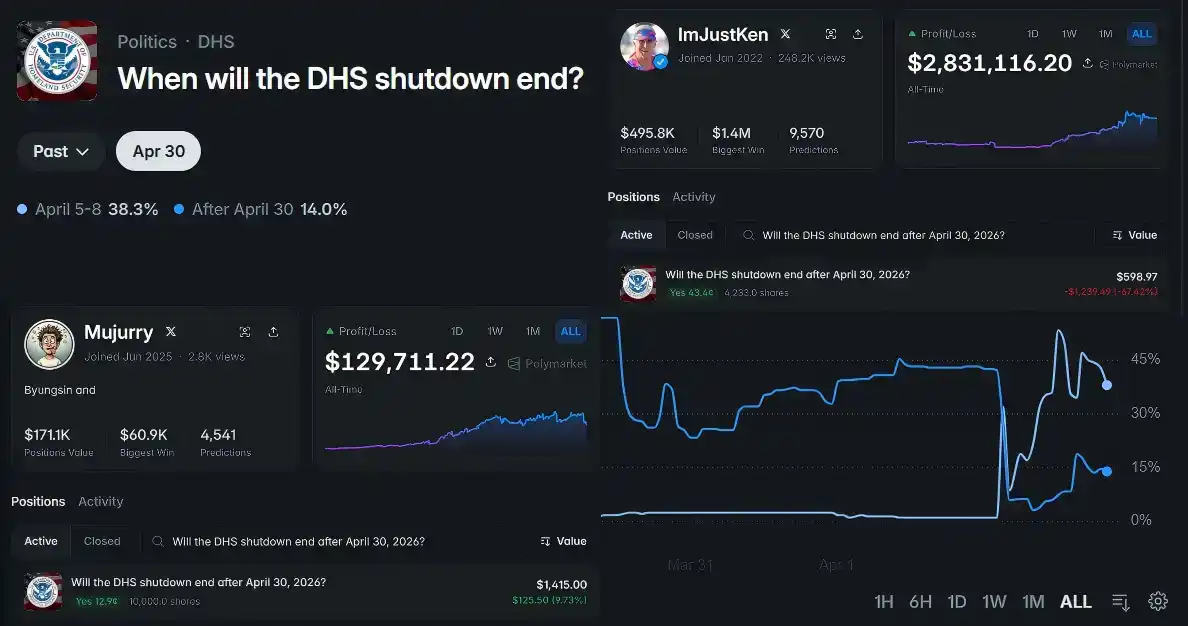
Betting on these two time nodes are many "smart money" traders—seasoned participants with high past prediction accuracy and strong profitability in the political sector. Behind such trading profiles lies a clear logic: if the shutdown does not end during the window of April 5 to 8, the likelihood of reaching an agreement within the month will significantly decrease.

April 5 to 8 coincides with Congress returning from recess, when both parties will once again place the funding bill on the table. If an agreement can be reached within a few days after returning, and the bill passes both the House and Senate before being signed, the shutdown will end.

However, if this window is missed again, the House and Senate will subsequently become engrossed in other agenda items. Without strong political pressure, the motivation for the two parties to return to the negotiating table will greatly diminish.

Musk's "Offer to Pay" and ICE's "Filling In"

Due to continuous TSA employee resignations causing severe delays at major airports, Elon Musk stated on March 21 that he was willing to pay TSA personnel's salaries, which led to the Polymarket trading event "Will Musk pay TSA employees' salaries?".
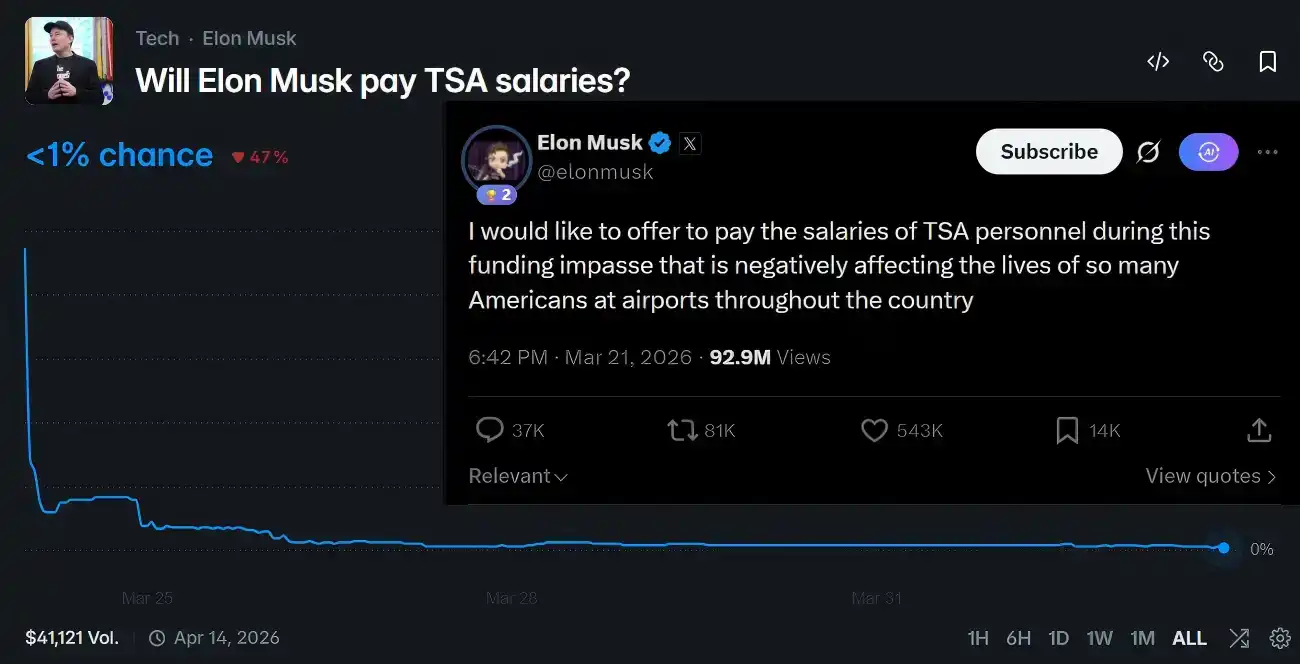
However, shortly after Musk's post, the White House declined the offer citing legal compliance and conflict of interest concerns: according to U.S. federal law, government employees cannot accept external compensation related to their official duties;加之 Musk's deep involvement in federal government contracts, direct payment of salaries faces serious conflict of interest challenges.

Although the refusal was legally justified, ordinary people still need to make a living. To minimize the impact of the aviation system's paralysis on the midterm elections, Trump ordered the deployment of Immigration and Customs Enforcement (ICE) agents to airports in March to replace TSA employees who had left due to unpaid salaries.

But the scene that unfolded once these ICE agents entered the airports made the entire shutdown event seem even more absurd.

After Trump took office, ICE, to meet the goal of "arresting 3,000 people daily and deporting a million people annually," has been drastically compressing recruitment and training processes—planning to hire ten thousand additional law enforcement officers and shortening the originally scheduled 16 weeks of in-person training to 8 weeks.

In short, the professional competence of these ICE agents themselves is already questionable.

TSA security work requires systematic training, covering core skills such as X-ray machine operation and explosive detection, for which ICE agents simply lack the qualifications.

Thus, a historic scene unfolded: TSA employees, while working unpaid, had to demonstrate security procedures to ICE agents and teach them how to maintain order. Most ICE agents did not actually conduct security checks but instead patrolled the terminals, using their law enforcement status to question and deport suspected illegal immigrants.

Data confirms the outcome of this farce: after ICE's deployment to airports, flight delay conditions did not significantly improve. By the end of March, the U.S. aviation system still experienced thousands of daily flight delays, with Atlanta Airport's TSA absenteeism rate nearing 40% and single-day flight delays exceeding 350. These numbers indicate that these ICE agents, who were supposed to act as a buffer for the shutdown, did not serve any expected purpose.

The "Nuclear Option" to Break the Deadlock

Another trading event related to this government shutdown is "Will Republicans use the 'nuclear option' to break the filibuster before December 31, 2026?", with a current probability of 31%.
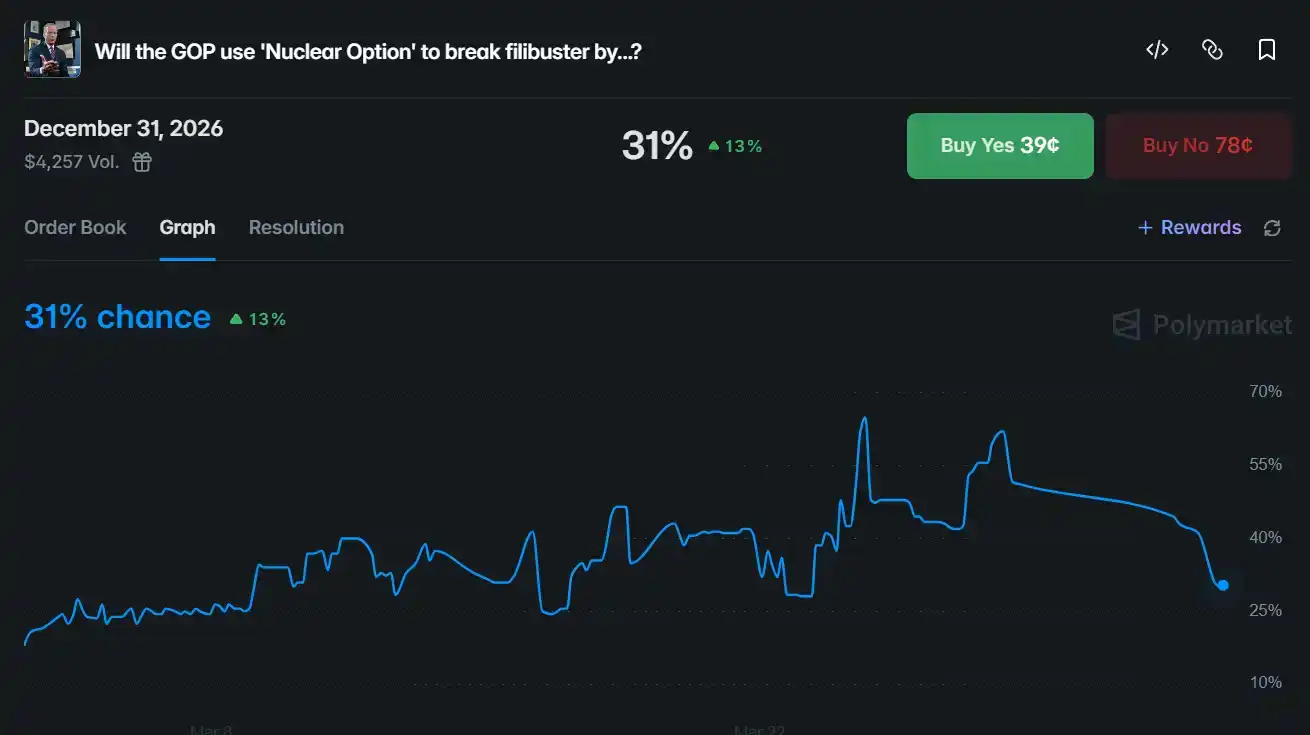
At first glance, the term "nuclear option" sounds intimidating; but in U.S. politics, it is not a literal nuclear weapon but rather one of the few yet highly destructive procedural trump cards available to Republicans.

In the U.S. legislative system, the House of Representatives is responsible for proposing and drafting appropriations bills, while the Senate is responsible for deliberation and voting. Typically, ending debate and proceeding to a vote in the Senate requires 60 votes—this means the minority party needs only 41 votes to block any bill by indefinitely prolonging debate through a filibuster.

The "nuclear option" provides a path to bypass this threshold: a senator raises a procedural appeal, and a simple majority (51 votes) overrules the presiding officer's decision, thereby forcibly lowering the vote threshold required to end debate from 60 votes.

Currently, Senate Republicans hold 53 seats; once the nuclear option is triggered, the Democrats' ability to obstruct will be nearly zero.

But the reason the "nuclear option" is called "nuclear" lies in the high cost it imposes on the user:破坏 Senate rules会被选民视为滥用权力; more crucially,一旦共和党未来失去多数席位, the same rules could be used by Democrats for retaliation.

The pit dug today might be filled by oneself tomorrow. The 31% probability is the market's true pricing of this dilemma.

Even as this shutdown deadlock remains unresolved, Trump must simultaneously deal with the escalating situation with Iran.

On one side is the high-pressure game of diplomacy and military action, on the other are airport lines, unpaid wages, and partisan bickering—the troubles this U.S. administration needs to manage simultaneously are far greater than what headlines suggest. Crises in domestic and foreign affairs never wait for the other to be resolved first.

Amid such turmoil, the rich array of political and current events prediction events on prediction markets will continue to serve as an objective mirror, helping us capture the true trajectory of these narratives.


Related Questions

QWhat is the main reason for the ongoing DHS shutdown mentioned in the article?

AThe shutdown is due to a stalemate between Democrats and Republicans over the Department of Homeland Security (DHS) funding bill.

QHow has the DHS shutdown affected airport operations in the United States?

AThe shutdown has caused significant disruptions, with over 10,000 DHS employees unpaid, nearly 11% of TSA staff absent, and passengers facing extremely long security lines, such as in New Orleans where queues extended to the parking lot.

QWhat was Elon Musk's proposed solution to the TSA payment issue, and why was it rejected?

AElon Musk offered to pay TSA employees' salaries, but the White House declined due to legal compliance issues and potential conflicts of interest, as federal law prohibits government workers from accepting external payments related to their duties.

QWhat is the 'nuclear option' in the context of U.S. Senate procedures, and what is its current probability of being used according to Polymarket?

AThe 'nuclear option' is a procedural tactic to bypass the 60-vote threshold for ending debate in the Senate, allowing legislation to pass with a simple majority. Polymarket estimates a 31% probability that Republicans will use it by December 31, 2026.

QHow effective was the deployment of ICE agents to replace TSA workers during the shutdown?

AThe deployment was largely ineffective. ICE agents lacked proper training for TSA duties, such as operating X-ray machines, and instead focused on patrolling and immigration enforcement. Flight delays remained high, with no significant improvement in airport operations.

Related Reads

Annual Salary of Millions Competing for Electricians, Meta Rushes to Open Its Own Technical School

The AI boom is facing an unexpected bottleneck: a severe shortage of skilled construction workers and electricians. As tech giants like Meta, OpenAI, and Alphabet race to build massive data centers—such as OpenAI's $16 billion "Stargate" project—they are hitting a critical labor wall. The U.S. needs an estimated 130,000 more electricians, 240,000 construction workers, and 150,000 supervisors by 2030 for AI infrastructure alone, but tens of thousands of electrician jobs go unfilled each year. While AI companies offer high premiums, with electricians earning up to $280,000 annually, worker scarcity still causes massive losses—delays on a single project can cost $14.2 million per month. The complexity of building AI data centers, which require immense power (equivalent to powering hundreds of thousands of homes), sophisticated electrical systems, and advanced liquid cooling solutions, demands highly skilled technicians who are in short supply. To combat this, companies are investing heavily in training. Meta has committed $115 million to a free training school offering tuition, housing, and stipends, targeting 5,000 new workers. OpenAI is partnering with unions to secure skilled labor. These efforts are paying off, with a significant rise in Gen Z interest in trade schools over college. However, the power demands are staggering. AI data centers are driving a rapid surge in electricity consumption, projected to account for up to 12% of U.S. power use by 2028 and raising costs for consumers. Furthermore, the construction boom is project-based, leading to a potential future glut of trained workers once building peaks, which could depress wages industry-wide. The race for AI supremacy now depends as much on skilled hands as on advanced chips.

marsbit32m ago

Annual Salary of Millions Competing for Electricians, Meta Rushes to Open Its Own Technical School

marsbit32m ago

OpenAI No Longer Sells Its Most Expensive Model for Profit

OpenAI is shifting its business strategy away from promoting its most expensive, flagship models for every task. Recent price cuts—80% for GPT-5.6 Luna and 20% for Terra—signal a deeper change: the company now actively advises users that many tasks don't require the most powerful model. Instead, OpenAI recommends a tiered approach: use the high-end GPT-5.6 Sol for complex planning and analysis, then delegate execution to cheaper models like Luna. This mirrors moves by Anthropic, which recently launched Claude Opus 5 at half the price of its top model, Fable 5. Both companies are de-emphasizing flagship models as primary revenue drivers, using them instead for brand prestige and technological showcases. The industry is entering a "mass-market" phase, similar to automotive, where high-volume, cost-effective models handle daily operations and drive scale. OpenAI's price reductions are partly enabled by AI models themselves optimizing underlying code and infrastructure, creating a self-reinforcing cycle of efficiency gains and cost reduction. Competition is shifting from "who is smartest" to "who offers the best value." The goal is no longer selling individual models but fostering widespread API adoption and ecosystem lock-in. By making AI calls cheap and ubiquitous, companies like OpenAI aim to become the indispensable, utility-like infrastructure powering automated workflows—the "water and electricity" of software, quietly embedded everywhere.

marsbit32m ago

OpenAI No Longer Sells Its Most Expensive Model for Profit

marsbit32m ago

Will the Fed Definitely Raise Interest Rates in September? How Will Crypto and U.S. Stocks Withstand the Pressure?

The market's expectation for a September Fed rate hike surged dramatically in early August, jumping from under 50% to over 80% within a week. This shift followed a contentious July FOMC meeting, where a 9-3 vote to hold rates revealed growing dissent from hawkish members advocating for an immediate hike to combat persistent inflation. The primary catalyst for this repricing is rising oil prices, driven by renewed geopolitical tensions around the Strait of Hormuz, which threaten global supply. Energy costs directly influence inflation metrics, making the upcoming July CPI report (due August 12th) a critical data point. If it shows inflation reaccelerating, the probability of a September hike will solidify. For Bitcoin and crypto assets, this is typically bearish news. Bitcoin continues to behave as a high-beta, liquidity-sensitive risk asset. A rate hike raises the opportunity cost of holding non-yielding assets and could drive capital toward money markets, pressuring crypto prices in the short term. However, historical patterns suggest that if a hike is perceived as the end of a tightening cycle rather than the start, any negative price impact may be brief. U.S. stocks, particularly crypto-linked equities like Coinbase and growth-oriented tech stocks, are also vulnerable. Higher rates increase discount rates in valuation models, putting pressure on high-multiple companies. This coincides with a pivotal tech earnings season where investor focus has shifted from massive AI capital expenditure to tangible revenue and cash flow generation. Companies with negative cash flow and weak growth narratives could face heightened volatility if borrowing costs rise in September. In summary, a September Fed hike has evolved into a mainstream market scenario. Key factors to watch are oil prices, the July CPI report, and Fed communications, which will determine the final decision and its impact on volatile crypto and equity markets.

marsbit43m ago

Will the Fed Definitely Raise Interest Rates in September? How Will Crypto and U.S. Stocks Withstand the Pressure?

marsbit43m ago

Trading

Spot
活动图片




