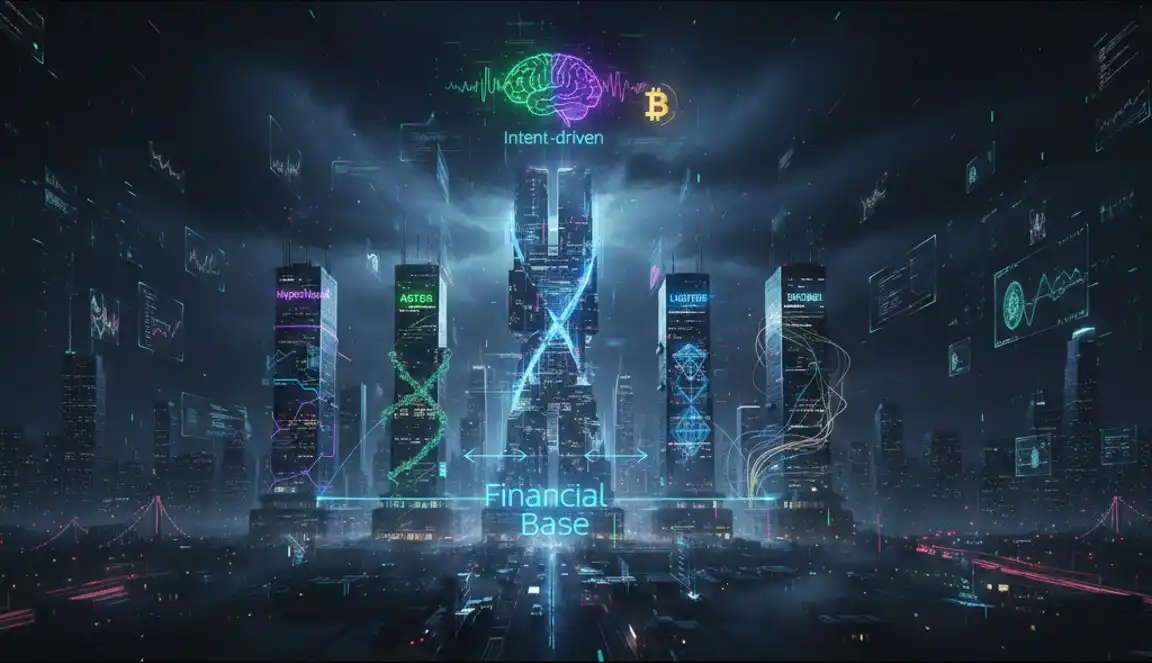
Vitalik Buterin Argues Merging DAOs and Prediction Markets Is Good for Creators as SUBBD Token Soars

bitcoinistPublished on 2026-02-03Last updated on 2026-02-03

Abstract

Ethereum co-founder Vitalik Buterin proposes merging DAOs with prediction markets, a concept he calls "info finance," to improve on-chain governance and content curation by using market-based truth-seeking mechanisms. This shift could benefit creators by replacing opaque Web2 algorithms with transparent, capital-backed systems. Meanwhile, SUBBD Token ($SUBBD) is highlighted as a practical implementation, combining AI tools and Web3 payments to reduce platform fees and empower creators. It has raised over $1.4M in its presale, offering staking rewards and aiming to disrupt the $85 billion creator economy by decentralizing monetization and operational workflows.

Ethereum co-founder Vitalik Buterin is at it again.

This time, he’s pivoting the crypto conversation toward the intersection of decentralized autonomous organizations (DAOs) and prediction markets, a concept he calls ‘info finance.’

In recent commentary on the evolution of on-chain governance, Buterin suggested that prediction markets offer a truth-seeking mechanism that standard DAO voting lacks. By requiring participants to have ‘skin in the game,’ these markets can filter noise from signal.
That distinction matters because the current creator economy is bloated with intermediaries.

When Buterin talks about merging these technologies, the implication for creators is profound: a shift away from opaque Web2 algorithms toward transparent, market-driven curation. Instead of a platform like YouTube or TikTok deciding which creators gain visibility based on black-box ad metrics, a prediction-market-based DAO could surface high-quality content based on crowd sentiment backed by capital.

It’s a move from attention farming to value verification.

But let’s be real, theoretical governance models are only half the equation. The other half is infrastructure that actually empowers creators to bypass rent-seeking platforms today.

While Ethereum’s architect sketches out the future of on-chain coordination, new challengers are already dismantling the Web2 monopoly on content monetization. Leading this charge is SUBBD Token ($SUBBD), a project specifically engineered to disrupt the $85 billion creator economy by mixing AI tools with permissionless payments.

Get your $SUBBD here.

AI-Driven Tools Lower Barriers in The $85 Billion Creator Economy

The structural weakness of the legacy creator economy isn’t just governance, it’s extraction. Platforms routinely snatch cuts ranging from 20% to 50% of a creator’s earnings. Vitalik’s vision of “info finance” attacks the curation layer, but SUBBD Token ($SUBBD) attacks the operational layer.

By merging Web3 infrastructure with advanced AI, the platform offers a tangible solution to the friction that stifles independent creators.

The project distinguishes itself through utility that goes beyond simple transactions. SUBBD provides an AI Personal Assistant for automated interactions and proprietary AI Voice Cloning technology, allowing creators to scale their output without burning out.
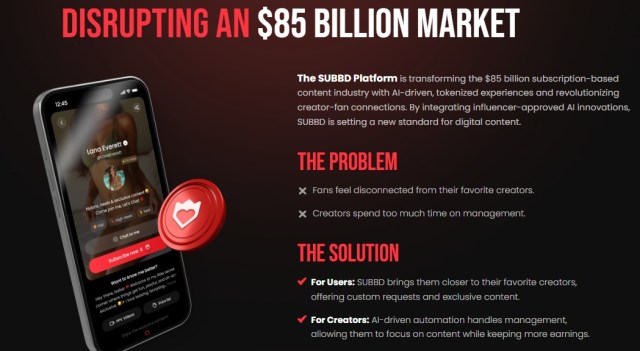
This is critical. In a market where consistency is currency, AI tools that optimize workflow are just as valuable as the payment rails themselves.

Plus, the platform introduces a governance model where the $SUBBD token dictates feature rollouts. This aligns with the broader industry trend of moving control back to the users, mirroring the ethos of Buterin’s DAO-centric proposals. By removing the 70% revenue cuts common in Web2, the project effectively redistributes value from the platform back to the talent.

Check out the SUBBD whitepaper for more details.

You can buy $SUBBD here.

Presale Data Shows Demand for Decentralized Content Platforms

Market sentiment is shifting toward utility-driven assets, and the capital flows prove it. According to official reporting, SUBBD Token ($SUBBD) has raised over $1.4M in its ongoing presale. This level of early-stage liquidity indicates strong investor appetite for projects that bridge the gap between AI technology and crypto-economic incentives.
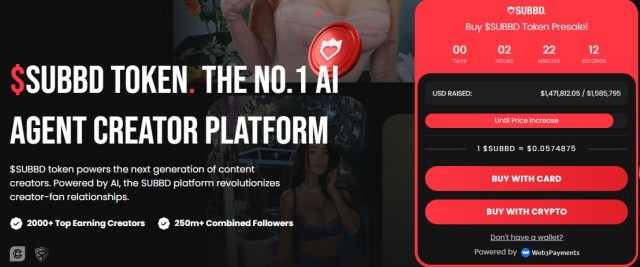
Smart money is watching the entry price carefully. With tokens currently priced at $0.05749, the valuation allows for accessible entry before potential listing volatility kicks in. Unlike meme coins driven purely by hype cycles, this capital raise appears underpinned by a clear revenue model and a staking protocol designed to lock up supply.

The protocol offers a fixed 20% APY for the first year of staking. This incentivizes long-term holding, stabilizing the token economy while the platform scales its user base. For investors, the combination of high-yield staking and exclusive access to ‘HoneyHive’ benefits, such as beta access and XP multipliers, creates a dual value proposition: immediate yield and future utility.

As the creator economy continues to expand, platforms that offer financial sovereignty combined with operational AI tools are positioned to capture significant market share.

Visit the official site to view the presale.

The content provided here is for informational purposes only and does not constitute financial advice. Crypto assets are high-risk investments. Always conduct independent due diligence before investing.


Related Questions

QWhat does Vitalik Buterin call the concept of merging DAOs and prediction markets, and what is its purpose?

AVitalik Buterin calls the concept 'info finance.' Its purpose is to provide a truth-seeking mechanism for on-chain governance by requiring participants to have 'skin in the game,' which can filter noise from signal and shift content curation from opaque Web2 algorithms to transparent, market-driven systems.

QHow does SUBBD Token ($SUBBD) aim to disrupt the creator economy according to the article?

ASUBBD Token ($SUBBD) aims to disrupt the $85 billion creator economy by merging Web3 infrastructure with advanced AI tools, such as an AI Personal Assistant and AI Voice Cloning technology, to lower operational barriers, remove high platform revenue cuts (up to 70%), and provide permissionless payments, thereby redistributing value from platforms back to creators.

QWhat are some key features of the SUBBD platform mentioned in the article?

AKey features of the SUBBD platform include AI-driven tools like an AI Personal Assistant for automated interactions, proprietary AI Voice Cloning technology, a governance model where the $SUBBD token dictates feature rollouts, and a staking protocol offering a fixed 20% APY for the first year to incentivize long-term holding.

QWhat does the presale data for SUBBD Token ($SUBBD) indicate about investor sentiment?

AThe presale data, which shows that SUBBD Token has raised over $1.4M, indicates strong investor appetite for utility-driven projects that bridge AI technology with crypto-economic incentives. This reflects a market shift towards assets with clear revenue models and practical applications, rather than those driven purely by hype.

QHow does the article contrast Vitalik Buterin's vision with the approach of SUBBD Token?

AThe article contrasts Vitalik Buterin's vision, which focuses on improving the curation layer of the creator economy through 'info finance' and prediction-market-based DAOs, with SUBBD Token's approach, which targets the operational layer by providing AI tools and Web3 infrastructure to reduce friction, eliminate high platform fees, and empower creators directly.

Related Reads

How Many Tokens Away Is Yang Zhilin from the 'Moon Chasing the Light'?

The article explores the intense competition between two leading Chinese AI companies, DeepSeek and Kimi (Moon Dark Side), and the mounting pressure on Yang Zhilin, the founder of Kimi. While DeepSeek re-emerged after 15 months of silence with its powerful V4 model—boasting 1.6 trillion parameters and low-cost, long-context capabilities—Kimi has been focusing on long-context processing and multi-agent systems with its K2.6 model. Yang faces a threefold challenge: technological rivalry, commercialization pressure, and investor expectations. Despite Kimi’s high valuation (reaching $18 billion), its revenue heavily relies on a single product with low paid conversion rates, while DeepSeek’s strategic silence and open-source influence have strengthened its market position and valuation prospects, now targeting over $20 billion. Both companies reflect broader trends in China’s AI ecosystem: Kimi aims for global influence through open-source contributions and agent-based advancements, while DeepSeek prioritizes foundational innovation and hardware independence, notably shifting to Huawei’s chips. Their competition is seen as vital for China’s AI progress, with the gap between top Chinese and U.S. models narrowing to just 2.7% on the Elo rating scale. Ultimately, the article argues that this rivalry, though anxiety-inducing for leaders like Zhilin, is essential for driving innovation and solidifying China’s role in the global AI landscape.

marsbit4h ago

How Many Tokens Away Is Yang Zhilin from the 'Moon Chasing the Light'?

marsbit4h ago

TechFlow Intelligence Bureau: ChatGPT Helps Amateur Mathematician Crack 60-Year-Old Problem, CFTC Sues New York Regulator Over Coinbase and Gemini

An amateur mathematician, with the assistance of ChatGPT, has solved a combinatorial mathematics puzzle originally proposed by Hungarian mathematician Paul Erdős in the 1960s. This marks another milestone in AI-aided mathematical research, demonstrating the evolving capabilities of large language models in formal reasoning. In other AI developments, OpenAI introduced a new privacy filter tool for enterprise API usage, automatically screening sensitive data. Meanwhile, the Qwen3.6-27B model achieved 100 tokens per second on a single RTX 5090 GPU using quantization, significantly lowering the cost barrier for local AI deployment. In crypto and Web3, the U.S. CFTC sued New York’s financial regulator, challenging its oversight of Coinbase and Gemini—a first-of-its-kind federal-state regulatory clash. Following a vulnerability, KelpDAO and major DeFi protocols established a recovery fund. Tether froze $344 million in assets linked to Iran’s central bank upon U.S. Treasury request, highlighting the centralized control risks in stablecoins. Separately, Litecoin underwent a 3-hour chain reorganization to undo a privacy-layer exploit. In the U.S., former President Trump invoked the Defense Production Act to address power grid bottlenecks affecting AI data centers and dismissed the entire National Science Board, raising concerns over research independence. A retail trader gained 250% on a $600k Intel options bet amid AI-related speculation. Xiaomi announced its first performance electric vehicle, targeting rivals like Tesla. Meanwhile, iPhone users reported devices automatically reinstalling a hidden app daily, suspected to be MDM-related. A Chinese securities report noted that A-share institutional crowding has reached its second-longest streak since 2007, signaling high valuations and potential style rotation. The day’s developments reflect a dual narrative: AI is enabling unprecedented individual breakthroughs, while centralized power structures—whether governmental or corporate—are becoming more assertive, underscoring that decentralization is as much a political-economic challenge as a technical one.

marsbit4h ago

TechFlow Intelligence Bureau: ChatGPT Helps Amateur Mathematician Crack 60-Year-Old Problem, CFTC Sues New York Regulator Over Coinbase and Gemini

marsbit4h ago

Trading

Spot
Futures
活动图片