Visa Brings Stablecoins To $1.7 Trillion Platform In BVNK Partnership

bitcoinistPublished on 2026-01-15Last updated on 2026-01-15

Abstract

Visa has partnered with stablecoin infrastructure provider BVNK to integrate stablecoin payments into its Visa Direct platform, a $1.7 trillion real-time global payout system. This collaboration aims to modernize money movement by reducing friction and providing faster, more efficient payment options, including during non-banking hours. Initially targeting markets with strong digital payment demand, the service will include stablecoin pre-funding and payouts. The partnership follows an investment by Visa Ventures in BVNK in May 2025. Both companies emphasize the transformative potential of stablecoins as a core payments infrastructure. This move comes as stablecoin adoption grows, with total transaction volume reaching a record $33 trillion in 2025, led by USDC and USDT.

Visa has partnered with BVNK to bring stablecoin payments to the Visa Direct platform, expanding its digital payments infrastructure.

BVNK Will Power Visa Direct’s Stablecoin Infrastructure

As announced in a Wednesday press release, BVNK and Visa have formed a strategic partnership to enable stablecoin payments on the latter’s Visa Direct platform. Based in the US, Visa is the second-largest card payment organization globally, behind only China’s UnionPay. In fact, when excluding China, the firm is the single largest, making up for 50% of total card payments.

Lately, Visa has been exploring digital asset payments, particularly those involving stablecoins, in a bid to modernize money movement. In 2025, the payments giant ran multiple stablecoin pilots related to Visa Direct, its $1.7 trillion real-time global payouts platform.

Now, it seems Visa has taken the next step by partnering with BVNK, a stablecoin infrastructure provider processing over $30 billion in payments annually. Mark Nelsen, Visa’s head of product, commercial, and money movement, said:

Stablecoins are an exciting opportunity for global payments, with enormous potential to reduce friction and expand access to faster, more efficient payment options – including during weekends, holidays and when banks are closed.

Starting with markets with strong demand for digital payments, BVNK will power a few different Visa Direct services, including stablecoin pre-funding and payouts. Visa’s new deal with BVNK hasn’t come out of the blue. Back in May 2025, Visa Ventures made an investment in the digital asset payments rail company. Jesse Hemson-Struthers, BVNK CEO, noted:

Visa and BVNK both believe in the transformational potential of stablecoin technology, not just as a payment method, but as a powerful layer of payments infrastructure.

Following the initial rollout, a broader global expansion of the service is planned, but so far, it’s unconfirmed which markets will be included, only that Visa will decide it based on “customer needs.” Stablecoins have witnessed growing adoption during the past year, as multiple countries have pushed on with legislation related to the sector. Among the most notable developments was the signing of the GENIUS Act by US President Donald Trump.

According to a report from Bloomberg, total stablecoin transaction volume rose 72% to $33 trillion in 2025, a new record.
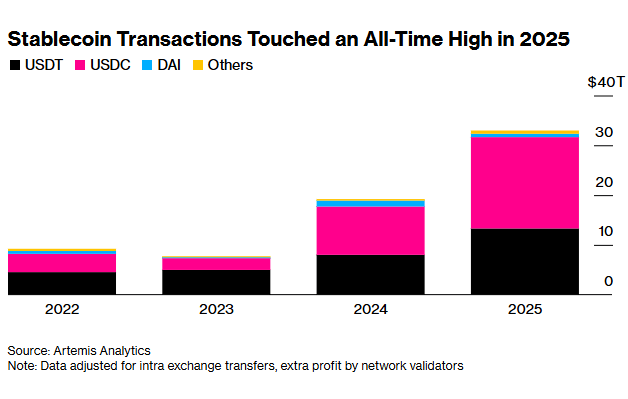
The breakdown of transactions across the major fiat-tied tokens | Source: Bloomberg

Tether’s USDT is the largest fiat-tied cryptocurrency based on market cap, with a valuation that’s more than double Circle’s USDC, but the latter still dominated in transactions during 2025. USDC made up for $18.3 trillion of the total volume, while USDT accounted for $13.3 trillion.

Together, the two tokens covered an extreme majority of the total volume last year, suggesting that activity related to other dollar-pegged tokens and non-USD stablecoins remained low.

Bitcoin Price

At the time of writing, Bitcoin is trading around $95,000, up more than 3% over the past week.

Looks like the price of the coin has surged over the past day | Source: BTCUSDT on TradingView


Related Questions

QWhat is the main purpose of the partnership between Visa and BVNK?

AThe partnership aims to enable stablecoin payments on Visa's $1.7 trillion Visa Direct platform, expanding its digital payments infrastructure.

QHow much payment volume does BVNK process annually according to the article?

ABVNK processes over $30 billion in payments annually.

QWhich two stablecoins dominated transaction volume in 2025, and what were their respective volumes?

AUSDC dominated with $18.3 trillion in transaction volume, while USDT accounted for $13.3 trillion in 2025.

QWhat significant development in US stablecoin legislation is mentioned in the article?

AThe signing of the GENIUS Act by US President Donald Trump was mentioned as a significant development in stablecoin legislation.

QWhat was Bitcoin's approximate price and weekly performance at the time of writing?

ABitcoin was trading around $95,000, up more than 3% over the past week.

Related Reads

Dialogue with a Macro Analyst: AI Drains All Liquidity from U.S. Stocks, $40K Bitcoin is the True Bottom

In a recent discussion, macro strategist Luke Groman, founder of FFT LC, presented a sobering analysis of current markets. He argues that while the S&P 500 hits new highs, this is largely driven by just seven AI stocks, which are "sucking all the oxygen and liquidity out of the room." Bitcoin, which he calls the "last working smoke alarm for liquidity," is signaling trouble, having entered a difficult period. Groman explains that the AI boom is fueled by accounting practices that front-load revenue, creating an illusion of high profits while cash is being depleted. He warns this cycle could reverse sharply when construction slows. His base case is that stocks will rise in dollar terms but fall significantly when measured in gold or Bitcoin, highlighting that long-term US Treasury futures have already lost 90% of their value against gold over the past decade. He points to major structural risks, including China's dominance in rare earths—a small commodity market underpinning trillions in tech stock value—and the prolonged closure of the Strait of Hormuz, which he calls a "Suez Moment" for the US. This, combined with a shift towards a "no ticky, no washy" proof-of-work system for settling trade (using gold, not trust), signals deeper systemic distrust. Regarding US debt, Groman notes that historically, all 58 countries that reached a 130% debt-to-GDP ratio defaulted, primarily through inflation. The US crossed this threshold in 2020. He also highlights a contradiction in the AI narrative: if it's as transformative as claimed, it must destroy white-collar jobs, threatening half of US tax revenue—a reality at odds with the "no job loss" messaging from tech leaders. On Bitcoin, Groman sold most of his position near the top and hasn't fully re-entered. Citing technical analysis from Northstar Bad Charts, he suggests a potential bottom around $40,000 could materialize in Q3 or Q4. He concludes that while he may be labeled a doomsayer, his view is simply realistic, grounded in historical precedents and current macro pressures.

marsbit4h ago

Dialogue with a Macro Analyst: AI Drains All Liquidity from U.S. Stocks, $40K Bitcoin is the True Bottom

marsbit4h ago

Trading

Spot
Futures
活动图片




