VCs Sticking to the Primary Market: How Much Money Do They Still Have?

Odaily星球日报Published on 2026-04-22Last updated on 2026-04-22

Abstract

The article discusses the current state of the cryptocurrency venture capital (VC) market, based on a debate among investors from firms like Pantera Capital, Crucible Capital, and others. Key insights reveal that while VC funds are not short on capital, there is a scarcity of high-quality investment opportunities. The discussion highlights a structural shift: early-stage funding is more dispersed and competitive, with many smaller funds active, but later-stage growth capital is highly concentrated among a few large players like Paradigm and Pantera. Data indicates that over 80% of funding in 2026 went to later rounds, but this includes "graduated" fintech projects that have entered traditional VC realms. The core issue is not the availability of money, but its distribution and accessibility—early-stage founders face intense competition for funding, while later-stage funding is gatekept by a handful of major firms. This reflects a broader trend where VCs are being more selective, prioritizing long-term, proven projects over narrative-driven investments, and founders must demonstrate substantial progress and resilience to secure capital.

Original | Odaily Planet Daily (@OdailyChina)

Author | Azuma (@azuma_eth)
Who knows the current state of the cryptocurrency primary market best? Naturally, it's the VCs still active in the market.

In recent days, several investors from Pantera Capital, Crucible Capital, Blockworks, and Varys Capital engaged in a small-scale discussion on X about the industry's primary market situation. Although there were some differences in their views on the market's current state, their debate might help us understand the primary market's condition a step further.

Counterintuitive Reality: VCs Aren't Short on Money, But There Aren't Many Worthwhile Investment Opportunities

On the evening of April 20, Crucible Capital Partner and GP Meltem Demirors published a short post on X explaining why the number of financing deals in the cryptocurrency industry is significantly decreasing.

Demirors believes that, overall, the "supply side" of early-stage founders and projects in the cryptocurrency industry is not as large as in other high-growth industries. Over the past 4 years, this gap has become increasingly apparent, which is why this VC has started to shift its attention outside the cryptocurrency market.

The venture capital business in the cryptocurrency market has been developing for 10 years, but the truly proven directions that can generate "VC-level returns" are actually just a few — stablecoins/payments, exchanges, and financial products. For VC investors and frontline founders, the industry now has fewer blockbusters, longer cycles, so the requirements for industry insight, resilience, and long-termism are higher, which is why the barrier from seed round to Series A is also increasing.

Although there are still some "era-defining" founders building category-defining companies (the VC's job is to find them and win the opportunity to invest in them), the reality is that there is a clear gap between "the stories founders are telling" and "what VCs can reasonably invest in."

After Demirors' short post was published, it sparked discussion among many VC peers on the topic.

Several investors replied below agreeing with Demirors' view. Among them, Blockworks Co-founder Mippo followed up summarizing, agreeing with Demirors, the current problem in the primary market is the insufficient number of excellent founders and projects; actually, the VC side has plenty of funds to invest — but at the same time, early-stage VC funding is oversupplied, while funding focused on later-stage growth is still noticeably lacking.

Partial Disagreement: Where Exactly Is the Money Concentrated?

Regarding whether VC funds are concentrated in the early discovery stage or the later growth stage, Pantera Capital investor Mason Nystrom and Varys Capital Venture Lead Tom Dunleavy held completely opposite views, and the two engaged in a heated debate.

Dunleavy first stated that he disagreed with Mippo's view that "early-stage funds are oversupplied, later-stage funds are lacking": "I would take the completely opposite view. There is actually a lot of mid-to-late stage cryptocurrency VC money right now — mostly from recently raised and currently fundraising funds, like Paradigm, Multicoin, Pantera, Dragonfly, etc., and that's not even counting traditional VCs that partially dabble in the crypto market. Conversely, funding for seed and earlier stages focused on the industry is lacking...... As long as you haven't completely switched to looking at AI, there are actually many interesting projects to invest in."

But as an insider at one of the later-stage VCs listed by Dunleavy (Pantera), Nystrom strongly refuted Dunleavy's claim. He believes that VC funds in the industry are now more concentrated in the early stages, rather than Series A, Series B, or beyond.

Nystrom did the math: if a fund wants to focus on Series A or Series B financing, they need to invest in at least 20-25 projects, each requiring a large sum — about $15 million for Series A, about $40 million for Series B — by this calculation, a fund focused on Series A needs at least $300 million in assets under management (AUM), and a fund focused on Series B needs at least $800 million. This hasn't even accounted for reserve capital, which typically requires keeping 10% - 50% cash on hand. How many funds in the industry meet this requirement?

So the reality is, there might be at least 50 funds in the industry with AUM less than $100 million, but at the same time, there might only be about 15 funds with AUM over $400 million. There are extremely few big players in the industry that can participate in Series B and beyond; there might indeed be more Series B and later-stage funding in fintech (like stablecoins), but these projects have long "graduated" into the traditional VC system and can no longer be simply considered cryptocurrency market projects.

But Dunleavy was not convinced. In his response, he posted Galaxy's Q1 primary market financing report, mentioning that the number of industry-wide financing deals in Q1 fell by 49% year-on-year, but the average deal size increased by 76% (about $36 million) — the total financing amount for seed and earlier stages was only $268 million; Series A had $370 million; Series B was even higher at $1.1 billion; later stages were as high as $2.72 billion (mainly from Kalshi and Polymarket).

Dunleavy thus rebutted, saying the data proves that in 2025, over 50%+ of the industry's investment went to later stages (already a historical high), and in 2026 it has already reached 80%+.
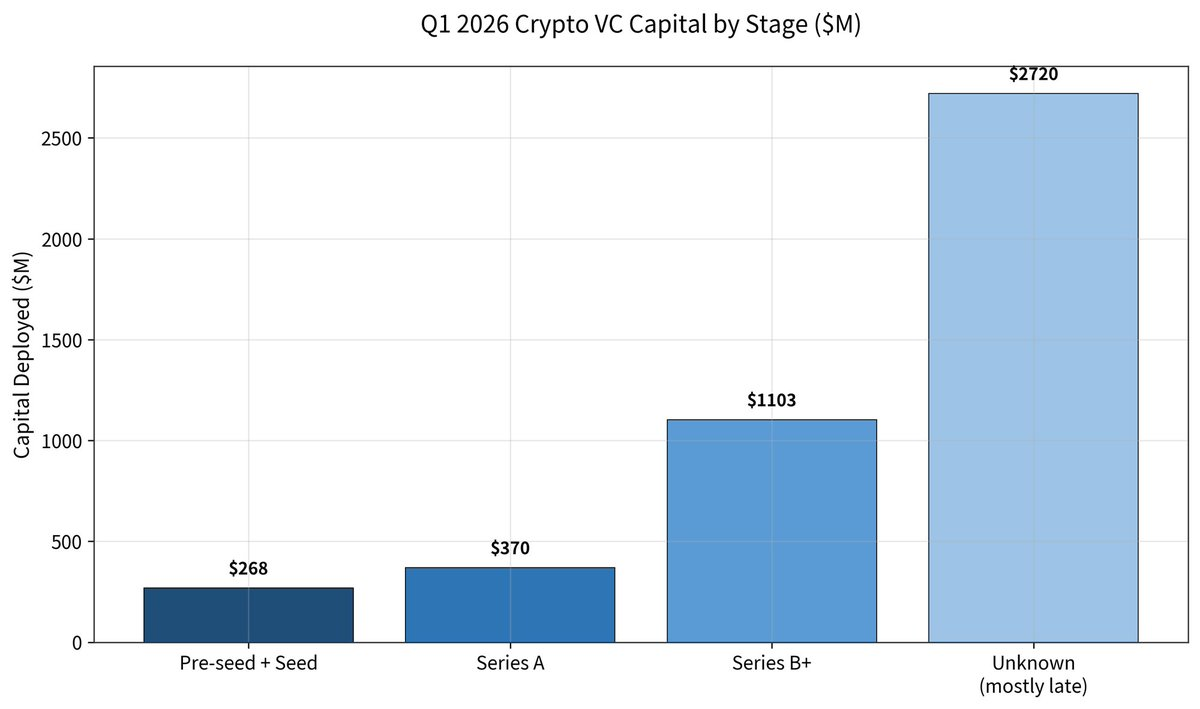
Dunleavy finally estimated the current funding situation in the primary market — available funds for Series A and later stages are about $6 to $7 billion, concentrated in 5 to 6 large institutions; available funds for seed and earlier stages are about $1 to $2 billion, scattered across dozens of smaller, more dispersed funds.

Nystrom responded again, stating that in the data posted by Dunleavy, the vast majority of later-stage investments actually come from fintech-related "graduated" projects, but such projects have long entered the sight of traditional VCs and received investment, and should no longer be counted within the industry.

Nystrom then continued to argue based on Dunleavy's conclusion that "only 5-6 funds can invest in Series A and beyond, but dozens of funds can invest in seed stage": "This means if you can't convince 1 of those 6, you're basically out of luck; but in the early stage, as long as 1 of the dozens of funds is willing to invest, you can survive. The 'accessibility' of these two is completely unequal."

Furthermore, funds like Pantera Capital that have the ability to invest in mid-to-late stages actually also invest in seed rounds, but the reverse is not true. Additionally, more and more VCs are turning into liquidity funds, so the scale of funds in the industry that can truly invest in mid-to-late stages is much smaller than the numbers suggest.

Compared to "Is There Money", the Real Question Is "Where Is the Money, Can It Be Accessed"

In short, neither side could convince the other, but based on the direct confrontation between these two frontline investors, we got a further glimpse into the reality of the cryptocurrency primary market — "is there money" does not seem to be the core problem of the primary market; "where is the money, can it be accessed" is.

Superficially, the data shows the industry's funds are still ample, even highly concentrated in later rounds; but from actual experience, both VCs and entrepreneurs are facing a more "structurally tightened" market — early-stage funds appear dispersed but competition is fierce, mid-to-late stage funds appear ample but the threshold is extremely high. This also means the rules of the game in the primary market are changing. The era of relying on narratives, traffic, and short-cycle realization to complete the financing loop is quickly fading away; replaced by a financing environment that relies more on real business progress, long-term capabilities, and deterministic growth paths.

For VCs, this is a cycle of "making fewer moves, focusing more on judgment"; for entrepreneurs, it is a survival test that must cross a longer cycle and a higher barrier.


Related Questions

QAccording to the article, what is the main reason for the decrease in the number of cryptocurrency financing deals?

AThe main reason is a shortage of high-quality founders and projects, not a lack of VC capital. There is a significant gap between the stories founders are pitching and what VCs can reasonably invest in.

QWhat is the key disagreement between Mason Nystrom and Tom Dunleavy regarding VC funding?

AThey disagree on where the VC funding is concentrated. Nystrom argues that funding is more abundant in the early stages (seed), while Dunleavy contends that the majority of capital is concentrated in the later stages (Series A and beyond), held by a few large funds.

QBased on the Galaxy Q1 report cited, what was the trend in deal size and number of deals in Q1?

AThe number of financing deals in Q1 decreased by 49% year-over-year, but the average deal size increased by 76%, to approximately $36 million.

QWhat does Tom Dunleavy estimate is the total amount of available capital for Series A and later stages, and how is it distributed?

ATom Dunleavy estimates that there is approximately $6-7 billion in available capital for Series A and later stages, concentrated in the hands of 5 to 6 large institutions.

QWhat is the article's conclusion about the core problem in the current primary market?

AThe core problem is not whether there is money available, but rather where the money is located and whether founders can access it. The market is structurally tighter, with intense competition for early-stage funding and extremely high barriers to accessing later-stage capital.

Related Reads

War Trade Unwinding | TradeXYZ Weekend Observations

Weekend markets saw a clear return of risk appetite. Major indices rose broadly, with significant gains in tech and precious metals, while energy sectors fell sharply on the "end of war" narrative. On June 14, oil prices initially rose on reports Iran had not yet finalized a memorandum of understanding. Later, YNET reported Trump might immediately lift the maritime blockade on Iran and the Strait of Hormuz. At 21:30, Trump confirmed on Truth Terminal that a deal with Iran was done, authorizing an immediate end to the US blockade and toll-free opening of the Strait. Iran's deputy foreign minister simultaneously announced an immediate and permanent halt to military actions on multiple fronts. Oil prices had already fallen to weekend boundaries, pre-pricing the news. The S&P 500 subsequently touched 7530. Markets will likely remain in a waiting period until the formal peace deal signing on June 19. At the moment of the deal announcement, gold jumped from ~4,221 to a high of 4,337, and silver from ~67.85 to 70.83, before stabilizing at higher levels. Individual stocks and ETFs like NBIS, RKLB, and LITE performed strongly. NBIS, added to the Nasdaq index, saw a target price increase due to strong AI cloud growth. RKLB, also added to the index, benefited from positive SpaceX valuation sentiment. LITE received a $1,130 target from JPMorgan. SPCX rose quickly after Musk tweeted SpaceX could potentially reach ~$1 trillion in revenue by 2030. In summary, the market shock from the multi-month war is beginning to dissipate. Israel's actions remain the key variable before the June 19 signing. Upcoming events like Fed Chair Warsh's debut and BoJ rate hike expectations will also significantly impact markets this week.

marsbit21m ago

War Trade Unwinding | TradeXYZ Weekend Observations

marsbit21m ago

Will the Next Crypto Bull Run Start with On-Chain Trading of SpaceX?

This article presents a scenario-based forecast for the crypto industry from 2026 to 2029, arguing that the next major cycle will be driven not by technological narratives but by legal access to real-world assets. The author predicts that by mid-2026, pre-IPO perpetual contracts for top private companies like SpaceX, OpenAI, and Anthropic on platforms like Hyperliquid will become the primary gateway for accessing quality assets, as most crypto-native tokens fail to capture real value. The much-hyped AI x Crypto intersection largely fails except for prediction markets, which thrive on betting on AI model supremacy. By 2027, public blockchain foundations are forced to choose between catering to retail speculation or building compliant infrastructure for institutions, with many opting for the latter. Growth in stablecoins and tokenized private credit/equity hits a "triple ceiling" due to regulatory and political uncertainty rather than market demand. The pivotal shift is forecast for 2028. A major liquidation event in pre-IPO perpetuals exposes the structural flaw of synthetic markets lacking a real underlying asset anchor. In response, regulatory changes finally allow the public solicitation of private securities resales to verified accredited investors. This creates a legitimate secondary market for real company equity, which then becomes the core asset class of the new bull market, relegating synthetic perps to a niche role. By 2029, the industry becomes "boring" but foundational. Tokens without claims on real cash flows or assets cease trading. Stablecoin growth is steady but politically capped. Crypto infrastructure fades from view as it gets absorbed into traditional finance backends. The article's central thesis is that the key bottleneck for crypto's next phase is legal and regulatory channels for real asset ownership, not technology.

marsbit1h ago

Will the Next Crypto Bull Run Start with On-Chain Trading of SpaceX?

marsbit1h ago

The Value Distribution of Stablecoins

**Summary: The Value Distribution of Stablecoins** The article argues that stablecoins are evolving from mere trading tools into broader channels for dollar access. It divides the stablecoin ecosystem into four layers to analyze how value is distributed: 1. **Issuance Layer:** Mints stablecoins, holds reserve assets, and captures the spread between reserve yield and user costs (e.g., Tether, Circle). This layer currently earns the largest profit margin. 2. **Infrastructure Layer:** Connects stablecoins to the traditional financial system, handling fiat on/off-ramps, banking integration, compliance (KYC/AML), and asset management (e.g., Bridge, BVNK). This is the "unglamorous" but critical work, building the essential bridges between crypto and real-world finance. 3. **Acquiring/Distribution Layer:** Integrates stablecoins into merchant systems, manages payment flows, and provides enterprise financial software (e.g., Stripe, Coinbase). They act as the access point for businesses. 4. **Application Layer:** The end-users and businesses that ultimately use stablecoins for payments, settlements, or as a store of value. They benefit from convenience but have little pricing power. The core thesis is that while the issuance layer currently dominates profits, the often-overlooked **infrastructure layer holds significant long-term potential**. The real challenge and barrier to mass adoption is not the on-chain transfer of stablecoins (which is simple), but the complex "last mile" integration into existing business workflows, banking systems, and regulatory frameworks across different countries. Companies in this layer are currently in a "land grab" phase, investing heavily to build networks, secure bank partnerships, and establish compliance pathways. While their position is currently pressured by the profitable issuers above and distribution platforms below, the article suggests that if stablecoins become a default financial rail for businesses, the infrastructure providers who have done the hard work of integration will ultimately gain strong pricing power and become entrenched, essential players.

marsbit8h ago

The Value Distribution of Stablecoins

marsbit8h ago

Trading

Spot
Futures
活动图片