USDC vs. USDT: $70.2T volume drives shift as Circle expands into Africa

ambcryptoPublished on 2026-03-25Last updated on 2026-03-25

Abstract

Circle partners with Sasai Fintech (Cassava Technologies) to expand USDC into Africa, aiming to revolutionize cross-border payments by making them faster, cheaper, and more reliable. This integration into Sasai's mobile platform addresses high fees (often over 7%) and slow traditional systems. The move occurs as stablecoins process $70.2T in annual volume, with USDC gaining market share against USDT, signaling a shift toward reliable, transparent systems. However, Circle faces regulatory challenges in the U.S., including concerns from the upcoming CLARITY Act, which contributed to a recent 20% stock drop. The expansion highlights a strategic focus on high-growth markets like Africa despite domestic uncertainties.

While many are currently concerned about Circle’s stock performance on the NYSE, the company’s partnership with Sasai Fintech, a business of Cassava Technologies, tells an interesting story.

This move isn’t just about expanding into Africa; it’s aimed at tackling a long‐standing challenge: cross‐border payments that remain slow, costly, and inefficient. The plan is to bring USDC into Sasai’s mobile platform, which already supports payments and remittances across multiple African countries.

USDC x Sasai’s partnership: A green flag

Currently, fees can go above 7%, so using a stablecoin like USDC can make transactions faster, cheaper, and more reliable.

By adding USDC into a mobile platform that already supports fast-moving trade, it removes the delays and high costs of traditional systems, where transactions can take days.

Additionally, the partnership is also meant to offer a stable and transparent way to make cross-border payments. This would, in turn, help businesses avoid local currency swings while staying connected to the global market.

Executives weighing in

Remarking on the same, Strive Masiyiwa, Founder and Executive Chairman at Cassava Technologies, said,

Africa’s digital economy is entering a new era, propelled by entrepreneurship, a mobile-first generation, and the acceleration of intra-regional trade.

Adding more to the sentiment, Jeremy Allaire, co-founder and CEO at Circle, noted,

Working with Cassava, we can extend the benefits of USDC and onchain infrastructure into high-growth payment corridors to deliver always-on global connectivity.

Stablecoin’s market dynamics: USDC vs. USDT

The partnership comes at an important time for stablecoins, which have handled a huge $70.2 trillion in transactions over the past year. While USDT was leading for most of 2025, things started to change in early 2026.

Even though total activity slowed a bit in March after a strong February, USDC has started catching up and even briefly matched USDT’s share.
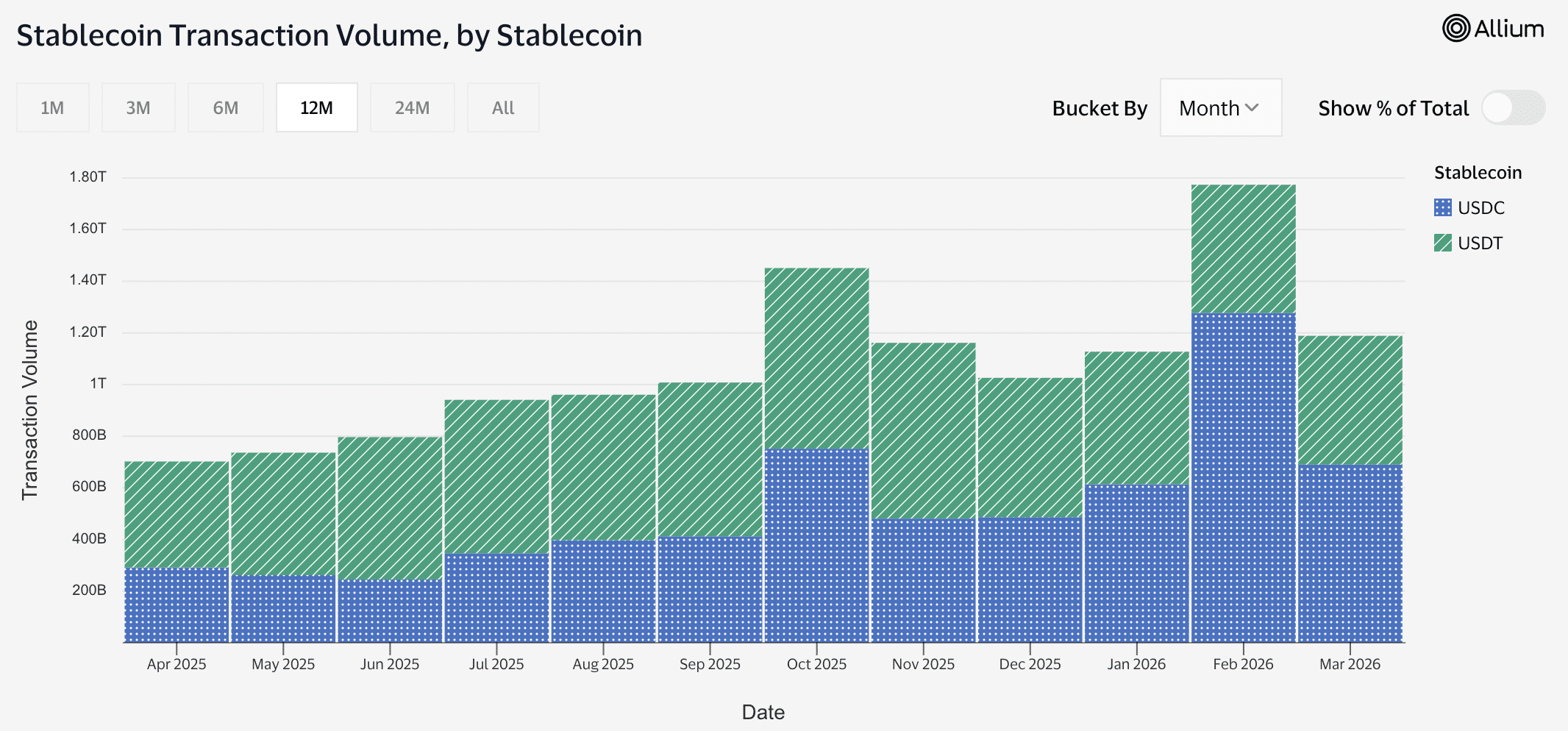
Source: Visa on-chain analytics

This rise in USDC signals a shift away from pure speculation toward more reliable systems, something Circle is now bringing to markets like Africa.

Regulatory clarity and more

While Circle expands into Africa, its position in the United States has become shaky due to new regulations.

In 2025, the GENIUS Act gave a positive direction for stablecoins by supporting dollar-backed digital assets. But now, the upcoming CLARITY Act is creating fresh concerns.

This has made investors nervous, as it could directly impact how companies like Circle generate revenue. As a result, Circle’s stock (CRCL) recently saw a sharp drop of nearly 20% on the 24th of March, closing at $101.17.

All this together shows that Circle is at a turning point, dealing with regulatory challenges in the U.S. while building a strong, usage-driven future in markets like Africa.


Final Summary

  • Integrating USDC into Sasai’s mobile network could cut remittance costs and speed up settlements.
  • The rising competition between USDC and USDT reflects demand for transparency and regulatory alignment.


Related Questions

QWhat is the primary goal of Circle's partnership with Sasai Fintech in Africa?

AThe primary goal is to tackle the challenges of slow, costly, and inefficient cross-border payments by integrating USDC into Sasai's mobile platform to make transactions faster, cheaper, and more reliable.

QAccording to the article, what significant shift in the stablecoin market does the rise of USDC signal?

AThe rise of USDC signals a shift away from pure speculation toward more reliable and transparent systems for cross-border payments and remittances.

QWhat recent U.S. regulatory development has created concerns for Circle and its investors?

AThe upcoming CLARITY Act has created fresh concerns and investor nervousness, as it could directly impact how companies like Circle generate revenue, contributing to a sharp drop in its stock price.

QHow much transaction volume have stablecoins handled over the past year, as mentioned in the article?

AStablecoins have handled a huge $70.2 trillion in transactions over the past year.

QWhich two key benefits does the article suggest the USDC integration will bring to African markets?

AThe integration is expected to cut remittance costs and speed up settlement times for cross-border payments.

Related Reads

How Many Tokens Away Is Yang Zhilin from the 'Moon Chasing the Light'?

The article explores the intense competition between two leading Chinese AI companies, DeepSeek and Kimi (Moon Dark Side), and the mounting pressure on Yang Zhilin, the founder of Kimi. While DeepSeek re-emerged after 15 months of silence with its powerful V4 model—boasting 1.6 trillion parameters and low-cost, long-context capabilities—Kimi has been focusing on long-context processing and multi-agent systems with its K2.6 model. Yang faces a threefold challenge: technological rivalry, commercialization pressure, and investor expectations. Despite Kimi’s high valuation (reaching $18 billion), its revenue heavily relies on a single product with low paid conversion rates, while DeepSeek’s strategic silence and open-source influence have strengthened its market position and valuation prospects, now targeting over $20 billion. Both companies reflect broader trends in China’s AI ecosystem: Kimi aims for global influence through open-source contributions and agent-based advancements, while DeepSeek prioritizes foundational innovation and hardware independence, notably shifting to Huawei’s chips. Their competition is seen as vital for China’s AI progress, with the gap between top Chinese and U.S. models narrowing to just 2.7% on the Elo rating scale. Ultimately, the article argues that this rivalry, though anxiety-inducing for leaders like Zhilin, is essential for driving innovation and solidifying China’s role in the global AI landscape.

marsbit2h ago

How Many Tokens Away Is Yang Zhilin from the 'Moon Chasing the Light'?

marsbit2h ago

TechFlow Intelligence Bureau: ChatGPT Helps Amateur Mathematician Crack 60-Year-Old Problem, CFTC Sues New York Regulator Over Coinbase and Gemini

An amateur mathematician, with the assistance of ChatGPT, has solved a combinatorial mathematics puzzle originally proposed by Hungarian mathematician Paul Erdős in the 1960s. This marks another milestone in AI-aided mathematical research, demonstrating the evolving capabilities of large language models in formal reasoning. In other AI developments, OpenAI introduced a new privacy filter tool for enterprise API usage, automatically screening sensitive data. Meanwhile, the Qwen3.6-27B model achieved 100 tokens per second on a single RTX 5090 GPU using quantization, significantly lowering the cost barrier for local AI deployment. In crypto and Web3, the U.S. CFTC sued New York’s financial regulator, challenging its oversight of Coinbase and Gemini—a first-of-its-kind federal-state regulatory clash. Following a vulnerability, KelpDAO and major DeFi protocols established a recovery fund. Tether froze $344 million in assets linked to Iran’s central bank upon U.S. Treasury request, highlighting the centralized control risks in stablecoins. Separately, Litecoin underwent a 3-hour chain reorganization to undo a privacy-layer exploit. In the U.S., former President Trump invoked the Defense Production Act to address power grid bottlenecks affecting AI data centers and dismissed the entire National Science Board, raising concerns over research independence. A retail trader gained 250% on a $600k Intel options bet amid AI-related speculation. Xiaomi announced its first performance electric vehicle, targeting rivals like Tesla. Meanwhile, iPhone users reported devices automatically reinstalling a hidden app daily, suspected to be MDM-related. A Chinese securities report noted that A-share institutional crowding has reached its second-longest streak since 2007, signaling high valuations and potential style rotation. The day’s developments reflect a dual narrative: AI is enabling unprecedented individual breakthroughs, while centralized power structures—whether governmental or corporate—are becoming more assertive, underscoring that decentralization is as much a political-economic challenge as a technical one.

marsbit3h ago

TechFlow Intelligence Bureau: ChatGPT Helps Amateur Mathematician Crack 60-Year-Old Problem, CFTC Sues New York Regulator Over Coinbase and Gemini

marsbit3h ago

Trading

Spot
Futures
活动图片




