US-Iran Negotiations Countdown: What Cards Does Trump Hold?

比推Published on 2026-03-24Last updated on 2026-03-24

Abstract

Summary: On March 23, Trump announced a 5-day suspension of planned strikes on Iran’s energy infrastructure, citing "productive dialogue" and "major consensus." However, Iran’s parliament speaker denied any direct talks. This marks the 7th time since 2018 that Trump has threatened Iran but only fully followed through twice—withdrawing from the JCPOA in 2018 and launching "Epic Fury" in February 2026. Brent crude fell 10.92% to around $100 after the delay announcement, reflecting market skepticism. Three scenarios post-deadline are possible: a temporary freeze agreement (oil at $80–90), extended talks (oil at $95–110), or resumed strikes with Hormuz blockade (oil up to $150+). Trump’s demands go far beyond the 2015 nuclear deal, including zero uranium enrichment and halting missile development. Current indirect mediation via Turkey, Egypt, and Pakistan lacks the structure of past multilateral talks. If talks fail, Trump’s options include strikes on power plants or Kharg Island (handling 90% of Iran’s exports), tariffs on nations trading with Iran, and cyber operations. Iran can counter by blocking the Strait of Hormuz (20% of global oil transit) for months and using its remaining missiles. Both sides face a credibility trap—military escalation risks oil price spikes, while repeated delays weaken threat credibility. The 5-day window is part of an ongoing high-stakes cycle.

Author: Rhythm BlockBeats

Original Title: If the US and Iran Don't Reach an Agreement in 5 Days, What Other Cards Does Trump Have?


On March 23, Trump announced a 5-day suspension of strikes on Iran's energy infrastructure, claiming that there had been "very good, productive dialogue" and "major points of consensus" between the US and Iran. Upon the news, Brent crude fell from $112 to $99.94, a single-day plunge of 10.92%, the largest single-day drop since the start of Epic Fury.

However, Iranian Parliament Speaker Mohammad Bagher Ghalibaf denied the same day that any direct negotiations had taken place. Turkey, Egypt, and Pakistan are acting as intermediaries to relay messages, with Kushner and Witkof coordinating, but there is disagreement even on the basic fact of "whether talks are happening."

On the Iran issue, this is not the first time Trump has issued an "ultimatum" and then stepped back. From 2018 to now, a similar pattern has occurred 7 times.

7 Threats, 2 Delivered

Laying out all of Trump's major threats against Iran from 2018 to the present reveals a clear pattern.
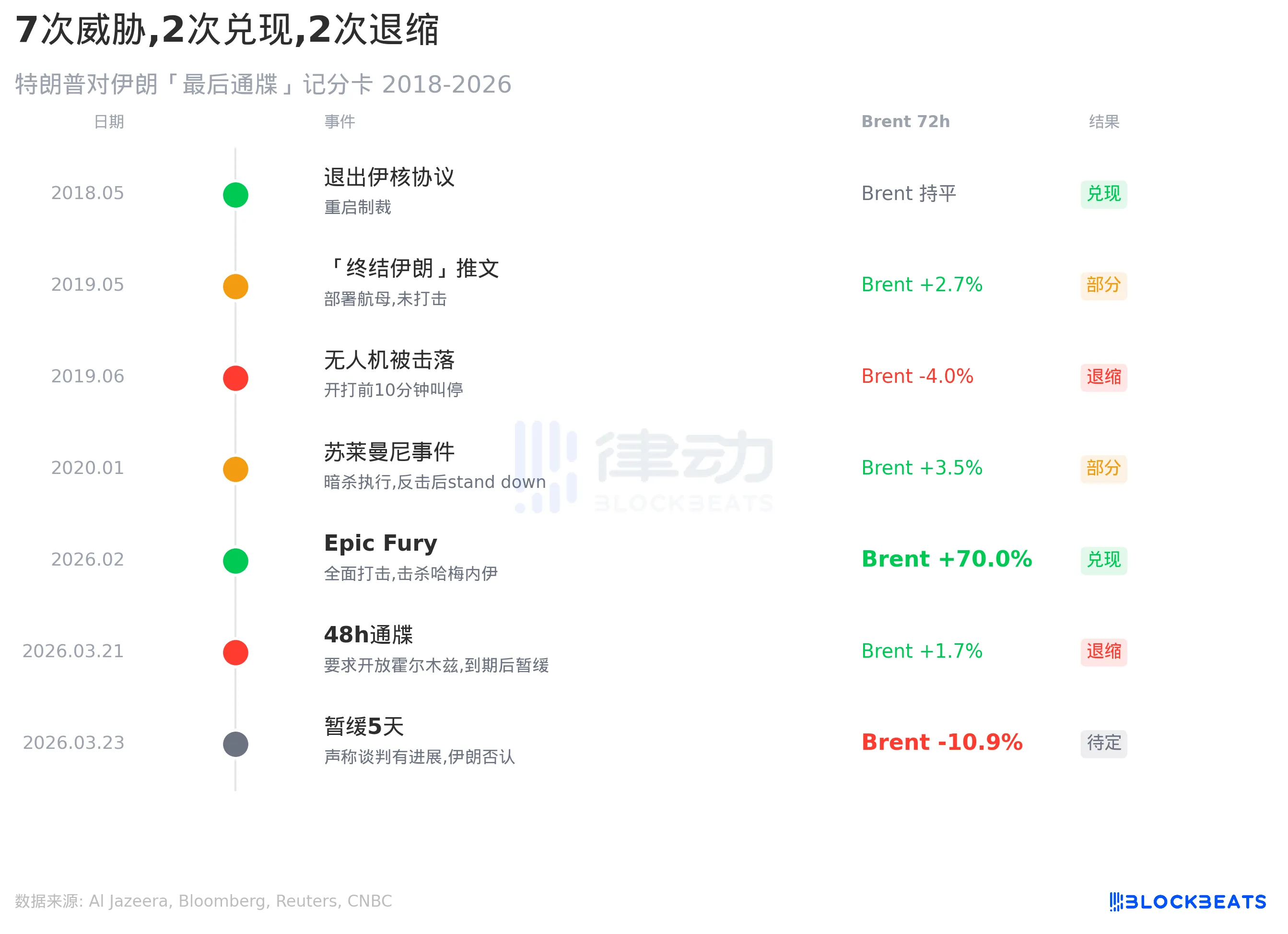
In 2018, he withdrew from the JCPOA, followed through, and sanctions were reinstated as scheduled. In February 2026, he launched Epic Fury, also followed through, killing Khamenei within 24 hours and destroying over 70% of Iran's missile launchers (according to Israeli intelligence assessments). These two were fully delivered, with oil prices reacting violently; Epic Fury drove Brent from $71 to $119.50, a 70% increase.

But the other side is equally prominent. In June 2019, after Iran shot down a US drone, Trump ordered strikes on Iranian radar and missile sites; the military was "cocked and loaded," but he called it off 10 minutes before launch. On March 21, 2026, he issued a 48-hour ultimatum to Iran to reopen the Strait of Hormuz; when it expired, he didn't strike, instead switching to a "5-day suspension."

Out of 7 instances, 2 were fully delivered, 2 were partially executed, 2 were退缩 (stepped back), and 1 is pending. The market's response is also changing. After the 2019 strike call-off, oil prices fell back only 3-5%. This time, with the 5-day suspension, oil prices directly fell 10.92%. The market's reaction amplitude to "suspension" type signals is放大 (amplifying), because investors are increasingly quickly pricing in the "threat devaluation."

What $100 Oil is Saying

After the 5-day window expires, there are three paths.

First, reaching some kind of framework agreement. Not a comprehensive deal, more likely a 30-60 day temporary freeze to buy time for后续 (follow-up) negotiations. In this scenario, Brent could fall back to the $80-90 range, close to Goldman Sachs' 2026 average price forecast of $85.

Second,延期 (extending) and continuing talks. After the 5 days expire, neither striking nor signing, but换 (exchanging for) a new suspension window. Oil prices remain震荡 (oscillating) in the $95-110 range, with war risk premium neither eliminated nor increased.

Third, resuming strikes加上 (plus) continued blockade of the Strait of Hormuz. According to CSIS's scenario modeling, if Iran expands attacks on Gulf oil facilities after being struck, Brent could surge to $130-150. Goldman Sachs' extreme scenario is more aggressive: if the Hormuz blockade lasts 60 days and Middle East production is长期 (long-term) reduced by 2 million barrels/day, oil prices could break the 2008 historical high of $147.
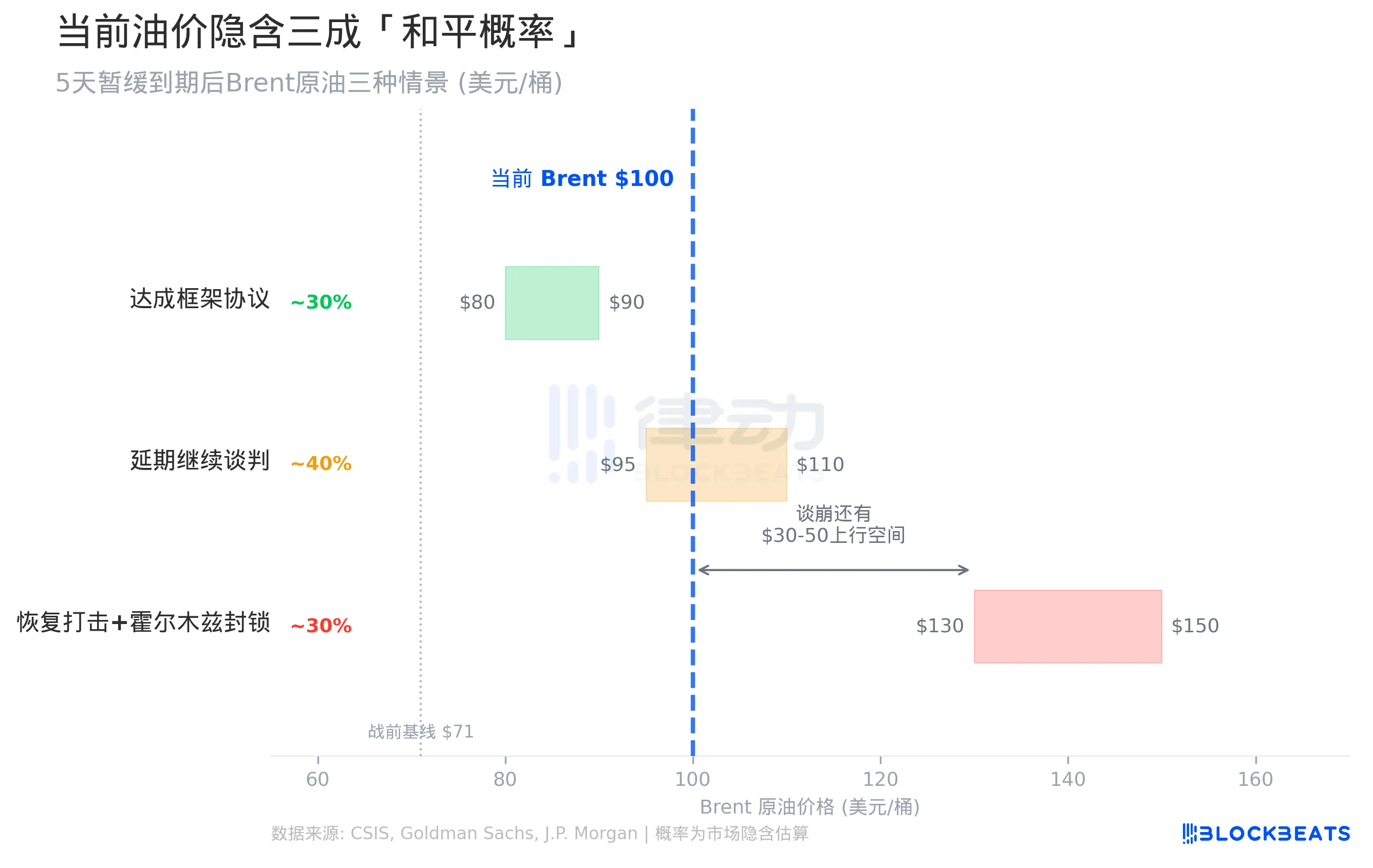
The current $100 Brent pricing roughly implies about a 30-40% probability of "reaching an agreement." Put another way, the market believes there is a 60-70% chance that the situation will not fundamentally improve after 5 days. If talks collapse, oil prices have another $30-50 of upside potential.

The 2015 Negotiations Took 35 Months

Trump's six core demands include zero uranium enrichment, dismantling nuclear facilities, a 5-year freeze on missile development, stopping funding proxy militias, recognizing Israel's right to exist, and US physical custody of Iran's stockpile of highly enriched uranium. This set of demands far exceeds the framework of the 2015 JCPOA. The当年的 (that year's agreement only limited enrichment levels to 3.65%, kept facilities operational, and did not address missiles or proxy militias.

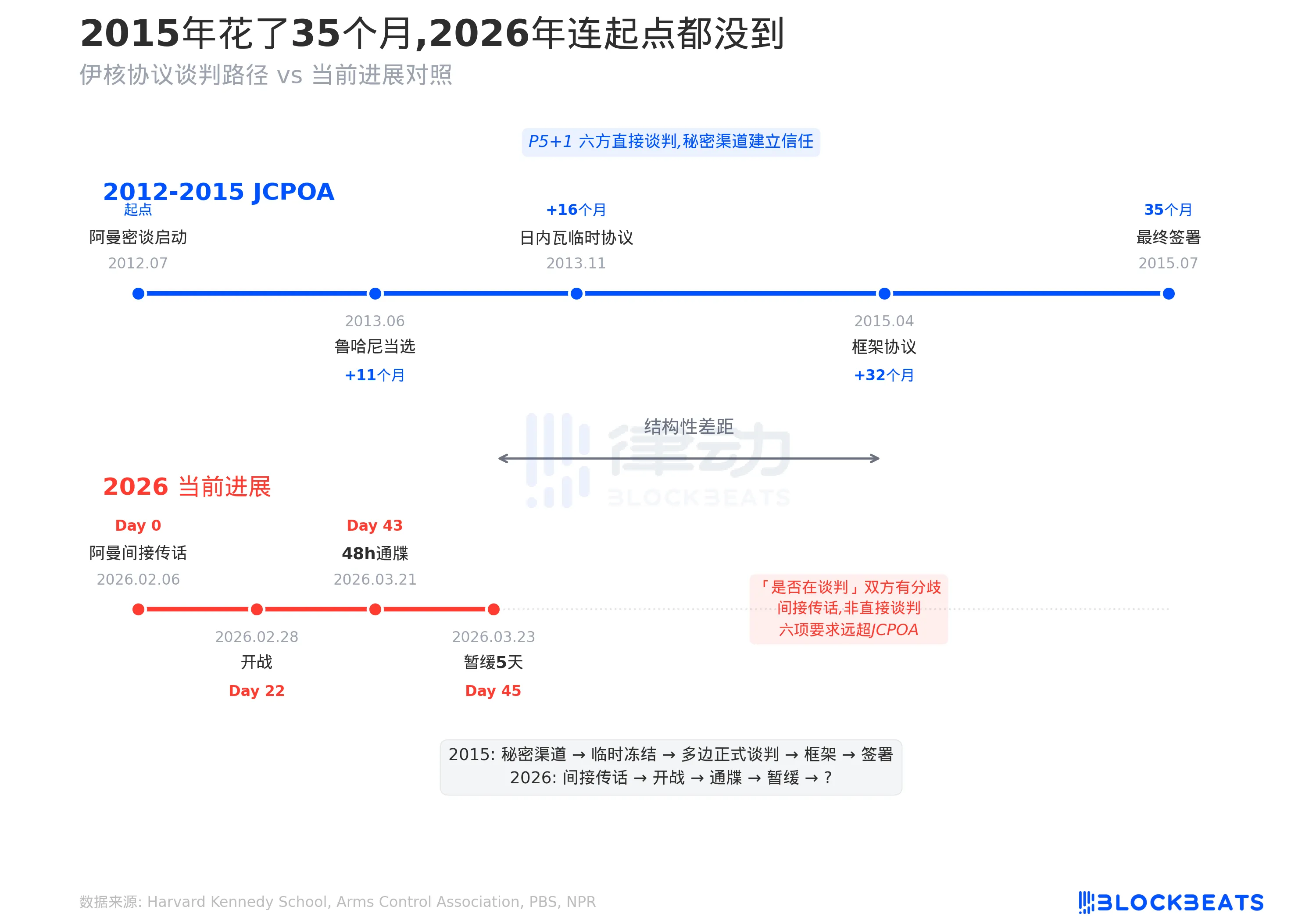
The 2015 JCPOA started with secret contacts in Oman in July 2012 and took 35 months until the final signing in Vienna. In between, there was Rouhani's election bringing pragmatists to power, the interim Geneva agreement building trust, and 20 rounds of direct P5+1 six-party negotiations.

Where is the progress in 2026? There was one indirect message relay through Oman on February 6th, then the war started on February 28th. As of the March 23rd suspension, only 45 days have passed, and the two sides don't even agree on "whether negotiations are happening." The intermediary structure involves Turkey, Egypt, and Pakistan separately relaying messages, not the multilateral direct谈判 (negotiations) of P5+1. The precondition for谈判 (negotiations) (both sides acknowledging their existence) isn't even met yet, whereas the 2015 path used secret channels to build trust for over a year before entering public谈判 (negotiations).
If No Deal, What Other Cards Does Trump Have?

The military card is the most direct. Power plant strikes are the direct object of the 5-day suspension; resuming strikes has the lowest operational threshold. More升级 (escalated) options include blockading or occupying Kharg Island; Al Jazeera reported on March 20th that plans were already being discussed. Kharg handles 90% of Iran's crude exports, about 1.3-1.6 million barrels/day (according to EIA data). Regarding nuclear facilities, Natanz was damaged in the first week of the war, Fordow's highly enriched uranium has not been moved since being struck in June 2025 (according to FDD analysis), but Iran's new Pickaxe Mountain facility, built 100 meters underground in granite near Natanz, is beyond the reach of airstrikes. Currently, the US military has deployed 2 carrier strike groups, over 16 surface vessels, and more than 100 aircraft in the Middle East (according to Military Times), the largest scale since the 2003 Iraq war.

On the economic card, Trump announced in January a 25% tariff on countries doing business with Iran. The main targets are China (over 90% of Iran's oil trade), as well as India, the UAE, and Turkey. Iran's current oil exports are still 1.5-1.6 million barrels/day, with daily revenue of about $140 million (according to Defense News data).

Cyber warfare is already underway. According to Foreign Policy报道 (reporting), before the Epic Fury kinetic strikes, US Cyber Command had already launched "non-kinetic effects," paralyzing parts of Iran's communication and early warning systems.

But Iran is not without counter-cards. According to US Defense Intelligence Agency (DIA) assessments, Iran can maintain a blockade of the Strait of Hormuz for 1-6 months. The Strait of Hormuz sees 20 million barrels of crude and refined products pass through daily, accounting for 20% of global oil consumption (according to EIA data), while Saudi Arabia and the UAE's pipeline bypass capacity is only 3.5-5.5 million barrels/day, leaving a huge gap of 14.5 million barrels/day. Iran still has about 1,500 ballistic missiles and 200 launchers (according to Israeli military estimates), and Hezbollah holds about 25,000 missiles (according to Israeli assessments).

This is the underlying博弈 (game theory) logic of the 5-day window. Trump faces a credibility trap: if he strikes, oil prices could spiral out of control, putting pressure on the domestic economy. If he doesn't strike, the cycle of ultimatums and suspensions will further weaken the pricing power of military threats. Iran's dilemma is对称 (symmetrical): if they talk, domestic hardliners won't agree. If they don't talk, the next round of strikes could target power plants and Kharg Island. The March 28th expiration date is not the end point; it's the next flip of this trap.


Twitter:https://twitter.com/BitpushNewsCN

Bitpush TG Discussion Group:https://t.me/BitPushCommunity

Bitpush TG Subscription: https://t.me/bitpush

Original link:https://www.bitpush.news/articles/7622904

Related Questions

QWhat are the three possible outcomes after the 5-day window for US-Iran negotiations expires, and how would each affect oil prices?

AThe three possible outcomes are: 1) A framework agreement is reached, likely a 30-60 day temporary freeze, which could cause Brent crude to fall to the $80-90 range. 2) The talks are extended with a new grace period, keeping oil prices fluctuating in the $95-110 range. 3) The US resumes strikes and the Strait of Hormuz remains blocked, which could push Brent crude to $130-150 or even higher, potentially surpassing the 2008 high of $147 per barrel.

QAccording to the article, what is the market's implied probability of a deal being reached after the 5-day window?

AThe current Brent crude price of $100 implies a market probability of about 30-40% that an agreement will be reached. This means the market believes there is a 60-70% chance that the situation will not fundamentally improve after the 5 days.

QHow do Trump's current core demands on Iran compare to the 2015 JCPOA agreement?

ATrump's six core demands are far more extensive than the 2015 JCPOA. They include zero uranium enrichment, dismantling nuclear facilities, a 5-year freeze on missile development, stopping funding for proxy militias, recognition of Israel's right to exist, and physical custody of Iran's highly enriched uranium stockpile by the US. The JCPOA only limited enrichment levels to 3.65%, allowed facilities to remain operational, and did not address missiles or proxy militias.

QWhat military and economic options does the US have if negotiations with Iran fail?

AMilitarily, the US could resume strikes on power plants, which is the most direct option. More escalatory options include blockading or occupying Kharg Island, which handles 90% of Iran's crude exports. The US has a significant military presence in the region. Economically, the US has already imposed a 25% tariff on countries trading with Iran, primarily targeting China, India, the UAE, and Turkey. Cyber warfare operations are also already underway.

QWhat countermeasures does Iran have at its disposal, according to the article's assessment?

AIran can maintain a blockade of the Strait of Hormuz for 1-6 months, which transits 20% of global oil consumption. It still possesses an estimated 1,500 ballistic missiles and 200 launchers. Its proxy, Hezbollah, is assessed to hold about 25,000 missiles. These assets provide Iran with significant retaliatory capabilities.

Related Reads

Playnance’s $GCOIN Lists on KoinBX Amid Rapid Growth in India

Playnance's native token, $GCOIN, has been listed on the cryptocurrency exchange KoinBX as of June 18. This move aims to enhance accessibility for its rapidly growing community, particularly in India, where the blockchain-powered Web3 iGaming ecosystem has gained significant traction. Over 130 partners in Playnance's "Be the Boss" program have built communities engaging thousands of active players in the region. The "Be the Boss" model allows participants to create and manage their own gaming communities, earning rewards tied to community activity. CEO Pini Peter noted India's high engagement, with community leaders successfully building player networks. One partner, Dr. Nicolas, reported earning over $57,000 through the program in recent months, highlighting both the financial rewards and the opportunity to grow an engaged community. $GCOIN serves as the ecosystem's core utility token, incentivizing participation and aligning the interests of players and community leaders ("Bosses"). The listing on KoinBX is part of Playnance's strategy to expand globally, increasing the token's utility and accessibility by combining community ownership, gamified engagement, and blockchain-based incentives. Founded in 2020, Playnance is a Web3 iGaming infrastructure company focused on creating live, non-custodial, on-chain products to onboard mainstream users. It currently processes approximately one million transactions daily, aiming to simplify the user experience while maintaining full on-chain transparency.

TheNewsCrypto16m ago

Playnance’s $GCOIN Lists on KoinBX Amid Rapid Growth in India

TheNewsCrypto16m ago

STRC Hits Historic Low, Saylor's Perpetual Motion Machine Grinds to a Halt

STRC, the perpetual preferred stock issued by MicroStrategy to fund its Bitcoin purchases, hit a historic low of $85.32, a 17% discount to its $100 par value. Designed as a "digital credit engine" to trade stably near par and enable continuous share issuance for buying Bitcoin, its plunge signals a breakdown in this model. Three key factors drove the decline: 1. Bitcoin's price fell over 50% from its peak, trading around $63,000 amid hawkish Fed signals. 2. MicroStrategy's cash reserves were depleted after a $1.5 billion convertible note repayment, slashing the dividend coverage for STRC's 11.5% yield to ~7 months. The company then sold 32 BTC to cover dividends—Michael Saylor's first Bitcoin sale since 2022—damaging the "never sell" narrative. 3. A competing Bitcoin-backed preferred stock, Strive's SATA, offers a higher yield (~13%) and daily dividends, drawing investors away from STRC. The drop triggers a negative cycle: STRC below par halts ATM share issuances, cutting off a key funding source for Bitcoin buys and potentially forcing more BTC sales for dividends, further eroding confidence. While Saylor argues the model is mathematically sound—needing only 2.3% annual Bitcoin growth to sustain itself—the market is testing the resilience of the leveraged Bitcoin treasury strategy in a bear market. The STRC price now reflects rising skepticism about this financial machinery's durability during downturns.

marsbit36m ago

STRC Hits Historic Low, Saylor's Perpetual Motion Machine Grinds to a Halt

marsbit36m ago

A Guide to Grayscale’s ‘Bottom Fishing’: Using Cash Flow to Assess Cryptocurrency Value

**Title:** Grayscale's Guide to Bottom-Fishing: Valuing Cryptoassets Using Cash Flows **Summary:** This report by Grayscale Research presents a fundamental valuation framework for cryptocurrency assets, moving beyond pure speculation to analyze those with underlying cash flows. It distinguishes between "commodity-like" assets (e.g., Bitcoin) and "cash-flow" assets, primarily within DeFi. Using the leading decentralized lending protocol Aave as a case study, the analysis applies traditional financial methodologies like Discounted Cash Flow (DCF) and Price-to-Earnings (P/E) multiples. Key findings indicate that AAVE tokens are currently undervalued. Despite recent challenges, the protocol's strong revenue growth, ~50% net profit margin, and diversified treasury support a fundamental valuation range of $80-$100 per token (compared to a ~$75 market price at the time of writing). In a base-case scenario driven by stablecoin adoption and regulatory clarity, the fair value could rise to around $175 within a year. The report emphasizes that protocol success does not automatically translate to token value. It critically examines the "value capture" mechanisms—such as buybacks, burns, and staking rewards—that channel protocol profits to token holders. Furthermore, it addresses the legal and governance complexities of Decentralized Autonomous Organizations (DAOs), noting their difference from traditional corporate equity but highlighting how robust, transparent governance can align protocol economics with holder interests. The conclusion is that the crypto market is maturing, with capital increasingly flowing towards projects with demonstrable fundamentals, real adoption, and disciplined capital allocation, creating opportunities for value-based investors.

marsbit1h ago

A Guide to Grayscale’s ‘Bottom Fishing’: Using Cash Flow to Assess Cryptocurrency Value

marsbit1h ago

After semiconductors lead the gains, are funds buying into AI orders or a macroeconomic rebound?

After US-Iran talks led to a temporary ceasefire and framework for reopening the strategic Strait of Hormuz, U.S. stocks rose on June 18, with the Nasdaq gaining 1.9%. The semiconductor and AI hardware sectors outperformed. This rally stemmed primarily from reduced geopolitical risk, which lowered oil prices and inflation expectations, easing discount rate pressure on high-valuation growth stocks like tech. The key question is not whether tech rebounded, but the nature of the rebound. The market appears to be selectively repricing AI infrastructure plays rather than broadly chasing AI narratives. Gains were concentrated in chips, optical interconnects, memory, and domestic manufacturing—segments tied to tangible data center build-outs and capital expenditure. Intel's ~10% surge, fueled by a Trump statement about potential Apple collaboration, exemplifies this mixed dynamic. It reflects policy catalysts and domestic manufacturing sentiment more than confirmed fundamentals. Meanwhile, strong earnings from companies like Astera Labs (revenue up 93% YoY) provided concrete evidence of AI-driven demand in hardware. In essence, the rally represents a risk-premium recalibration. Lower Middle East tensions opened a valuation repair window, and capital flowed first into AI infrastructure segments with visible near-term revenue streams. The sustainability of this move hinges on upcoming Q2 earnings, specifically continued strength in cloud provider capex, AI server orders, and hardware company guidance. Policy hopes alone are insufficient; the cycle needs validation from orders and financials.

marsbit1h ago

After semiconductors lead the gains, are funds buying into AI orders or a macroeconomic rebound?

marsbit1h ago

Trading

Spot
Futures
活动图片