U.S. Forces Cross Border to Capture President: Why Did Prediction Market Stage 'Calling a Stag a Horse'?

比推Published on 2026-01-07Last updated on 2026-01-07

Abstract

U.S. forces conducted a cross-border operation in Venezuela on January 3, capturing President Nicolás Maduro—an act widely considered a military invasion under international law. However, on the prediction market Polymarket, the contract "Will the U.S. invade Venezuela by January 31, 2026?" did not resolve as "Yes" despite the event-driven surge in probability to 80%. Instead, the platform updated its rules post-facto, stating that the operation—including Trump’s remarks about “running Venezuela”—did not meet its specific definition of “invasion.” The probability subsequently dropped to 4%. The article suggests regulatory and insider manipulation: Polymarket, though CFTC-regulated, received investment from Donald Trump Jr. last year. On-chain analysis reveals that a new wallet, funded from an account linked to Trump family associate Steven Witkoff, placed a $30,000 bet on “Maduro leaving office” just hours before the operation, turning it into over $400,000. The piece concludes that Polymarket may be manipulated by political and financial elites using asymmetric information and last-minute rule changes to profit at the expense of ordinary traders.

Author: Liu Kaiwen

Original Title: U.S. Captures Another Country's President, Trump-Linked Platform Says This Doesn't Count as "Invasion"


CARACAS, Venezuela – In the early hours of January 3rd local time, U.S. forces entered Venezuelan territory simultaneously by air and ground, secured several key military facilities, and escorted President Nicolás Maduro to the United States.

Precision airstrikes, armed ground troops taking control, abducting a head of state... According to common definitions under international law, this constitutes a military invasion of a sovereign nation.

Meanwhile, on Polymarket, the world's hottest prediction market, a group of traders had already begun celebrating their own victory triggered by this attack.

They had bet that the U.S. would invade Venezuela before the event, and the smoke and artillery fire reported in the news seemed like an early celebration of their high-odds, massive profits.

At that moment, no one who had placed a bet thought they were already destined to lose the moment they entered the trade.

News Reported Globally Never Happened on Polymarket

The market "Will the U.S. invade Venezuela before January 31, 2026?" had a straightforward definition of invasion before the attack: "a military offensive by U.S. armed forces with the purpose of establishing control."

After the attack, the probability (which translates to odds) in this market surged from 2% to 80%. This probability-as-odds trading model meant traders who bet "Yes" before the attack saw massive floating profits.

Then, just as mainstream media globally were reporting on the "U.S. attack on Venezuela," the market suddenly saw multiple large trades betting "No," asserting that "the U.S. did not invade Venezuela." This caused the probability to drop to a low of 7%.
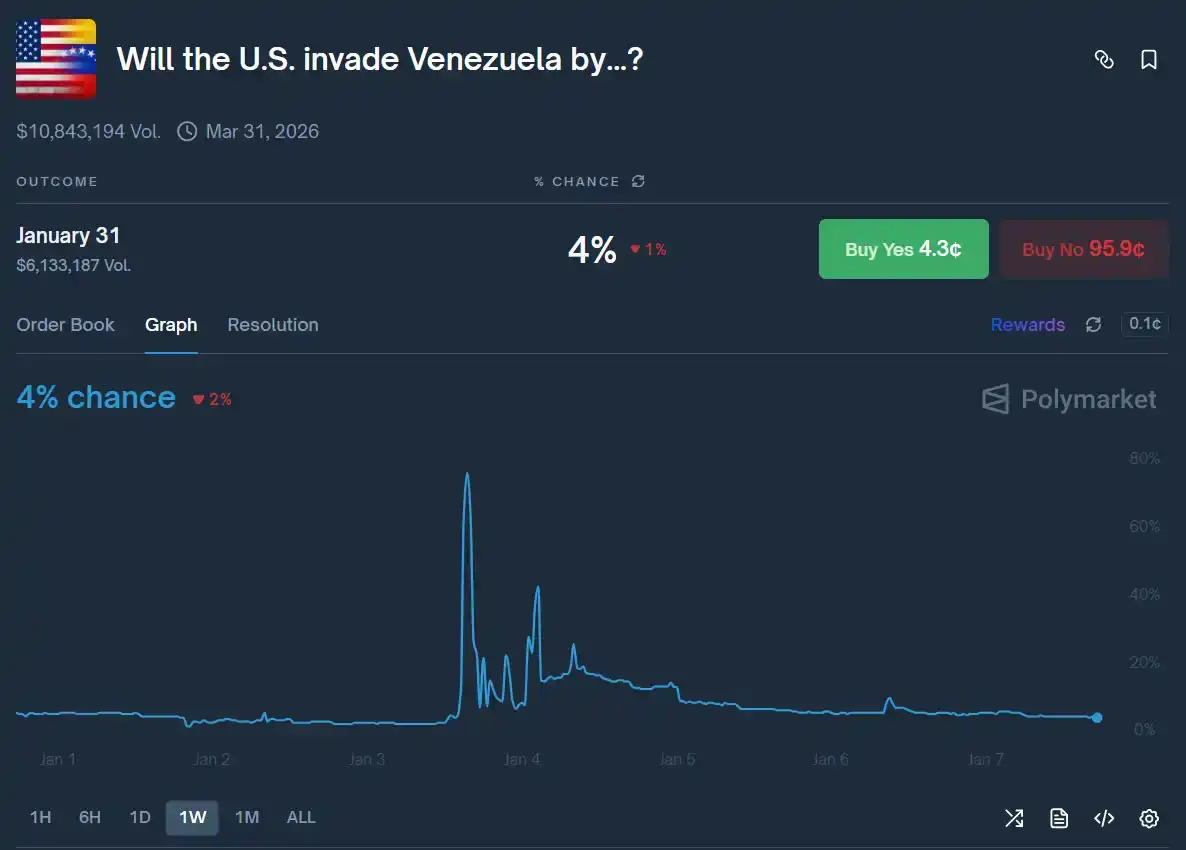
Even after Trump brazenly stated "run Venezuela" following the attack, as of the time of this writing, the market has still not been resolved, and the probability has fallen back to 4%.

This earth-shattering military invasion seems to have never happened on Polymarket.

"Tailor-Made" Rule Updates: Using Wordplay to Deny an Invasion

If you were to look for proof of the invasion happening on Polymarket, it does exist: hours after the attack, the platform officially published a rule supplement:

This market refers to U.S. military operations intended to establish control. President Trump’s statement that they will「run」Venezuela while referencing ongoing talks with the Venezuelan government does not alone qualify the snatch-and-extract mission to capture Maduro as an invasion.

In simple terms: U.S. troops entering the country and bombing don't count as an invasion. Trump talking about invading, occupying, and running the country doesn't count as an invasion. Capturing the president doesn't count as an invasion.

But they stick to their line: "military action with the purpose of establishing control counts as invasion."

Writing job description requirements based on a family register probably wasn't this rigorous. Traders who bet earlier didn't need to consider these hidden clauses, which didn't exist at the time, when analyzing the military situation.

Meanwhile, traders (mostly whales) who bet "No" during the period when its odds surged, relying on these tailor-made rule updates, again achieved substantial profits.

The same script played out in another market: "Will the U.S. and Venezuela engage in military conflict within 2025?" On December 26, 2025, Trump stated publicly in an interview that U.S. forces had destroyed an important facility inside Venezuela.

Multiple mainstream media outlets subsequently reported on the incident, with CNN noting the operation was "planned and executed by the Central Intelligence Agency (CIA)."

Shortly after the event, the platform issued a rule supplement stating that "operations executed by non-military intelligence agencies do not qualify."

As luck would have it, the CIA falls precisely into the category of a non-military intelligence agency.

Without the U.S. government ever formally clarifying which branch was responsible for the action, Polymarket, based on CNN's reporting citing "anonymous sources," precisely excluded a military strike from the settlement criteria.

Why Change the Rules? Digging into the Trump Family's Prediction Market Ties

As losing traders gathered on forums to protest, a more fundamental question emerged: Why would Polymarket risk its reputation being destroyed to modify the rules in plain sight?

Clues point to unusual names at the top of the platform.

Despite its decentralized facade, Polymarket is a实实在在 (shí shí zài zài - real, actual) private company regulated by the U.S. Commodity Futures Trading Commission (CFTC). A pivotal investment that changed its fate occurred last August:

Donald Trump Jr. – the eldest son of the sitting U.S. President – his private investment company formally took a stake in Polymarket, and he himself subsequently joined the company's "Advisory Board."

The timing is intriguing: after Trump Jr.'s investment, Polymarket, which had long operated in a regulatory gray area, quickly obtained an operating license from the CFTC, legalizing its operations in the U.S.

And the CFTC's five highest-ranking commissioners are all appointed directly by the President.

"This is just normal business investment," some commentators tried to downplay the connection. "The Trump administration supports cryptocurrency innovation anyway."

The next step would be to verify whether people close to Trump are using information asymmetry to profit on Polymarket.

From On-Chain Data to White House Inner Circle: When 'Coincidences' Are Too Many to Be Coincidences

Let's turn our attention to three hours before the raid occurred.

In another related market, "Will Maduro leave office before January 31, 2026?", a previously inactive new wallet address suddenly injected $30,000 into the market, all betting "Yes." As Maduro was put on a plane, this $30,000 turned into over $400,000 within hours.

The account's behavior pattern was highly suspicious: newly created, single deposit, betting on only one market within a specific time window, immediate withdrawal after profit. This is the操作 (cāozuò - operation, modus operandi) of treating the prediction market as a private ATM.

Who was this "insider"?

On-chain analysis blogger @Andrey_10gwei found, by comparing deposit/withdrawal amounts on exchanges, that the funds for this insider account could be traced back to an account with the domain "stevencharles.sol".

Steven Charles?

Opening the website for core members of WLFI, orchestrated by Donald Trump Jr., reveals that the second person from the left in the front row is a co-founder of the company, also a New York real estate developer, provided campaign funds to Trump, and the two have a friendship spanning nearly 40 years.
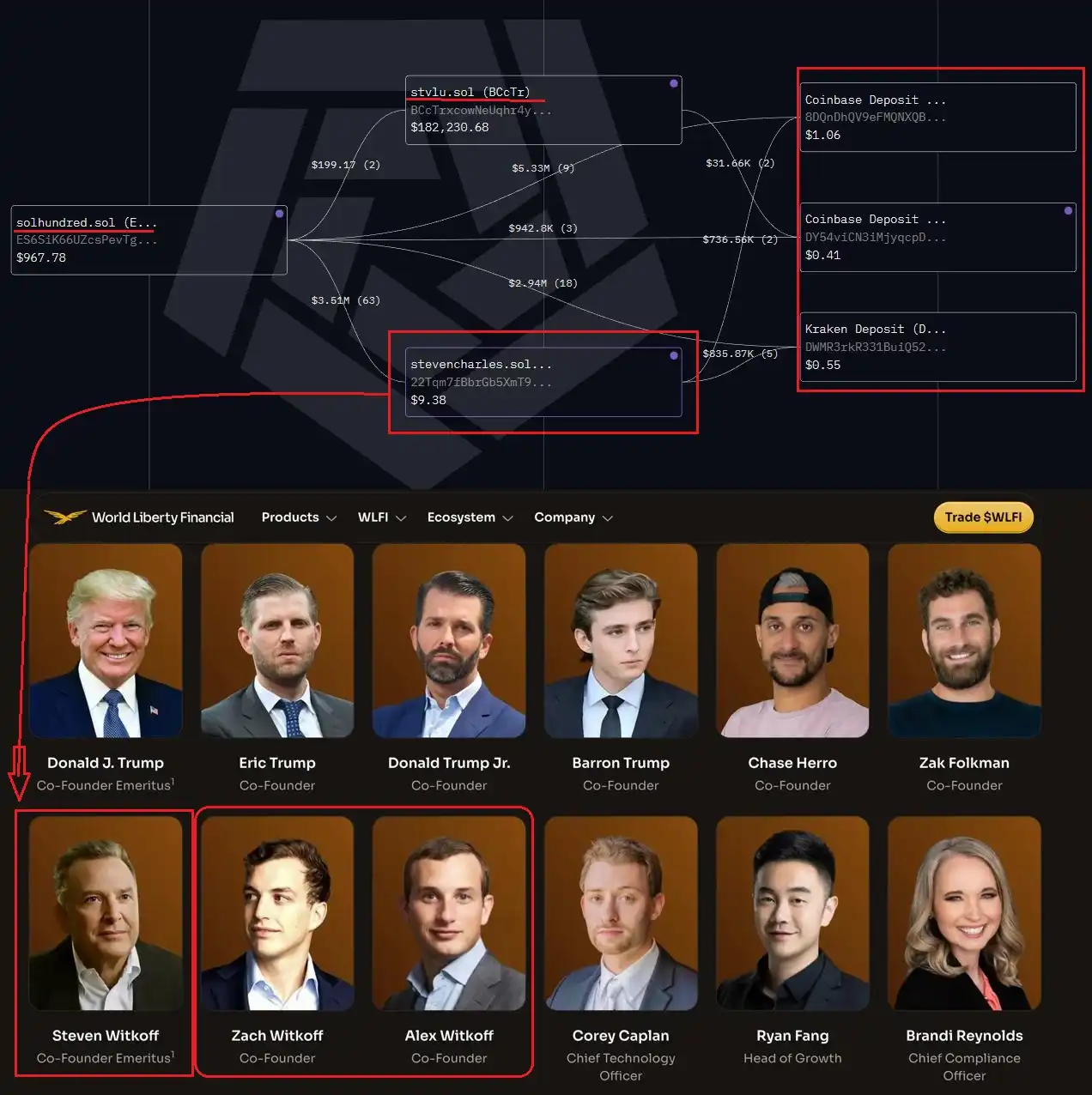
(cr: https://x.com/Andrey_10gwei/status/2007904168791454011?s=20)

His full name? Steven Charles Witkoff. A perfect match for the "stevencharles" on-chain domain.

A mysterious account turning $30k into $400k in 3 hours, an on-chain funding source named "stevencharles", a business magnate inextricably linked to the President's family who can directly influence Polymarket.

Three events with probabilities近乎于零 (jìn hū yú líng - approaching zero)串联在一起 (chuàn lián zài yīqǐ - strung together) can no longer be explained away as coincidence.

Conclusion

Polymarket, touted as a decentralized fair trading platform, might seem to ordinary person as just a financial tool to profit by betting on outcomes.

But perhaps in corners unseen by the common person, it has long become a white glove for those who can arbitrarily修改对错定义本身 (xiūgǎi duì cuò dìngyì běnshēn - modify the very definition of right and wrong), frequently using market-intervening rule updates and asymmetric information差 (chā - gap, asymmetry) to repeatedly empty people's assets.

How long the common person can survive here depends entirely on the desires and moral boundaries of the elite group.


Twitter:https://twitter.com/BitpushNewsCN

Bitpush TG Discussion Group:https://t.me/BitPushCommunity

Bitpush TG Subscription: https://t.me/bitpush

Original link:https://www.bitpush.news/articles/7600740

Related Questions

QWhat was the main event described in the article regarding the US and Venezuela?

AThe article describes a US military operation on January 3rd where American forces entered Venezuela, took control of key military facilities, and captured President Nicolás Maduro, transporting him to the United States.

QHow did the prediction market Polymarket initially react to the news of the military operation, and how did that change?

AInitially, the probability of 'Yes' on the market 'Will the US invade Venezuela before January 31, 2026?' surged from 2% to 80% after the operation. However, the probability later plummeted to as low as 7% and then to 4% after the platform issued a rule update that redefined the event, effectively ruling that the operation did not qualify as an 'invasion'.

QWhat connection does the article suggest exists between Polymarket and the Trump family?

AThe article suggests a significant connection, stating that Donald Trump Jr., the son of the US President, invested in Polymarket through his private investment firm and joined its 'Advisory Board'. This investment coincided with the platform receiving regulatory approval from the CFTC, whose commissioners are appointed by the President.

QWhat evidence does the article present to suggest insider trading on the Polymarket platform?

AThe article presents on-chain data showing that a previously inactive wallet deposited $30,000 into the market 'Will Maduro leave office before January 31, 2026?' just three hours before the operation. This bet, which turned into over $400,000, was traced back to a wallet domain named 'stevencharles.sol', which was linked to Steven Witkoff, a long-time associate of the Trump family and a co-founder of a company run by Donald Trump Jr.

QAccording to the article, how did Polymarket justify not settling the 'invasion' market as 'Yes' after the military operation?

APolymarket issued a rule update stating that the operation to capture Maduro was a 'snatch-and-extract mission' and that President Trump's statement about 'running' Venezuela, in the context of ongoing talks with its government, did not alone qualify the military action as an 'invasion' as defined by their market's rules, which specified 'U.S. military operations intended to establish control'.

Related Reads

Weekly Editor's Picks (0725-0731)

Weekly Editor's Picks (0725-0731) provides a curated selection of deep analysis, filtering out market noise. Key themes from this week include: **Macro & Policy:** The Federal Reserve's upcoming meeting is marked by high uncertainty, balancing cooling inflation data against persistent price pressures. Meanwhile, the U.S. crypto regulatory Clarity Act faces critical political hurdles, with its 2026 passage probability seen as low. **Investing & Crypto:** Analysis suggests long-term crypto success depends on conviction through volatile cycles, focusing on assets like Bitcoin and core smart contract platforms. A trend noted is the increasing similarity between global equity markets (especially tech) and crypto, driven by narrative and leverage. Several major crypto protocols show strong revenue growth, but this isn't always translating to token price appreciation due to sell pressure and structural factors. **AI & Semiconductors:** Nvidia's rising credit default swap rates signal market concern over AI infrastructure financing risks. The storage sector experienced volatility as markets began pricing in potential 2027 oversupply. Despite a record profitable quarter, SK Hynix's results were deemed "below expectations," reflecting heightened investor demands for future growth visibility. **Markets & DeFi:** TradeXYZ demonstrated remarkable accuracy in pre-market pricing for a major A股 listing. The token ONDO saw gains, linked to its growing role in the on-chain tokenized stock ecosystem. **Ethereum:** Post-Pectra upgrade, a major structural shift is underway as Lido begins migrating millions of ETH to new validator architectures designed for capital efficiency. **Also Highlighted:** Butian's bullish stock market move; OpenAI's Altman promising major advances; Samsung and SK Hynix securing large AI chip deals; Apple reaching a $5T market cap; and ongoing discussions around exchange security following Poolin's bankruptcy case.

marsbit16m ago

Weekly Editor's Picks (0725-0731)

marsbit16m ago

Low Investment Isn't Apple's Immunity Pass

While Meta and Google face investor scrutiny over ballooning AI capital expenditures, Apple's minimal AI investment has paradoxically become a strength. Its market cap recently reclaimed the global top spot, surpassing $5 trillion. The irony is deep: Apple's own AI efforts have lagged, with "Apple Intelligence" delayed and core talent lost, forcing reliance on partners like Google Gemini and Alibaba's Qianwen. Its Q3 FY2026 (Q2 CY) earnings initially seemed stellar. Revenue hit $109.4B (up 16% YoY), with iPhone and Mac sales, growing 22% and 29% respectively, driving most of the growth. However, the stock fell over 8% post-earnings. The primary concern was a weaker Q4 revenue growth forecast of 9-11%, below expectations, due to looming supply chain constraints. Apple is feeling the indirect cost of the AI boom. Soaring memory and chip prices, fueled by massive data center investments from Microsoft, Amazon, and others, are forcing Apple to raise Mac and iPad prices significantly. The upcoming iPhone launch is also expected to see substantial price hikes. Despite avoiding heavy AI infrastructure spending—its capital expenditures are actually down 28%—Apple cannot escape the industry-wide supply and cost pressures. While Apple's operating cash flow remains robust, its substantial R&D spending (up 32% YoY) has yet to yield major AI breakthroughs. As Tim Cook prepares to step down as CEO, Apple faces a challenging transition: balancing its premium hardware success against the strategic and cost pressures of the AI era it has so far cautiously navigated.

marsbit1h ago

Low Investment Isn't Apple's Immunity Pass

marsbit1h ago

PA Graphics Explanation | One Chart to Understand the Major Web3 Events in August 2026

**PANews Crypto Calendar: Key Web3 Events in August 2026** PANews introduces its revamped crypto calendar, featuring comprehensive coverage, flexible filtering, and easy export options. The market in August will be shaped by multiple key events across macroeconomics, regulation, tokenomics, and project developments: * **Macro & Policy:** Key US economic data releases (July Non-Farm Payrolls, CPI), the Federal Reserve meeting minutes, and the Jackson Hole Economic Symposium will be in focus. On the regulatory front, the US Senate plans to release a new draft of the *CLARITY Act*, while the EU's expanded crypto ban against Belarus comes into effect. * **Token Unlocks:** Significant token unlocks are scheduled for assets including ENA, AVAX, CONX, ZRO, and KAITO, which may influence market volatility. * **Project Updates & Shutdowns:** Several services, including Exchange Art, Ctrl Wallet, Zapper, NFTfi, and Summer.fi, are set to cease operations or undergo major adjustments. Users are advised to manage their assets accordingly. * **Corporate Activity:** Q2 earnings reports from companies like SpaceX, Circle, and Nvidia are due. Unitree Robotics will initiate its IPO subscription on the STAR Market, and Moonshot AI plans to begin a Pre-IPO financing round. * **Industry Events:** Major conferences such as Bitcoin Asia 2026 and the 2026 Digital Expo will take place. The overarching market narrative for August will revolve around macroeconomic expectations, regulatory developments, token unlock schedules, and ongoing industry consolidation.

marsbit1h ago

PA Graphics Explanation | One Chart to Understand the Major Web3 Events in August 2026

marsbit1h ago

Wall Street's Most Famous 'Cassandra' Now Has His Sights Set on Nvidia

Michael Burry, the famed "Big Short" investor, has once again captured Wall Street's attention with a series of short positions against major tech and semiconductor stocks, most notably Nvidia. In late June and July, through his "Cassandra Unchained" newsletter, Burry disclosed short bets against Nvidia, Tesla, Applied Materials, Caterpillar, the SOXX semiconductor ETF, and later, Micron Technology. His core thesis revolves around potential distortions in the AI infrastructure boom, specifically questioning whether extended depreciation schedules (e.g., 6 years vs. a realistic 2-3 years for AI chips) by cloud giants like Microsoft and Google artificially inflate profits. He also raises concerns about possible "off-balance-sheet circular financing," where chip demand might be propped up by vendor-backed funding to clients. Nvidia's stock experienced volatility following these disclosures, briefly dipping but largely holding near Burry's reported entry points, leaving his positions roughly flat or slightly underwater as of late July. This move is part of a pattern for Burry, whose track record since his legendary 2008 bet is mixed. He has faced notable losses, such as on Tesla in 2021, while scoring on broader market turns like the 2020 pandemic crash. His methodology focuses intensely on free cash flow and scrutinizing original financial documents to spot overvaluation and structural risks, but it often struggles with timing the market. The article contrasts Burry's stance with other prominent investors. Steve Eisman, another "Big Short" figure, is not shorting Nvidia, citing strong fundamentals but expressing nervousness about sustainability. Jim Chanos agrees with the broad "accounting mismatch" concern—comparing it to the dot-com bubble—but targets financial leverage in private equity firms rather than the chip stocks themselves. While Nvidia's short interest remains relatively low at 1.3-1.4% of float, the massive stock size means absolute short losses have been significant, exceeding $5 billion earlier this year. The piece concludes that for ordinary investors, the key takeaway is not replicating specific short bets but learning from the critical frameworks these investors use: questioning rosy accounting, identifying structural vulnerabilities, and maintaining skepticism during market euphoria, even if pinpointing the exact catalyst for a downturn remains elusive.

marsbit1h ago

Wall Street's Most Famous 'Cassandra' Now Has His Sights Set on Nvidia

marsbit1h ago

Weekly Selection丨Epic Stock Market Volatility, Changxin Tech's IPO Reshapes Storage Landscape, Saylor Aims to Re-Anchor STRC Around September 8th

PANews Weekly Digest: Market Turmoil, Tech Breakthroughs, and Crypto Developments. The week saw significant volatility across global markets. South Korea's KOSPI index experienced extreme turbulence, including multiple trading halts, largely driven by sharp declines in AI hardware stocks like SK Hynix. In contrast, China's Changxin Xinqiao (CXC) achieved a landmark IPO with a market cap surpassing 4 trillion yuan, marking a major success for the domestic DRAM industry after a decade of losses. In the crypto and Web3 space, several key narratives emerged. AI is driving demand for new infrastructure, with projects like AI agent wallets and programmable payments gaining traction, attracting interest from firms like Coinbase. The Bitcoin mining sector is pivoting, with companies like MARA focusing on energy management as electricity becomes a core AI-era asset. Meanwhile, the RWA (Real World Assets) sector faces a "utilization puzzle," with hundreds of billions in on-chain assets remaining dormant. Notable market movements included a historic single-day surge of over 17% for the KOSPI index and a significant migration of $16.5 billion in staked ETH within the Lido ecosystem. Michael Saylor announced a target to re-peg the STRC stablecoin around September 8th. Other highlights include discussions on Ethereum's ambitious 2030 roadmap for scaling and privacy, analysis showing high protocol revenues not always translating to token price gains, and warnings from Citi about potential extreme commodity price shocks by late 2026.

marsbit1h ago

Weekly Selection丨Epic Stock Market Volatility, Changxin Tech's IPO Reshapes Storage Landscape, Saylor Aims to Re-Anchor STRC Around September 8th

marsbit1h ago

Trading

Spot
活动图片